
Join Puck to listen to this article
The Summer of Rhode is coming to an end, and it did not disappoint. In May, Hailey Bieber’s beauty juggernaut was acquired by E.l.f. Beauty in a deal that was valued at a cool billion, and shortly after Labor Day became Sephora’s most anticipated retail launch in years. Of course, Bieber’s “clean girl” skincare and makeup was always projected to put up huge numbers, but I’m told the first week—especially the first day—was a “blowout.” Frankly, I don’t think anyone expected the launch to be this successful.
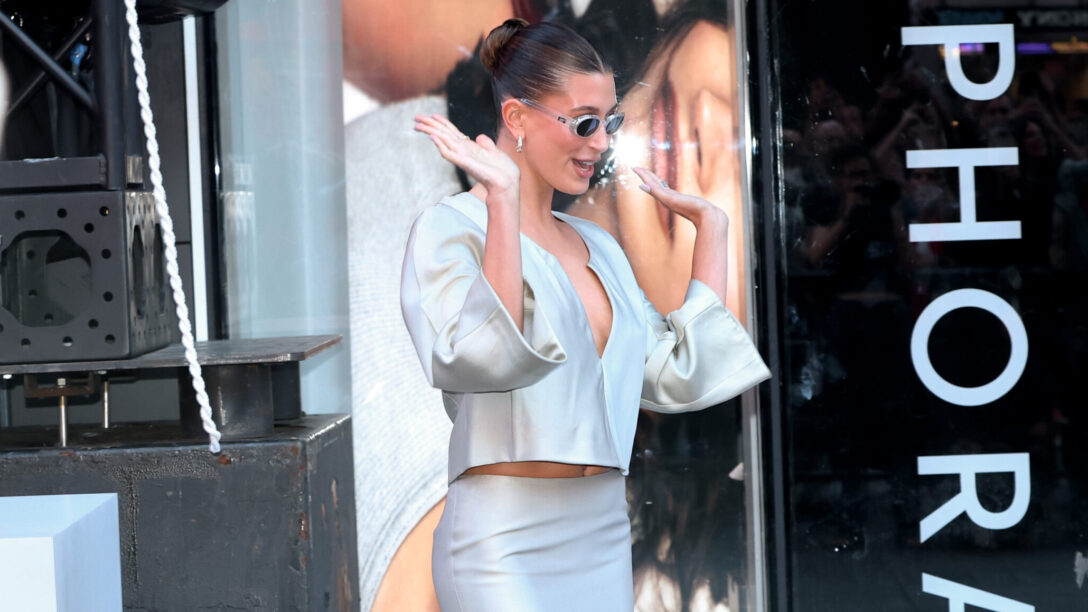
In the end, Rhode’s debut was the largest in the retailer’s history, according to several sources—smashing records once held by Rihanna’s Fenty and Selena Gomez’s Rare. Two people with knowledge of the numbers confirmed that Rhode’s first day sales totaled approximately $15 million across Sephora’s North American stores and online. Bieber herself apparently quoted a figure slightly below that while ringing the opening bell at the New York Stock Exchange a day after launch. (Spokespeople for Sephora and Rhode declined to comment.)
When I visited Sephora’s SoHo outpost on Thursday, the day of the launch, I witnessed crowds huddled around the brand’s shelves, so I circled back a few days later to see what was left. I was told by a person close to Sephora that all the makeup and some skincare in the highly trafficked SoHo store sold out “within hours” on launch day before a full restock the following Monday. This person compared the rollout to Fenty’s, which debuted in Sephora in September 2017 and is considered one of the retailer’s biggest launches of all time. “This blew Fenty out of the water,” they said.
Still, some were perplexed by Sephora’s lack of foresight. The end goal is always to sell through inventory, but to sell out of so many items within hours meant that Sephora’s purchase orders missed the mark. “So many stores are sold out. How could they have messed that up?” said a person with knowledge of the rollout. In some ways, it’s a testament to one of the most compelling––if not the most compelling––things about Rhode, which is the strength of its individual products. To wit, Rhode launched with 16 SKUs at Sephora, but there’s only really about 10, given that several are combo kits or mini versions of marquee products. To sell that much product, with so few items available, is pretty remarkable.
A Shorter Shelf Life
Rhode’s entrée into Sephora also marks the first real operational challenge for the brand, which was originally intended to be a lean, direct-to-consumer business with few employees and minimal overhead. After E.l.f. backed up the Brink’s truck, Rhode immediately staffed up and prepped for wholesale distribution. In my mind, the biggest question was whether Rhode could efficiently leverage E.l.f.’s wholesale expertise, hiring abilities, and technological backbone to service a retailer at scale. So far, the answer seems to be yes.
And yet, while Rhode’s early success at Sephora is a testament to the E.l.f. integration, the retailer gets a big share of the credit, too. Sephora has been on a tear lately. Over the past six weeks, it has launched a number of exclusive, personality-driven brands, from celebrity makeup artists and hairstylists to underage influencers and industry veterans: Hung Vanngo Beauty, M.ph by Mary Phillips, Chris McMillan’s hair products, Melanie Bender’s Lore, etcetera. And who could forget Sincerely Yours, the controversial skincare brand from 15-year-old influencer Salish Matter? (Casey Lewis identified a few red flags surrounding it here.) Still, earlier this month, a Sincerely Yours event at American Dream Mall reportedly drew a crowd of over 80,000.
But no brand on Sephora’s shelves can match Bieber’s selling power. According to a person close to Sephora, “Rhode’s sucking all the oxygen out of the room for every other brand—everyone’s showing up only for that.” In other words, at least for now, Rhode hasn’t given Sephora the “halo effect” many had hoped for. “There are only so many finite dollars, especially in this market when everything’s soft,” an insider said, adding that there’s a “full expectation” that Rhode’s closest competitors, including Glossier and Rare, are going to start feeling the effects.
Naturally, Sephora has been preparing for this exact scenario. The retailer is hyperfocused on churn and expecting shorter brand lifespans—not only because of Rhode, but also on account of the ruthless brand-turnover cycle that defines modern retail. Alas, what were once decades-long partnerships now last just three to five years. “I remember when Fenty was the Rhode, and then Rare was the Rhode,” said a high-profile founder. “And that’s okay––these brands don’t need to last forever.
So far, Sephora’s done a decent job adapting to this new reality. Under Artemis Patrick, the extremely talented C.E.O. of Sephora North America, the retailer has reinvented how brands are merchandised and marketed, with a bias toward the short-term partnerships and new, exclusive-to-Sephora brands over legacy lines you can find in any department store. They recently launched creator platforms, where influencers can make shoppable Sephora storefronts à la Amazon, often featuring indie brands. “They’re in maximum benefit territory,” the insider said. “They can just hop onto the next hottest thing.”