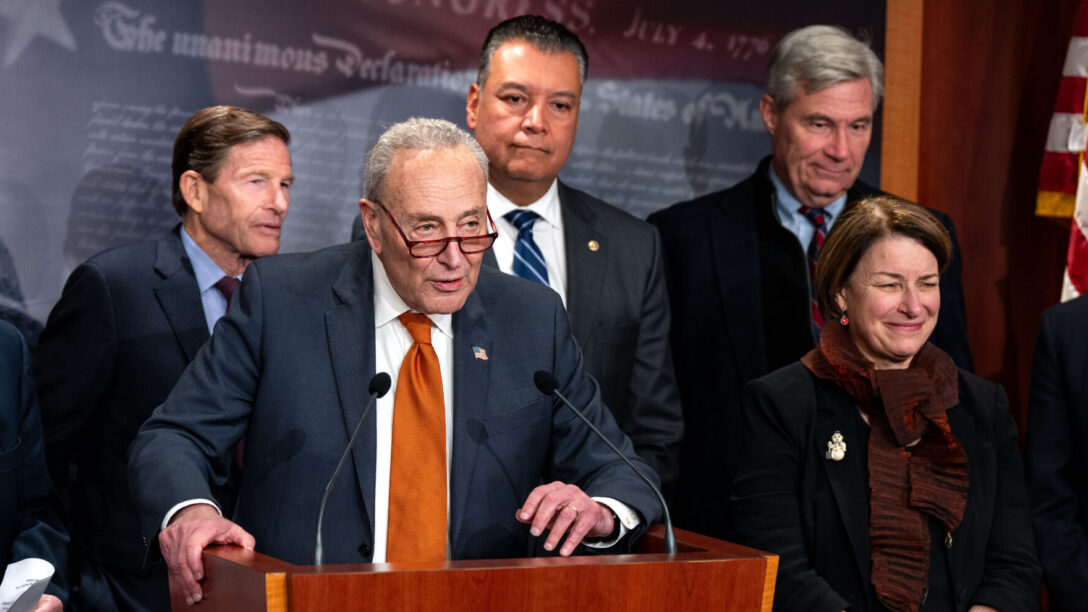
Despite Trump’s unpredictable, anxiety-provoking, market-rattling, ethics-pulverizing first 100 days, the latest Puck/Echelon poll shows he’s still more popular than Democrats with voters.
Polls and focus groups tell the same story: Voters might not like Donald Trump, but they really don’t like the Democrats.
Photo: Kent Nishimura/Getty Images
After more than a decade in the wilderness—or cornfields, in this case—Iowa Democrats finally got some good news this week: Rob Sand, the youthful-looking 42-year-old state auditor from the small town of Decorah, announced that he’s running for governor. He is the Democrats’ best statewide candidate in years, and his announcement video communicated why. It wasn’t one of those overly produced hype videos that populate your social media feeds every two years during campaign season. You know the genre: multiple cameras, too much Bruckheimer sepia tone, some generically stirring music licensed from Jingle Punks, slo-mo shots of the candidate walking down a quaint main street in some town they haven’t visited in years.
Instead, Sand did what every modern politician should be doing these days to reach the public. Wearing a t-shirt and baseball cap, he turned his phone camera on himself, talked straight to the camera, and explained who he is and why he’s running in a brief 90 seconds. He asked for people to follow him, share his content, and chip in a few bucks. The format works for Sand because he is, as the saying goes, Iowa nice. The clip has racked up more than 1 million views in just over a day.
But this is still red Iowa, so I was also struck by what Sand didn’t say in his video: He’s a Democrat. Sand positions himself only as a common-sense independent, saying that he’s spent his political career fighting government waste and fraud, standing up to special interests and insiders, and promising to help the economy work for Iowans. Among the one-liners: “The independent-minded state auditor” … “Iowa deserves to have a governor for all” … “We need more public service and less politics.” Even his campaign’s color scheme—shades of green and orange, rather than Democratic blue—is a choice. Shunning your party label is a common tactic for any candidate running in a state that swings in the opposite political direction—Arnold Schwarzenegger being a prime example out here in California—but Sand’s unmentioned party further reinforces the fact that the Democratic brand right now is in shambles.
Death by a Thousand Cuts
Polls and focus groups tell the same story: Voters might not like Donald Trump, but they really don’t like the Democrats. The party is seen as old and out of touch, catering to urban elites while somehow remaining hopelessly uncool, and too focused on progressive cultural concerns rather than the hallowed kitchen table. Our new poll, in partnership with Echelon Insights, reveals the Democratic brand problem remains a vexing one. Voters are clearly souring on Trump’s management of the economy, immigration, and foreign policy—the president’s overall approval rating has dropped to a lowly 46 percent, down seven points since Echelon’s polling after his inauguration—but Trump’s slippage isn’t doing much to help the Democrats’ reputational problems.
In the new poll, only 26 percent of voters say they agree with the Democratic Party on “issues that are important to you,” a number that’s remained unchanged since February. On the generic ballot question—“If the election for Congress were held today and you had to make a choice, for whom would you vote?”—Democrats are also stalled out. Voters gave Republicans a one-point edge, 48 percent to 47 percent, which is also unchanged from February.
There was even more bad news for the Blue Team. After months of campaign-style rallies against the Trump agenda, passionate floor speeches, public protests, special elections, and experiments with new forms of media, Democratic voters still don’t believe their party leaders are doing enough to stand up to the White House. Democratic voters overwhelmingly say (64 percent to 20 percent) that Democrats in Washington are not doing enough to fight Trump. This represents almost no change from February, when the split was 60 percent to 17 percent.
There was one bright spot in this new round of polling. Contrary to the conventional wisdom that Trump has forever captured the hearts of the American worker—either through his culture war appeals, or his nascent trade war—voters still say the Democratic Party cares more about workers and the middle class than the G.O.P., which is seen by most voters as caring more about “Big Business and Wall Street.” The margins are slim, but Dems still have an edge: 48 percent of voters say the Democratic Party cares more about workers, compared to 45 percent who said the same about the Republican Party.
Democrats are also seen as caring more than the G.O.P. about the middle class, by a 49–43 margin. Healthcare also plays to the Democrats’ favor—53 percent of voters say Democrats care about healthcare, compared to just 37 percent who said the same about Republicans. To state the obvious, it’s a big reason Democrats are making such an issue out of potential cuts to Medicaid in the new Republican budget plan.
Sticks & Stones
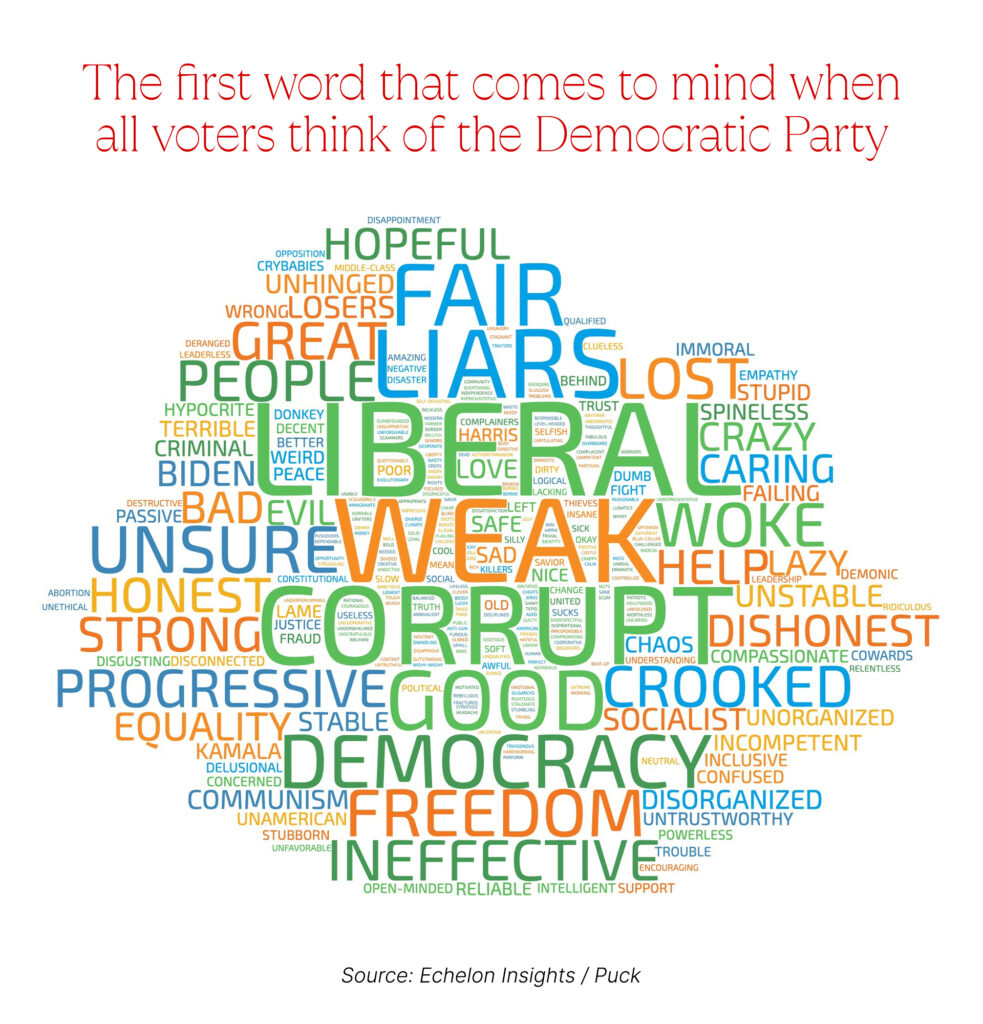
But back to the bad news. We had Echelon ask voters a simple open-ended question about the Democrats—“What is the first word that comes to mind when you think of the Democratic Party?”—and to build a word cloud with the responses. Among all likely voters, the results were sobering. The top responses, as you can see below, were “liberal,” “weak,” and “corrupt.” Those negative terms were followed by a mixed bag of descriptors—“good,” “democracy,” “liars,” “fair,” “freedom”—but you have to squint to find more than a dozen vocabulary words that could be categorized as positive.
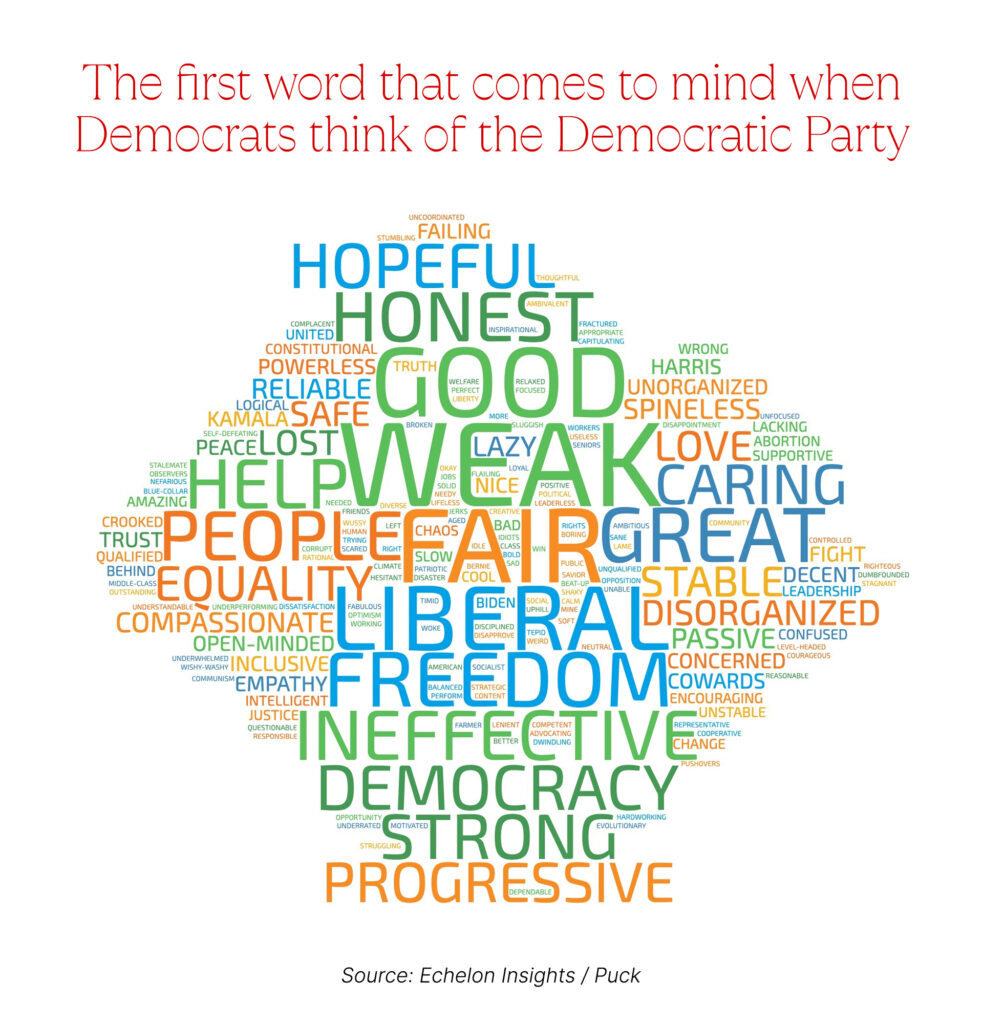
Among Democratic, and Democratic-leaning, voters, the top description of their party in one word was—surprise!— “weak.” Among Dems only, the responses were predictably more favorable, but it’s hard to look at the cloud and not see the words “ineffective” and “disorganized” staring back at you.
The Manosphere Paradox
As with any party that’s out of power, leaderless, and searching for a lane, the Democrats’ messaging will ultimately be shaped in the next presidential primary. Looking at 2028, Echelon found Kamala Harris continuing to lead the pack among possible presidential contenders, with 36 percent of Democrats naming her as their top choice—not surprising given her national fame compared to other potential candidates. But, as with most polls of the 2028 primary, a sizable majority of Democrats picked someone other than the former vice president. Trailing Harris on the 2028 list: Pete Buttigieg (10 percent), Tim Walz (9 percent), Gavin Newsom (6 percent), and Alexandria Ocasio-Cortez (5 percent). Everyone else was in the low single digits, including my colleague John Ourand’s favorite sleeper candidate, Stephen A. Smith, who finished in asterisk territory.
Much of the current conversation about the 2028 primary—still years away—is about gender, and not just because Joe Biden appeared on The View last week and dubiously blamed Harris’s loss last November on sexism. Democrats are desperate to reverse their trajectory with male voters over the past half-decade, especially with men under 40 of all races and education levels. It’s a challenge made more confounding by the striking leftward drift of young women away from the sensibilities of the median voter, as NBC News recently documented. I’ve been writing about how some Democrats—Buttigieg and Newsom chief among them—are starting to dip their toes into the “manosphere” in an effort to remind men, and their fellow Democrats, that they don’t have to be the party of tedious scolds.
The question hovering above these recent conversations about men, podcasts, and identity politics is an uncomfortable one: Should the next Democratic nominee be a white man? In the Trump era, Democrats have now lost two presidential elections with a woman on top of the ticket, only managing to win the White House in 2020 with an aging white man as nominee. During that election’s primary season, Democratic voters expressed concerns about nominating a woman to run against Trump, a dynamic that ultimately hurt Elizabeth Warren’s once-frontrunning primary campaign.
So, we had Echelon pose the question to Democratic voters: “Would you prefer a man or woman as the party’s 2028 nominee?” For now, voters don’t seem to care: 21 percent of Democrats said it should be a woman, while 12 percent said it should be a man. But 76 percent of Democrats said they didn’t care either way. We also asked whether the nominee should be white or a person of color. Again: The vast majority of Democratic voters (76 percent) said the candidate’s race won’t matter to them. But among those who did express a preference, a noticeable gap emerged: 20 percent of Democrats said their party’s presidential nominee should be a person of color, while only 4 percent said the nominee should be white.
Shared with you by a Puck member
Enjoy this free article thanks to a friend. You can keep exploring Puck with a free account or enjoy a 14 day free trial.
Didn't get an email? Check your spam folder and confirm the spelling of your email, and try again. If you continue to have trouble, reach out to fritz@puck.news.
Didn't get an email? Check your spam folder and confirm the spelling of your email, and try again. If you continue to have trouble, reach out to fritz@puck.news.
Member Exclusive
Get access to this story
Create a free account to preview Puck’s full offering, including exclusive articles, private emails from authors, and more.