
On Monday afternoon, a group of 59 white Afrikaners waving American flags arrived at Dulles International Airport, just outside the U.S. capital. On his first day in office, Trump had frozen the admission of all other refugees, including people who had been vetted and approved, and who were already packing their bags, both literally and metaphorically. And yet, two weeks later, the administration created a special refugee status for white South Africans, repeating the dubious and widely debunked claims that they are “victims of unjust racial discrimination” and amplifying false claims of a “white genocide” by allies like Elon Musk and Charlie Kirk.
The obvious hypocrisy of the move generated a predictable controversy over this administration’s hearty embrace of white nationalism—and of the unusual preponderance of white South Africans in Trump’s inner circle.
But to America’s seasoned diplomats, something else stuck out: These so-called refugees were welcomed in a Dulles hangar by Deputy Secretary of State Christopher Landau, the number two at Foggy Bottom, and Deputy Homeland Security Secretary Troy Edgar. Normally, no administration official greets the thousands of refugees who arrive in the U.S. every year, and certainly no one of such high rank. But not only did two deputy cabinet secretaries come to meet the Afrikaners, both of them also said repeatedly that they’d given their personal contacts to the new arrivals should they need any help getting settled. (As someone who once arrived as a refugee at Dulles, I can personally attest to the fact that not everyone gets such a royal welcome.)
To career State employees, the decision to send a high-level delegation to meet a small clutch of people with questionable asylum claims was not just a breach of protocol—it was a clear and disturbing signal about which causes the United States would champion. “When have a D.H.S. deputy and deputy secretary of state ever gone to meet refugees?” a former senior State official fumed. “When has that ever happened? That never happens!”
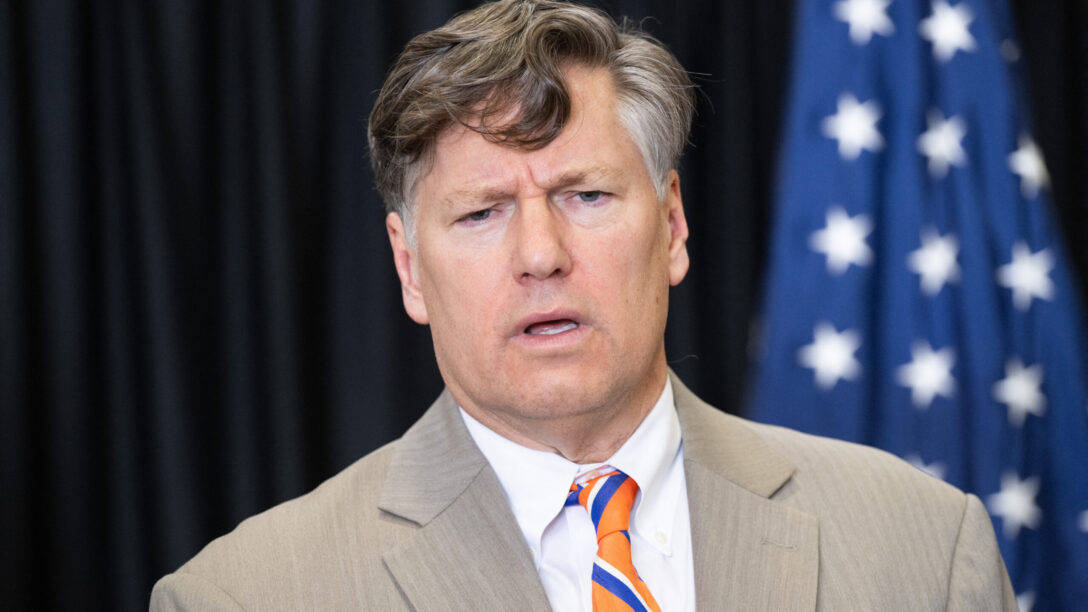
Some members of the diplomatic community were also triggered by what they perceived to be another clear and disturbing signal: Landau’s tie. It was striped orange, white, and blue, “the colors of the South African flag under apartheid,” a recently retired senior State Department official pointed out. “I gasped when I saw the deputy secretary’s tie,” this person said. According to the Anti-Defamation League, which has hewn closely to the Trump administration this time around, “white supremacists in South Africa and elsewhere around the world, including the United States, have adopted the flag as a symbol of white supremacy.”
Was this sartorial choice a coincidence, a dog whistle, or an overt political message? Some of the wonks at Foggy Bottom, who enter a workplace every day through a lobby festooned with all the flags of the world, saw a connection. The Trump administration, after all, has made “reverse racism” against whites the central focus of its “civil rights” work. And diplomats are trained to be highly attuned to the subtle signals that might be conveyed, for instance, by a choice of clothing. “Who told him to wear that tie?” asked the former senior State official. “It was not an accident.” As the retired official put it: “If it’s a coincidence, it’s certainly an awkward coincidence. It’s like they’re trying at the highest levels to make these messages clear.”
The State Department’s spokeswoman, Tammy Bruce, did not respond to a request for comment, but Anna Kelly, the deputy White House spokeswoman, did. “Are the tragic examples of persecution told by the refugees upon arrival noted anywhere in your story?” she emailed. “Or does it purely focus on the palace intrigue of their arrival and what administration officials are wearing?”
“A Very Difficult Situation”
Staties were also shocked that Landau invoked his father while addressing the so-called refugees—on camera, naturally. “Many of us, our families have had a journey not too different from the journey you are embarking on today,” Landau told the Afrikaners. “My own father was born in Europe and had to leave his country when Hitler came in in the 1930s, and made his way to South America first and then eventually the United States.” He spoke about entering government service in order to give back to a country that “allowed my family to escape a very difficult situation in another country.”
That was certainly one way to put it. His father, George Landau, was a Jew living in Vienna when the Anschluss occurred. The “difficult situation” the family faced, of course, was the full-scale dehumanization and mechanized slaughter of Jews. Two years ago, Landau was far less oblique in describing what had happened to his father. “When I asked him about life under the Nazis in Vienna, he said, ‘Well, there was this episode where this guy forced me to get on my hands and knees and scrub the street with a brush,’” he told an interviewer. “It was a traumatic episode.”
George was able to leave Nazi Austria in 1938 in the nick of time, escaping just before an actual—and genre-defining—genocide took place. From there, he went to Colombia because, according to his son, he had relatives there, and only made his way to the U.S. later. At that time, after all, the U.S. had extremely restrictive immigration quotas to keep Jews and other undesirables out in favor of more-desirable immigrants from northern and western Europe. Sound familiar?
Landau used this family trauma to express his sympathy for what the Afrikaners allegedly went through in post-apartheid South Africa. That was galling enough: Nazi sympathizers in South Africa, including those who worked with German intelligence during the war to overthrow the pro-British government, were a key pillar of the apartheid regime.
But Landau pressed on, expressing his utter confidence that the “refugees” will fit right in here. “A lot of you are farmers,” he said. “When you have quality seeds, you can put them in foreign soil and they will blossom. … We are excited to welcome you here to our country, where we think you will bloom.” The language struck the State Department officials I spoke with as nationalist blood-and-soil speak, as well as an overt racial claim about the superior ability of whites to assimilate into America, a purportedly white Christian country. These were “quality seeds,” as opposed to all those other people from what Trump called “shithole countries.” (Or, as Kirk put it on his podcast, “We have enough Mohammedans. We need more South Africans. These are Christians. Look at the difference.”)
The fact that the deputy secretary invoked his family’s escape from the Holocaust in welcoming Afrikaners—one of whom, unsurprisingly, turned out to have posted about how Jews are “untrustworthy” and “dangerous”—while parroting the language of the antisemitic far-right was infuriating to Staties current and former. “He is disgracing his heritage,” one of them, who is Jewish, spat.
The Diplomat
George Landau went on to become a distinguished American diplomat, serving as ambassador to Cold War–era Paraguay, Chile, and Venezuela, and holding diplomatic posts in Uruguay and Spain, where Christopher was born in 1963. “When I was a little boy, my dad would sometimes bring me into work at the State Department on Saturday mornings,” the younger Landau tweeted in March, shortly after his confirmation as its second-in-command. “I remember the colorful Hall of Flags, the endless linoleum corridors, and the onion paper with the Great Seal of the United States. Now I’m walking those same hallways and corridors as Deputy Secretary. There’s something deeply satisfying in life about closing the loop.”
Christopher Landau, though, took a different route to get there. He went to Harvard Law School, clerked for ultra-conservative justices Antonin Scalia and Clarence Thomas, then became prominent in white-shoe, Federalist Society–type conservative legal circles. He was put on Trump’s list of potential Supreme Court nominees. Instead of landing on the court, however, Landau was nominated to serve as ambassador to Mexico during Trump 45. At the time, he did the rounds, seeking advice from the diplomatic graybeards about how to run an embassy, what pitfalls to avoid, etcetera. “He was certainly conservative,” recalled one person who spoke to him at the time. “I found him rational, not ideological.” (Landau, who is fluent in Spanish, did well enough in that post that Mexican President Claudia Sheinbaum commended him for his work.)
But like many traditional conservatives with ambition, Landau appears to have changed with the times. He is now constantly on X, sucking up to Musk and Trump, and slamming every one of the right wing’s favorite targets: A.O.C., “what passes for the foreign policy establishment,” as well as his State Department colleagues, whom he calls “lackeys within the career bureaucracy.” He tweets constantly, bantering with his “loving wife, Caroline,” or complaining about not being able to adjust the thermostat in his office and having to work in a SCIF without his cellphone all day. (He can also get quite nasty. While he was ambassador to Mexico, Landau went after a local female college student who criticized him on Twitter, and would not relent from trolling and attacking her even after she closed her account.)
All of this leads people in and around Foggy Bottom to believe that Landau is not a white supremacist, but a cynical careerist. “When I see Landau now, I don’t know how much I’m seeing Landau and how much I’m seeing performance art to survive the current administration,” said a retired senior diplomat who knows (and likes) the man. “When the White House wants you to do something, you do it. And you do it as best you can—especially when you have a D.H.S. minder standing right behind you. This is a very strange administration; they’re looking in paranoid fashion for disloyalty.”
But others are less charitable. They speculate that Landau is going above and beyond, trying to curry favor and get the boss to notice him and his classic, prep-school good looks—lantern jaw, blue eyes, good-ol’-boy mop of hair. The hope, they suspect, is that the president will remember his exemplary service when the inevitable happens and “‘Liddle’ Marco Rubio” gets fired. “A lot of the stuff he’s doing, he doesn’t even have to do to keep his job,” said the former senior State official. “I don’t think he had to go to Dulles and wear an apartheid flag tie. But he did.”