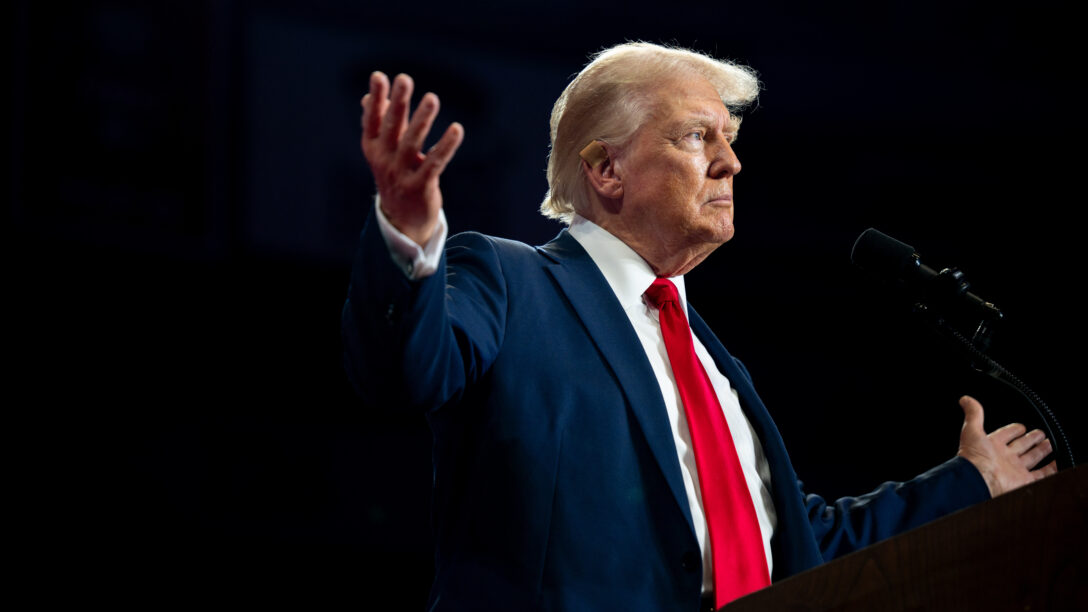

It’s sad but true: Wall Street is preparing for a return of Donald Trump and all the crazy that comes with him. Sure, a handful of investors—Bill Ackman, Dan Loeb, Steve Schwarzman, Howard Lutnick, Nelson Peltz, and John Paulson among them—are happy about it, likely fearful that Kamala Harris would derail their gravy train, I guess. But most of the other people I talk to on Wall Street are resigned to a Trump victory on November 5, even though they are sick about it.
The political guru Charlie Cook all but predicted Trump will win in a talk at the Economic Club of New York this past week. The market proxies also all seem to be moving in Trump’s favor. DJT, the publicly traded company that my friend Scott Galloway says is the best indicator of Trump’s political fortunes, is pointing increasingly toward his victory. After reaching a low of around $12 a share on September 23, two weeks after the Trump-Harris debate, the stock has been on a tear. It now trades at nearly $35 a share, fairly tripling in a month’s time. It was up another 11 percent on Friday, to $39 a share. Trump’s personal stake in the company of just under 60 percent is now worth $4.7 billion. One longtime Wall Street trader worried that deep-pocketed friends of Trump are driving up the DJT price to make a victory look apparent, even though the stock market and battleground state voting patterns are decidedly different animals. “Someone like Elon could be buying the stock,” he emailed me. “No big deal money wise for him, but the phony strength in DJT stock gives the impression that Trump will win.”
The Real Clear Politics “betting average” of a group of investor bets on the outcome of the presidential election has Trump at 60 percent to Harris’s 40. And, as my partner Tara Palmeri recently noted, this reflects the confidence currently emanating out of Mar-a-Lago. Polymarket, perhaps the leading election betting site, is giving Harris a 60 percent chance of winning the popular vote but favors Trump’s chances of winning the Electoral College at 64.2. A republic if you can keep it, indeed.
One former, very senior Wall Street executive who did a stint in Washington, and who might like to go back, is resigned to the inevitability of Trump 2.0. Part of his worry, he says, is how people experience the economy, and whether they feel better off than four years ago. Objectively speaking—with low unemployment, higher wages, a roaring stock market, and an economy that’s currently the envy of the world—they should feel better, but apparently they don’t. Inflation is a big part of the problem, even though the actual rate of inflation has come down in recent months. “Inflation is cumulative,” he said. “And it could be the cost of just everyday goods, everyday services. What’s it cost to get a plumber to my house? What’s it cost to borrow money? All those things have gone up, and whether the president’s responsible for them or not—and by the way, the president’s not as responsible or can’t control as much as people think—they own the outcome.”
The View From the .001 Percent
This former executive—a Democrat—agreed that 13 years of quantitative easing, the Federal Reserve’s policy of zero-interest rates, exacerbated the inflation problem. But most people in America don’t understand QE or ZIRP. Alas, Trump and the MAGA movement have done “a good job” of making “people feel like part of their economic plight is illegal immigrants coming in and taking their jobs and if it weren’t for these illegals you’d get paid more.” Was there any truth to that argument, I wondered? “Probably not,” he said. He also pointed out that Trump and his team have done “a good job” of making people forget how crazy things were, every day, during his administration.
But, the former executive went on, there are “two sides to every coin, and unfortunately, Harris is not a really good candidate, either.”
He noted that her polling with men “in any race, color, or creed” is “just horrible”—at least compared to how Democratic presidential candidates have performed historically—arguing that “it’s not a male-female thing, because I think the country is more than ready for a female president.” What is it, then? “I really think that giggly, smiley thing gets her in so much trouble,” he said, echoing a misogynistic refrain that, unfortunately, has become a common knock against Harris in some quarters. “It’s the nonverbal cues that are so important when you’re trying to win someone’s emotions.” Ultimately, he said, it’s a matter of “which extreme bothers you” more—the “giggly woman” or the “insane demagogue.”
He thinks both candidates often misfire in connecting on a human level. He cited as an example Harris’s non-answer to the question on The View of what she would have done differently in the Biden administration. “How about if she’d said, ‘Hey, everyone’s smarter with hindsight. Based on the numbers we’ve seen now, we clearly made a misjudgment at the southern border.’ All she had to do was be human for one minute, and say, ‘Okay, I’ve learned something. Everyone’s smarter today than they were four years ago.’ As much as Trump misses the human gene and the empathy gene, she sort of misses it, too. She’s just more eloquent about it.”
Like many on Wall Street, he said he’s “praying” that at least one of the houses of Congress goes to the Democrats in order to keep Trump in check—what Wall Street types approvingly call “gridlock” in Washington. He said he thinks the Republicans will take the Senate with 51 seats, but nevertheless believes Trump would have a hard time getting his most radical nominees and legislation through the upper chamber. As for the House, he said that a few weeks ago it was clear that the Democrats would take it back, but now he’s not so sure. He thinks it’ll come down to congressional races in New York and California.
According to another Wall Street bigwig who called me the other day, it was probably “crazy in hindsight” to pick Harris to be the nominee, without a process that might have resulted in a more middle of the road option, a popular governor like Josh Shapiro, in Pennsylvania, or Andy Beshear, in Kentucky. Harris, he argued, is running, “a pretty shitty closing campaign” by choosing to focus on the threat posed by Trump rather than making an affirmative case for herself: “She should be out there saying, Hey, what do you mean inflation? Inflation is down. We’ve had a soft landing. The economy is recovering. Interest rates are coming down. It’s morning in America. A pandemic? We pulled out of it. We’re poised for economic growth. The stock market’s always a leading indicator, and it’s bullish.” He thinks Harris should stop attacking Trump and instead present her positive vision for the future. “It happens to be the truth,” he said. “You’ve got to go on the offensive.”
He, too, is hoping for gridlock to help rein in Trump. He said he thinks the Republicans will win the Senate and that, somehow, the Democrats will squeak out a winner in the House, but his doubts are mounting. “I thought for sure the Democrats had it,” he said, “but then I listened to Charlie Cook, and he’s ringing a fire bell.”
On the other hand, on Thursday night I made an appearance on Stephanie Ruhle’s show on MSNBC. Before I was on set with CNBC’s Ron Insana, I got a chance to catch up with Mark McKinnon, the longtime Republican political advisor. He was wearing his trademark “Open Road” Stetson. He told me, in not so many words, that he was convinced that Kamala was going to win, and it wouldn’t really be that close. Here’s hoping he’s right. Sometimes, after all, Wall Street gets it wrong.