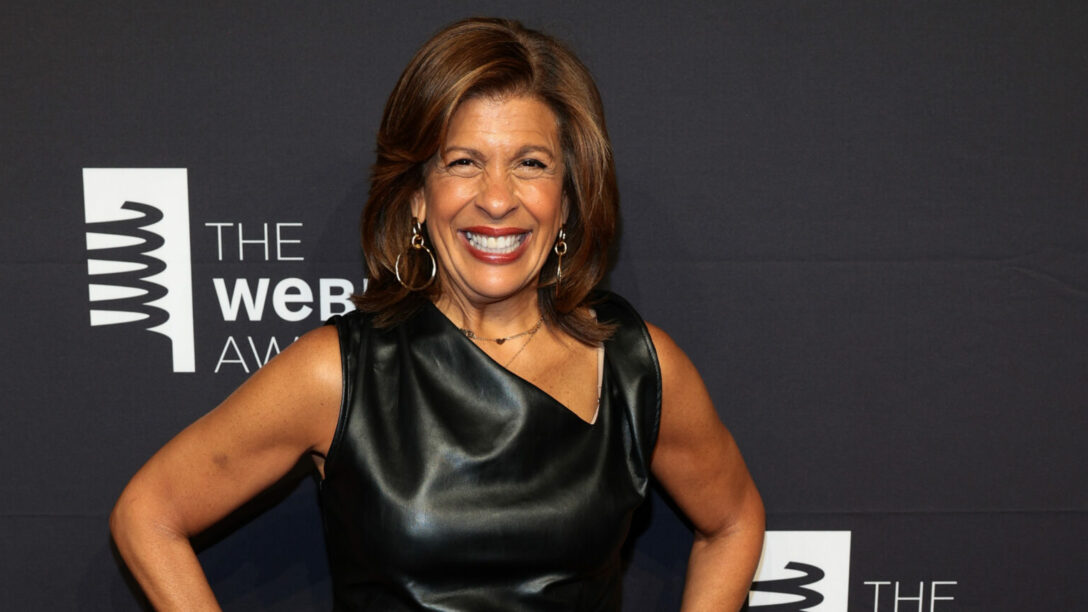

On Thursday, Hoda Kotb, the widely beloved and perpetually ebullient Today show co-host, sat on the Studio 1A couch among her teary-eyed colleagues and revealed that she would be leaving the program early next year. In the subgenre of Today farewells, this was about as genuinely harmonious and well-composed an exit as the network suits could have expected—a far cry from the infamously awkward Ann Curry departure, obviously, to say nothing of the Matt Lauer cancellation that presaged Hoda’s own ascension to the chair. Tears and praise and declarations of love flowed unencumbered. Savannah Guthrie called Hoda “our sunshine,” Al Roker called her “our North Star.”
Hoda had decided to step down in August, she said, upon turning 60. She had reached “the top of the wave” and decided it was time to give her children “a bigger piece of my time pie.” Of course, all that is indisputably true. Hoda is going out on top—indeed, thanks to the Olympics, Today just beat Good Morning America in the quarter for the first time since she began hosting in 2018—and 60 is a reasonable time to start pivoting toward the true joys of life. (Hell, Woj just did it at 55.) Indeed, I’m reliably told that Hoda had entertained the idea of leaving NBC on the occasion of her 50th birthday, too.
Nevertheless, the choreography of Hoda’s exit also belied some unpalatable economic realities that the smoothie-sipping audience didn’t really need to hear about. Hoda was making more than $20 million per year at NBC, according to sources with direct knowledge of her salary. (Savannah also makes more than $20 million; Lauer had made $25 million.) NBC executives loved Hoda and knew her value to the brand, but also made clear to her agents that such stratospheric contracts were no longer justifiable given the industry’s inexorable decline. A decade ago, Today and GMA each averaged around 5 million viewers; today, their audiences are just more than half of that, at around 2.8 million. And they’ve fared even worse in the advertiser-coveted 25- to 54-year-old demo, declining from around 2 million viewers each to about 600,000. Thus, instead of a pay raise, NBC proposed a cut.
Alas, Hoda’s situation is not unique. An economic realignment is coming to television, and the star system is nearing its end. Inevitably, almost every handsomely paid on-air talent will be forced to take a haircut or, at best, accept an almost negligible 2 to 4 percent cost-of-living raise. Alternatively, they’ll be asked to graciously make way for significantly lower-priced successors. “This is the age of the great resetting of TV news contracts,” one veteran media executive told me. “Everyone is getting their pay cut or their jobs eliminated. In the coming year, some big names will announce they want to spend more time with their kids or families or write new chapters. And that may be true. But they also don’t want to work for less money even though they have already made a fortune.”
After all, the current economic arrangement is entirely unsustainable. GMA co-hosts George Stephanopoulos, Robin Roberts, and Michael Strahan cost Disney at least $75 million a year, a ludicrous expense that will need to be greatly reduced during the next round of contract negotiations. Both Stephanopoulos and Roberts are 63, and may determine they don’t want to be paid less to wake up before 4 a.m. to service a shrinking audience. Strahan already moonlights as a Fox NFL analyst, which would be a fine safety net. Yes, the era keeps ending, but it’s starting to end a little faster.
Holt to Llamas?
Of course, some networks have already waved the white flag. CBS News, which is in the midst of an aggressive cost-cutting exercise ahead of the Skydance-Paramount merger, recently revealed its plans to elegantly nudge Norah O’Donnell out of the CBS Evening News chair and replace her with a rotating cast of relatively inexpensive and mostly forgettable co-anchors, wholly abandoning the talent-led strategy that has governed television news almost since its inception. CNN spent a decade trying to stand up talent-led morning shows before Mark Thompson abandoned the effort altogether. He has also not overhauled his primetime lineup, despite historically low ratings—a quirk that enrages some in the building but inevitably signals to those outside the greenroom that he gets it and is investing his energy on growing new revenue streams.
In many cases, the end of the star system will play out through a gradual sunsetting. As I reported this summer, Lester Holt, now 65, is likely to step down from NBC Nightly News following the inauguration and may be replaced by Tom Llamas, a far less expensive talent who has spent three years getting his reps in on the streaming service. When the 76-year-old Wolf Blitzer departs CNN, as he is likely to do next year, there will be no high-seven-figure offer to bestow upon the person who replaces him. Had Kaitlan Collins ascended to primetime a decade earlier, she would likely have commanded more than twice the $3 million she makes today—though that really isn’t bad given the lack of experience she’d had in the anchor chair.
You can’t shut this still-lucrative business down all at once, of course, and there are exceptions to the rule. Ari Emanuel and Mark Shapiro famously convinced NBC to give Rachel Maddow $30 million a year to host one night a week because former NBC C.E.O. Jeff Shell and NBC News chairman Cesar Conde couldn’t countenance a Maddow-less MSNBC at the time. Was it worth it? There’s obviously no ledger in Cesar’s drawer to measure the R.O.I. They just know that MSNBC continues to command an evangelical audience of liberals—the new MSNBC Live event series now allows fans to experience this hotblooded Maddowmania in communion, if you’re into that sort of thing—and is suddenly eating CNN’s lunch on the big political nights.
Is that because of Maddow’s brand or CNN’s forfeiture? Wouldn’t liberals tune in to MSNBC anyway? Who knows?! In any event, they’re not tuning in for Joy Reid, alone—and, indeed, I’m told that Reid’s next contract offer will not include a raise.
Similarly, back at Studio 1A, Hoda’s exit has suddenly made Savannah far more valuable to the franchise. Meanwhile, I’m told Savannah has privately intimated to friends and colleagues that this contract may also be her last. Is that sincere, or a negotiating posture? Surely, Cesar and NBCU Media Group chairman Mark Lazarus have no interest in finding out. Savannah is one of those rare, made-for-broadcast talents who can talk about faith and motherhood and friendship and deliver tragic news about coups and shootings and hurricanes and conduct command performance interviews with U.S. presidents and get dressed up in a Taylor Swift costume. She is the personification of Steve Burke’s old highfalutin “symphony” strategy—whereby NBC’s various assets and talents serviced its various properties and channels. So when Craig Melvin or whoever inevitably takes over Hoda’s chair—for a lot less than $20 million, of course—NBC will want to keep Savannah there alongside him.
Hail, Cesar!
Savannah’s value highlights one of the unique challenges of managing television news through its long decline. And it’s particularly acute at the NBC News Group, which is truly built around specific talent-led brand pillars: Today, Maddow, Morning Joe, Squawk Box, etcetera—which is really to say Savannah, Rachel, Joe, and Andrew. (No, Meet the Press is not a meaningful part of the business anymore.) Fortunately, NBC is part of a $160 billion telecommunications conglomerate that can cushion the blow for those talents a while longer. For so many others in the building, their value is mostly related to their proximity to these fiefdoms and their vassals, such as an E.P. like Libby Leist (Today) or Alex Korson (Morning Joe).
Meanwhile, the rest of the NBC News folks are living a newly humbled existence. They’re fielding requests from the streaming bookers or being left to deal with Rebecca Blumenstein and Carrie Budoff Brown, former Times and Politico journalists, respectively, both of whose still very apparent inexperience in the world of television continues to grate on the veteran talent, even long after their Ronna McDaniel fiasco. You may have noticed that NBC News did not get a presidential debate this year. There may be myriad reasons for that—debate rules negotiations, the preferences of the campaigns, etcetera—but internally, there are just two, and they each have a name.
Of course, the real blame for this situation lies with Cesar, who devised this organizational hydra that neutered other executives and talent and inevitably empowered himself. (Whatever you think of the guy, it’s impressive that he pulled it off.) That’s all fine and well, so long as you have Savannah and Rachel and Joe, but what happens after they decide to refuse a pay cut? Cesar, a shrewd corporate angler who always seems to be contemplating the next position, or board seat, probably won’t be around long enough to answer that question. Earlier this week, I received a tip that he was planning his own exit choreography. It turned out to be erroneous—for now.