
Join Puck to listen to this article
This week, in the span of about 10 minutes, I received texts from three current or former CNN employees alerting me to an abnormal programming tweak. “Turn on CNN,” said one. “What the fuck is that set?”
On air, Anderson Cooper and two guests were seated at a table speaking into massive desk microphones that channeled Edward R. Murrow. Anderson’s jacket was off, his sleeves were rolled up, tie loosened, and monitors filled the backdrop. Yet rather than relying on those sophisticated technological assets for the network’s coverage of the war in Iran, the producers would cut to a bird’s-eye view of the table itself, upon which lay a physical map of the Middle East.
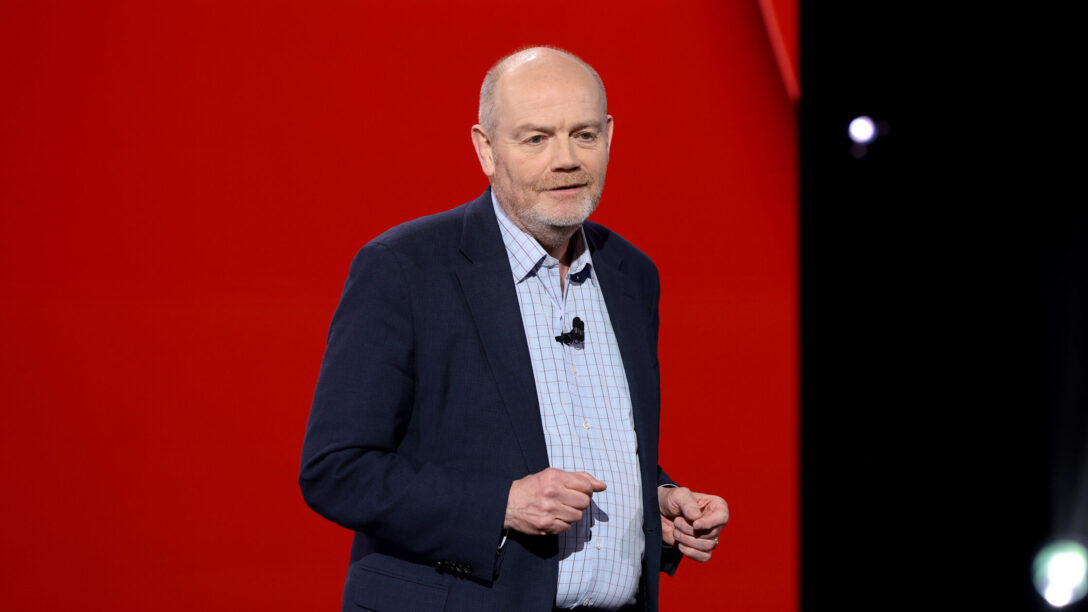
These avant-garde innovations, which a network spokesperson described as “an experiment,” were inspired by a meeting with content leaders in which CNN C.E.O. Mark Thompson alluded to the old Murrow broadcasts—a cigarette in his mouth, a pile of papers on the desk—and noted that it gave the air of a real journalist doing real journalism. The experiment continued on Friday when a jacketless Jake Tapper broadcast from his own office—which, as the CNN kremlinologists know, is adorned with old campaign posters of losing presidential candidates.
On some level, Mark shouldn’t be faulted for testing new formats. CNN’s programming has grown listless, its ratings dismal. Why not shake it up? Still, his instincts here have opened him up to predictable ridicule. “If only there were a cutting-edge solution for getting good audio that didn’t involve a massive mic under your chin,” Joanna Stern, the technology journalist, sniped on X. “Perhaps one day a television network will gain access to such innovations.” “Who is this for?” several users asked when I noted Jake’s forthcoming office hour. Tim Miller, the reliably punchy Bulwark pundit, said he was “looking forward to John Berman from the bathroom stall.”
In some ways, this stunt was merely the latest hallucination of the late-stage cable news industry’s inescapable vertigo. In an era when producers and network chiefs are licensing straight-to-video, YouTube-ified podcasts to fill airtime and slim down the P&L, CNN is paying its most handsomely compensated anchors to mimic the formula. And at moments like these, it’s important to distinguish innovation from bad ideas.
Casual Tees
It may be giving the 1950s, but Mark’s experiment is telegraphing a very present-day anxiety about cable’s diminishing influence in a cultural firmament where social media and podcasts are dominant. It’s the same apprehension that inspired ESPN to license Pat McAfee, and, more recently, inspired MS NOW to ink a similar deal with Jon Lovett & Co.’s Crooked Media. If the creator era rewards informality and authenticity, the thinking goes, then Anderson and Jake need to be more informal and authentic. In the last decade, Jay Shaylor, the executive producer of The Situation Room, forbade guests from wearing denim pants on set (I learned the hard way), but Mark wants Jake to lean into his jeans-and-Nikes Philly guy persona.
Authenticity matters more than ever in media, but this is almost certainly the wrong execution. CNN needs fresher programming on linear and digital, to put it mildly, but it won’t get there by dressing down its most authoritative TV talent—and it almost certainly shouldn’t attempt to do so during a war, when CNN’s production value and professionalism is most valued. By squeezing TV people into the influencer mold, the network runs the risk of making its best anchors look like Regina George’s mom. It has also inspired some reconsiderations of Mark’s programming acumen, which until now was considered at least marginally better than that of his predecessor. (If CNN wants podcast energy, it would do better to go out and acquire or license genuinely good podcasts.)
In a stroke of cosmic timing, Mark’s experiments happened to coincide with Bari Weiss’s decision on Friday to shutter CBS News Radio, home of those smoky newsrooms where Murrow got his start. (One observer quipped that CNN might look to inherit the old mics.) But, of course, CNN and CBS News are on the cusp of being combined, and, as I’ve reported, will likely soon rely on the same back-end infrastructure. Both networks are sorely in need of programming innovation and, yes, experimentation—but their success still relies on playing to their strengths. Any sucker can sit at a table in their office and talk into a microphone.
That’s where these experiments ultimately fall flattest. People who want to get their news from influencers and content creators have an almost infinite fount of them at present. And anyone who has spent any time in a newsroom in the last decade or three knows that the problems plaguing the business are both fundamental and foundational. Aesthetic tweaks aren’t going to cut it.