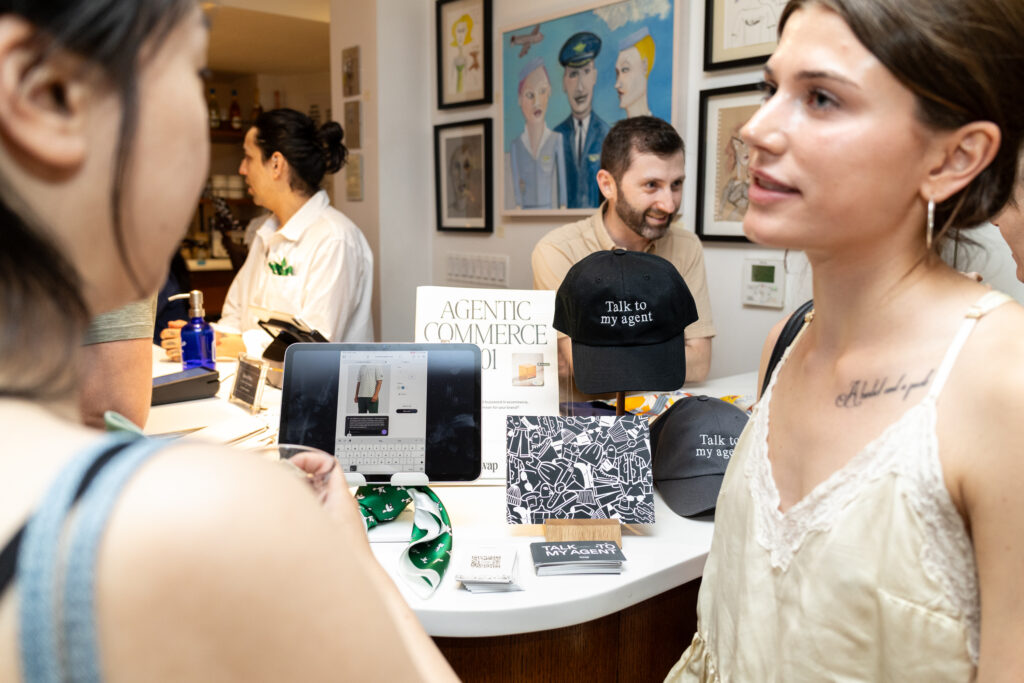
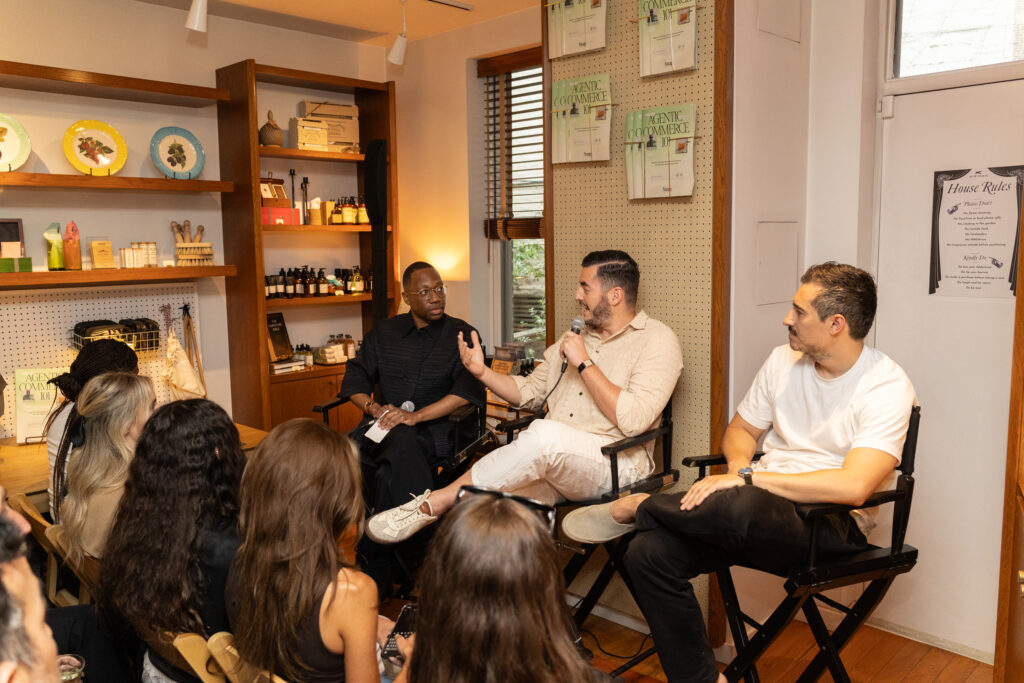
A candid conversation with Swap marketing executive Juan Pellerano-Rendón and Bandit Running co-founder Nick West about how to take e-commerce into the 21st century… without alienating consumers.
The discussion touched on the agentic future of shopping, as Swap rolls out new tools for brands to prepare for A.I.-powered shopping experiences.
Photos: Jackie Molloy/Courtesy of Puck
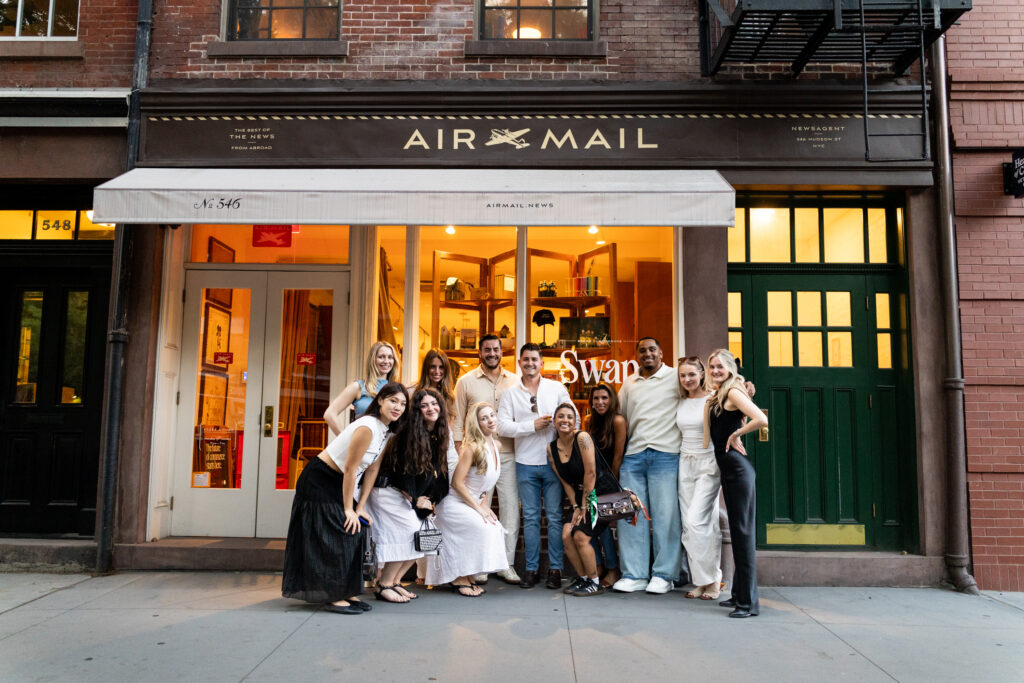
Last week in the West Village, Juan Pellerano-Rendón, the chief marketing officer at e-commerce software provider Swap, and Nick West, the co-founder of standout activewear brand Bandit Running, sat down with Puck’s Malique Morris for a fascinating, freewheeling conversation about the state of e-commerce in the A.I. era. Naturally, the discussion touched on the agentic future of shopping, as Swap rolls out new tools for brands to prepare for A.I.-powered shopping experiences. The trio also delved into personalization, the build vs. buy dilemma, and how to acclimate consumers to A.I. future shock. As always, the following has been lightly edited for length and clarity.
The A.I. Opportunity
Malique Morris: Juan, you and I have had many conversations about A.I. and e-commerce, and how e-commerce hasn’t evolved over the past 20 years. What has changed—and what hasn’t changed fast enough?
Juan Pellerano-Rendón: When you look at e-commerce, in 2006 the cart abandonment rate was 60 percent. Currently, we’re at 70 percent. So if anything, we’re actually regressing in getting more consumers to convert. This is where A.I. has an opportunity. What we’ve built with the agentic storefront can really help consumers convert more, get an integrated experience with the brand, and reduce returns. This is the first time you have an opportunity to make a tangible change in how consumers experience and shop with you. So why not now?
Nick West, why not now? As a brand builder, what changes have you seen since having Bandit Running online?
Nick West: Before Bandit, I co-founded a baby food company, and we put a lot of our marketing budget into conversion rate optimization. When we started Bandit, we made the concerted decision to spend zero optimizing our website—we literally ran our first A/B test last month. In the early days, at a small scale, a change in 10 bips on conversion doesn’t have much impact. We thought if we poured all of our energy into building deep emotional affinity with the brand, people would basically just elbow grease their way through to checkout. Once we’ve gotten to a certain scale, now the math plays out differently—at a million site sessions a month, a 10 percent increase in conversion can have a real impact. It has coincided nicely with tools like what Swap is building, because we can get a lot smarter about how we’re recommending products, personalizing the experience, and identifying at what points in the customer journey we should be optimizing. I think, to a point, optimization will become a commodity. The experiences will be so good that brands will need to have as good and emotional I.R.L. engagement as they do a site experience, and the ones who match those up perfectly are going to be the ones that ultimately do well.
A big change I’ve seen in the past 10 years in e-commerce is people expecting online shopping to feel like Netflix or Instagram—the feed is for you—but e-commerce has been slow to get there. What does “agentic commerce” really mean, and how does it get us closer to that true personalization?
Pellerano-Rendón: What luxury fashion houses love about it is the way you can blur the experience to being close to in-store. You have the element of being able to discover, like in a TikTok feed, but there’s also a personal conversation agent trained to the brand. You’re able to virtually try on—we have amazing videos, where I could be in front of a camera and a shirt on my body would change live—and have this agent that knows and learns and understands you. So every time you come back, the experience only improves, the same way a personal shopper would in-store.
On a base level, when you say “agent,”how is it related to people using ChatGPT or Perplexity?
Pellerano-Rendón: Agentic commerce is a broad term. Really simply, for me, it’s an agent you use to purchase a good or service. Right now, ChatGPT has the experience with Sephora; Gemini and Gap have teamed up. But they’re creating walled-garden experiences where brands are not getting the wins they should be. Because if you’re a Sephora customer, you can only experience this through ChatGPT. The incentives for the L.L.M.s are aligned to keep customers on those platforms—they’re not aligned with the brand to help you convert and sell more, or even own that data to begin with. We’ve presented something to market that we feel is the best representation of a brand that you can use A.I. for, to bring the customer closer in rather than giving them a disparate experience.
Nick, when and how were you convinced that something like agentic commerce was something you should take seriously?
West: A couple years ago, when I started playing around with ChatGPT and chatbots, I instinctively wanted to understand what it could do and what it couldn’t do—its limitations, and what it might be able to do in the near future. Very simply being a prediction and recommendation machine, thinking about the problems in the business—in a fashion business, its biggest obstacles are the time between when you make an inventory buy and all the things that happen in between it going to market. Being a prediction machine, being able to surface insights in that in-between time, helped me realize that if we could do things with agentic commerce, or A.I. in general, better, faster, and cheaper, we could be making dynamic changes to the business in that in-between time instead of waiting until products go to market. It effectively compresses the signal-insight-action loop. Then the possibilities are pretty infinite as to how you could deploy it—it becomes about identifying the highest-impact opportunities you should be investing in to further optimize and accelerate the business.
Juan, how are you convincing prospective brand partners to get on board with what Nick is saying, to see what he sees in agents and commerce?
Pellerano-Rendón: The proof is in the data we’ve published. We’ve seen conversion rates be 2x compared to .com. We’ve seen return rates drop by 20 percent. We’ve seen consumers spend more time on site and give the richness of that data to the brand. For us, it’s a way for brands to own the future and the outcomes of what A.I. can bring to their business, rather than—to your point, Nick—kind of using other L.L.M.s out there, which ultimately aren’t aligned with your end goals of having the data, personalizing it, and giving consumers a better experience that converts more for your business.
As a brand operator, what A.I.-powered tools are you looking for in the market?
West: The first thing we did—knowing how many tools were popping up and the multitude of directions we could go from an A.I. investment allocation perspective—was to build our own knowledge graph on the back end. We connected about 200 of our own datasets to run causal relationships. A knowledge graph is basically the proprietary way that we interconnect our datasets to understand our business in totality, and then adding a context layer, which is basically like an instruction manual to tell the operating system what certain things mean. We knew there would be a lot of whiplash, and we knew the most powerful aspect of the agentic commerce world is also on the back end—we wanted to know where we should be prioritizing our efforts. Like, what is the [lifetime value] of a customer who receives their package in six days versus three days?
Juan, talk to me about the importance of testing some of those back-end tools before you get to what the consumer sees.
Pellerano-Rendón: What Nick said is probably more advanced than 80 to 90 percent of the brands we speak to. But at the end of the day, the richness of the data you have on the back end is the most important tool, because that is what eventually gets ingested on the storefront side, taking all the P.D.P., all the product data, all the descriptions, and even what is already learning better on your .com. We can train the agent based on all the available data you already have.
Luxury Leaps In
Let’s talk about the tension between build versus buy. As a brand operator, how do you think about what to build in-house versus what to buy?
West: I think about it the same way I thought about whether or not we should operate a coffee shop in our Bleecker Street store. We are not in the coffee business, and so we brought Rhythm Zero in to run that coffee shop. I am in the business of knowing my customers and their behaviors and making really great products for them. I am not in the business of logistics optimization. I try to think about it from a core competency perspective—is it something we should be truly investing in, because it’s core to the long-term durability of the brand and the way customers perceive us? There are incredible full-stack tools like Swap that I would never even pretend to think we could build, and then there are a lot of widgets that are basically skins you can build on your own. The durable agentic commerce tools are the ones that are creating real solutions that learn with your business over time.
Brunello Cucinelli and Ralph Lauren both launched A.I.-powered shopping assistants in the past year. What does that say about how other brands, particularly smaller ones, should be investing in similar technology?
West: It’s really interesting that the super-premium luxury end of the market has historically thrived on gatekeeping and scarcity. Them being first movers and adopting these tools is good, because it gives permission for brands lower on the positioning pole to adopt them. I ask myself, which is going to be the first luxury brand that makes it incredibly hard to shop on their website? I do think there will be brands that run in the opposite direction as things get a lot easier. These brands don’t want everybody to buy their products—that’s how they are aspirational in the first place. It feels like there’s some tension in them being first movers. I was surprised that Brunello would move on it so fast.
Pellerano-Rendón: Confidentially, we have been speaking to a few luxury fashion houses. What resonates with them is, How do I make my .com feel closer to the experience that you have in store?
Is there any correlation between consumers vocalizing their fears around A.I. online and how they’re interacting with A.I. shopping assistants?
West: I think the online anti-A.I. discourse is pretty disassociated from the way people actually behave. On the creative side, it’s inevitable that it’s harder and harder to distinguish what actually is A.I., and perception kind of becomes reality to a point. On the shopping side, if you’re going to be able to spend less time shopping and still get the right product, you’re going to use the tool. I think a lot of it is just online chatter disassociated from behavior.
Pellerano-Rendón: According to a Deloitte study, 80 percent of brands feel that they are bringing the best possible experience to consumers. But over the last three to five years, more than half of consumers feel that shopping has actually gotten harder and worse. People just want to be able to find what they’re looking for, and if there’s a means to an end with that, consumers are going to adopt it.
Didn't get an email? Check your spam folder and confirm the spelling of your email, and try again. If you continue to have trouble, reach out to fritz@puck.news.
Didn't get an email? Check your spam folder and confirm the spelling of your email, and try again. If you continue to have trouble, reach out to fritz@puck.news.
Member Exclusive
Get access to this story
Create a free account to preview Puck’s full offering, including exclusive articles, private emails from authors, and more.