 |
 |
|
Welcome back to Dry Powder. I’m Bill Cohan.
Greetings from the box next to Josh Harris’s seats at the former FedExField, where I just watched his Commanders blow out the Titans. In some ways, Josh has become the most popular man in Washington, ever since he acquired the town’s NFL franchise from the much-despised Dan Snyder. But more on that another time.
Today, I’m going to shake things up in the spirit of Thanksgiving. First, I’ve got an update on Michael Saylor’s Bitcoin strategy, and a few thoughts from our congressional correspondent Abby Livingston on tariff-gate, before turning to the behind-the-scenes choreography of the recent Magritte sales at Christie’s, as brought to you by my partner Marion Maneker. You’ll know many of the players here, including Ken Griffin, the late Mica and Ahmet Ertegun, Lyor Cohen, and Max Carter, a generationally talented vice chairman at Christie’s, who also happens to be the son of my friend Graydon Carter.
Let’s get to it…
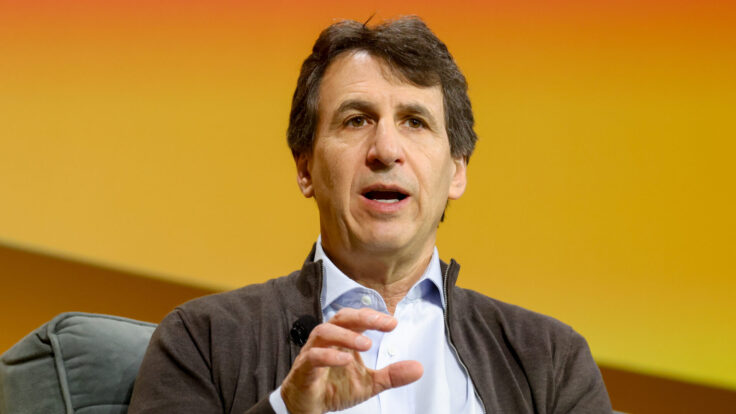
- Saylor’s Bitcoin moonshot: Last week, when I wrote about Michael Saylor—the executive chairman of MicroStrategy, who has turned the enterprise software company into the world’s largest known holder of Bitcoin—it was largely in response to a nearly incomprehensible interview he gave to CNBC’s Andrew Ross Sorkin. In a word salad of financial gobbledygook, he tried to explain his company’s novel play to fund its latest Bitcoin purchases via its issuance of zero-coupon convertibles. As of this writing, MicroStrategy astoundingly owns 386,700 Bitcoin, worth $37.4 billion, for which it paid a mere $22 billion. So it’s sitting on a gain of roughly $15 billion.
Fortunately, a dose of clarity is now available thanks to my friends Anthony Scaramucci—a.k.a., The Mooch—and Tom Lee, a Wall Street research analyst whom I used to work with back in the day. Fresh off their dose of Thanksgiving tryptophan, the two men had a discussion, on the Wealthion podcast, about what Saylor is up to at MicroStrategy. “As Bitcoin has risen and MicroStrategy’s stock has gone up, it’s created an opportunity for them to issue convertible bonds and debt to acquire more Bitcoin,” Lee explained. “What’s been novel is that they’ve issued these debt securities for almost no interest cost—essentially, zero-interest bonds. And so they’re funding this without having to actually pay for the interest expense.”
In other words, Saylor is getting investors to fund his Bitcoin bonanza and rewarding them with zero interest payments, which raises the question: Why would anyone buy these bonds? Well, according to Tom, “They’re offering, for the first time, the ability for someone to put a billion dollars to work in the bond world, to own a bond that has exposure to Bitcoin,” he said. “These have been incredibly high-performing bonds; they’ve been the best-performing bonds. So they’ve helped bond managers outperform buying typical corporate bonds, but then with this upside in crypto.”
As always, this isn’t investment advice. But if MicroStrategy’s stock continues its rocket-ship trajectory—it’s up 678 percent in the last year—things should work out just fine for these bondholders. But woe betide these investors if Bitcoin tumbles from its all-time high, or if MicroStrategy’s stock falls off its all-time high. In fact, the stock is already down 18.2 percent from the high it reached on November 20. If you like volatility, this is your baby.
- SpinCo game theory: In my recent appearance on my partner John Ourand’s excellent The Varsity podcast (yes, that’s also the name of his private email), we discussed the fate of Comcast’s SpinCo, and how that amalgamation of cast-off linear channels will impact the media industry writ large. Then we turned to my recent reporting on the remarkable saga of Wyc Grousbeck’s leveraged buyout of the Celtics two decades ago. You can listen to the episode here.
|
|
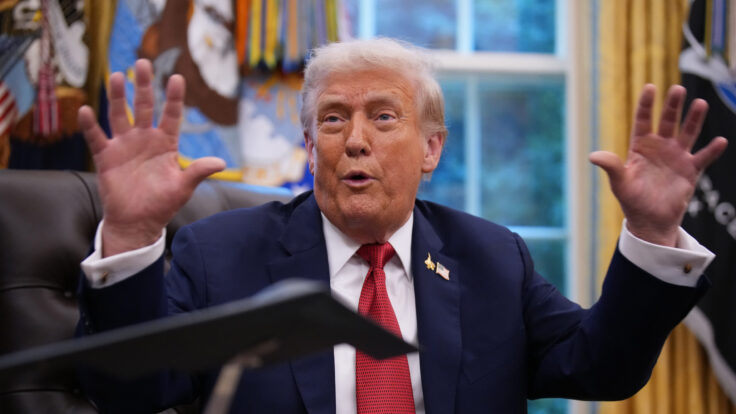
And now, Abby and executive editor Ben Landy anticipate the Trump tariff ripple effects in a snippet from yesterday’s episode of The Powers That Be…
|
|
|
|
Ben Landy: Just before Thanksgiving, Trump announced that he was serious about imposing massive tariffs on China, Mexico, and Canada—our three closest trading partners. How are the lawmakers, aides, and operatives on Capitol Hill responding to this?
Abby Livingston: One of the things to know is that it’s extremely hard to pass a trade deal. But there are a lot of measures he can take unilaterally from the executive branch without the help of Congress. This is something he’s talked about for decades. He can be malleable on many subjects, but on this one, he’s had a firm worldview. I think we may see ripple effects—then, add on his promise to deport millions of undocumented workers, and suddenly you have a labor shortage in farming. I’m not sure the American public understands how different this Trump administration is going to be from the previous one. There aren’t any guardrails. This could be extremely disruptive to Americans at the grocery store.
|
|
A MESSAGE FROM GOLDMAN SACHS
|

|
|
2025 starts now with the sharpest forecasts on next year’s global economy from Goldman Sachs.
Explore a comprehensive range of viewpoints — from the specialists on the trading floor to the independent research desks — on the year ahead.
Read the Outlooks
|
|
|
|
How are Democrats gearing up—psychologically and tactically—to resist any of these measures? Are they picking and choosing their shots in these first two years of a Trump administration?
There’s been a common thread among a handful of prominent Democratic members who will be in the Senate next year. They’re acknowledging the exhaustion in the Democratic Party right now; there’s a worldview of sitting back and letting Republicans fight some things out. In my interview with Elissa Slotkin, she was specific in saying that she is not going to expend her energy fighting every single thing that Donald Trump is pushing. She intends to engage when it’s strategic and things are irreversible. That won’t always sit well with the energetic base, who want to fight everything, everywhere, all the time.
[Click here to listen to the full episode of The Powers That Be]
|
 |
| The Making of an $18.8 Million Mini Magritte |
| The behind-the-scenes story of how a small gouache work from the Belgian master leveraged timing, demand, and deal heat to draft off the Ertegun piece for a new record of its own. |
|
|
|
| The $121 million sale of philanthropist Mica Ertegun’s prized Magritte painting, considered by most to be the best of the 27 images the artist made in his L’empire des lumières series, was the dramatic highlight of the November auction season in New York. But the announcement of the sale also set up another drama, playing out six lots later, when a much smaller version of the same image, painted on paper, sold for $18.8 million—more than twice the previous record for a work on paper by the Belgian surrealist. In the end, the sale unfolded like clockwork, but it masked a carefully choreographed series of events that had taken place behind the scenes.
Prior to the announcement that Ertegun’s estate would be coming to market, art advisor Gabriela Palmieri knew that the big painting’s sale would be a singular opportunity for her clients, whose family had owned a version of the image painted on paper for more than 40 years, never showing it or even letting Magritte scholars know they had it. The collectors weren’t active sellers, but Palmieri convinced them the Ertegun sale would set up a once-in-a-lifetime market opportunity. Of the 27 images Magritte made of the night-shrouded street under a daybright blue sky flecked with picture-perfect clouds, 10 were painted on paper using opaque watercolors called gouache. Ertegun owned the largest painting on canvas in private hands; Palmieri’s clients had the largest work on paper.
The work on paper, like the painting on canvas, was of exceptional quality. Palmieri knew the houses were competing for Ertegun’s estate, and she knew that no matter who won the competition, she would approach that house with the news that her long-hidden prize would also be available for consignment. When Christie’s won the competition and secured a backer for the painting at $95 million, guaranteeing not only that the Magritte would sell but for a record price, Palmieri knew that her clients’ gouache would never be worth more than on that day and in that sale. |
|
|
| Outsiders tend to view art market results as a measure of an artwork’s intrinsic value. There’s a popular idea, promoted by the art industry at various times, that the most expensive works of art are the best works of art, but insiders know that the value of any work is relative. It requires the right circumstances to create the confidence and competition needed for buyers to want to compete to own a painting. And timing is everything.
The Magritte market has been climbing for the last three years. In 2022, $222 million in Magritte’s works were sold at auction. Last year, $192 million worth of the popular surrealist’s art traded hands publicly. Both figures were substantially higher than the previous high-water mark in Magritte’s market; in 2019, $116 million in sales were hammered. So far in 2024, with almost all of the year’s auctions completed, there have been $300 million in Magritte sales, with $177 million spent in November alone, including on the two L’empire des lumières images. After learning of the consignment for Ertegun’s Magritte, Palmieri convinced her clients to craft a unique arrangement: a $6 million estimate that signalled that the 14-by-18-inch work on paper was as important as any that has ever come to auction. |
|
|
| With the proper market signifiers in place, it would come down to Christie’s ability to market the two works in a way that played to their strengths, but didn’t undercut one another. Having the third-party guarantee for the big painting was crucial, alleviating any concern that bidders would be split between the works. In their exhibition, Christie’s placed the big Magritte in an alcove of its own, facing Ed Ruscha’s prized “gas station” painting, which would also be on the block. They placed the small gouache in another alcove, a decent walk away, along with some other surrealist and dada masterworks.
The gouache was being sold as a different class of object: The painting on canvas was a trophy, the work on paper a connoisseur’s piece. But part of the strategy was to attract disappointed bidders on the big painting to the smaller gouache as a kind of value play. If a bidder was prepared to spend more than $100 million for a large painting, the smaller version would seem like a bargain, or maybe a consolation prize. |
|
|
| In the end, the bidding for the large painting played out basically as expected. One or two bidders chased the work up to the well-publicized $95 million level. That number was so well known that when a Christie’s specialist tried to lob in a chopped bid at $88.5 million, auctioneer Adrien Meyer responded to his colleague with a light-hearted over-the-shoulder quip: “I can’t hear those bids.”
Once the guarantee was met, all the action came from two telephone bidders. The guarantor and eventual winner was represented by Alex Rotter, Christie’s chairman of the 20/21 art departments. His opponent was Xin Li-Cohen, the house’s jet-setting deputy chair with strong ties to China. At least one observer who watched the bidding was charmed by the symmetry of Li-Cohen—who is married to Lyor Cohen, a legendary music industry presence—bidding on the prized painting of Mica Ertegun, another glamorous, globe-trotting figure who was married to a legendary music executive. (In fact, Cohen oversaw Atlantic Records, which Mica’s husband, Ahmet Ertegun, co-founded, and whose hits likely paid for the painting in 1968.) Li-Cohen chased the work all the way to $103.5 million; and, for a few moments, it seemed as if she might prevail. A flurry of calculations ensued on Rotter’s side of the room before he jumped his bid another million above the expected next increment of $104 million, to $105 million. With that, the hammer came down.
If Rotter’s bidder, widely gossiped about and reported without contradiction as billionaire Ken Griffin, was also the third-party guarantor, the selling price was probably somewhere below the pro forma $121 million a non-guarantor would have paid. (Christie’s no longer reports net prices, as Sotheby’s continues to do.) Nevertheless, the value statement had been made. The top price for a Magritte had moved up by 50 percent in two and a half years, repricing almost everything underneath. A few lots after the gouache of L’empire des lumières, a slightly smaller gouache of a different Magritte image, La recherche de l’absolu, estimated at $3 million, made $8.4 million with fees. By contrast, two other Magrittes owned by Ertegun, which sold at the beginning of her sale, only made prices around the estimate levels. There was no Magritte bidding bump before the big L’empire painting sold. There was one after. Timing really is everything.
Christie’s had carefully placed the Ertegun L’empire des lumières as the last lot, a fitting crescendo to her dedicated sale, but selling the gouache required an assist. The hope was that the underbidder on the large painting would switch to the smaller one, but bruised feelings take a little time to get over, and Christie’s would have wanted a little space for the impact of the big sale to sink in. Also, if the big painting sold to the guarantor in an anticlimactic moment, the change of sale from Ertegun to various owners would act as a buffer, allowing bidders to regroup and rebuild momentum.
In the end, there were five lots placed between the big Magritte and its little brother, but the gouache was positioned right before Christie’s other big lot of the evening: Ed Ruscha’s Standard Station, priced at $50 million but expected to be bid higher. In setting up the lot order, Christie’s both expressed its confidence in its ability to market both paintings and put all of its eggs into one high-risk basket. The big Magritte had a belt-and-suspenders third-party guarantee, but the small Magritte and the Ruscha were being sold naked, as they say. Both the little Magritte and the big Ruscha had to sell well for Christie’s to call the night a success—and make any money.
In the end, Christie’s didn’t have to worry. Close to a dozen different bidders chased the L’empire gouache. Bidding started in the room for as little as $4.8 million, but quickly escalated in a relay race of bidding and counter-bidding. Max Carter, who had done so much to carry the ball on Palmieri’s consignment in-house, came in at $11 million. There were still several bidders active at $14 million, but Li-Cohen—who’d come in at $12.5 million, presumably representing the under bidder on the big empire painting—pushed to $15.5 million. Carter took one last shot, chopping his bid to $15.7 million, which signalled to Li-Cohen that $16 million would most likely take it. She bid that… and won.
Art auctions rarely adhere to such a tightly choreographed and cinematic script. Minutes before the sale, Michel Legrand’s theme to The Thomas Crown Affair came over the sound system, in homage to a Magritte having been the object of Crown’s larcenous obsession in the 1999 remake. The sale of the gouache provided the necessary subplot to bring the whole story together. |
|
|
|
| FOUR STORIES WE’RE TALKING ABOUT |
|
|
|
|
|
 |
|
|
|
Need help? Review our FAQs
page or contact
us for assistance. For brand partnerships, email ads@puck.news.
|
|
You received this email because you signed up to receive emails from Puck, or as part of your Puck account associated with . To stop receiving this newsletter and/or manage all your email preferences, click here.
|
|
Puck is published by Heat Media LLC. 227 W 17th St New York, NY 10011.
|
|
|
|