|
This is Wall Power. And I’m Marion Maneker, your regular guide through the art world demimonde.
Tonight, in the spirit of the New Year, I’m examining some themes I’ve divined in the barrage of year-launching art-market soothsaying—including two egregiously irresponsible predictions.
But first…
|
- Heritage Auctions posts record $1.9 billion in sales: A $6 million comic book; a $24 million baseball jersey worn by Babe Ruth; and a $32.5 million pair of movie-prop bedazzled “ruby” slippers that carried Judy Garland to Oz: These are the record sales figures for objects of cultural importance sold last year by Dallas-based Heritage Auctions—the digitally innovative firm that began as a coin-auction house and has now become a dominant player in the auction market. They helped push the firm’s annual sales to a record $1.867 billion.
Heritage has been on such a growth tear, in fact, that it has more than doubled its auction total in just four years, adding a billion in sales since the firm made $873 million in 2020. C.E.O. and co-founder Steve Ivy says entertainment memorabilia grew by an explosive 2.5x year over year—indeed, these objects fetched the kinds of prices usually reserved for major works of art. Another factor in a big year: comic books, several of which Heritage sold for more than $1 million each.
- The battle for Artnet rages on: When last we discussed the parties warring for control of Artnet, the annual general meeting scheduled for November 18 had been postponed on short notice due to the lack of an auditor. Today, Weng Fine Art issued a press release announcing that Pascal Decker, the head of Artnet’s supervisory board, will resign from the three-person governing body unless the A.G.M. is held before the end of February. (That board also includes founder Hans Neuendorf, who sold $50,000 worth of Artnet stock in December.) If Decker resigns, a replacement will be appointed by a German court. Weng Fine Art’s C.E.O. Rudiger Weng would be a likely contender, considering his firm is the largest shareholder in Artnet, and he has already announced his candidacy for a seat on the supervisory board.
A representative for Artnet responded to the news with a statement: “As announced on November 28, 2024, Artnet’s management is completing the tender process to solicit an auditing firm as outlined by the regulatory framework of the Frankfurt Stock exchange. The AGM is therefore planned for late February. WFA’s attempt to force an AGM outside this process has been rejected by the court.”
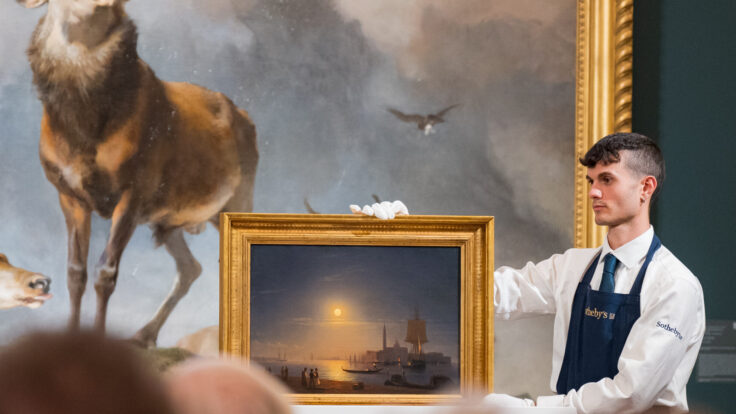
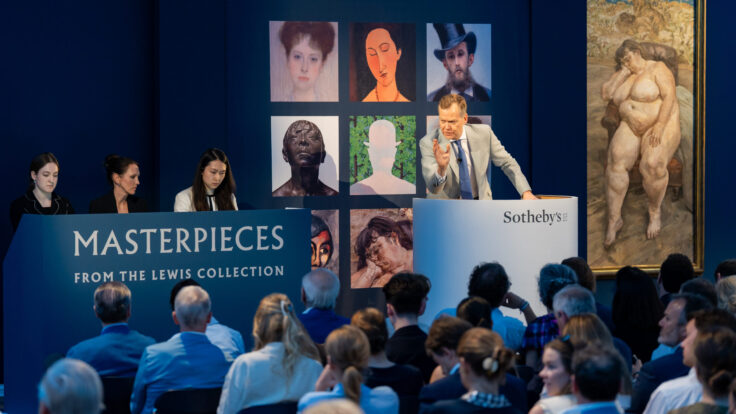
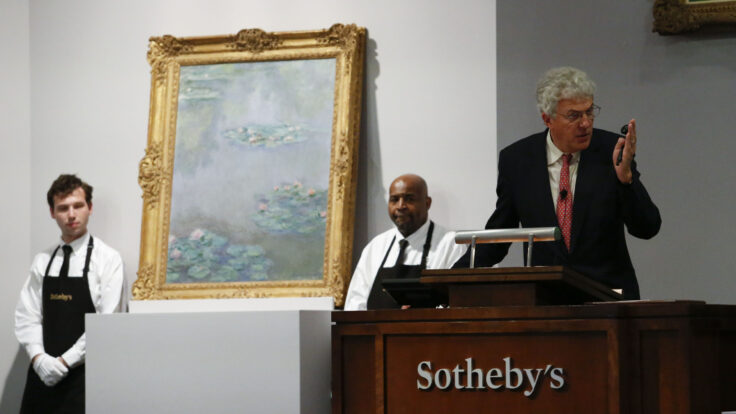
- Patrick Drahi moves his official residence to Israel: Sotheby’s majority owner Patrick Drahi has a house in Nevis, and has long listed Zermatt, Switzerland, as his domicile on corporate documents, according to Bloomberg. But just recently, Drahi seems to have begun using Tel Aviv as his new base of operations. “The change of residency was for personal reasons,” per Bloomberg, “including family, according to a person familiar with his motives, who confirmed the move.” (He’s also had some trouble with the Swiss tax authorities in the past.) Meanwhile, as my partner John Ourand noted yesterday, Drahi’s Altice is engaged in a holy war with billionaire Jim Dolan’s MSG Network, and has taken the Knicks off the air in innumerable New York City homes. Will this factor in the minds of city bureaucrats on the landmarks commission as they decide how much work Sotheby’s can do inside the Breuer building?
|
|
Now, let’s get to the predictions…
|
|
|
|
Will the strong stock market gains of 2024 translate into art market sales? Has money from the Middle East returned to art? What about the rising prominence and wealth of India? A survey of some art market predictions might help the industry tell itself a better story.
|
|
|
|
I try to avoid making predictions—mostly because I’m terrible at it—but I also know that making them is an inevitable part of closing out a year and welcoming a new one. Whether that’s because knowledgeable people can’t resist showing off, or virtue-signalling, or just trying to manifest a desired outcome by vocalizing it, a practice known on Wall Street as “talking your book,” I will let you decide.
As a compromise, I’m evaluating other people’s predictions for the coming year—as a way to both summarize and comment on the emerging conventional wisdom. What’s interesting here is less about what turns out to be correct, but rather what these prognostications can teach us about the mood and expectations of the art market.
Five main themes kept coming up in my reading: Gains in the equity markets will translate into art sales; demand from the Middle East will revive the upper end of the market; a new generation of wealthy people in India will raise the status and value of Indian art and artists; private sales will continue to sustain the art market amid the auction drought; and a new market narrative needs to emerge.
|
Let’s take these in order, starting with whether the unexpected strength of the equities markets means more money will be spent on art. The main measure of the U.S. equities market, the S&P 500, was up 24 percent last year, far exceeding what most analysts had predicted. (See what I mean about predictions?) But as Alex Glauber pointed out in ARTnews, the equity markets are a double-edged sword for the art market. They can generate a wealth effect that translates into art sales, but the anticipation that the Trump administration could unleash greater profits is balanced by uncertainty and the heightened potential for volatility.
More to the point, the equity markets are actually a relatively small portion of the wealth picture. Meanwhile, though, the market for treasuries is already moving in the wrong direction ahead of Trump’s inauguration, and Bloomberg was hinting darkly on Sunday that one prominent trader who made a lot of money during the Great Recession thinks the current situation is analogous to where things stood in 2005 to 2007. If that’s not dark enough for you, we’ve just had our first human death from bird flu. The virus does not transmit from human to human right now, but there’s always a chance we’re also on the cusp of an early-2020 scenario, if you really want to go negative…
On a less apocalyptic note, let’s remember that the financially flush have no obligation to spend their money on art. As we saw last year, when art lending unexpectedly took off, other markets can draw cash out of art as collectors seek a real return. A strong 2025 could produce a similar result.
|
|
Market gains aren’t the only potential source of new money for the art market. There’s talk, especially from the Fine Art Group’s Philip Hoffman, that new buyers from the Middle East will enter the market for so-called blue chip (read: expensive) art—which, if it occurs, would be auspicious. The auction market for works above $1 million, and especially above $5 million, has suffered greatly these past two years. Supply has obviously been an issue, but supply also follows demand.
On the other hand, even though Hoffman has a long history in the region, his evidence for this new demand is, unfortunately, a bit thin. It amounts to, in his words, “a slew of major investments, new museums and real estate outposts.” That reads more like new infrastructure than actual new collectors.
One place we do know there are more actual buyers is in the market for Indian modern and contemporary art, which really took off in 2023. It moderated slightly last year, but no one thinks we’ve seen the last of the Indian art market as the country generates more wealth. We saw a similar story play out two decades ago with Chinese contemporary art, when Taiwanese and mainland Chinese buyers scoured the globe for works of art to repatriate from Europe and the U.S. After that came the growth of a market for pan-Asian and Western artists in the region.
Now it looks to be India’s turn. Amrita Jhaveri, a gallerist in Mumbai, told The Art Newspaper that there’s already growing visibility for, and interest in, a wave of artists who came of age in the 1970s and ’80s after the success of the famous Indian modern painters of the post-Independence era. Jhaveri singled out mostly female artists, such as Arpita Singh, Nilima Sheikh, and Mrinalini Mukherjee.
|
Of Auction Houses & Narrative Shifts
|
Even though the art market looks to auctions to set the headline prices that drive sales across the secondary market (and often have strong effects on primary market pricing, too), people like Hoffman and former auctioneer Jussi Pylkkänen are pointing to the robust private market and suggesting it might remain the preferred arena for sellers. Let’s not sleep on this prediction, because it could have a profound effect on the tenor and tone of the art market. The possibility that the top of the market continues to be hidden in private sales is an enormous deal, and probably a subject for another column, soon.
Meanwhile, the search for a new narrative—a collecting thesis that redefines the pecking order in terms of art history, popularity, and value—may be the overriding theme of the current market. A narrative is what lures the marginal buyers—the ones who are following other collectors without, possibly, fully understanding their rationale. The art world tends to call these spendy buyers “speculators,” but they’re really the opposite, and their disappearance is one reason the market feels like it has lost energy.
When you see commentators like Amy Cappellazzo note in The Art Newspaper that we live in a bland, algorithmically attenuated information environment, part of what she’s saying is that we need a new thesis—actually, many new theses. “Thinking and betting bravely on something less than obvious,” Cappellazzo wrote, “is what will save us personally, and bring a renewed robustness to the art market, curatorial practice, dinner conversations and free thinking.”
|
Now for the dubious takes. First was the claim trumpeted in a headline in The Art Newspaper that one unnamed auction house will fold—for which the source, London dealer Niru Ratnam, offered no evidence. I guess we’re supposed to infer that Ratnam means Sotheby’s, just because there’s been so much news recently surrounding its layoffs and cashflow.
Remarkably, even amid the recent dour drumbeat, there’s no reason to believe that Sotheby’s is unprofitable. (Indeed, people who have recently left the company have many things to say, but the one thing they don’t say is that the company is losing money.) As Wall Power subscribers know, the cuts at Sotheby’s have nothing to do with shortfalls, and everything to do with generating a greater return to pay its investors or attract new capital. This sort of prediction either demonstrates the schadenfreude within the market, or the lack of broader financial acuity—perhaps both.
It’s entirely possible—in the sense that anything is possible—that Phillips or Bonhams or even Christie’s could go out of business. But it is exceedingly unlikely. Bonhams is backed by private equity; by all accounts, there was a very good offer to buy Phillips not long ago. And Christie’s is owned by a family office with deep pockets that also owns other assets that fit nicely with the auction business.
The other irresponsible prediction I saw recently was in, of all places, an in/out list for 2025. Cats and cat memes are out, artist Nicole Eisenman told Cultured magazine. What’s in? “Long lunches with a bottle of wine; Peptides and bio-hacking lite; Still life painting; Ideological decay.” Cute. But there’s also this item on her “in” list: “Assassinations.”
Cultures make folk heroes out of unlikely, and often miscast, figures. That said, even making what you think are wry jokes about political violence is decadent, nihilistic, and just plain stupid. Happy New Year, by the way.
|
That’s it for me today. Tomorrow, Inner Circle subscribers get an exclusive first look at my analysis of ARTDAI’s 2024 data and what it says about the state of the art market. If you’re not yet an Inner Circle member, you can fix that here. Otherwise, you’ll get the summary on Friday.
Speak to you then,
M
|
|
|
|
Puck’s daily political newsletter from Washington, featuring Tara Palmeri, Julia Ioffe, Peter Hamby, Tina Nguyen, Abby Livingston and Puck's new Chief Political Columnist, John Heilemann, on what’s really happening in this town—inside the White House and the Pentagon, on Capitol Hill, K Street, and the campaign trail.
|
|
|
|
The ultimate fashion industry bible, Line Sheet offers incisive reportage on all aspects of the business and its biggest players. Anchored by Lauren Sherman, the preeminent fashion journalist of her generation, Line Sheet also features veteran reporter Rachel Strugatz, who authors the definitive guide to what’s happening across the beauty industry, and Sarah Shapiro, a longtime retail strategist who writes about e-commerce, brick-and-mortar, D.T.C., and more.
|
|
|
Need help? Review our FAQ page or contact us for assistance. For brand partnerships, email ads@puck.news.
You received this email because you signed up to receive emails from Puck, or as part of your Puck account associated with . To stop receiving this newsletter and/or manage all your email preferences, click here.
|
|
Puck is published by Heat Media LLC. 107 Greenwich St, New York, NY 10006
|
|
|
|