Welcome back to Wall Power, where we’re resting up after our wildly successful art
summit, The Art of Influence. I’m Marion Maneker.
I want to thank everyone who attended The Art of Influence yesterday. We talked about what’s really going on in the art world, and everyone seemed to leave on a positive note, with a greater sense of confidence about the future. Also, a sincere thanks to our partner Glenn Fuhrman and The FLAG Foundation for a truly memorable day—and evening, too. It was great to chat with so many of you at Glenn’s dinner
at Loring Place last night. One thing I can assure you: My colleagues at Puck, starting with Louise Johnson, really know how to throw a great event.
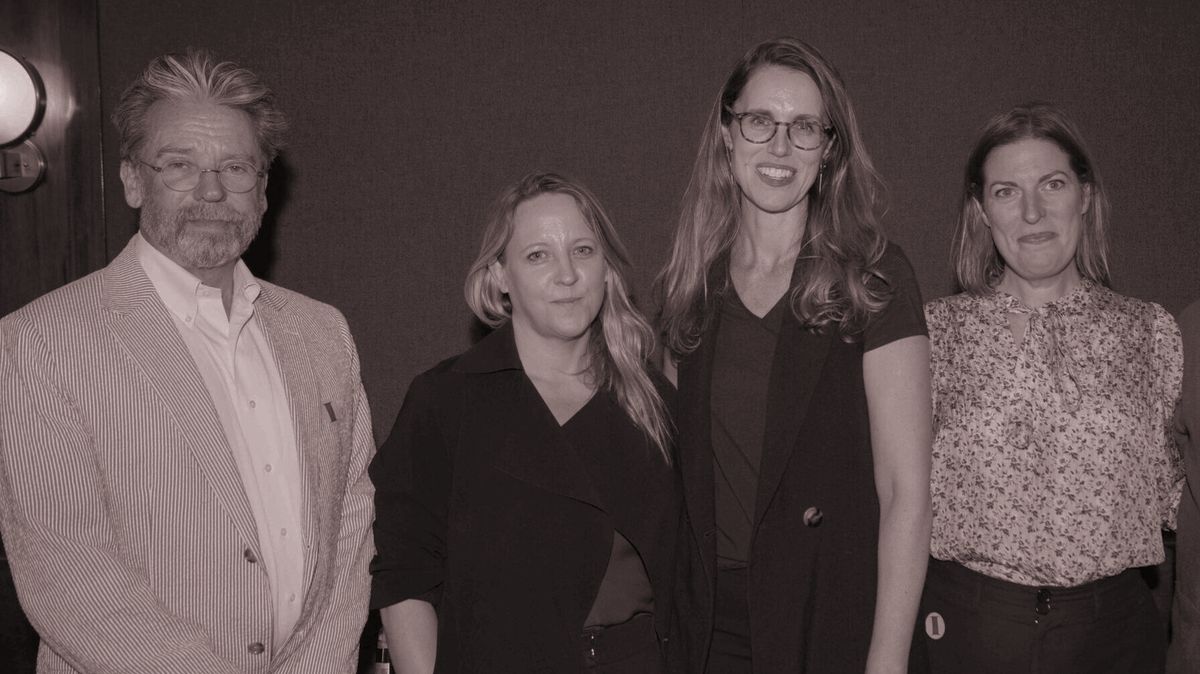
I’ll have excerpts from the lively day of conversation after the dust settles. In tonight’s issue, I’ll present portions of a dialogue I conducted, earlier this month, at the Independent 20th Century art fair. The panel consisted of a group of directors from four very different museums around the United States, and
our discussion revealed the complexity and variety of the institutions that make up the art world. I hope you find the exchange as illuminating as I did.
🚨 A quick public service announcement: I was reading my colleague Matt Belloni’s What I’m Hearing newsletter late last night with
admiration. It’s not just the range, quantity, and variety of Matt’s work, though there is certainly plenty of all that. Last night’s newsletter also included the launch of a new recurring feature on the tricks of the P.R. trade, as well as streaming guru Julia Alexander’s always-excellent analysis. Indeed, Puck was built upon What I’m Hearing, and Matt is still moving the ball forward with new features and voices.
Four years later, Puck has evolved to eight franchises,
each focused on a single industry. To celebrate, we’re offering new subscribers 20 percent off your first year of Puck. Join our community to get the inside story, or buy a colleague a gift subscription. They’ll thank you for it.
Also, if you are thinking about upgrading to the Inner Circle, now is a
great time since we’re also offering 20 percent off there, too. Just click here to claim your spot. |
|
|
A MESSAGE FROM OUR SPONSOR |
|
|
- An Art of Influence recap: For those of you who couldn’t join us at our Art of Influence event yesterday, panels and interviews will be available to Inner Circle subscribers over the next several weeks. (Upgrade here if you want to access them all.) In the meantime, a quick recap: The day started with superstar collectors—Michael Ovitz, J. Tomilson
Hill, Dasha Zhukova Niarchos, and Glenn Fuhrman—sharing their unique perspectives. We followed that with three prominent art advisors—Wentworth Beaumont, Brett Gorvy, and Patti Wong—offering their insights into each region of the world and the specific needs of collectors therein. Afterward, Glenn conducted an eye-opening interview with Nicolas Party, who
has become one of the most successful artists of his generation. The chat revealed the fascinating dynamics of his work with six different galleries.
After a delicious lunch, Charles Stewart discussed his vision for Sotheby’s now that the Breuer Building is set to become part of the brand’s personality. (Charlie didn’t let it slip that he won the Lauder collection—more on that in another newsletter—before he set off to London.) Museum directors
Anne Pasternak of the Brooklyn Museum and Scott Rothkopf of the Whitney let us in on their challenges and triumphs, especially around increasing free access to their museums. Finally, the inimitable Larry Gagosian, looking especially stylish in his tortoiseshell aviator shades, shared insights from his 40 years of experience through market cycles.
The real success of the event was bringing together so many people in the art industry
who—despite seeing one another at gallery openings, auctions, art fairs, and cocktail parties—never really get a chance to spend time just thinking and talking about how the art world works and could work better. The best measure of the conference’s value was the fact that so many of those in attendance left in an upbeat mood about the coming season. Thank you, again, to all who participated. - Pritzker art for sale: The art collection of
Cindy and Jay Pritzker, who founded the Pritzker Architecture Prize, among their many other philanthropic endeavors, will be sold at Sotheby’s across nine different sales, including the Modern Evening sale in November. The dominant lot in the collection, at least in terms of potential value, is Vincent van
Gogh’s Romans parisiens (Les Livres jaunes), which is expected to sell for more than $40 million. A large Henri Matisse painting from 1944-46, Léda et le cygne, is estimated at $7 million.
A Paul Gauguin from 1889, La Maison de Pen du, gardeuse de vache, has a $6 million estimate. Max Beckmann’s Der Wels (Catfish), from 1929, is estimated at $5 million. An Ernst Ludwig
Kirchner, Hallesches Tor, Berlin (Hell Gate, Berlin), from 1913, is estimated at $3 million. Joan Miró’s La Mère Ubu, a large bronze sculpture conceived in 1975, is estimated at $4 million. Finally, among the works likely to appear in the evening sale is Camille Pissarro’s Bords de l’Oise à Pontoise, estimated at $1.2 million. My first impression is that these estimates are intentionally quite low—which should be a good sign
for the works.
|
Now on to the main event… |
|
|
A candid conversation with four museum directors of wildly varying
kinds of institutions, about what it means to be stewards of art in an especially uncertain environment. |
|
|
Museums come in many different types and sizes, with varying missions, but it’s
always a struggle, in any environment, to fund and support them. That’s especially the case now, given the uncertain political-economic-cultural landscape. So, earlier this month, the Independent 20th Century art fair organized a diverse panel of museum directors to discuss the challenges and opportunities facing their institutions—with yours truly as the moderator.
Among the four museums represented were two with permanent collections (Princeton University Art Museum and Storm King) and
two without them (the Aldrich Contemporary Art Museum and Aspen Art Museum). Their directors each brought different perspectives on acquisition, experimentation, and the relationship between artists and audience. Princeton’s James Steward and Storm King’s Nora Lawrence both oversee permanent collections, albeit in profoundly different spaces—one a university building, and the other a 500-acre outdoor museum in the Hudson Valley. Cybele Maylone,
the executive director of the Aldrich in Ridgefield, Connecticut, and Nicola Lees, the artistic director and C.E.O. of the Aspen Art Museum in Colorado, emphasized the freedom of lacking such collections, and what it means for their programming. As always, this excerpt from our conversation has been edited for length and clarity. |
The Collector’s Challenge
|
Marion Maneker: James, your museum is
built around substantial, very historic collections. How does acquisition fit in?
James Steward: Princeton has been in the business of acquiring or commissioning public art since the late ’50s. We have one of the great public art collections in the country, and we didn’t want it to become static. We very much see ourselves as building on the past, rather than being limited by it. The challenge is thinking about how to collect objects
that reinforce the connective tissues across collections of such diversity, and how the architecture can give voice to individuals who would have previously never been part of our museum or campus. |
|
|
A MESSAGE FROM OUR SPONSOR |
|
|
We want to continue opening up the question of “voice” and who has it. Our job is not
simply to be an incubator of future art historians—though we still want to be that—but to be a resource for the whole of the university’s community. One of the great challenges is thinking about how to create collections, and present and interpret them in ways that not only speak to diverse publics, but also bring them together.
We have significant endowments that we can only spend on acquiring works of art. That’s a gift, and it’s a big part of what led me to Princeton; there is
not another academic museum in the world that can collect as aggressively and intentionally as we can. It creates both a responsibility and an amazing opportunity to think about how to give a voice to narratives that would not have been part of the museum enterprise otherwise. We’ve acquired 2,000 new objects in the last three years.
Nora, a lot of what you have at Storm King is site-specific. I presume many of the works there either can’t be moved, or you wouldn’t want to move
them. So how do you think about adding to the museum’s collection long term?
Nora Lawrence: I think we can show, in a really nice way, this range of not only site-specific work, but also of the production of sculpture and outdoor artwork from the mid-20th century until today. There have been artists along the way that have shown us how they want their works displayed in our landscape. We can allow artists to have conversations over a
really great amount of space—an artist’s work can be proximate to others without really taking up the same space. Visitors can take their time winding through Storm King at their own pace and in their own way, and can make these connections without necessarily having everything in their actual eyesight at the same time. It’s about the visitor completing the works for us. That’s really important. Artists and visitors are really the top two people we want to make sure we’re giving everything
to.
Cybele and Nicola, since your museums are both non-collecting, can you give a sense of the strength and weakness of being in a very different position—not having to think about a permanent collection?
Cybele Maylone: We love not having a permanent collection. I recently had a conversation with someone who’s involved in the museum industry, and he said, I don’t really think of the Aldrich as a museum. You’re an
incubator; you’re kind of a site for experimentation. Not having a collection allows us to take these risks with artists and have that be our central priority. We follow artists and their ideas, and there’s a great freedom to that. Not collecting is a central part of who we are, and it allows us to do the kind of work with artists that we do.
Nicola Lees: In many ways, it gives us an advantage, because we’re able to double down on how we can collaborate and reinvent what
collaborating means. For us, it’s about collaborating rather than collecting.
Steward: I want to reassert the importance of collecting institutions, if we’re doing our jobs correctly and also being sites of experimentation. [At Princeton], we’ve re-curated the whole of our collections. There isn’t a single object going on view that doesn’t have a completely newly written interpretive support, of a kind that says, We’re going to challenge what you think about even your beloved
friends. We refer to ourselves, to the aggravation of our humanists, as a laboratory. They seem to be annoyed that I borrow a term from science to describe part of what we do, but I think that’s critical. Most of the artists whom we’ve commissioned have really wanted to engage in dialogues with the past. |
The Journey & The
Destination
|
All four of your museums are destinations; you’re not tourist attractions in
major cities. How do you approach programming?
Lees: I try to pretend I don’t think about audiences, but it’s really all I think about. Because [the Aspen Art Museum] is a temporary exhibition space, we really think about exhibitions as events. We’re doubling down on what it means for people to gather and convene, and what it means to conjure an energy. We also think about atmospheres. We’ve been able to increase our audience at a moment
when a lot of institutions have been struggling with lower visitor numbers. We’re really prioritizing a younger audience as well—and that also means in terms of philanthropy and board members. It’s a struggle for us to bring artists to Aspen, so we’re really working on investing in artists being in Aspen. We’re an artist-founded, artists-focused museum, so that’s a big thing that we’re raising money for and investing in. We really want to feel like what we’re doing is relevant to a younger
generation of artists. |
|
|
Maylone: At [Aldrich], we try not to think about driving audience during the
conception of our programming. We’re in a very traditional community in Connecticut, so the things that we do, by our very nature, are somewhat off-putting to our neighbors. That’s by design; that was Larry Aldrich’s vision for the place from the jump. Our chief curator, Amy Smith-Stewart, develops a program that is true to our mission and the way we want to serve artists. We know that we bring audiences in, in service of the artists. But the scale of the
Aldrich has always lent itself to intimacy with works of art. We love when people come to the museum, but that’s not the primary anxiety. We know the things we could do that would draw greater interest, but we want to follow our mission.
You can’t quantify the emotional experience of someone in the gallery, so I’m curious what metrics you use to alert yourself to either positive or negative things going on with the
gallery?
Maylone: We have a document we complete at the end of every exhibition, where we tally up how the exhibition performed against the budget, how successful it was for fundraising, and how the artist feels—that’s a key measure of success for us, whether it was a positive experience for them. We look at it holistically, and use a lot of data points, because there are exhibitions that get great press and no one comes to see—and
exhibitions that get no press and all the visitors love. I don’t feel it’s one thing in particular, except the artists’ experience.
Steward: Because we’re on a college campus, one of the measures I’m looking for is some direct evidence of how many students are actually experiencing our work. And it’s not going to happen in one way. There’s the classroom experience, there’s what I call the co-curricular, and then there’s the social. The curricular experience is the easiest to
measure, because we have six so-called object study classrooms in which we bring students in direct dialogue with works of art. And when we grew those numbers from something like 700 students a year to 6,000 a year, that was a really lovely metric that, not least, was super persuasive when I was fundraising, because it showed that the work we’re doing was directly impactful. Because we’re assuming those touch points were substantive ones. They were coming and having a deep dive with a faculty
member, with a curator, and hopefully leaving thinking a bit differently.
Lawrence: We hear from artists over not just the short term, but over a number of years about what the experience of working with us meant to them. Almost every year, we do a project with an artist who’s not had a lot of experience working on a large scale or outdoors. That’s really hard to do when you’re an emerging artist. There’s no money for it, there’s usually not the place to display it; you’re not
going to do that without the prompt of the invitation. We want to continue seeding this world of ours, with artists thinking on this grand scale. |
Tomorrow, we will have Elizabeth Dee in the Inner Circle discussing her
recent announcement moving the Independent 20th Century art fair to the Breuer Building. I hope you’ll join us there.
M |
|
|
The ultimate fashion industry bible, offering incisive reportage on all aspects of the business and its biggest
players. Anchored by preeminent fashion journalist Lauren Sherman, Line Sheet also features veteran reporter Rachel Strugatz, who delivers unparalleled intel on what’s happening in the beauty industry, and Sarah Shapiro, a longtime retail strategist who writes about e-commerce, brick-and-mortar, D.T.C., and more. |
|
|
Finally, a media podcast about what’s actually happening in the media—not the oversanitized,
legal-and-standards-approved version you read online. Join Dylan Byers, Puck’s veteran media reporter, as he sits down with TV personalities, moguls, pundits, and industry executives for raw, honest, sometimes salacious conversations about the business of media and its biggest egos. New episodes publish every Tuesday and Friday. |
|
|
Need help? Review our FAQ page or contact us for assistance. For brand partnerships, email ads@puck.news. You received this email because you signed up to receive emails from Puck, or as part of your Puck account associated with {{customer.email}}. To stop receiving this newsletter and/or manage all your email preferences, click here. |
Puck is published by Heat Media LLC. 107 Greenwich St, New York, NY 10006
|
|
|
|