Greetings! As you can probably tell, today’s newsletter looks a little different. After three years, we’ve redesigned the look and feel of our private emails, and want to know what you think. If you have any feedback, please click here to take a brief survey.
|
Good afternoon, and welcome to a yuletide edition of Dry Powder. I’m Bill Cohan, coming to you today from terra firma. Thanks to all for the excellent feedback about my voyage to faux space last week. It belatedly occurred to me to share this photo of my Zero-G journey. For the many who wondered about my galactic haircare product: It’s au naturale…
Today, I’m offering my analysis on the new cable M&A market. Steven Cahall, the equity analyst at Wells Fargo, is out with a fascinating note that ponders some potential outcomes—I agree with some of his theories, and I tender some of my own.
But first…
|
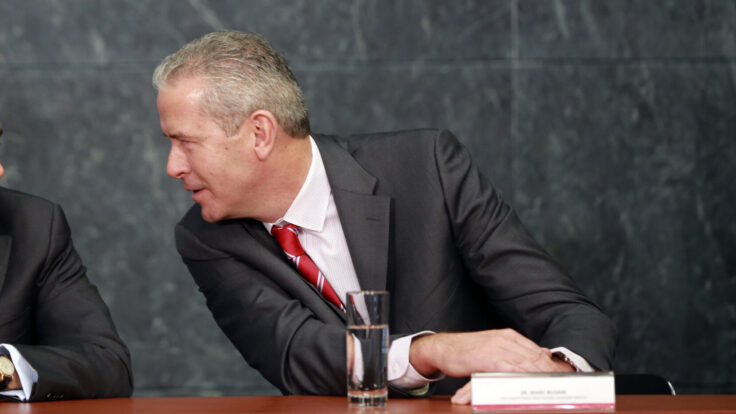
- On Apollo succession…: While it was a fun and amusing flirtation, I never really thought that Apollo C.E.O. Marc Rowan had much of a chance of becoming Donald Trump’s treasury secretary. Not only is Marc much smarter than Trump, he’s also much richer—with a net worth of around $11 billion these days, according to Bloomberg—and that did not seem like the right combination of attributes for a Trump II cabinet secretary. Alas, he would have been a fine choice in the hypothetical event of another financial crisis—loyal readers know that I’ve long thought we are overdue for a major correction—given his encyclopedic understanding of the financial markets, particularly the bond market, as well as the more arcane places that risk is hanging out these days. Anyway, Marc is back to running Apollo.
During his Treasury dalliance, however, succession planning at Apollo became a juicy topic on Wall Street. I thought the parlor games were overstated. Marc, who is 62, has chosen to run Apollo akin to the way a conductor leads an orchestra: He no longer plays any of the instruments himself, and is surrounded by phenomenal talent. When I’ve asked him in the past whether Apollo is involved in certain deals—if, say, the firm was seriously looking at a bid for Paramount Global—he’s told me that he doesn’t really know (hard to believe, but sure…) and referred me to the team working on those sorts of opportunities.
Since Marc took over as C.E.O., in March 2021, the Apollo stock has nearly quadrupled, largely on account of that deep bench and Apollo’s focus on the exploding market for private credit, as Rowan pointed out the other day at an investor conference. For years, a core group of executives has managed the various parts of Apollo’s business, including Jim Zelter, who runs the credit business; Scott Kleinman, who runs private equity; and Jim Belardi, who oversees Athene, Apollo’s all-important annuity insurance behemoth. The team is large and skilled, Rowan said. “We’ve elevated the next generation, which is another 10 in asset management and another handful in retirement services,” he told me. In other words, he’ll have options if he does eventually get hoovered up into an administration, either this one or another.
|
|
And now, to the main event…
|
|
|
|
After a year of legacy media conglomerate C.E.O.s alternately putting “everything on the table,” the scope of the real deal activity will become clear in 1H25.
|
|
|
There’s been lots of speculation about Hollywood M&A activity next year, and for all the obvious reasons: a new transactional Trump regime, the end of Lina Khan’s reign at the F.T.C., and of course, the recent one-two punch of Comcast’s SpinCo announcement and Warner Bros. Discovery’s gestural move to reorganize the company by separating its declining cable assets from its growing studio and streaming businesses. There’s also been a lot of chatter that the Ellisons and Gerry Cardinale might engage in some form of a linear roll-up—a deal with a competitor, a spin, etcetera—once their deal to acquire Paramount Global closes, which is expected as soon as the second quarter of 2025.
Naturally, I have my own thoughts on how all the pieces might come together to form a new industrial architecture—and, as you might imagine, it largely comes down to capital structures and corporate governance. SpinCo, Comcast’s new, soon-to-be publicly traded company, will include both MSNBC and CNBC (surprisingly), as well as USA Network, Oxygen, E!, Syfy, and the Golf Channel, but not NBC, Telemundo, or Bravo. Brian Roberts, the controlling shareholder of Comcast, will continue to control SpinCo via his voting shares. Comcast leadership has been clear with me that the new SpinCo will not be overleveraged, nor will Comcast consider partnering with a private equity firm on the project. I have my doubts about this, as loyal readers know, but I’ve been doing this long enough to be certain that Comcast leadership isn’t being rewarded to share its longer-term plans yet. They simply need to get SpinCo to market first.
|
|
|
Instagram Teen Accounts: a protected experience for teens, guided by parents
Instagram Teen Accounts are designed to address parents’ biggest concerns, providing automatic protections for who can contact their teens and the content they can see.
The impact: Built-in limits give parents more peace of mind when it comes to protecting their teens.
Learn more
|
|
|
|
David Zaslav’s decision to quarantine Warner Bros. Discovery’s linear assets, thus creating two operating divisions at the company, is obviously a prelude to deal activity, probably in 2025 or 2026. But I actually think the deal opportunities on the cable side are less interesting to contemplate. I still believe that a combination of NBCU and WBD, with or without their respective linear TV assets (but increasingly looking like without), is not only viable, but may even be necessary for the two companies to compete long-term with the likes of Disney, Amazon, Apple, and Google. But that will only happen if Zaz and Roberts can reach some sort of amicable détente on structure, ownership, and control.
That’s a complex negotiation, given the egos involved, but I still think there’s hope, especially since the parties in question were able to reach a friendly enough agreement on a new “must-carry” deal to keep WBD’s cable channels on Comcast’s cable distribution network. I’ve also speculated on the likelihood that private equity, with its hundreds of billions in dry powder, will want to get involved with these high cash-flowing but declining assets—the precise set of conditions that could facilitate the conversations between the two companies. The gold standard for this kind of structure remains what TPG and AT&T agreed to do with DirecTV in 2022. First, TPG bought 30 percent of DirecTV, allowing AT&T to deconsolidate the assets from its financial statements (and to stop having to answer Wall Street’s questions about the decline). Then, in September, TPG agreed to buy the 70 percent of DirecTV that it didn’t already own. (Disclosure: TPG, as you know, is an investor in Puck.)
Yes, the Comcast executives continue to claim that there will be no private equity in SpinCo, but let’s wait and see. I note with interest that Zaz has not said anything material about how much leverage he’ll end up putting on WBD’s linear TV assets in the event of a spinoff, or whether he would allow private equity to play. I take that as Zaz’s own Everything is on the table moment. He certainly is well familiar with TPG’s DirecTV deal, and I’ve got to believe if he can extract more value from his cable assets by partnering with private equity, he’ll do it. Could Zaz be on the verge of a real wishbone split here—unloading the cable nets while eventually combining his digital assets with NBCU’s, thus completing the final act of his public L.B.O. experiment, and extracting real value for his patient shareholders? (This is not investment advice.) We’ll have to wait to see.
|
Steven Cahall, an equity analyst at Wells Fargo, recently published a comprehensive report on how he thinks a variety of media and media-related assets will fare next year. I found Steve’s predictions particularly interesting—especially the fact that his top theme for 2025 is, in his words, the “legacy cable roll-up.”
Steve’s report is filled with intriguing tidbits and observations. For instance, while Comcast only coughed up the revenue generated by SpinCo in fiscal 2024 (approximately $7 billion), Cahall estimates that SpinCo’s EBITDA will be about $2.4 billion, or a hefty EBITDA margin of 34.3 percent. He tagged a 4x EBITDA multiple on the assets, giving SpinCo an estimated enterprise value of $8.5 billion, inclusive of $2.1 billion of debt, or debt of less than 1x estimated 2024 EBITDA. That would certainly qualify SpinCo as “well-capitalized,” although it is decidedly unexciting, and it should be able to carry more debt and still be attractive to investors, if Comcast would only consider a private equity partner to underpin the capital structure.
Cahall’s analysis values the equity of SpinCo at around $1.50 per Comcast share, providing shareholders an incremental, but hardly consequential, 3.8 percent boost to Comcast’s share price. He predicts the combination of SpinCo and existing Comcast would result in a share price of $40.47, a modest bump to Comcast’s $39 share price on December 17, the date of his report. “SpinCo is a positive for [Comcast], but not a game-changer,” he wrote.
That’s an understatement, to be honest. A lot of work and expense will go into generating that extra $1.50 per share, and it’s hard to imagine that Roberts and his executives would go through all this trouble for such a meager pop. With a P.E. firm along for the ride and more debt piled atop SpinCo, the pop for Comcast could be far larger. “We think the bigger implication from the transaction is the precedent + opportunities it might set for WBD and PARA, and whether SpinCo could act as a consolidator of other networks to improve scale,” Cahall continued.
In his report, Cahall predicted that SpinCo’s most likely near-term acquisition target will not be either WBD’s or Paramount Global’s linear assets. They each have too much debt, he argued, and he thinks that Comcast’s SpinCo shareholders don’t “want leverage.” (I’m not convinced, as you know.) “Too much debt on a levered asset risks erasing the equity value,” Cahall wrote. That’s obviously true.
|
|
|
|
Instead, he thinks SpinCo will more likely try to go after Starz, which is the forlorn stepchild in the crazy Lionsgate universe, or AMC Networks, which has a market value these days of around $400 million. They are “near-term merger candidates to build scale, as they have low leverage and relatively unique prestige dramas that could be seen as complementary to the mostly nonfiction content of the [Comcast] nets.”
As for Zaz’s linear TV assets, Cahall wrote that while they could be spun off or sold, “it’s much more difficult than initial optimism might be implying.” The fact that WBD’s stock traded up some 15 percent on the news of the reorganization while its bonds traded down, he argued, implies that the market is expecting some sort of leveraged spinoff of these assets. But he thinks that private equity won’t be able to partner with WBD’s linear assets, even if Zaz gives them the green light. He reasons that at 4x 2025 estimated EBITDA of $6.7 billion, WBD’s linear assets (CNN, TNT and TBS, etcetera) would have a valuation of $27 billion—too rich for a private equity firm or even a group of private equity firms.
I disagree with Steve, here. I believe Zaz could sell private equity a 30 percent stake in his SpinCo for $8.1 billion—a big check, yes, but not an insurmountable one, especially if a consortium of firms comes together for the deal. (After all, TPG is writing a check for $7.6 billion for the 70 percent of DirecTV it doesn’t already own.) Cahall also thinks that a 4x EBITDA purchase multiple may be too high an entry point for the savvy private equity crowd. I’ll concede that point. “Something well bought is half sold,” Gus Levy, the wily senior partner of Goldman Sachs, used to say.
Cahall also thinks WBD’s bondholders would drive a hard bargain with Zaz in order to be offloaded onto the WBD spinco and would need “a lot of coaxing” to go along. He predicts 2x leverage on WBD’s spinco would be possible. If so, that would be something like $13.5 billion of debt, which would delever the remaining WBD to around $25 billion.
Cahall predicted the remaining WBD, sans linear, would have EBITDA of $2.8 billion in 2025, a still-unattractive 9x leverage. He urged caution, at least for equity investors. “There is reason to be optimistic that Studios/D.T.C. could be valuable as both a stand-alone and takeout vehicle,” he wrote. “But, even using [Comcast’s] 15x multiple on Sky, it implies to us that much of the M&A potential for WBD is already priced in. We’re therefore loath to chase it here as we think a lot has to happen prior to monetization of a separation.”
|
|
Cahall was clear that he doesn’t think Disney will participate in the linear spinco feeding frenzy. Its television assets, he noted, “represent the core content that’s on streaming,” adding that he expects Comcast and Disney to keep NBC and ABC, respectively, since they are “strategic assets for sports distribution.” As for Paramount, he thinks the new owners will want to keep CBS, which has valuable NFL and college basketball rights, but that BET/VH1 may be jettisoned, as has been long under consideration. As for MTV, Comedy Central, and Nickelodeon, he thinks those assets are still under “strategic review.”
In sum, Steve concluded that “there is something there” when it comes to the potential for a larger linear TV roll-up, with the most likely path being some combination of Comcast’s SpinCo and WBD’s presumed spinco, with AMC and Starz being picked up along the way in stock deals. That kind of roll-up, Cahall estimates, would have an enterprise value of $38 billion, including $17.2 billion of net debt, $13.4 billion of which would come from WBD. I’m not sure if it’ll happen this way or some other way. But what’s clear is that we appear to have arrived, after much strategic fretting, at a time when something like this will definitely happen, and I suspect it’ll all start coming together, one way or another, in the first half of 2025.
|
|
|
|
Join Puck’s chief political columnist, John Heilemann, as he roams the corridors of power and influence in America on this twice-weekly interview show, taking you beyond the headlines with the people who shape our culture: icons and up-and-comers, incumbents and insurgents, moguls and machers in the overlapping worlds of politics, entertainment, tech, business, sports, media, and beyond. The conversations are rich and revealing, unrehearsed and unexpected… and reliably impolitic. A Puck-Audacy joint, new episodes drop every Wednesday and Friday.
|
|
|
|
An insider-friendly tip sheet from Matthew Belloni, who spent 14 years in the trenches at The Hollywood Reporter and five before that as an entertainment lawyer. Subscribers also receive What I’m Hearing+, a companion email focused on entertainment law, the streaming industry, and more.
|
|
|
Need help? Review our FAQ page or contact us for assistance. For brand partnerships, email ads@puck.news.
You received this email because you signed up to receive emails from Puck, or as part of your Puck account associated with . To stop receiving this newsletter and/or manage all your email preferences, click here.
|
|
Puck is published by Heat Media LLC. 107 Greenwich St, New York, NY 10006
|
|
|
|



_01JFB1GH9T74QMXMDNSSWY8WS1.jpg "Instagram")