{{ 'now' | timezone: 'America/New_York' | date: '%b %d, %Y' }}
|
|
|
Greetings from Los Angeles, and welcome back to In the Room. The Paul Allen
estate has officially put my Seattle Seahawks on the market and enlisted Allen & Co. (no relation) and Latham & Watkins to assist with the sale. I’m reliably told that Jeff Bezos, who had been interested in acquiring the Washington Commanders, is not pursuing the Seahawks.
Back here in Hollywood, we should know by this time next week whether David Ellison’s best and final offer was enough to wrest control of Warner Bros. Discovery from
Netflix. When you’re done here, my partner Bill Cohan has the readout on the latest plot twists and whether Larry Ellison is really prepared to backstop what Ted Sarandos & Co. are mocking as “the largest proposed leveraged buyout in history.”
In tonight’s issue, we go inside the three-ring CBS circus, with
fresh news and notes on Anderson Cooper’s surprise defection from 60 Minutes and the Bari Weiss psychodrama, and Stephen Colbert’s zero-fucks crusade against David Ellison and the network’s front office. Plus, above the fold, a quick note on the Norah O’Donnell morning-show rumors.
🎙️ Plus, on the latest episode of The Grill Room, Puck’s own John Ourand joined
Julia Alexander to assess the biggest sports-media storylines of the moment: the NFL’s forthcoming rights negotiations and international ambitions, NBA tankonomics, and NBC’s Olympics calculus. Follow The Grill Room on Apple, Spotify,
or wherever you prefer to listen.
Also mentioned in this issue: Steve Swartz, Rebecca Kutler, Shari Redstone, Bill Owens, Scott Pelley, Sharyn Alfonsi, Bill Whitaker, Brendan Carr, James Talarico, and
more…
But first…
|
-
Best of times, Hearst of times: Hearst brought in record revenues and profits last year, according to an internal memo from C.E.O. Steve Swartz. Of course, it has done so by methodically pivoting away from the consumer-facing media empire it built over the last century—glossy magazines, newspapers, cable stakes—and doubling down on a B2B software-and-data business that now accounts for 60 percent of all profits, up from less than 10 percent before Swartz took
the helm in 2013.Under Swartz, Hearst has leaned heavily into high-margin, recurring-revenue businesses like Fitch Ratings and other industry-specific data-and-analytics services, transforming from a publisher into an information-infrastructure company that still underwrites the media titles—Esquire, Cosmo, etcetera—for which it’s known (at least by people like you… ). As Peter Kafka pithily observed this week, “One way for an old media company to
survive is by getting out of the media business.”
- Kutler gets Crooked: As anticipated, MS NOW chief Rebecca Kutler has landed a McAfee-style licensing deal with Crooked Media, the company behind the liberal chatcast hit Pod Save America. The deal will bring the full Crooked podcast portfolio to MS NOW for a program airing Saturdays at 9 p.m. ET. I imagine that Crooked’s real estate will eventually stretch out
across more programming hours throughout the week. Meanwhile, I’m also told that Kutler is open to more podcast-licensing deals like this, so be sure to burnish your pitch decks.
- And finally…: I was amused by a New York Post report this week that suggested Norah O’Donnell may be returning to CBS Mornings. The network announced last week that Norah would co-anchor the show for three mornings next week to promote her new book, We
the Women, which the Post then parlayed into an item about “chatter” of a possible return. I get it, it’s a tabloid, and a Norah-obsessed tabloid at that. But no, nothing to this.
|
|
|
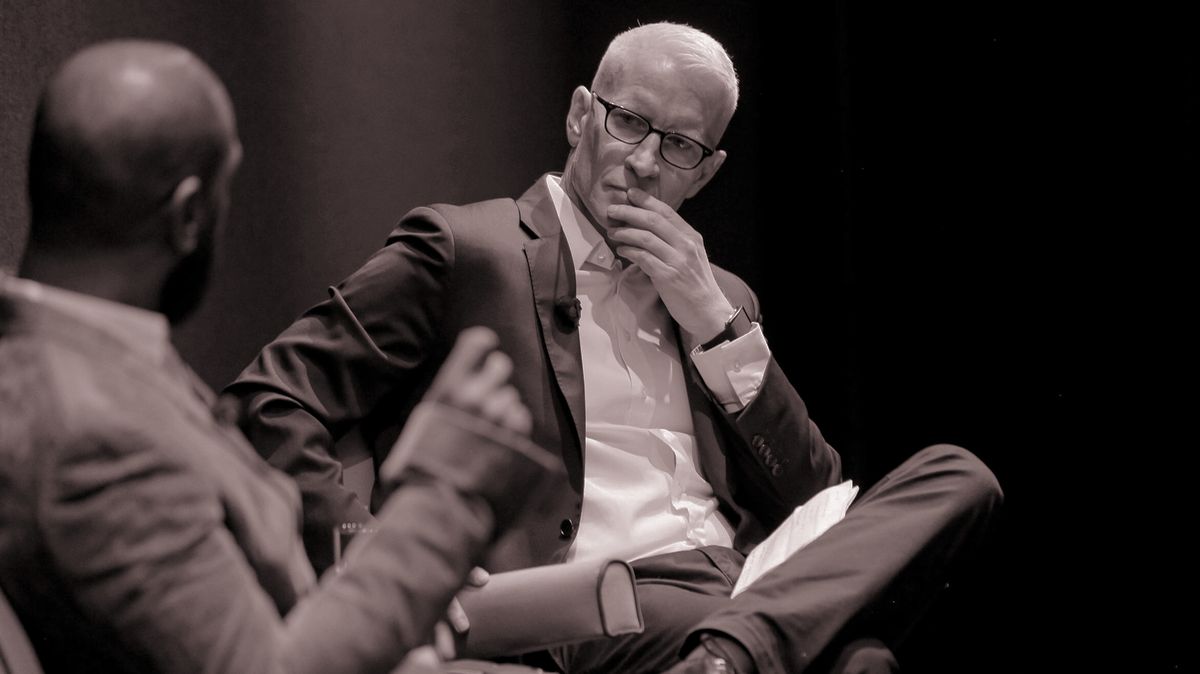
CBS News was abuzz in all the wrong ways again this week as Anderson Cooper
announced his departure from 60 Minutes. But the real story at CBS is not Cooper’s martyrdom (Colbert has that covered), it’s what his exit portends for the show’s future and the coming exodus of news talent.
|
|
|
Earlier this week, Anderson Cooper’s agents informed CBS News that their client
had decided to forgo a contract-renewal offer and would leave 60 Minutes, where he has been a correspondent for nearly two decades. The loss of the newsmagazine’s most famous talent blindsided Bari Weiss and the rest of the CBS leadership, I’m told, since they’d all been under the impression that he was likely to renew his deal. Anderson publicly attributed his decision to a recalibration of personal priorities—he has two young sons—but there was obviously more
to it. “These negotiations were on the one-yard line,” a source familiar with the state of the talks told me. “It was total chaos,” said another person close to the network. “Everyone was caught off guard.”
The fate of 60 Minutes, in its current makeup, has been in question ever since Trump started leveraging his influence over Shari Redstone’s dwindling liquidity and then David Ellison’s M&A ambitions. From his
exploitation of the Kamala edit to Bari’s “Inside CECOT” face-plant, the show has transformed into a political piñata, which has in turn repeatedly pitted proud and righteous talent against risk-averse network executives. Former top producer Bill Owens fell on the sword in the final days of the Shari regime,
Scott Pelley has been a vocal critic since Bari walked into the building, and Sharyn Alfonsi has been aggressively defiant to the point of insubordination. But few expected Anderson—famously reserved,
introverted, and, unlike the rest, a genuine celebrity—to play the martyr.
In truth, he probably didn’t intend to, either. Anderson’s actual motivations for leaving—I can’t claim to be inside his head—are likely less a Pelleyesque objection to Bari’s or David’s politics than a personal rejection of the entire Trump II–era CBS psychodrama, which, frankly, isn’t worth his time. Anderson makes around $17 million to $18 million a year at CNN, as I’ve reported, and, I’m told, around
another $2 million at 60 Minutes. (No wonder this business never evolves—who would want to give that up?)
The latter assignment, which can be incredibly taxing, was never about the money but rather the prestige and personal gratification of producing high-impact journalism for the nation’s most revered newsmagazine. Once you strip away the show’s patina and turn it into another combatant in the culture wars, it’s harder to justify the time commitment— especially
if you’ve got two kids and an eight-figure day job (Anderson re-upped at CNN in December).
In any event, Anderson’s exit may prove to be a watershed moment for the show and perhaps the entire division. Bari saw Anderson as a key talent at CBS News, and, as I’ve reported, even floated the idea of bringing him to the network full-time as the anchor of
Evening News. With his exit, 60 Minutes will now have six full-time correspondents, at least half of whom openly object to Bari’s management either because of her editorial sensibility or her disregard for coddling the talent, or both. The parlor game du jour inside CBS News right now is guessing which correspondent will jump ship next—Pelley? Whitaker? Meanwhile, everyone assumes Bari will let Sharyn’s contract lapse after their semi-public contretemps
over the CECOT package.
|
I’ve often noted that Bari is a change agent who is baffled by network television’s bloat and more
than slightly contemptuous of her recalcitrant staff. She is quite eager to see some folks exit the building—and hundreds will, after an impending round of layoffs. But the changes at 60 Minutes can’t be so easily rationalized by the broader “CBS News needs change” narrative. When David and his charges inherited the news division, they saw 60 Minutes as
the only valuable asset in that portfolio. CBS Mornings and Evening News were perennial third-place shows, but 60 was the envy of American television journalism and the biggest non-sports program on television, averaging 8 million to 9 million viewers weekly.
Somehow, just four and a half months into the job, Bari seems to be jeopardizing that position. She’s lost the one premier talent that she wanted to keep, and more are
agitating to follow. (Again, we’ll see if Scott Pelley really wants to start a Substack… ) And while the show could certainly benefit from new blood, producing a 60-caliber, 12-minute television package is also a specialized craft requiring reporting stamina, narrative architecture, and broadcast muscle memory that a cocksure Free Press émigré can’t simply learn on the fly. “It’s hard to see how most of those correspondents aren’t gone at season’s end,” one veteran TV executive
said. “This is a really bad sign for 60.”
On Monday, hours after Anderson confirmed the news of his exit, CBS News issued a statement thanking him for his dedication to the show, which ended with a standing invitation to the star correspondent to change his mind. “ 60 Minutes will be here if he ever wants to return,” it said. Behind the niceties, CBS insiders described more dour vibes. “Bari is pissed,” a source said. (She did not respond to calls.)
Of course, she
may yet welcome Anderson back to the fold. CNN parent Warner Bros. Discovery has reopened merger negotiations with the Ellisons, which means Bari could conceivably take control of the cable news network some day—provided she’s still in the job.
|
In another ring of the CBS political circus, Stephen Colbert has gone to war with
his overlords over their unwillingness to stand up to new pressure from Brendan Carr. As you probably know by now, the F.C.C. chairman is trying to wield leverage over broadcast networks by enforcing the “equal time rule,” from which news programs and late-night shows have long been exempt.
Carr has apparently picked Texas state representative and rising Democratic star James Talarico as his political football on this issue, having launched an inquiry
into ABC’s The View after Talarico appeared on that show, which inspired CBS’s lawyers to intervene during the Late Show’s taping on Monday and stop the candidate from appearing on their air. Colbert posted the interview on his YouTube channel instead, where it received far more attention than it ever would have without the current controversy.
If you’re not yet familiar with the specific ins and outs, you probably don’t care to be. Suffice to
say that everyone from Carr to Colbert is posturing and trying to score political points, and no one is benefitting as much as Talarico. (Well done, Brendan.) In short, Colbert is ignoring some of the nuance but is directionally right: CBS is self-censoring in order to avoid unwanted regulatory scrutiny. He wants his bosses to show some backbone, and they don’t want to die on the hill of a late-night host whose show has already been canceled partly for booking rising political celebrities rather
than pop stars.
In truth, these specifics don’t really matter. Talarico—it could have been any politician—is merely a pretext for federal intervention. The delta between Colbert’s accusations of censorship and CBS’s claim that it merely outlined new guidance to avoid potential downstream obligations is a distinction without a difference. The message, implicit or explicit, was that booking this guest could invite scrutiny. And scrutiny, in this environment, is the thing to be avoided.
Whether that’s “self-censorship” or “risk management” almost certainly depends on where you sit.
Obviously, Colbert and everyone with a fondness for the fourth estate would like CBS to call Carr’s bluff. But from management’s perspective, it’s hard to justify the math: Colbert’s show, much like all of CBS News, is a rounding error inside a sprawling portfolio—movie and television studios, a streaming service, NFL rights, etcetera—that the Ellisons hope to expand via a WBD
acquisition. They’d rather weather the “corporate cowardice” P.R. hit and take solace in the fact that outrage cycles are short, attention spans are shorter, and capital markets care more about cashflow than courage. Not to be glib, but in the media industry today, it’s actually the story of our time. Anyway, contra Colbert and Alfonsi, that’s their bet. Let’s see if they are right.
|
|
|
Puck fashion correspondent Lauren Sherman and a rotating cast of industry insiders take you deep behind the scenes of
this multitrillion-dollar biz, from creative director switcheroos to M&A drama, D.T.C. downfalls, and magazine mishaps. Fashion People is an extension of Line Sheet, Lauren’s private email for Puck, where she tracks what’s happening beyond the press releases in fashion, beauty, and media. New episodes publish every Tuesday and Friday.
|
|
|
A professional-grade rundown on the business of sports from John Ourand, the industry’s preeminent journalist,
covering the leagues, players, agencies, media deals, and the egos fueling it all.
|
|
|
Need help? Review our FAQ page or contact us for assistance. For brand partnerships, email ads@puck.news.
You received this email because you
signed up to receive emails from Puck, or as part of your Puck account associated with {{customer.email}}. To stop receiving this newsletter and/or manage all your email preferences, click here.
|
Puck is published by Heat Media LLC. 107 Greenwich St., New York, NY 10006
|
|
|
|