{{ 'now' | timezone: 'America/New_York' | date: '%b %d, %Y' }} |
|
|
|
Hi, and welcome back to Line Sheet. I had drinks with Max Stein last night at the Dresden.
Yes, I know you want him to represent you. Maybe someday!
In today’s extra-special Inner Circle issue (trade up here), I share a major development in the Armani sale saga and offer thoughts on Jonathan Saunders’s new gig at Kate Spade New York, as well as Kering’s recruitment of a major LVMH executive to run Bottega Veneta. Plus, I’ve got proprietary info on how the war has
decimated Middle East luxury sales.
Tomorrow on Fashion People, my guests are Contra Sports Club founders Amy Schultz and Jessika Alexander. Contra is a training club in Los Angeles designed for professional athletes and creative-types alike. (It also happens to be in the middle of Melrose Hill, an incredible retail story that reminds us that everything comes down to real estate.) I admire what Amy and Jessika are building: most importantly, a
personal training gym that doesn’t smell bad. We discuss the business of being in shape, peptides, and plenty more. Listen here and here.
Also, mentioned in this issue: Tom Ford, Joanne Crevoiserat, Luca de
Meo, Hearst, Karen Harvey, Chris Berend, Bernard Arnault, Dario Vitale, Betty Draper, Kate Spade, Leonardo Maria Del Vecchio, Gucci, Giorgio Armani, Stuart Vevers, Leonardo Del Vecchio, Adam Selman, Romain Spitzer, the Bettencourt Meyers family, and more. |
Three Things You Should
Know…
|
- Panic
at the Dubai Mall: Next week, LVMH, Hermès, and Kering all report second-quarter earnings, offering a glimpse into their separate soap operas. We’ll get a sense of the Kering turnaround, a view into how LVMH is managing its uneven fashion portfolio, and understand whether Hermès is managing its business as well as it seems. In particular, analysts will be focused on their performance in the Middle East amid the war in Iran.
The center of luxury shopping in the region is
inarguably the Dubai Mall, which welcomes more than 100 million customers annually and accounts for a large chunk of sales. According to a source with access to the information, foot traffic in the mall was down 80 percent in the past four months. (A rep for Emaar Properties, which owns the Dubai Mall, did not respond to a request for comment.)
One market source suggested that sales are probably down a corresponding percentage at most brands, which would wreck various companies’
quarters and require major lift in the U.S. and Asia. (Despite Trump’s bombast, this war isn’t ending any time soon.) Gucci, the only Kering brand whose numbers are still broken out, will be the bellwether to watch. - What’s up with the LVMH fragrance guy going to Bottega Veneta?: Last week, Luca de Meo made good on his word and hired a luxury industry executive to run Bottega Veneta: Romain Spitzer, the
former head of the fragrance group at LVMH Beauty. As I hiked the Austrian mountains on my holiday, I wondered how de Meo convinced Spitzer to leave such a stable and financially rewarding job—besides, of course, a lot more money. I assume that he pitched the notion that Bottega Veneta has the prestige and potential to change his career. After all, Bottega also has a burgeoning fragrance business that could become a huge revenue source.
But de Meo’s turnaround effort continues to
remind me of the paucity of executive talent in the luxury space. I’m sure that Spitzer has a convincing vision, but there’s also no denying that de Meo probably didn’t have many good choices. - Tapestry’s bet on Jonathan Saunders: Today’s issue was going to be about Jonathan Saunders’s appointment as creative director of Tapestry-owned Kate Spade New York, but then I got scooped while on vacation. Anyway, I still have things to say. For
one, it makes complete sense that Saunders would want to take a lucrative job at a public company whose shares are up 13 percent year to date. (Everyone is seeing how rich Adam Selman is gonna get from Victoria’s Secret… I mean, I am sure that didn’t cross Saunders’s mind—really, he’s not like that—but it definitely hasn’t gone unnoticed by many of his peers.)
The appointment also means that Saunders can move back to New York, where he’s lived for the past decade or so.
Saunders had been based in Stockholm, where he was designing for H&M-owned & Other Stories, and I have to presume that most non-natives can only survive so many Northern European winters, even if the light show is pretty.
Regardless, there is a big opportunity here. It seems that group C.E.O. Joanne Crevoiserat may be attempting to apply the same sort of playbook at Kate Spade that has worked at Coach with Stuart Vevers—which, long story short, would
resurface the brand in the culture and thereby lavish all the credit upon Saunders. I wish him all the best; he’s a nice person and a great designer, and we are lucky to be able to purchase his work. There’s a reason why top New York executive recruiter Karen Harvey can place him so easily.
And yet, a final word of warning: Kate Spade New York is a tricky, tricky brand. Founded in the 1990s, its late namesake used the tropes of American sportswear to create a brand that
was darker and deeper than most people recognized. She also made some of the first “It” bags ever. When Spade sold the company to Liz Claiborne and departed, the winking irony of its Betty Draper code was lost; and while the business grew in those first years post-sterilization, it subsequently suffered. Tapestry was always too focused on Coach to really pay attention to it, and it faltered without commercial viability or a brand heart. Like Spade, Saunders has a good sense of
color, but he would be smart to focus on the heritage bag silhouettes and work to really understand the brand’s complex history, which is ripe for mining.
|
And now, on to the Armani news… |
|
|
|
The biggest revelation in the Armani sale saga is how few buyers can realistically absorb a
luxury house of its scale. |
|
|
|
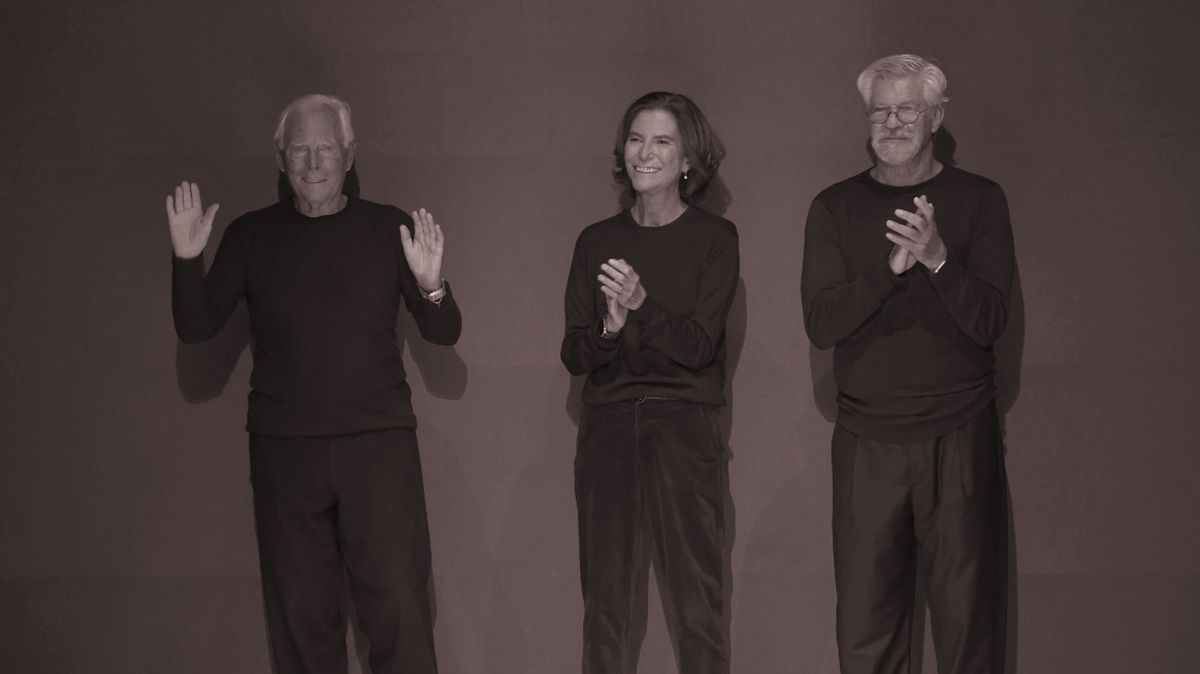
As both a designer and a showman, Giorgio Armani was a truly orthogonal thinker. And perhaps
his greatest innovation was bequeathed on his own deathbed. Rather than leaving his family-controlled business—an unequivocally iconic asset, but one that had inarguably seen better days—as a tender rabbit lying in wait for private equity or strategic vultures, he wrote in his will that if someone were to buy a stake in his business, he wanted it to be a family-run company. The document specifically mentioned LVMH, as well as L’Oréal and EssilorLuxottica, with whom Armani already has
long-time licensing deals. The will also stipulated a two-step deal in which at least one investor takes a 15 percent stake in the business by April 2027, with an option to acquire a majority stake by September 2030. It was a masterstroke that afforded Mr. Armani a patina of control from the world beyond.
Of course, capitalism doesn’t quite work that way. First off, the will didn’t technically stipulate that it must be one of those three companies, just a
company in their likeness. It also didn’t say that there had to be just one buyer. Nevertheless, his wish created one of the great sagas of this era and effectively created a prime market for his interest in the business. For the past eleven months, the fashion world has been waiting to see whether one—or multiple—of his three preferential buyers would make an offer.
In June, it seemed that all three were still in the running—with L’Oréal as perhaps the most enthusiastic suitor. Last
month, L’Oréal Luxe president Cyril Chapuy told The Business of Fashion that the company was indeed interested in becoming a shareholder, and that “if his heirs decide they want to keep partnering with us as shareholders, we will be ready, but the ball is in their court.” A few weeks later, however, I heard from sources in
Paris close to the L’Oréal board and the Bettencourt Meyers family, which controls the French beauty conglomerate, that they would not make an offer for the stake in Armani. These were sources directly familiar with the board’s thinking.
Of course, the French love to say pas possible… until something is possible. On the record, L’Oréal is keeping its options open. “This is an unfounded rumor,” a rep for L’Oréal said. “As we have stated before,
we are touched and honored that in his will Mr. Armani considered L’Oréal to acquire a stake in his beautiful company. We will study this opportunity, which builds on our long-shared history, whenever the Armani SpA representatives choose to open the discussion.”
But there’s an argument that L’Oréal’s only path to investment would require a solid manufacturing partner, similar to Estée Lauder’s relationship with Zegna to produce and manage Tom Ford. (But that situation was quite different
since it more or less revolved around the fact that Lauder might lose its licensing rights from Ford, himself, if the company didn’t buy him out.) L’Oréal already controls Armani’s fragrance and cosmetics license through 2050—a business estimated to generate €1.5 billion in annual sales—so there may be little incentive to escalate the relationship, especially given how much work needs to be done internally at Armani to modernize its operations.
In some ways, the
speculation around L’Oréal suggests that Armani’s list may have been more quixotic than realistic. Indeed, the Armani clothing business is more mid-market than designer, making it a tough fit for LVMH, too. Since this drama kicked up, people familiar with the LVMH board have suggested that the company would be a complex fit. Yes, Bernard Arnault reveres the brand, but the current infrastructure does not align with the French conglomerate. If he’s going to acquire a middle-market
brand with luxury positioning, it’s going to be Ralph Lauren, which would open up an entirely new customer base and is run impeccably. |
That leaves EssilorLuxottica, another family-run business that is already partnered with Armani in
the eyewear category, as the final preferred destination. But the company’s own succession drama may make this sort of major move unlikely. Earlier this year, 31-year-old heir Leonardo Maria Del Vecchio tried to raise money to buy out his brother and sister. There were dueling lawsuits, including one filed by a stepbrother. The suits were dropped in June, but there’s still plenty of family drama—largely stemming from the fact that patriarch (and Luxottica founder)
Leonardo Del Vecchio divided his stake in the business equally among eight different heirs, creating a governance nightmare.
Anyway, I have never thought it will end up being one of the Big Three. Armani’s last testament was vague, and certainly open to interpretation, and the emphasis on those three companies has been overblown. After all, Armani’s lawyers wrote that he would like the business to be acquired by companies such as L’Oréal, LVMH, and
EssilorLuxottica, or something similar. In the end, I suspect that the industry-insider board is going to get creative, and the structure of the deal will follow the market rather than a wish.
In fact, it’s easier to imagine a world in which Dario Vitale already works at Armani by the time any sort of deal materializes. Whether or not Vitale and the company have signed an agreement, I do know that Vitale is signed somewhere, and that he worked on a major
project to show to the group. Does it sound rash to take a job with a company whose ownership is up in the air? Absolutely. But as I’ve noted before, that didn’t stop him at Versace. And this time around, I’m sure the powers that be have done everything they can to ensure Vitale feels secure. Plus, who knows? Maybe the future of Armani has already been decided behind the scenes, and we are all just blindly waiting for the big reveal. Crazier things have happened in fashion. |
Dylan Byers on Hearst’s hiring of Chris Berend, the legacy publisher’s new
chief content and experience officer. All I know about Hearst’s live events strategy is that they are very into Cannes Lions. Perhaps it’s not good that that’s all I know.
[In the Room]
We love the new clear-eyed Chloé campaign. We love color!
[Design Scene]
Alessandro Sartori’s steady hand at Zegna and Haider Ackermann’s irresistible cuts at Tom Ford brought Zegna Group’s overall revenue up 6 percent in the first half of the year, despite declines in other parts of the business. Also, Thom Browne C.E.O. Sam Lobban’s D.T.C. strategy is starting
to pay off. Sales for the brand came in flat in the second quarter of the year, after a 9 percent decline in the previous quarter. [Zegna]
Skims’ new London flagship should be a big hit considering its outperformance at Selfridges.
[WWD]
Givenchy’s perfume guy Yann Musquin is taking Romain Spitzer’s place as LVMH’s head of fragrances. [Business of Fashion] |
Until tomorrow,
Lauren
P.S.: We use affiliate links because we are a business. We may make
a couple bucks off them. |
|
|
|
Puck founding partner Matt Belloni takes you inside the business of Hollywood, using exclusive reporting and insight to explain the
backstories on everything from Marvel movies to the streaming wars. |
|
|
|
Puck’s daily art market email, anchored by industry expert Marion Maneker, offers unparalleled access to the mega-auctions and galleries,
elite buyers and sellers, and the power players who run this opaque world. |
|
|
|
Need help? Review our FAQ page or contact us for assistance. For brand partnerships, email ads@puck.news. You received this email because you
signed up to receive emails from Puck, or as part of your Puck account associated with {{customer.email}}. To stop receiving this newsletter and/or manage all your email preferences, click here. |
Puck is published by Heat Media LLC. 107 Greenwich St., New York, NY 10006 |
|
|
|
|