{{ 'now' | timezone: 'America/New_York' | date: '%b %d, %Y' }} |
|
|
|
Welcome back to Dry Powder. I’m William D. Cohan.
In today’s issue, the
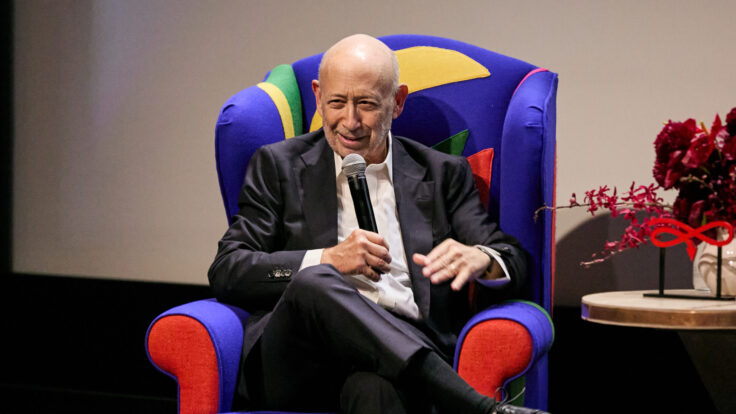
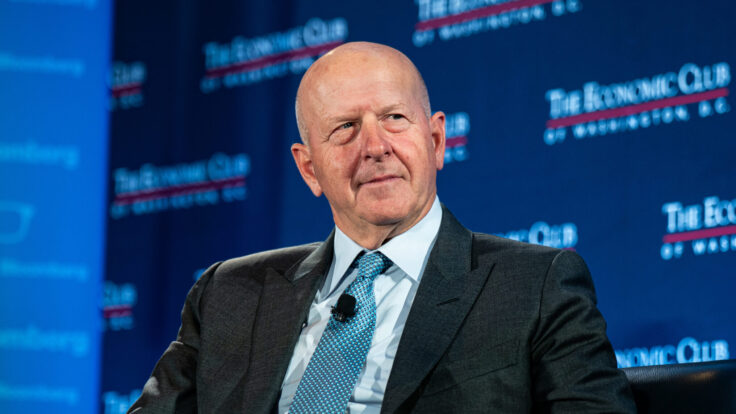
director’s cut of my chat with former Goldman C.E.O. Lloyd Blankfein, which took place last Wednesday at a private Puck event in Manhattan. (If you missed my conversation, last week, with current Goldman C.E.O. David Solomon, you can find that here.) Naturally, the author of Streetwise: Getting to and Through
Goldman Sachs had plenty to say about the current dynamics on Wall Street—from the A.I. I.P.O. madness to the jitters in the private credit markets—and the inner workings of Goldman, itself. And yes, it’s been a big Goldman week at Puck, and elsewhere in the universe, thanks in part to Goldman’s $110 million payday for being a co-lead underwriter of the SpaceX I.P.O.
Up top, some news and notes from the Tribeca Film Festival, and an update from my partner Marion
Maneker, the author of Puck’s Wall Power, on Sotheby’s outpost at Art Basel.
Also mentioned in this issue: Ash Koosha, Albert Oehlen, Johan Nauckhoff, Bryan Cranston, Denis Villeneuve, George Condo, Tom Rogers, J.J. Abrams,
Gary Cohn, Bridget Riley, David Rothschild, Yayoi Kusama, Etel Adnan, Ben Stiller, Gerhard Richter, and more… |
|
|
|
Claude, the AI without ads A space to think. Anthropic keeps conversations with Claude ad-free: no sponsored links, no advertisers shaping answers, no paid product placements you didn't ask for. When you bring your hardest problem to an AI, you shouldn't have to wonder who it's working for. Learn more |
|
|
|
- A.I.
takes Tribeca: There are plenty of legitimate concerns in Hollywood about the $110 billion combination of Paramount Skydance and Warner Bros. Discovery, to which the Justice Department gave its perfunctory approval on Friday. If the deal closes, which could happen as early as July 15, the pro forma’d company will have some $80 billion in debt and need to find some $6 billion of synergies, or cost savings. Some 5,000 Hollywood professionals—including eminences such as J.J.
Abrams, Ben Stiller, Kristen Stewart, Bryan Cranston, and Denis Villeneuve—have signed an open letter calling for government action to stop the deal. And yet, an even more existential challenge looms over the industry: the arrival of viable, feature-length A.I.-generated films that can be made quickly, at minimal cost, and with a level of quality that
demands serious attention.
In some ways, that future is already here. At the Tribeca Film Festival last week, Ash Koosha debuted Dream of Violets, his powerful and visually arresting docudrama about the wanton killing of thousands of protestors by the Iranian government earlier this year. Notably, Koosha used A.I. to generate images based on snippets of the actual events. His brother, Pooya, did the amazing postproduction work.
Koosha
completed the film in just a few months and on a shoestring budget of some $2,000, not including his compensation. “I slept three hours a night for two months, and I never thought this would finish into a film to become something that is screened at Tribeca Film Festival,” Koosha said after the premiere, noting that he and his brother had been prosecuted, beaten, and imprisoned in Iran before leaving the country.
The film was executive produced by Tom Rogers, the former
GE executive and cable visionary, who had a big role in bringing us CNBC and MSNBC. Rogers took a moment during the premiere to elaborate on the film’s technological implications. “We’re all sensitive to the fact that there are people who earn their livelihoods from the current way films are made, and the disruption A.I. is going to cause is obviously something that is not easy to digest,” he said. “But when it comes to the positive side of what this technology can do, there are so many
independent filmmakers who have great ideas, creative thoughts that just can’t be brought to the screen, because of the financial barriers that exist in terms of raising money.”
Rogers continued: “Even if it’s an independent film in the $10 [million] to $15 million range, those films don’t get made. What Ash has proven is that you can create a beautiful, artistic film, as deeply haunting as this film is, that can be brought to life at close to zero cost. … But along the way, there’s
obviously going to be a lot of disruption.”
|
|
|
|

| Marion Maneker
|
|
- Sotheby’s takes
Zurich: Since auction houses still are not allowed into prestigious art fairs like Art Basel in Basel (or any other fair, for that matter), Sotheby’s has loaded $30 million worth of art into its relatively new Zurich location, right across the street from the famous Kronenhalle restaurant. The private selling exhibition is meant to attract traditional European and Swiss collectors, and some of the younger generation of new buyers, who seem to be emerging out of Geneva with a mix of
modern and contemporary works ranging in price from $300,000 to $6 million.
The show, titled Jump In, was put together by David Rothschild, who heads private sales in contemporary art for the U.K., and Johan Nauckhoff, Sotheby’s head of fine art for Switzerland, who expects to see significantly more foot traffic in the gallery space than the 1,200 visitors they had during last year’s debut. The new show includes an Edgar Degas
pastel on canvas of two ballet dancers, an Andy Warhol Four Jackies, plus works by Claude Monet, David Smith, Gerhard Richter, Yayoi Kusama, Georges Braque, Giorgio de Chirico, George Condo, Lucio Fontana, Pablo Picasso, Bridget Riley, and Albert Oehlen.
So far, the response has
been promising. Rothschild told me they sent out the preview on Wednesday, and sold an untitled Etel Adnan painting within an hour.
|
|
|
|
A very candid conversation with Lloyd Blankfein, the former Goldman C.E.O., about the
tremors in private credit land, this summer’s multitrillion-dollar I.P.O. bonanza, and whether the markets have an Apollo 13 problem. |
|
|
|
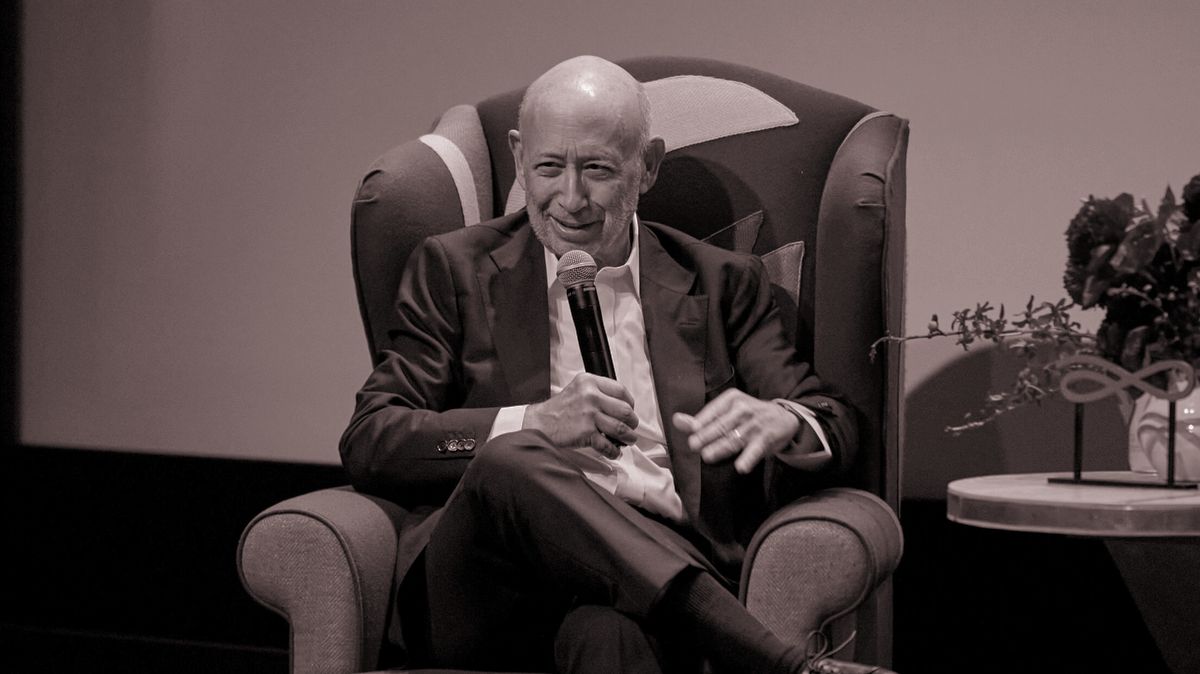
Last week, I had the distinct pleasure of chatting with Lloyd Blankfein, the former Goldman
C.E.O., during a Puck private event at the Whitby Hotel in Manhattan, in partnership with Mayer Brown. Lloyd has written a memoir called Streetwise: Getting to and Through Goldman Sachs, about his truly remarkable life trajectory and the inner workings of the legendary blue-chip firm.
In our
conversation—which, for Dry Powder readers, is a bookend of sorts to my recent chat with current Goldman C.E.O. David Solomon—we not only discussed his book and my own tome, but also some of the most burning questions
currently occupying Wall Street. This readout has been lightly edited and condensed. |
|
|
|
Claude, the AI without ads A space to think. Anthropic keeps conversations with Claude ad-free: no sponsored links, no advertisers shaping answers, no paid product placements you didn't ask for. When you bring your hardest problem to an AI, you shouldn't have to wonder who it's working for. Learn more |
|
|
|
Bill Cohan: Can you believe how much money Wall Street is making
these days? JPMorgan Chase makes $60 billion of net income a year, and Goldman is on track to make $20 billion this year. It seems like the investment banking business is literally on fire.
Lloyd Blankfein: Right now, there’s a lot of alignment with tailwinds on the economy. I know the K-shapedness: some people are experiencing the best economy that we’ve ever had, and some the worst economy, and they’re both true. Add that to the
reopening of the capital markets, which have been closed for a while, so there’s all this pent-up demand of companies that are nervously waiting in line to go public—because that window can close. It’s like the last boat out of Europe in 1939—everyone wants to jump ahead and get on that before it closes up. So that’s a moment.
Is it a sustainable moment?
No. Moments aren’t sustainable, that’s why it’s a moment. These moments are
cyclical, and when things go well, it creates the stuff that goes bad. So in this moment, when everybody’s going out and making hay because the sun is shining, remember Apollo 13—the reason why it blew up was because there was some defect two years earlier they hadn’t discovered. What’s embedded in the balance sheets now is going to be the seeds of the next part of the cycle.
We have this confluence of three gargantuan companies that have been private for a long time that are just
beating on the door to go public—SpaceX, OpenAI, and Anthropic. What do you make of this phenomenon? And should people be wary of investing in these companies? [Nota bene: This is not investment advice.]
Should people be wary? Yes, of course, everybody should always be wary. Look, there are a lot of massive companies that are trying very hard not to go public. But at some point, it becomes very,
very hard to stay private when your own people are clamoring to realize some value. Goldman Sachs tried to do that for a long time, because we were the last big company that stayed private well after the others. It’s not always a pleasant experience to be a public company. When you’ve seen me testifying, it was not as much fun as it looked.
What about private credit? Are you worried about the whole phenomenon?
The fact that people are focused on private credit is
actually a good thing. Everyone’s looking for what’s going to set this [next crisis] off, what’s going to cause it. What ignites it is not the big deal. Private credit and private equity is probably mismarked on balance sheets, because firms can’t return capital, which means that they’re marked too high.
It’s been 15 years since the last crisis of the century. If you don’t have that reckoning for 15 years or 17 years, which is where we are now, it builds up. Think of it like California,
dry tinder on the floor of a forest, that’s what that stuff is now. If you have the tinder in a forest, something’s going to set it off. Maybe it’ll be a cigarette butt, maybe it’ll be a lightning strike. But what’s causing it is not the spark, it’s the kindling. When you have a mini-crisis, like with Silicon Valley Bank, or what’s happened with private credit, that’s kind of like a controlled burn. So if we get rid of all that bad stuff, that’s much less for the whole big system. But the real
issue is the kindling.
But I thought Dodd-Frank was designed to eliminate the kindling, at least in the regulated banks.
Things have evolved. If you want to avoid the 80-year storm, and make sure you never have it again, then you’re going to avoid all the growth in the 79 years in between—it just can’t work. In Dodd-Frank, it says traders should facilitate transactions but not take risk to make money. It’s not an earthly thing. So you had a few years where it was
discombobulated, nobody could do anything, and then the interpretation started to flow in the direction of being able to engage in activity.
One of the consequences of pushing markets toward the unregulated sector is pushing what used to be done on bank balance sheets, which were very highly regulated, into a space like private credit, where it’s not regulated. Before, you could take a boardroom table at the New York Fed and sit everybody around it that encompassed 90 percent of the
market. You’d need Citi Field now.
In your book, you lavish praise on Gary Cohn, your number two. But in my Vanity Fair story in 2017 about Cohn entering the first Trump administration, I reported that when you were sick, he tried to engineer a coup at Goldman to replace
you.
Why’d you think that?
Because it was true, and you don’t mention that in your book.
You know the theories of multiple universes and quantum mechanics—in your universe, that’s true. But in my universe, it’s not true. He was always appropriate. It was such a subtle coup that I wasn’t aware of it, and didn’t know about it. I don’t think that’s true at all, honestly. [Ed. note: Okay, Lloyd, we can agree to disagree.] |
“It Left Us Very
Exposed”
|
When I wrote House of Cards, about Bear Stearns, some
people blamed Goldman for part of their problem, because of your incessant demand for collateral. A lot of your brethren sort of blame Goldman. How do you feel about it?
Some things go with the territory. Look, how do I feel about it? I don’t like it, but if you’re going to go at the universities, you’re not going at Arizona State, you’re going at Harvard. If you’re the government, you want to make a point, and if you’re going to go at finance,
you go at Goldman. There were other reasons, too. There was the whole “Government Sachs” thing—more than half the Treasury was ex-Goldman, including the secretary of Treasury. A third element was that we were very easy pickings in those days, because we were a wholesale firm—we had no consumer businesses at all, no relationship with the general public. It was a mortgage crisis. We participate in the secondary mortgage market, but we were hardly ground zero—go get a mortgage from Goldman Sachs:
You can’t. It left us very exposed to be singled out. We were also the only ones that were solvent. I saw it coming, that we were going to be the ones that were going to get it kicked out of us, and we did.
What do you think distinguishes Goldman Sachs, through crises and ups and downs, so that it’s been able to survive?
I think it really is a partnership culture. When you’re addressing the people who work there, they’re not just
your employees or your subordinates, they’re your fellow owners of the firm. Their fortunes rise and fall with the firm as a whole, and not just their narrow thing. They expect to be treated as owners, because they are. So when we had these various crises, people couldn’t leave. They didn’t want to leave. There were people who told me at the beginning of the financial crisis that they were leaving at the end of the year and then said, “No, no, we can’t leave, the firm is in distress,” and I
said, “We’ve taken account of it. You can leave.” They said, “You don’t understand. If we leave, that will kill our reputation with the alumni, with the network.”
I say the same thing about Goldman that I say about Harvard. You could debate whether it’s a great place to be, but there’s no debate that it’s a great place to have gone. |
|
|
|
Join Puck’s chief political columnist, John Heilemann, as he roams the corridors of power and influence in America on this
twice-weekly interview show, taking you beyond the headlines with the people who shape our culture: icons and up-and-comers, incumbents and insurgents, moguls and machers in the overlapping worlds of politics, entertainment, tech, business, sports, media, and beyond. The conversations are rich and revealing, unrehearsed and unexpected… and reliably impolitic. A Puck-Audacy joint, new episodes drop every Wednesday and Friday. |
|
|
|
An essential, insider-friendly Hollywood tip sheet from Matthew Belloni, who spent 14 years in the trenches at The
Hollywood Reporter and five before that practicing entertainment law. What I’m Hearing also features veteran Hollywood journalist Kim Masters, as well as a special companion email from Eriq Gardner, focused on entertainment law, and weekly box office analysis from Scott Mendelson. |
|
|
|
Need help? Review our
FAQ page or contact us for assistance. For brand partnerships, email ads@puck.news.
You received this email because you signed up to receive emails from Puck, or as part of your Puck account associated with {{customer.email}}. To stop receiving this newsletter and/or manage all your email preferences, click here. |
Puck is published by Heat Media LLC. 107 Greenwich St., New York, NY 10006 |
|
|
|
|