{{ 'now' | timezone: 'America/New_York' | date: '%b %d, %Y' }} |
|
|
Welcome back to The Varsity. I’m John Ourand, recovering in New York
following Puck’s rousing holiday party.
In March 2023, regional sports network owner Diamond Sports Group filed for bankruptcy. The company, now known as Main Street Sports, came out of Chapter 11 about a year ago. And today, in what was clearly a strategic leak, The Wall Street Journal broke the
news that DAZN is about to take a majority stake in the company, with an official announcement coming just after the new year. Kudos to C.E.O. David Preschlack for resuscitating the company so much that DAZN decided to use it as the focal point of its U.S. strategy.
In today’s issue, Julia Alexander writes a story that I never thought I’d see again: Cable subscriptions are growing. Is this a dead-cat bounce, or a harbinger of things to come? As
with all of Julia’s excellent work, today’s story is only available to Inner Circle subscribers. Click here to upgrade.
Mentioned in this issue: Joe Burrow, Lamar Jackson, John Cena, Jimmy Pitaro, Nick Khan, Brad Pitt, Eddy Cue, Lionel Messi, Anthony
Wood, Neal Mohan, and more…
Take it away, Julia… |
My sincere apologies to lifelong John Cena fans who had to witness “The Champ” tap
out during the final match of his professional wrestling career. It was a little devastating to watch—and many, many people did watch. The fight was the highest-grossing gate in WWE history, according to the outfit, with 19,232 tickets sold at Washington’s Capital One Arena on Saturday evening. (Ourand was in the building and reports having witnessed a grown man near him cry when Cena tapped out—though it may have been Marchand.) It’s easy to chalk this up to Cena’s
appeal (always a big draw), but the WWE has also been on a bit of a tear lately: Viewership and attendance are both up, and between that $5 billion Netflix deal and $1.6 billion from Jimmy Pitaro, WWE president Nick Khan must feel like jumping (for joy) off the top rope. |
- Have a seat?: Setting aside Joe Burrow’s appetite to continue playing football, it’s been a pretty rough season for Cincinnati Bengals fans. Not only did they have to suffer through being shut out by Lamar Jackson’s Baltimore Ravens on Sunday, but many of those in attendance at Paycor Stadium did so while literally sitting in cold, wet snow—a violation of the league’s rules.
The situation stood in contrast to a
similar weather-affected game last season in Buffalo, where Bills fans took up shovels to clear more than a foot of snow off the stands. In a statement defending the decision not to deice the seats, the Bengals organization argued that snow is easily wipeable, and that ushers were there to help if asked. Is this all a little stupid? Yes. But would clean, dry seats have helped ease the pain of a 24-0 loss? Also yes. Alas, the family-owned Bengals have one of the cheapest ownership groups in the
league. - Gamblers’ woes: Legal sports betting is only increasing in popularity—and with it, gambling problems. (Who could have possibly foreseen…) According to recent data published by Axios, calls to the national gambling help line have increased by nearly 150 percent over the past eight years in
states where sports betting was legal by August 2025. In states where sports betting was not legal, the number of calls also increased, but only by 45 percent. (Prediction markets such as Kalshi and Polymarket, which are not regulated like other betting platforms, fill the void in some of those locales.)
Other studies have highlighted several downstream effects associated with the rise in legal sports gambling, including more alcohol consumption among young men. America
has always loved its vices, and wagering on sports is arguably the signature vice of our age. Perhaps over time, better, research-driven regulation may ameliorate some of these issues. Just don’t expect legal sports gambling to disappear. You can’t put the six-leg parlay back in the bottle. - Apple’s past and future: Some of the most insightful people working in and around sports rights have had a hard time understanding Apple’s strategy in the space.
Its 10-year, $2.5 billion MLS deal is fizzling out three years early, and the company is about to spend $750 million for five years of F1 exclusivity in the United States. Maybe the latter has something to do with the success of Brad Pitt’s F1 film, which grossed over $630 million worldwide, but it’s been unclear what Apple services chief Eddy Cue thinks works and what doesn’t.
That said, recent ratings give a sense of what success might
look like for both leagues within Apple’s ecosystem. The MLS Cup drew about 4.6 million viewers across Apple TV and its linear partners, with Fox and Fox Deportes drawing just under 1 million viewers combined—more than double last year’s viewership on the two linear networks. Obviously, MLS and Apple executives are hoping that putting games in front of the pay wall next year will improve those numbers.
On the F1 side, the league’s final season on ESPN averaged around 1.32 million viewers
per race. (The previous record of 1.21 million viewers was set in 2022.) Of course, Apple needs to prove it won’t simply halve the audience that still had access to the races via the passive convenience of their cable packages. Will hardcore fans in the U.S. beat out casual viewers for a league as specific as F1 when it’s exclusive to the country’s only major streamer never to appear on Nielsen’s monthly Gauge report? We’ll find out next year.
|
And now, speaking of cable… |
|
|
Amazingly, cable just posted its first quarterly sub growth since 2017, thanks to
YouTube TV and Hulu+Live TV and the rise of sports-centric skinny bundles. Is it too much to call it a comeback? |
|
|
You may have already heard the good news: Cable—yes, that cable—just recorded its first
quarter of net subscriber growth since late 2017. Net subs actually rose by more than 300,000 in the third quarter, driven almost exclusively by virtual doppelgängers like YouTube TV, according to analysis from MoffettNathanson. More specifically, the surge was likely due to a flurry of skinny bundle signups going into the fall sports season: college football, the NFL, hockey, basketball. But when you consider that more than 1 million customers canceled their cable service in the previous
quarter, and close to 2.5 million canceled in Q1, the net gain is, well, something.
Now everyone is running diagnostics and trying to understand exactly what happened. Is the growth just a happy little blip amid a continued downward trend? After all, Q3 is always the best quarter for cable, followed by significant churn in Q1. But among the executives I talk to, there’s reason to believe that cable may have found its bottom… for now. |
Perhaps the most important factor in pay TV’s mini resurrection is the rise of the skinny
bundle. As survey after survey shows, a majority of the fewer than 50 million homes still clinging to cable do so for sports, even as consumers overall have become more price sensitive. And so, as streaming has become more attractive, cable distributors have gotten much smarter about offering skinny sports bundles that are more competitive on cost. DirecTV, Hulu+Live TV, and YouTube TV now offer (or are introducing) skinny packages of sports-only channels at around $70 per month, slightly
cheaper than the cost to subscribe to all the major streamers with sports, though YouTube TV’s skinny bundle pricing is still unknown.
That’s part of the reason that Disney and NBCU have gone to war with YouTube TV over the latter’s ability to offer skinnier sports bundles. These new bundles have almost all the major sports options that fans want (DirecTV also offers regional sports network add-ons for $20 more per month), which means they can also create customizable products
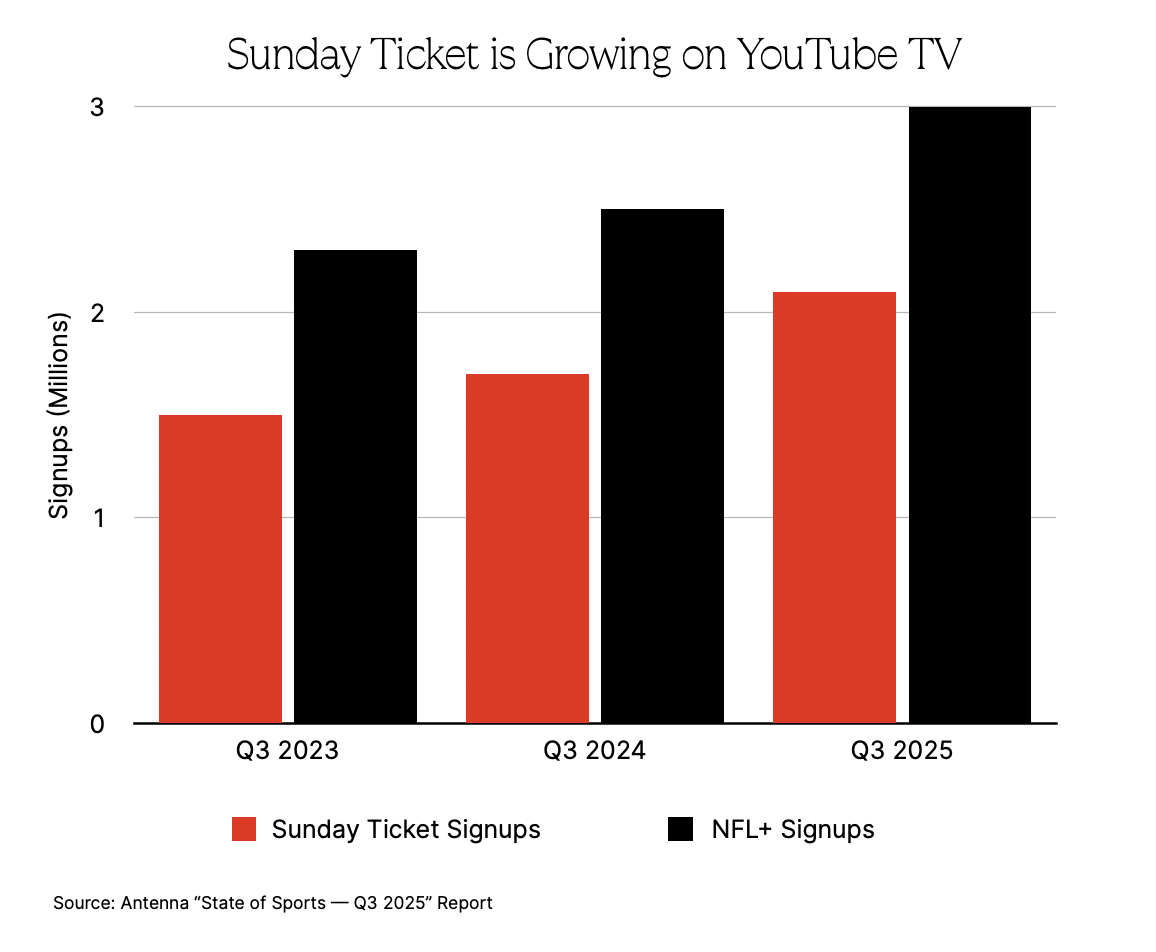
like four-screen multiviews. Sure, this feature also exists on ESPN’s streaming app, but ESPN only has access to its own programming. If you’re a diehard NFL fan, you can tune into all the different broadcast network games on Sunday… or just pay for Sunday Ticket on YouTube. |
Of course, these conflicts between content providers and distributors have really come to
a head over the question of ingestion—the word of the year in recent carriage disputes. In short, virtual pay TV operators are racing to fend off streaming competitors by incorporating partner content directly into their apps—while those partners are also fighting to make more of their best content exclusive to their own platforms.
The stakes are material on both sides. YouTube TV, for example, has increased its price by more than 130 percent since it was introduced in
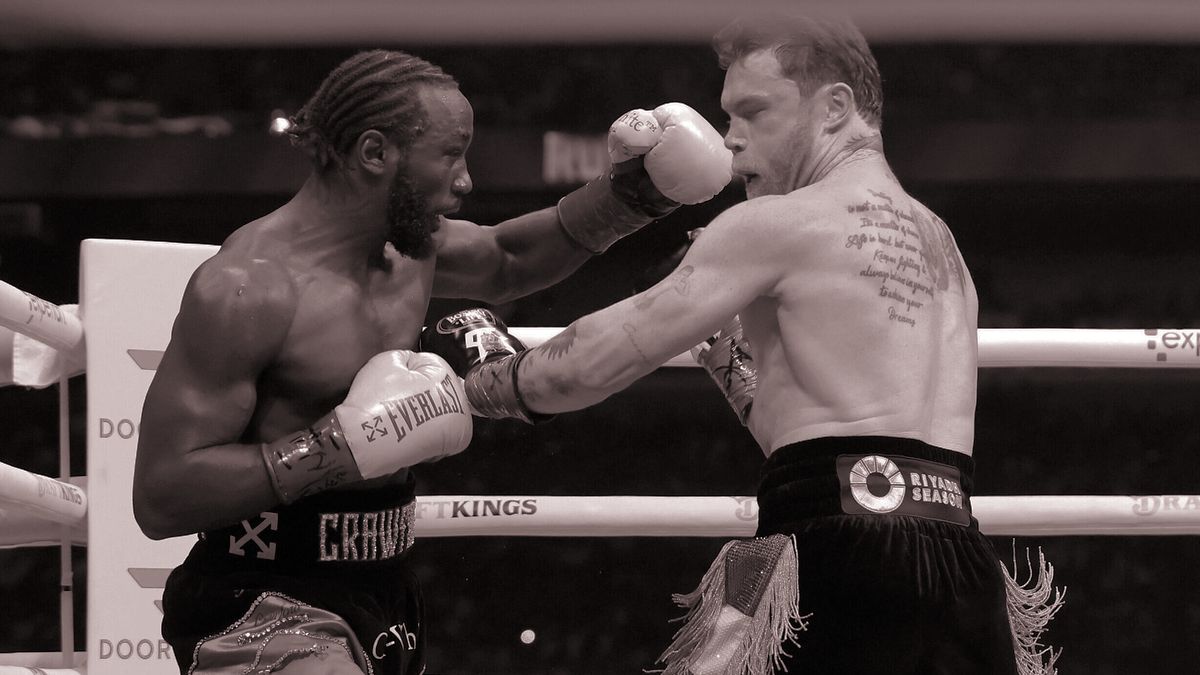
2017. It has also become the third-largest cable provider in the country, with roughly 10 million customers, behind Charter and Comcast. When the leagues were mostly working with traditional media players, YouTube only had to worry about striking the right deal with the right partners. Now though, the leagues are leaning into streaming just like everyone else, and sports are really working. The Canelo vs. Crawford fight on Netflix drove just over
238,000 signups in the U.S. in September, according to Antenna. (Wednesday, for its part, drove 79,000.)
For virtual cable platforms like YouTube TV, which has been at the center of the ingestion conversation, winning the ingestion fight isn’t only about building a moat; it’s also about providing a better customer experience in an age when it’s still so damn hard to find games across so many streaming platforms. A similar logic undergirds Amazon’s push to build out its
Prime Video Channels ecosystem, which turns Prime Video into a one-stop hub for add-on services (Paramount+, Peacock, Apple TV, etcetera). It’s also why Roku C.E.O. Anthony Wood is investing heavily in reducing confusion around sports discovery, and why Apple TV now sends push notifications alerting viewers when there’s a “close game.” Meanwhile, linear TV is still the simplest way to find every sport and every game in the same place. |
Thanks, Julia. See you all on Thursday.
John |
|
|
Puck sports correspondent John Ourand and a rotating cast of industry insiders take you inside the executive suites
and owners boxes where the decisions that shape the entire sports business are made. You’ll hear interviews with players, network execs, and everyone in between. The Varsity is an extension of John’s private email for Puck by the same name. New episodes publish every Wednesday and Sunday. |
|
|
Ace media reporter Dylan Byers brings readers into the C-suite as he chronicles the biggest stories in the industry:
the future of cable news in the streaming era, the transformation of legacy publishers, the tech giants remaking the market, and all the egos involved. |
|
|
|
|
MATTHEW BELLONI & WILLIAM D. COHAN |
|
|
Need help? Review our
FAQ page or contact us for assistance. For brand partnerships, email ads@puck.news.
You received this email because you signed up to receive emails from Puck, or as part of your Puck account associated with {{customer.email}}. To stop receiving this newsletter and/or manage all your email preferences, click here. |
Puck is published by Heat Media LLC. 107 Greenwich St., New York, NY 10006 |
|
|
|