Happy End of Partial Shutdown Day, everyone. I’m Peter Hamby.
Tonight, I
have exclusive new polling of American college students, revealing how much they’re really using A.I. chatbots for schoolwork, mental health, and… romance. We’ve also got numbers on how young people are feeling about Trump’s second term so far, and their opinions on the Democrats and Republicans considering a run for the White House in 2028. There’s good news for A.O.C., bad news for J.D. Vance, and a lot of work to do for everyone
else…
Programming note: On Thursday, Leigh Ann Caldwell will be hosting our next Puck Power Breakfast, this time with Ohio Republican Sen. Bernie Moreno. It will be the first in a series of “Crypto Morning” events, in partnership with Solana Policy Institute. The event is invite-only, but not to worry—we’ll recap it here next week. |
|
|

| Abby Livingston
|
|
The Texas Senate Democratic primary got personal yesterday afternoon, after a podcaster accused
rising star James Talarico of calling his former Senate Democratic rival, Colin Allred, a “mediocre Black man.” (Allred dropped his Senate campaign and opted to run against Rep. Julie Johnson for a Dallas House seat instead.) Allred then posted a two-minute video in which he trashed Talarico and endorsed Democrat Jasmine Crockett in the primary.
Talarico responded with a statement saying the podcaster had mischaracterized
a private conversation. “Despite our disagreements, I deeply respect Congressman Allred,” he said. “We’re all on the same team.” Maybe… |
Retiring Sen. Tina Smith of Minnesota endorsed “my friend” Lt. Gov. Peggy
Flanagan in the open-seat race to succeed her, saying, “We need leaders who have the courage to take bold action, challenge the status quo, and fight for people so they can be safe and afford their lives.” This is a huge get for Flanagan, and the timing is crucial: State and local D.F.L. leaders are beginning their endorsement process this week. Meanwhile, Rep. Angie Craig, Flanagan’s top rival for the nomination, had $3.8 million on hand, compared to Flanagan’s
$800,000, as of the end of the year. The primary takes place in August, so we likely have months of trench warfare ahead. |
|
|
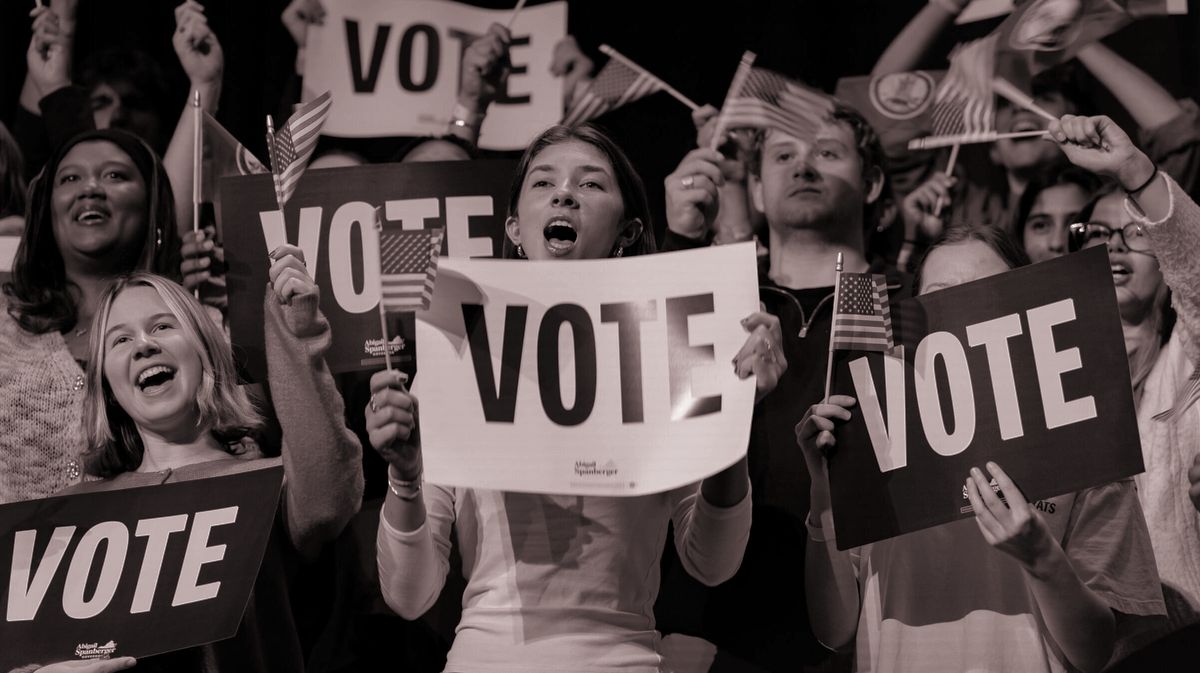
An exclusive new survey finds that college students still like Kamala Harris, are totally
hooked on A.I., ultra-polarized by J.D. Vance, and have close to zero thoughts on Josh Shapiro and J.B. Pritzker. |
|
|
In his annual budget address to lawmakers Tuesday, Pennsylvania Gov. Josh Shapiro became the
latest big-name governor to sound the alarm about A.I. chatbots and the “new risks” they pose to vulnerable young people. “This space is entirely unregulated and there are no protections,” he said.
Yes, Shapiro also acknowledged the potential upsides of artificial intelligence, naming research hubs in Pennsylvania and boasting about luring A.I. data centers to the state. But in the next breath, he sternly called on legislators to pass laws requiring age verification and parental consent
for A.I. chatbot use; enact a ban on chatbots that produce sexually explicit or violent content featuring children; and force companies to periodically remind users that there’s not another human being on the other side of the screen. He also ordered state agencies to “explore all legal options” against app developers who build chatbots claiming to be experts delivering medical advice.
His list of demands echoed recent high-profile efforts by other governors—most prominently New York’s
Kathy Hochul, California’s Gavin Newsom, and Florida’s Ron DeSantis—to crack down on A.I. companies and develop stricter consumer protections for parents and kids. In Harrisburg, Shapiro unleashed a stat intended to freak everyone out. “Thirty percent of teens report using an A.I. chatbot every day,” he said, citing a Pew Research study from December. “For kids who are lonely, or having a hard time, it can feel easier to turn to
one of these apps for advice than to a real-life friend or parent or teacher.”
That report from Pew studied kids between the ages of 13 and 17. But new data I’ve obtained suggests that A.I. usage is significantly higher among Americans who are just ahead of that cohort in life—namely, those over 18 and attending college. According to a new
poll from The Generation Lab conducted exclusively for Puck, 59 percent of two-year and four-year college students reported using an A.I. chatbot “always” or “sometimes” for help with schoolwork, research, or presentations. Another 37 percent of college students said they know someone who uses a chatbot for “mental health or emotional support.” (In public opinion research, asking respondents about the preferences of their peers, rather than their own preferences, can reduce self-censorship
and reveal a more accurate result.)
Meanwhile, college students estimated that an overwhelming majority of their peers—90 percent—use A.I. chatbots at least once a month for mental health reasons or emotional support. Asked how often they did so, 17 percent said daily, 47 percent said weekly, and 26 percent said monthly. I also had The Generation Lab ask college students if they know “anyone your age who has used an A.I. chatbot for a romantic or intimate relationship.” A big majority, 70
percent, said no. But 21 percent said yes, which is not an insignificant number. And given the rapid evolution of A.I. technology, it’s easy to see why more and more young people might turn to chatbots for romantic or sexual fulfillment in the coming years. |
The poll, which surveyed 1,135 students nationwide at two- and four-year colleges from January 25 to 29, also
offered some alarming insights for Donald Trump’s Republican Party. Of course, when it comes to politics, the sentiments of college students shouldn’t be read as a proxy for all young people. Slightly less than half of Americans have an associate’s degree, and a little more than a third have obtained a bachelor’s degree. But young people with degrees lean toward the Democratic Party, and they are many times more likely to vote than their peers without one, especially in off-year
and midterm elections. The poll found that if the elections were held today, college students would overwhelmingly vote against Trump’s G.O.P., much like they did in Virginia, New Jersey, and California last November.
Indeed, the poll found that college students overall have an astoundingly negative view of Trump’s performance one year into his administration. Asked to describe “the impact of Trump’s presidency on the country so far,” 62 percent of students said Trump is “making things
worse,” while an abysmally low 8 percent said Trump is “making things better.” The rest said Trump’s term has been “a mix of good and bad” (22 percent) or had no opinion (8 percent).
Heading into the midterms, Republicans are clearly being dragged down by Trump’s negative image. When asked, “Which party cares more about lowering costs for Americans and helping people obtain good-paying jobs?” only 17 percent of respondents named Republicans. A much larger plurality, 46 percent, named the
Democrats. Still, as I’ve been writing for years, young people don’t really trust that either political party can solve their problems or has their best interests at heart. While Democrats have an advantage on economic issues right now, 37 percent of respondents said that neither party cares about lowering costs or creating jobs. |
I also asked Generation Lab to take the temperature of college students on the politicians gunning to succeed
Trump when he leaves office. Not surprisingly, perhaps, the poll found that White House hopefuls in both parties have a lot of work to do—not only to win over young people, who are increasingly difficult to reach in our modern media environment, but to introduce themselves in the first place.
For the Democrats, Gavin Newsom, Kamala Harris, Pete Buttigieg, and Alexandria Ocasio-Cortez were the most well-known and
well-liked among college students. Harris’s reputation is not a surprise given her fame: 51 percent of Democratic and Dem-leaning college students said they had a favorable opinion of the former vice president, but a notable 29 percent said they had an unfavorable one, with 20 percent offering no opinion.
After Harris, Ocasio-Cortez had the highest favorable rating among college students (46 percent), followed by Newsom (34 percent) and Buttigieg (30 percent). But even more noteworthy
were the “no opinion” numbers, which were sky-high even for these famous Democrats—a reminder that the youngest voters are still learning about politicians who are old news to most of us in the business. Meanwhile, for other Democrats considering a run for president in 2028, the challenge of building a reputation among young people looks even more daunting: Only a fraction of college students offered opinions on Shapiro, J.B. Pritzker, Andy
Beshear, Mark Kelly, and Ruben Gallego. Cory Booker was an unknown quantity to 40 percent of college students despite being a U.S. senator for more than a decade and running for president in 2020.
On the Republican side, the possible G.O.P. candidates are more well-known to college students, likely because several of them are Trump administration officials or associates
who are frequently in the news cycle. Vice President J.D. Vance—the frontrunner in most 2028 horserace polls—has the highest favorable rating of any G.O.P. hopeful, at 30 percent. But Vance’s unfavorable rating among Republican college students is in disastrous territory for a politician who fashions himself as an ambassador to the next generation of conservatives. Almost half of Republican and G.O.P.-leaning college students (48 percent) have an unfavorable opinion of
Vance. That number tracks with other recent surveys, which I’ve covered for Puck, suggesting that the more young people get to know Vance, the more they dislike him.
But the poll also found that most of the potential Republican candidates—Marco Rubio, Donald Trump Jr., Ron DeSantis, Robert
F. Kennedy Jr., Ted Cruz, Glenn Youngkin—are similarly underwater with G.O.P. college students on the favorability question. Maybe that’s because young Republicans are disappointed with the Trump administration’s record on the economy. Or it could suggest that, after the murder of Charlie Kirk, campus conservatives are speaking a different cultural language—more trad, more xenophobic,
more Christian, more testosterone-infused—than most of the buttoned-up Gen X and Millennial Republicans eyeing the White House in 2028. Whatever the answer, it’s abundantly clear from the poll that none of these Republicans has a hold on campus conservatives the way Trump has had over the last decade. |
|
|
The industry’s go-to source for unflinching reporting on the trillion-dollar business of artificial intelligence - perhaps the
single most important technology of our time. Ian Krietzberg, the powerhouse journalist behind The Deep View, delivers twice-weekly insights into the latest dealmaking and breakthroughs in A.I., and how the intersecting worlds of finance, entertainment, media, and politics are being transformed in its wake. |
|
|
Join Puck’s chief political columnist, John Heilemann, as he roams the corridors of power and influence in America on this
twice-weekly interview show, taking you beyond the headlines with the people who shape our culture: icons and up-and-comers, incumbents and insurgents, moguls and machers in the overlapping worlds of politics, entertainment, tech, business, sports, media, and beyond. The conversations are rich and revealing, unrehearsed and unexpected… and reliably impolitic. A Puck-Audacy joint, new episodes drop every Wednesday and Friday. |
|
|
Need help? Review our
FAQ page or contact us for assistance. For brand partnerships, email ads@puck.news.
You received this email because you signed up to receive emails from Puck, or as part of your Puck account associated with {{customer.email}}. To stop receiving this newsletter and/or manage all your email preferences, click here.
|
Puck is published by Heat Media LLC. 107 Greenwich St., New York, NY 10006 |
|
|
|