Hi, welcome back to Line Sheet, and happy first day of Spring.
Let’s get going by sharing some breaking news at the top: Goop Kitchen, Gwyneth Paltrow’s real exit opportunity, is opening in Silver Lake in early April. Finally, access to Calabrian chile Caesar dressing without having to drive to the Valley!
For the 99 percent of you who don’t live on the Eastside of Los Angeles, I’ve got the latest from Europe (Dolce & Gabbana’s debt; more Versace personnel changes), New York (Printemps’ opening night), and San Francisco (an interrogation of my own feelings about the Gapaissance and some news on Zac Posen’s future at the company).
Programming notes: Today on The Powers That Be, I’m chatting with power forward–turned–shooting guard Peter Hamby about LVMH succession (who will get the kiss from Daddy?). Plus… tariffs! Listen here and here.
Tomorrow on Fashion People, my guest is The RealReal C.E.O. Rati Sahi Levesque. We discuss shopping society’s collective addiction to the resale platform, and what it has been like for her to watch its transformation over the past 14 years. I’ve known Rati for pretty much all that time, so this was a fun one. Listen here and here.
A reminder: Today’s issue is for Inner Circle members only. If you upgrade your account now, email Fritz@puck.news and me and we will make sure its contents are hand-delivered to your inbox.
Mentioned in this issue: Richard Dickson, Gap, Madonna, Parker Posey, Zac Posen, Old Navy, Dolce & Gabbana, Alfonso Dolce, Donatella, Qataris, Jean-Marc Bellaiche, Abercrombie & Fitch, Simeon Siegel, Anna Wintour, Scott Sternberg, Kering, the Polo Bar, 15,000 square feet of red and gold mini-tiles, and many more…
|
|
|
|
A MESSAGE FROM OUR SPONSOR
|
|
|
Three Things You Should Know...
|
- Dolce & Gabbana’s rischioso beauty play: I found this Bloomberg interview with Dolce & Gabbana C.E.O. Alfonso Dolce (brother of co-founder Domenico) super weird. Not because Dolce said the company was on track to achieve €1 billion in actual beauty sales by the end of the 2027 financial year. That’s totally possible; those fragrances perform. But rather, because Dolce failed to acknowledge the challenges that the business has faced since buying back its beauty license in 2022. It’s an incredible undertaking for any brand, but especially one not backed by a conglomerate with a beauty supply chain already in place.Look, maybe the three reporters who worked on the story didn’t ask, but I was just talking about this with luxury executives in Milan. My understanding is that the process has been difficult, and helps to explain why Dolce & Gabbana borrowed €300 million in 2022. The company is still looking for another €150 million, on top of its €100 million line of credit. While overall revenue is up, the company is barely in the black, with EBIT of just €4 million on €660 million in annual sales in 2024. The good thing about a license is that it’s a simple business arrangement that throws off profit. Owning beauty directly will obviously offer Dolce more upside, sans the middle man, but it also comes with risks and CapEx aplenty. (Surely the notes are in place to finance the investment.)As usual, Dolce denied that the company is interested in an outside partner. They did the same last year when I reported, via multiple sources, that they had engaged a banker and that there had been talks with investment firms, including China’s HongShan, previously known as Sequoia Capital China. Perhaps it’s true that the officers of the family-run company would prefer to keep it family run, but this will only work if they pay back their debts and start generating a real profit. Otherwise, they may have to go down a far less savory path than private equity or venture capital.
- Versace’s loose threads: I’m hearing that Kaisa Kinnunen, currently S.V.P. of women’s design at Versace, will likely exit as Dario Vitale gets settled in as creative director. Kinnunen, who spent years with Demna at Balenciaga, is a well-liked second-in-command who may be ready for her own chance at stardom. (A rep for Versace had no comment.) Meanwhile, I was confused by The Wall Street Journal’s take on Donatella Versace’s relationship with parentco Capri. Group C.E.O. John Idol, according to the Journal, wanted the late Gianni Versace’s sister to “tone down” her designs, after he bought her company for €2.1 billion in 2018. Not once does the article mention current Versace C.E.O. Emmanuel Gintzburger, who has executed the lion’s share of the changes since arriving in September 2022. From my own reporting, I’m not so sure Idol knew what he wanted Versace to be—he had no true vision for the brand, in part because he had never operated in the pure luxury space prior to the acquisition. Donatella, who I presume has found it difficult to watch Versace’s brand equity erode, was at least paid handsomely in the original transaction. Let’s see how she engages with Versace after April 1, and furthermore, after it is no longer owned by Capri—if they do indeed sell it.
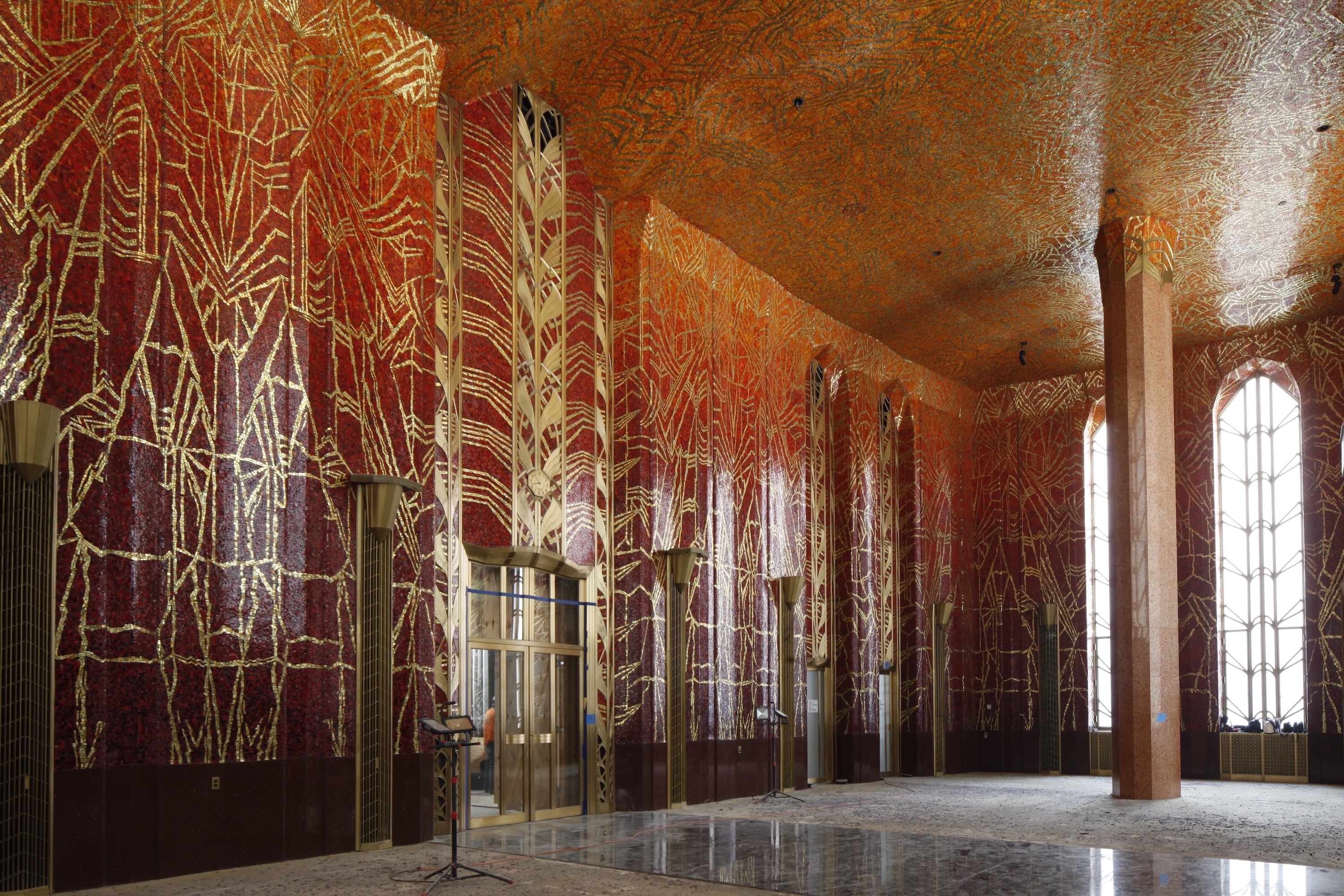
- A glorious downtown homage to ’80s excess: Printemps is hosting its opening party at 1 Wall Street in New York tonight. Are you going? Are you already there, standing in a corner of the lavish, glowing, lush, Laura Gonzalez–designed space, reading this to avoid talking to people? Either way, let me know what you think. I got a chance to take a hard-hat tour several weeks back and was mesmerized by the 95 percent-finished department store—an encapsulation of the greed-is-good Boom Boom trend, in retail form—extravagantly funded by Sheikh Hamad bin Khalifa Al Thani, the former emir of Qatar. (In 2013, a Qatari-backed investment fund acquired Printemps—which was, yes, long ago owned by the Pinault family—in a deal that valued the business at about €1.6 billion.)We can get into the financials another day, but it’s obvious that no expense has been spared in the 55,000-square-foot space. There are hand-painted frescoes on the walls and garments dangling from human-sized birdcages. The shoe room is actually the Red Room, a New York City landmark designed by muralist Hildreth Meière in 1931, which she covered in 13,000 square feet of red and gold tile mosaic.
|
|
The Red Room at 1 Wall Street. Photo: Courtesy of NYC Landmarks Preservation Commission
|
- How does Printemps C.E.O. Jean-Marc Bellaiche plan to deliver a return on the Qataris’ latest investment? Well, for one, discovery: 25 percent of the brands being sold were not previously available in the U.S. (including Camille Fournet, Vautrait, and Pinel et Pinel), so perhaps that’ll be novel enough to drive not only the tourists visiting the 9-11 memorial and the Wall Street bull, but also the increasing number of locals living and working in the area. (Puck’s offices are three minutes away.)On that beat, the motivating force here is food and beverage—including a wine shop. (Which is slated to sell mostly French wine, so… let’s see what happens with the tariffs.) To run the U.S. operations, Bellaiche hired Laura Lendrum—a veteran of Kering, but also Dean & DeLuca and Ralph Lauren, where she led the F&B efforts, including the expansion of Ralph’s and the opening of the Polo Bar. The hope, I’m sure, is that people who book multiple work breakfasts and lunches (and maybe an early dinner or two) in the restaurant will be enticed to do some shopping, too, Fred’s-at-Barneys style. It’s too early for me to assess whether it has a real chance at succeeding—there are the aforementioned tariff concerns, a finicky luxury consumer, and a potential recession with which to reckon—but good timing or bad, Printemps is a fun idea.
|
|
|
|
A reexamination of Richard Dickson’s hype-fueled turnaround at Gap Inc. Now that they’re through with the low-hanging fruit—cost cuts, a marketing refresh, store closures—can the management team truly transform the business?
|
|
|
Whatever you want to say about Richard Dickson’s Gap Inc. tenure—that he’s changing the game, or simply zhuzhing what’s becoming a meme stock—it would be impossible to deny that he has done something. The group’s comps (retail parlance for sales at stores open at least one year) were positive in every quarter of 2024, an achievement for a company whose namesake brand has been on the decline for more than 20 years. (The business of the Gap brand is half its former size.) Analysts, generally, are incredibly bullish on the future of Gap Inc.
For the past month, since Dickson announced the group’s impressive 2024 results, I’ve wrestled with my own feelings about the Gapaissance, tracked closely by Puck retail correspondent Sarah Shapiro. I’ve been covering the company in earnest since the late aughts. Years earlier, I worked at a Gap on London’s Kensington High Street during my semester studying abroad, selling the 2003 iteration of the Crazy Stripe sweater. And before that, as a teenager in the late ’90s, I became a head-to-toe Gap girl in bootcut corduroys and a sleeveless puffer, copied directly from the “ Everybody in Vests” commercial, where the models sang a Dust Brothers mix of Madonna’s “Dress You Up.” In a high school graphic design class, I created my own riff on Gap’s now-legendary print advertisements. I want to believe. I care about The Gap.
|
|
|
|
A MESSAGE FROM OUR SPONSOR
|
|
|
But I’ve had trouble getting on board with Dickson’s vision with the same conviction as most retail analysts. The recent “Feels Like Gap” campaign starring ’90s relic-turned- White Lotus star Parker Posey should have been catnip for me. Instead, I hated it. Gap can’t improve future sales by relying on tropes from the past. The commercial felt like a poorly executed rehash of those fabulous late ’90s jobs: “Everybody in Vests” but also “ Everybody
in Cords,” in which the models sing Donovan’s “Mellow Yellow,” and the most famous, “ Khakis Swing,” set to The Brian Setzer Orchestra’s “Jump Jive an’ Wail.” There’s certainly a way to successfully reinterpret the past. Designer Scott Sternberg’s inventive marketing for the now-defunct basics brand Entireworld was inspired, at least in part, by old Benetton ads—but they never felt desperate or watered down.
But the advertisement, itself, was only part of my problem with Posey’s Gap ad. Worse was that the clothes—a pair of high-waisted, Jesse Kamm–style sailor jeans; a sad, dishwater brown striped shirt; and an ill-fitting trench—were not attractive. In February, Sarah explained why the recent consumer hype around Gap may not last long, noting the exit of Chris Goble, who was in charge of product, but left for Dickies when he wasn’t offered a bigger leadership role at one of the portfolio brands. (Gap C.E.O. Mark Breitbard isn’t going anywhere; the M.B.A. and former chief of staff has avoided the chopping block through seven C.E.O.s, including his first boss there, Mickey Drexler.)
This isn’t a matter of taste, by the way. I vastly prefer the aesthetic qualities of Mike Jeffries–era Abercrombie & Fitch over the current, TikTok-fueled iteration. But during Abercrombie’s incredible run over the past two years, C.E.O. Fran Horowitz took the show, don’t tell approach, letting the double-digit growth be the story. For his part, the gleefully self-promotional Dickson has been on a press tour since the beginning of his tenure, rambling about how he’s going to fix the business in vague terms and M.B.A. jargon. (A recent gem: “Today, what’s certain is uncertainty.”) While the positive comps are real, they are in no way blockbuster, and can be attributed to a variety of tactics, including store closures, promotions, cost savings, and increased efficiencies in the supply chain.
Simeon Siegel, my go-to retail analyst at BMO Capital Markets, summarized this transition succinctly. “In a gross oversimplification (and a fully self-aware, too-casually thrown-out observer comment), improving a multiyear run of challenges is not all that ‘hard,’” he told me. “Doing it again the next year is. Richard (and team) are saying all the right things and putting up all the right results. The question is less whether Gap Inc. is doing a nice job, and more whether their actions have begun a sustainable fix. For better and worse, the burden of proof lies in management’s hands. But so does the opportunity.”
|
|
In an era when product is the best marketing, the only thing Dickson's team really needs to nail is the price-value equation. At the moment, it’s still unclear to me why someone would shop at the Gap over another basics purveyor. Fast Retailing–owned Uniqlo has terrible marketing, which hindered its ability to make headway in the U.S. for many years. But word spread about Heattech and AIRism, and now the company posts significant sales and profit gains every quarter in the region. As a friend of mine who works at a competitor said, Uniqlo is solutions-based. What problem is Gap solving?
|
|
|
It’s an issue across the Gap Inc. portfolio, and one that hasn’t been helped by the hiring of Zac Posen as the group creative director. Posen touches very little product—an Old Navy occasion line here, a Gap capsule there. For the most part, his job is imagemaking. (The number of Gap Studio units actually produced was likely quite low; a company of that size only sells out of units if they choose to.)
While Posen has recruited high-fashion talent into the portfolio to style and shoot campaigns, I’m still puzzled by why Dickson hired him for the role, which would have been more suited to a true creative director like Sternberg, who is experienced in overseeing marketing, merchandising, and design. ( Jenna Lyons was another obvious choice, but that didn’t happen for reasons I find difficult to understand.) Along with being nice, showing up, and wanting the job, Posen has provided Dickson with access to the Met Gala and the Vanity Fair Oscar Party. (Although I have a feeling Anna Wintour would have been happy to have Dickson no matter what, as long as he put up some advertising dollars.)
I’m told that Posen recently extended his contract by one year. That’s one more year than I expected, so that’s something. But the Posen situation speaks to my bigger issue with Dickson, which is not that he has bad taste; it’s not the right taste. The C.E.O. has done an undeniably formidable job of getting Gap Inc. on the right flight path. Let’s see if he can land the plane.
|
What I’m Reading… And Looking at… And Listening To…
|
Jade eggs, raw milk, and all, I am still pretty surprised that Rick Caruso supporter Gwyneth Paltrow did not denounce R.F.K. Jr.’s MAHA plan in Vanity Fair—or at least artfully dodge the question in its entirety. At some point—right around the start of the pandemic—Paltrow and Goop backed away from the woo-woo stuff, and never once veered into anti-vax territory. (At least that’s what I remember; feel free to correct me.) Anyway, I thought author Michelle Ruiz did as good a job as anyone could, given the tools she was given. I don’t like the cover. [ Jam Session]
The High Sport lookbook, styled by Charlotte Collet, makes me want to shop. [ Instagram]
R.I.P. Reinaldo Herrera Guevara, husband of Carolina Herrera and International Best Dressed List steward. [ WWD]
I need someone other than Vogue (no offense) to write about Justin Theroux’s recent wedding, which had a severe sponcon vibe, whether or not it was sponcon. [ Instagram]
|
And finally… I know only as much as you do regarding the New Yorker art critic’s behavior at the 100th anniversary party. Which is to say… I know too much! In the long run, the bigger problem for Jackson Arn may be that his work had many detractors. As one person with firsthand knowledge of the situation told me, “I mean… I didn’t love his Jenny Holzer review.”
Until tomorrow,
Lauren
P.S.: We are using affiliate links because we are a business. We may make a couple bucks off them.
|
|
|
Need help? Review our FAQ page or contact us for assistance. For brand partnerships, email ads@puck.news.
You received this email because you signed up to receive emails from Puck, or as part of your Puck account associated with . To stop receiving this newsletter and/or manage all your email preferences, click here.
|
|
Puck is published by Heat Media LLC. 107 Greenwich St, New York, NY 10006
|
|
|
|