Welcome back to Wall Power. I’m Marion Maneker.
This May at
Christie’s, Agnes Gund’s estate is selling only a few of her favorite works—the ones she kept to live with in her later years rather than donate to museums. Tonight, I look at those works, along with her role as an “ideal collector.” Up top, we have Sotheby’s 2025 financials, which they’ve released to me after officially closing the books—for the first time, we’re getting revenue and EBITDA numbers (even if they are adjusted). Plus, Dike Blair has a new
show opening on Thursday at Karma in Chelsea. And we close with an Andy Goldsworthy callback courtesy of The New Yorker.
Don’t forget: If you’re not already a subscriber, you can fix that here. If you do subscribe, think about upgrading to the Inner Circle. And if you’ve got something
you want to share with me (or you just want to gab), simply reply to this email or connect with me on SMS or WhatsApp at +1.917.825.1391
Mentioned in this issue: Leonard Lauder, Steven Cohen, the Reuben brothers, the Macklowes, Alice Neel, Lynda Benglis, Robert Gober, Julie Mehretu, Jacob
Lawrence, David Hammons, Martin Puryear, Rashid Johnson, Sanford Biggers, Ouattara Watts, Kara Walker, Ursula von Rydingsvard, Jim Hodges, Jacob Kassay, and more…
Let’s get started…
|
-
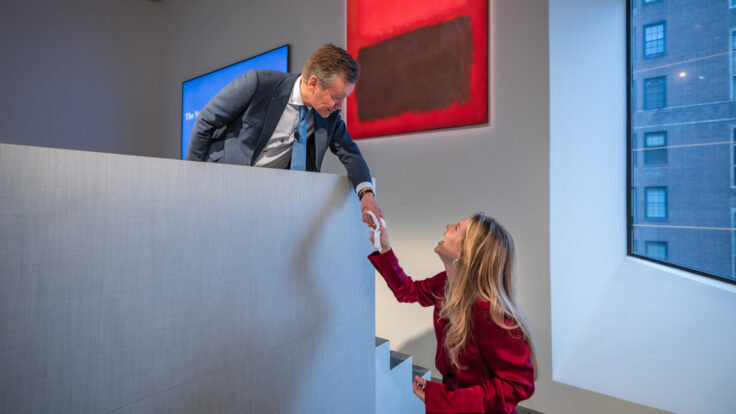
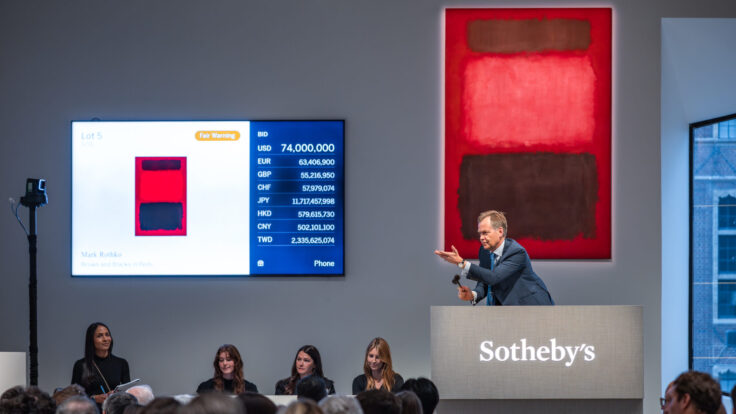
Sotheby’s revenue jumps 21 percent: Sotheby’s had a good year in 2025, and they’re taking a moment to release some internal numbers they have not shared since their days as a publicly traded company. Consolidated sales for 2025 came in slightly higher than projected, to land at $7.1 billion—an 18 percent rise from 2024. The auction house’s total revenue was $1.4 billion, up 21 percent from the previous year. Perhaps most important to the bondholders, adjusted EBITDA has been
reported at $363 million, 26 percent higher than it was in ’24. That number is what determines how easily the company can make its interest payments.There, too, Sotheby’s made progress, lightening its debt load from $1.1 billion to $818 million. This 27 percent improvement came from selling the York Avenue building, plus amending and extending an existing credit facility, according to C.F.O. David Kownator’s comments in a press release. There was also news not in the
release: Alexander Klabin is no longer an investor in the company. He had advised Sotheby’s Financial Services on scaling the operation.
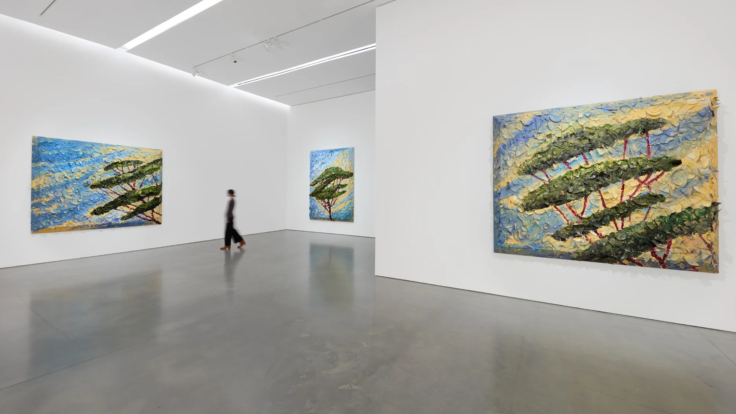
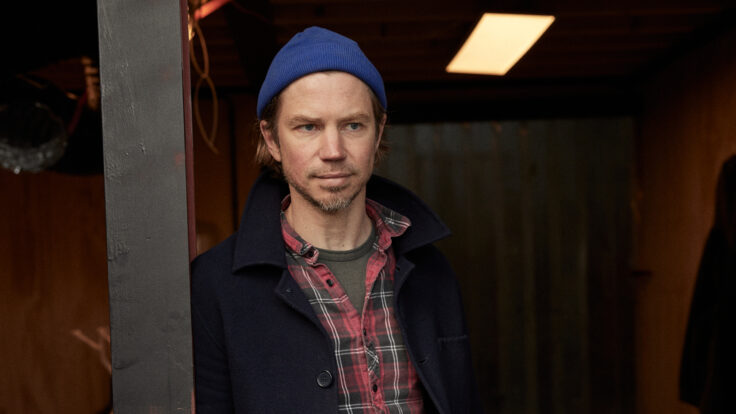
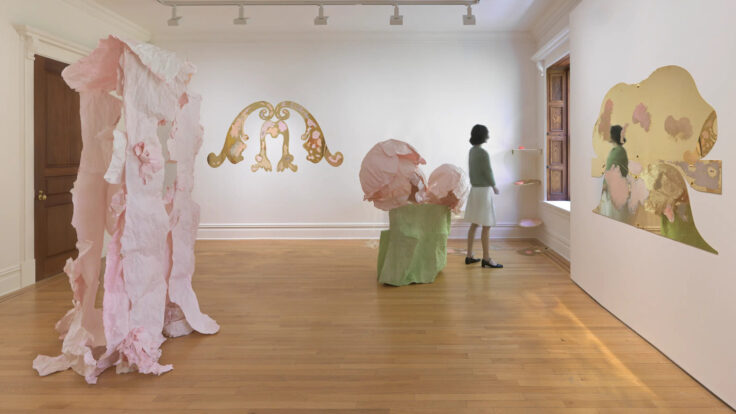
- Dike Blair opens at Karma: Dike Blair has been painting small still-life images for some time, even though he spent much of his career as a sculptor and a teacher at RISD. This Thursday, Karma will open what the gallery describes as his largest solo
show to date in New York of new paintings on aluminum, a technique the artist has been working with for the past two decades.The results are paintings that act like photographs. Yes, they are limpidly photorealistic, but only in the sense that they mimic an off-kilter, contemporary photography of cropped and diverted images. The most conventionally photorealistic ones
depict a vase of pink peonies on a windowsill or the view out a ferry window, over a railing and to the sea. In the latter image, the interior has warm incandescent light, while the exterior viewed through the window is bathed in the cold blue-white of an overcast day. In some images we see lamps; others show television sets and what’s playing on them; some show glasses on tables (both spectacles and drinking glasses filled with cocktails); some depict the corners of paintings by
Mondrian and Bonnard; some have light switches; others have electrical sockets. A few show us snippets of swimming pools. It’s hard to tell what to make of Blair’s world, except that the glimpses he provides in these paintings are inviting and reassuring.
|
Now, let’s get to the main event…
|
|
|
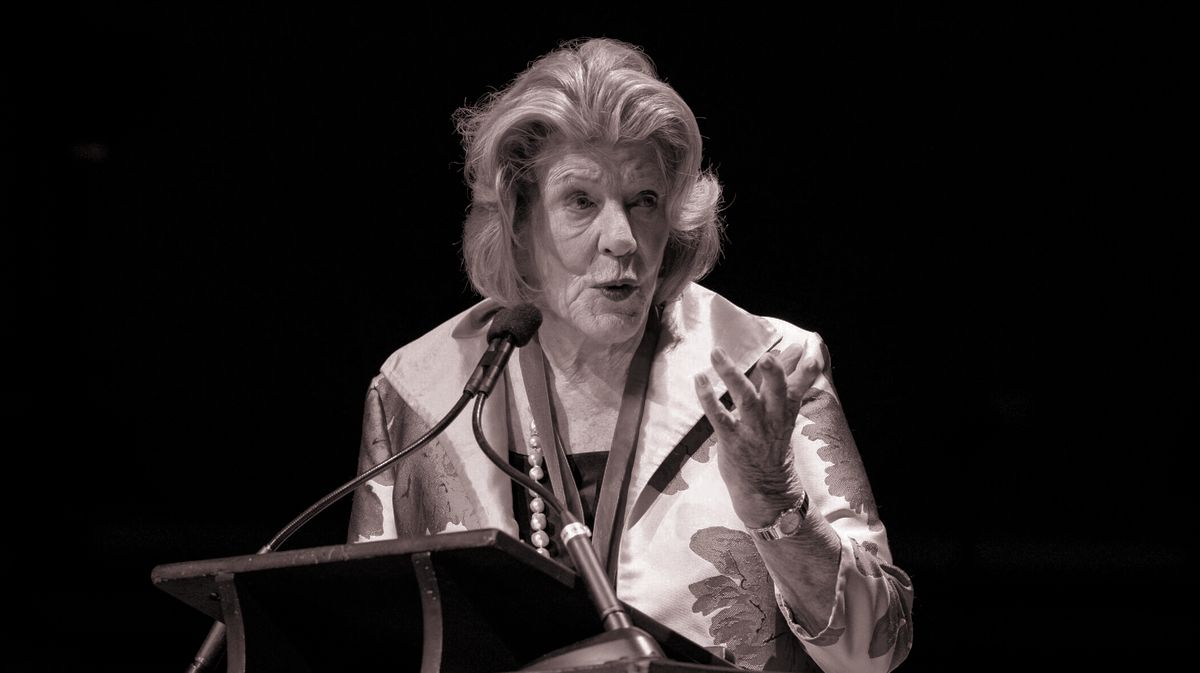
Agnes Gund, who died last September at the age of 87, was the kind of collector
who raised the stature—and the prices—of any artist she collected. Now three of her prized paintings are coming to auction.
|
|
|
After the solid sales in New York last November, the market has been hoping that more collections
like Leonard Lauder’s would appear for this May’s auctions. Now it’s getting a little of what it wanted—but at a price. Last Friday, Christie’s announced it would sell $123 million worth of Agnes Gund’s art this May, a far cry from the nearly $530 million that the Lauder collection achieved.
Presumably, the Lauder family was eager to vend Leonard’s art to avoid having to sell their depressed Estée Lauder stock holdings: By the time they made that
decision, in the summer of 2025, the company’s stock had fallen 84 percent from its late-2022 highs. Gund’s estate does not seem to be under similar pressure to sell all of her art. We’re just seeing three pieces—though two are very high-value works—and the estimates are, well, robust.
A collector with as much important art as Gund, who died in September at 87, always keeps a few sentimental, but significant, pieces. Sensing the market’s moment, Gund’s estate has decided to sell
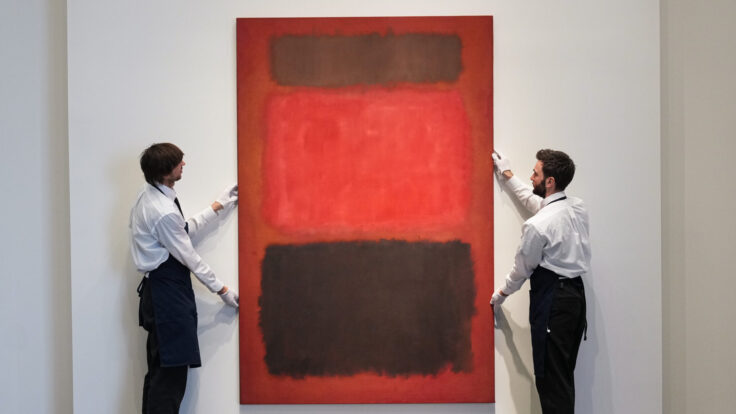
some, but not all, of them this spring. The most valuable of the three works coming to auction is Mark Rothko’s No. 15 (Two Greens and Red Stripe), from 1964, which will have an $80 million estimate. If it sells there, the buyer will pay a price with fees above the current record, which was set more than a decade ago at just under $87 million for a Rothko.
On the other end of the spectrum, Gund’s estate has offered a Joseph Cornell collaged box,
Untitled (Medici Princess), from 1948, with a $3 million estimate. That seems quite cheap against the Rothko, and even other Medici Princess boxes, like one that sold for just under $6 million in 2014. Two works titled Medici Slot Machine were sold for $5 million and $7.8 million in the same era. Does that mean Christie’s estimate is low? Probably not. Not many
high-value Cornells have sold in some time.
Also in the sale will be a Cy Twombly untitled “Roma” painting, from 1961, offered with an estimate of $40 million. Except the painting, according to a European Twombly-phile I was chatting with on WhatsApp last Friday, is smaller than the images suggest. It was also curiously dangled at an art fair in recent years—not for sale, of course, but not not for sale forever.
Big-name collectors, like the British
Reuben brothers, have bought similar works for less, like this one from the Macklowe collection that made $21 million. And the auction high-water mark for a Twombly from this era of his oeuvre is the $52 million paid
in 2017 for an incredibly well-preserved Leda and the Swan, from 1962, that had been stored in a crate for decades. Alas, that was at the tail end of Twombly’s market peak. My guide through the Twombly market told me that if Gund’s Roma painting made the $40 million low estimate, “it will be a very good sign for the market.”
|
I could not help but notice that the
story in The New York Times announcing the Twombly consignment contained a quote from an art advisor describing Gund as “truly an ideal collector.” I’m still wondering about that description. Aggie Gund, a banking heiress who served as a president of MoMA and a longtime member of the board, gave a lot of her art to institutions like that one and
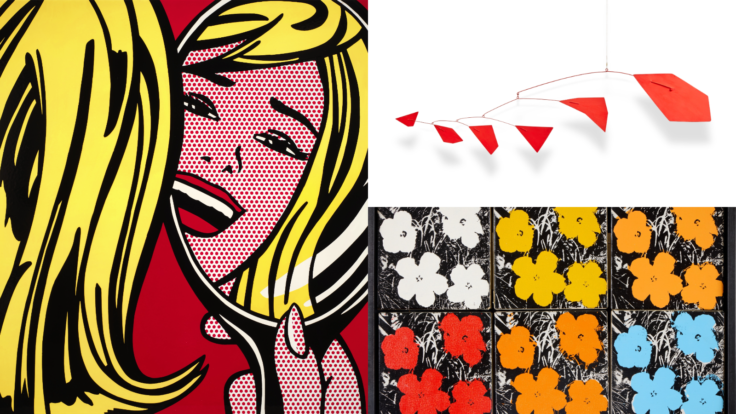
the Cleveland Museum of Art. She also sold art to support causes she thought worthy, including Roy Lichtenstein’s Masterpiece, from 1962, which Steven Cohen bought from her for $165 million.
But what made Gund’s collecting ideal? According to the advisor, her role as a philanthropist and her deep web of relationships made her collection a desirable destination for artists and their dealers alike. He was describing the art world’s penchant for
status: If you sell your artist’s work to a collector known for donating to top-flight institutions like the Cleveland Museum of Art or MoMA, there’s a good chance the artist’s reputation will benefit in the long run.
The art world calls that provenance. But it’s really just the hope that if Gund had a personal relationship with giants like Rothko, Lichtenstein, Rauschenberg, and Johns, and also liked your artist’s work enough to buy it, your artist might
be a giant someday, too. The implication is that dealers recognized the validating power of Gund’s ownership and sought her out. After all, she also served on the boards of the Frick, the Barnes, the Morgan Library, the Warhol foundation, and the Rauschenberg foundation.
I was curious to see what being an “ideal collector” might actually mean in practice. Christie’s press release tells us that Gund donated more than 1,000 works from her personal collection to MoMA, and 800 additional
works to other museums—though photographs of Gund in her home taken over the years suggest there’s plenty of good work by Frank Stella, Andy Warhol, Johns, and Rothko still in the estate’s possession. The Johns show at Gagosian right now features a Gund gift borrowed from MoMa, titled Between the Clock and Bed,
among its star trio of works. MoMa’s website lists dozens more works that Gund helped the museum acquire, including postwar stalwarts like Agnes Martin, Yayoi Kusama, Louise Bourgeois, James Rosenquist, Ellsworth Kelly, Hans Hoffmann, Robert Smithson, John Baldessari, Ed Ruscha, Alice Neel, Lynda Benglis,
Robert Gober, and many others. Cleveland’s website reveals donations of prominent names like Richard Serra, Brice Marden, Philip Guston, and Claes Oldenburg.
As impressive as that list is, in some ways it is expected that a rich patron reaching her maturity in the 1960s would have collected and befriended most of those artists. But her donations to Cleveland and MoMA also show her conviction, taste, and
foresight. They include major African American and African-diaspora artists like Julie Mehretu, Jacob Lawrence, David Hammons, Martin Puryear, Rashid Johnson, Sanford Biggers, Ouattara Watts, Kara Walker, and a Gee’s Bend quilt. Alongside these giants, though, there are donations of works by artists whose names are not so familiar, like
Ursula von Rydingsvard or Jim Hodges.
The one gift I found charming and telling was the Jacob Kassay electroplated silver canvas that Gund had donated to the Cleveland Museum in 2024 in partnership with the artist. Some of you will remember that Kassay was a brief sensation in the art market from 2011 to 2014, when his
process-oriented, formalist works were selling at auction in the $200,00 to $300,000 range. By 2016, his auction prices had fallen to mid-to-low five figures, and he seemed like a case study in the evanescence of art-market success.
I’m sure there were many collectors who got caught up in the Kassay mania and then donated their works to recoup some tax advantage or simply remove an awkward reminder from their collections. But Gund wasn’t one of them. Cleveland’s Kassay was made in 2018,
long after the artist’s star had burned out in the market’s imagination, and Gund acquired and donated it only six years later. That’s an intentional act that cuts against the prevailing wisdom and, one can only assume, expresses some personal conviction about the artist’s work. It cannot have been hard to get a Kassay in 2024, but there was Gund donating one. And that, I think, is the best reason she’s being described as the ideal collector.
|
Regular readers of Wall Power will remember that when I was in Scotland, in October, I was lucky
enough to be there during the final weeks of the National Galleries’ Andy Goldsworthy | Fifty Years show. Except for having spent time up the Hudson in Mountainville, New York, where Goldsworthy’s Storm King Wall is sited, I had never been able to spend an extended amount of time with his work.
Last week, The New Yorker’s
Rebecca Mead had a lengthy profile of Goldsworthy that emphasized his long residency in Scotland; his relationship with the Duke of Buccleuch, one of the largest landowners in the country; and the extensive project he’s been working on called Gravestones. The
project involves gathering stones that have been removed in the process of digging churchyard graves and depositing them in an enclosure on a hilltop in Scotland not so far from the border with England.
Mead quoted David West, whose job is to oversee a number of graveyards in the county where Goldsworthy is gathering his stones. West remarked that he had not really thought about art in any way until Goldsworthy made a presentation to him and his colleagues explaining the
project. “I never, ever thought I would be interested in that,” he told West. “And then Andy came along.”
Let that be the final note for today. I’ll see you tomorrow in the Inner Circle.
M
|
|
|
Finally, a media podcast about what’s actually happening in the media—not the oversanitized,
legal-and-standards-approved version you read online. Join Dylan Byers, Puck’s veteran media reporter, and Julia Alexander, a longtime media analyst, as they sit down with TV personalities, moguls, pundits, and industry executives for raw, honest, sometimes salacious conversations about the business of media and its biggest egos. New episodes publish every Tuesday and Friday.
|
|
|
The ultimate fashion industry bible, offering incisive reportage on all aspects of the business and its biggest
players. Anchored by preeminent fashion journalist Lauren Sherman, Line Sheet also features veteran reporter Rachel Strugatz, who delivers unparalleled intel on what’s happening in the beauty industry, and Sarah Shapiro, a longtime retail strategist who writes about e-commerce, brick-and-mortar, D.T.C., and more.
|
|
|
Need help? Review our FAQ page or contact us for assistance. For brand partnerships, email ads@puck.news.
You received this email because you
signed up to receive emails from Puck, or as part of your Puck account associated with {{customer.email}}. To stop receiving this newsletter and/or manage all your email preferences, click here.
|
Puck is published by Heat Media LLC. 107 Greenwich St., New York, NY 10006
|
|
|
|