{{ 'now' | timezone: 'America/New_York' | date: '%b %d, %Y' }} |
|
|
|
Welcome to The Hidden Layer. I’m Ian Krietzberg. Google, Microsoft, Amazon, and
Meta all reported very hot earnings yesterday. Yes, the A.I. boom is still alive and very well indeed—yet another reason for markets to forget about the war in Iran.
Today, a closer look at the A.I. company trying to secure a peace deal between Hollywood and Silicon Valley with a licensing platform it hopes will become an industry standard. Plus, news and notes on Google’s new Pentagon partnership and another horrifying legal headache for OpenAI.
Also mentioned in this
issue: Keanu Reeves, Luke Arrigoni, James Feldman, Chris Jacquemin, Andreas Kirsch, Harrison Ford, Chris Mammen, Sundar Pichai, Elon Musk, Jay Edelson, Mark Zuckerberg, and more…
Let’s get into it… |
Three Things You Should
Know…
|
- Google’s
evil-ish Pentagon deal: Google has reportedly signed a deal to provide its A.I. technology to the Defense Department for “any lawful government purpose,” according to The Information—similar to the deals struck by OpenAI and xAI. That leaves Anthropic as the only frontier lab with its own internal red lines regarding the military applications of its technology…although Dario Amodei and the White House appear to be in
make-up mode.
Google employees aren’t thrilled. Earlier this week, they published an open letter urging Google chief Sundar Pichai to refuse to make their technology available for classified workloads.
“We want to see A.I. benefit humanity; not to see it being used in inhumane or extremely harmful ways,” the letter reads. Andreas Kirsch, a senior research engineer at Google DeepMind, called the partnership “shameful,” and wrote in a post on X that it violates Google’s long-defunct “Don’t be evil” policy. (Google didn’t respond to a request for comment.)
|
|
|
|
A MESSAGE FROM OUR SPONSOR |
The frontier has moved. Buying tech and AI is easy. Turning it into measurable performance is not. In our work with
leading companies, these transformations deliver ~20% EBITDA uplift—but only when they focus on a few domains and change how the work gets done. In Rewired, we show how capabilities turn technology into repeatable, compounding value. Learn More |
|
|
|
- No
longer sustainable: With compute demand skyrocketing, it appears the era of cheap, subsidized A.I. is slowly coming to an end. Anthropic recently changed its pricing for enterprise firms. And on Monday, GitHub announced a change in its own pricing plans for its Copilot product: The monthly subscription fee now grants users an
allotment of credits that will be consumed on a per-token basis. “Today, a quick chat question and a multi-hour autonomous coding session can cost the user the same amount,” GitHub, which is owned by Microsoft, wrote in its statement. “GitHub has absorbed much of the escalating inference cost behind that usage, but the current premium request model is no longer sustainable.”
These changes are happening across the industry, as I’ve been reporting. Multiple executives have told me they’ve
seen their Anthropic bills multiplying by as much as 10x in recent months. Of course, it was probably inevitable that model pricing and inference costs would eventually converge. The big question is whether enterprise customers are already too hooked on A.I. products to give them up now. - The Tumbler Ridge lawsuit: The families of seven victims sued OpenAI and Sam Altman on Wednesday, arguing that the company was at least partially
responsible for February’s Tumbler Ridge attack—one of the deadliest mass shootings in Canadian history. The lawsuits, filed by Edelson, a firm that has regularly brought cases against OpenAI, have accused the company of allowing the shooter back on ChatGPT after temporarily banning their account for mass-shooting discussions, and electing not to report the shooter to the authorities. “OpenAI could have, and should have, prevented it,” the lawsuit claims. The suit goes on to allege that OpenAI
knew this shooter was planning an attack, and “after a contentious internal debate,” decided not to notify the authorities because it would set a precedent in which “reporting one case would mean reporting thousands.” Jay Edelson, the lead attorney for the plaintiffs, believes that the combination of OpenAI’s internal decisions and sycophantic product design “could support criminal liability.”
OpenAI says it has strengthened its guardrails, specifically regarding
potential threats of violence. “The events in Tumbler Ridge are a tragedy,” a spokesperson told me. “We have a zero-tolerance policy for using our tools to assist in committing violence.” The lawsuits come just a few days after Altman issued a public apology: “I am deeply sorry that we did not alert law enforcement to the account that was banned in June.
Going forward, our focus will continue to be on working with all levels of government to help ensure something like this never happens again.”
|
Quote of the Week: Trial
Buzz
|
“I came up with the idea, the name, recruited the key people, taught them everything I know, provided all the
initial funding. It was specifically meant to be for a charity that did not benefit any individual person. I could have started it as a for-profit and I chose not to. I chose to make it something for the benefit of all humanity.”
—Elon Musk, speaking from the stand on day two of the Musk v. Altman trial. OpenAI’s counterargument: Musk only started caring when he created a competitor. |
- Former
Google DeepMind researcher David Silver just launched a new venture, Ineffable Intelligence, ostensibly focused on achieving artificial superintelligence. Silver raised an eye-watering $1.1 billion in Series A funding, led by Sequoia and Lightspeed, with participation from Google and Nvidia, that values the nascent startup at $5.1 billion.
- It was a big deal last year when Meta announced its acquisition of Chinese A.I. startup Manus. But on
Monday, the Chinese government quashed Zuckerberg’s dreams of incorporating Manus’s agent, demanding the two parties unwind their $2 billion deal. Good luck…
- OpenAI reportedly missed key internal targets for new users and revenue, raising concerns about whether
they’ll be able to pay for all the compute they’re buying. (Some $122 billion in recent fundraising should help on that front.) Accordingly, A.I.-exposed stocks took a bit of a beating Tuesday, with Nvidia falling 1 percent, while Oracle, which has a $300 billion deal with OpenAI, fell 3 percent. CoreWeave, whose stock also took a hit, said in a somewhat ominous statement that “OpenAI is a terrific partner, but not our only one.” Yikes.
|
And now for the main event… |
|
|
|
With Hollywood and Silicon Valley on a legal collision course over I.P. infringement and
celebrity deepfakes, one company thinks it’s struck on a licensing solution that everyone—okay, almost everyone—can live with. |
|
|
|
It may feel like forever, but it’s only been a few weeks since OpenAI declared that it was shutting down
Sora, its A.I. video-generating social network, and terminated its billion-dollar licensing partnership with Disney. In the span of just a few months, Hollywood went from panicking about I.P. infringement and hiring lawyers to making peace with Sora, cutting deals with Sam Altman, and now… wondering what’s next.
But the sudden death of Sora doesn’t mean the industry’s A.I. problem has died, too. There are dozens, if not hundreds, of A.I.
image-and-video-generation apps, with more popping up all the time. A few, like Luma and Runway, have raised hundreds of millions of dollars. And according to Luke Arrigoni, the C.E.O. of Loti, a digital-likeness-protection company, the executives running these startups are “completely disabused of the notion that they’re going to go to L.A. and sign people up [for licensing] one by one.” OpenAI tried, of course, by first partnering with Disney—perhaps the most protective I.P.
guardian in Hollywood. But “in general, that has been a failed strategy,” he told me. “Not a single GenAI provider was successful at it.” |
|
|
|
A MESSAGE FROM OUR SPONSOR |
The frontier has moved. Buying tech and AI is easy. Turning it into measurable performance is not. In our work with
leading companies, these transformations deliver ~20% EBITDA uplift—but only when they focus on a few domains and change how the work gets done. In Rewired, we show how capabilities turn technology into repeatable, compounding value. Learn More |
|
|
|
Instead, Arrigoni has spent the past year developing a licensing solution called Interchange, which he hopes
will quickly become the industry standard. He described it as a sort of bridge between Hollywood and Silicon Valley—a final answer to a dizzying I.P. headache that has plagued both groups. “It’s a love letter to both sides,” he said. Now all he has to do is to succeed where everyone else has failed. |
A Marketplace for Your Face
|
Loti, which Arrigoni co-founded in 2022, has been racing to build one of the largest takedown platforms on
the planet. The company “eats the internet” every day, running dozens of machine learning algorithms to identify where its clients’ likenesses might have been used without their permission, and getting the platforms responsible to remove those images. Loti, which works with leading talent agencies including CAA and WME, already has about 20,000 celebrities in its system, Arrigoni told me. The next step, obviously, was to move beyond charging money to eradicate celebrity deepfakes and start
taking a commission for authorizing their digital likeness.
Arrigoni described Interchange as the “plumbing” that will enable both Hollywood and Silicon Valley to move beyond their current cat-and-mouse takedown game to establishing a proactive permissions-based licensing regime. Celebrities get to set their licensing prices and terms, and tech platforms get protection from the lawsuits that are beginning to pile up. Just as importantly, Loti’s advanced filtering technology
theoretically ensures these digital doppelgangers aren’t used for anything…untoward.
James Feldman, a managing partner at a major entertainment-law firm, and a member of Loti’s advisory board, described the new platform as an attempt to create a marketplace that doesn’t yet exist—and to enable a new kind of relationship between studios and audiences and brands. For people who have “some celebrity,” Feldman said, “they feel like, If there’s a way for me to be paid to make
my name and fame available, and I can make sure that it’s never going to be used in porn or political videos or violence or endorsements, that’s something that I’m sort of interested in.”
The trouble with Sora, Feldman suggested, was the inflexible copyright guardrails that OpenAI was forced to put up after Hollywood freaked out. As a result, the audience that initially flocked to the app quickly got bored when one of the few living celebrities they could play with was Altman himself.
“The idea of putting famous people in content that you're generating yourself is very exciting and attractive to people,” he said. “And it turns out that making content using generative A.I. is a lot less exciting and interesting when you’re just using fake, completely invented performers who are not famous.”
But the short-lived OpenAI–Disney licensing deal, announced in December, clearly evidenced some mutual interest in the business opportunity. It’s not just the studios, either; while
many A-list celebrities won’t whitelist their likeness at any price, one talent representative told me there’s a “big chunk in the middle, of people who aren’t really working that much and would like to have another way to make some money from their fame.” Indeed, Chris Jacquemin, the head of strategy at WME, told me the agency has started working with Loti both to protect their likeness and to monetize it. “Our clients should be setting the rules,” he said.
(Disclosure: WME represents Puck.) |
Gray Areas and Complications
|
Loti isn’t the first mover in this new economy. In 2024, CAA
launched The CAA Vault, which also empowers clients to control and set permissions for their digital I.P. across the internet. Other licensing regimes are beginning to pop up, too; Moody Pines, which aims to provide a pipeline of licensed audio data to model providers, complete with
revenue sharing for voice talent, is just getting off the ground, and Credtent has a pipeline of over a million licensed works specifically intended for worry-free A.I.-model training. But Arrigoni is hoping that Loti’s emphasis on enforcement will make it the market leader. Meanwhile, he told me, Loti is in conversation with all the major A.I. platforms about getting on board. “We're expecting a pretty big market saturation of this by the end of the year,” he said.
Of course, the legal
questions surrounding copyright in the A.I. context are still being defined. Dr. Chris Mammen, a patent and I.P. expert, offered up the example of a digital doppelgänger that looks a lot like Tom Cruise, but isn’t. With generated image and video content, the lines between something that looks like someone else and something that’s directly infringing on that person’s likeness is even fuzzier. Then, of course, there’s the complicated distinction between
an actor’s persona, which belongs to them, and a character they might have played, whose I.P. is owned by a studio. In other words, what’s the difference between Harrison Ford, Indiana Jones, Han Solo, and Paul, the psychiatrist on Shrinking? Could Ford license his likeness if he’s holding a ray gun, or wearing a fedora?
Arrigoni conceded that this is a “delicate thing right now.” And it goes further: SAG-AFTRA, for instance, is worried about a scenario where a
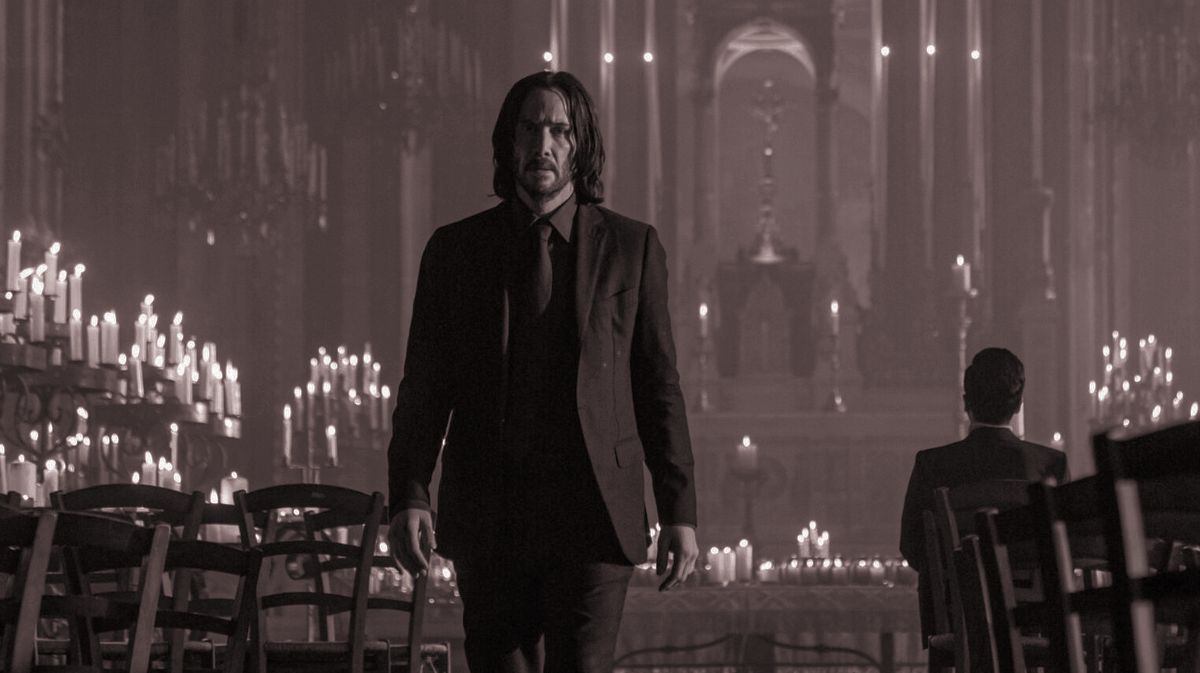
user might, say, decide to generate an image of Keanu Reeves as Indiana Jones. Would Disney then owe Reeves a licensing fee? “It becomes very complicated, very quickly,” Arrigoni said. The key, he said, is working with the studios directly, so they can tell Loti which actors are allowed to play which characters, and what kind of iconography—i.e., a whip and a hat—cross the threshold between an actor and a copyrighted character.
In other words, there’s still a
lot of work that needs to happen at the legal level before these sorts of issues are resolved—and the industry is just at the beginning of this adventure. “I don’t think we’re going to get a silver-bullet solution through legislature, courts, or private ordering anytime soon,” Mammen said. “There’s going to be a laboratory of experimentation, and some stuff’s going to work and some stuff’s not going to work, and it may be a while before it stabilizes.” Loti, for its part, is just hoping
that it can bring Hollywood and Silicon Valley to the same table. |
That’s all for today. I’ll see you next week.
Ian |
|
|
|
Join Emmy Award-winning journalist Peter Hamby, along with the team of expert journalists at Puck, as they let you in on the
conversations insiders are having across the four corners of power in America: Wall Street, Washington, Silicon Valley, and Hollywood. Presented in partnership with Audacy, new episodes publish daily, Monday through Friday. |
|
|
|
Ace media reporter Dylan Byers brings readers into the C-suite as he chronicles the biggest stories in the industry: the future
of cable news in the streaming era, the transformation of legacy publishers, the tech giants remaking the market, and all the egos involved. |
|
|
|
Need help? Review our
FAQ page or contact us for assistance. For brand partnerships, email ads@puck.news.
You received this email because you signed up to receive emails from Puck, or as part of your Puck account associated with {{customer.email}}. To stop receiving this newsletter and/or manage all your email preferences, click here. |
Puck is published by Heat Media LLC. 107 Greenwich St., New York, NY 10006 |
|
|
|
|