 |
| Welcome back to The Best & The Brightest. I’m Peter Hamby. |
| It’s great to be back in the saddle after a relaxing holiday. We are just a week away from the Iowa caucuses, which means we’re a week away from no longer having to pretend that the Republican race is actually competitive. The political media has invested a lot of time and money in making this primary seem more competitive than it actually is—that’s what we do—but even reporters on the campaign beat are tired of the pretense. It’s time for the press to start focusing on the real campaign—between Donald Trump and Joe Biden.
But first, Abby Livingston’s dispatch from the Capitol… |
| Boebert Being Boebert & AIPAC vs. Agwan |
|
Winter recess is nearly over, which undoubtedly is fueling dread among members who are currently heading to their local airports for the trip back to Washington, but also among the Capitol Hill staffers preparing to receive the circus once it arrives in town. And yet, this recess proved, once again, that time off in the home district is not always a good thing…
- Exhibit A: Lauren Boebert and her ex-husband, Jayson, engaged in some kind of public, physical altercation that drew a police presence in her Colorado district on Saturday night. Jayson told The Daily Beast that Lauren hit him in the face. The congresswoman responded, “I didn’t punch Jayson in the face and no one was arrested.”Ten years ago, this sort of incident would have been mind-blowing. These days, it’s just a relic of a slow news day. But there’s at least one politically interesting thing to behold here: The incident took place in Boebert’s hometown of Silt, which is a four-hour drive away from the lines of the 4th District, where she intends on running in the late-June primary.
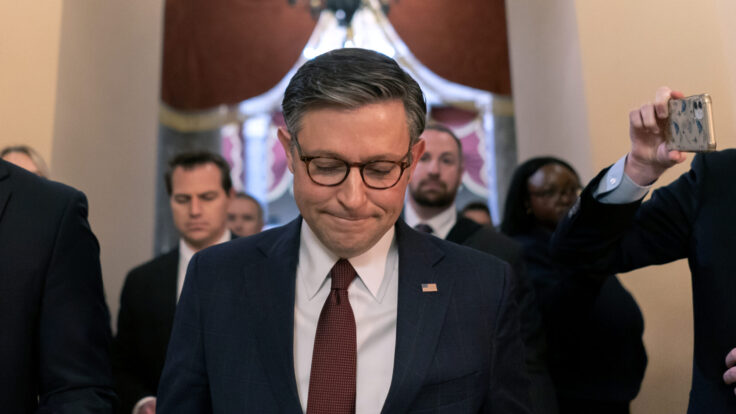
- Plus some good news for House Republicans…: California Gov. Gavin Newsom announced Monday that the special election to replace now-resigned former House Speaker Kevin McCarthy will take place on March 19. There was plenty of apprehension preceding that proclamation, since the sooner that election is held, the sooner Mike Johnson and the rest of House Republican leadership will bolster the House G.O.P.’s margin. The current expectation is that House Republicans will have a margin of one by the end of the month.Of course, Washington Republicans must be rooting for a single candidate in this safe seat to consolidate the vote and garner 50-percent-plus-one vote. If that happens, Republicans can avoid a May 21 runoff, and get McCarthy’s successor in office ASAP.
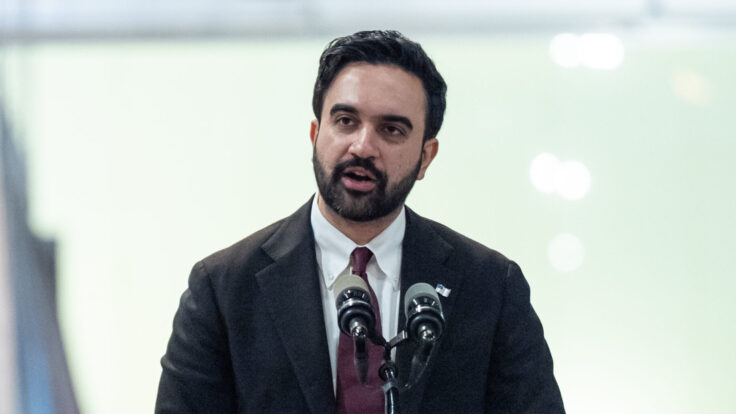
- And finally… AIPAC vs Agwan: Third-term Houston Democrat Lizzie Pannill Fletcher is taking her primary seriously. For the first time since her district saw a major redraw two years ago, she has a challenger: Pervez Agwan, who’s raised serious money (more than half a million dollars but with a very high burn rate). And he’s running against her on one of the most sensitive topics within the Democratic Party right now: the Israel-Gaza war. Currently, Fletcher is the only AIPAC-endorsed incumbent who has any semblance of an organized primary opponent, and Texas’s primary will be on March 5, the first primary day for Congressional races. So this is an early-season race to watch.Fletcher has picked up endorsements from both the new and old House Democratic leadership regimes. In a joint announcement, current leaders Hakeem Jeffries, Katherine Clark, and Pete Aguilar gave Fletcher their nod, along with Old Guard endorsements from Nancy Pelosi, Steny Hoyer, and James Clyburn. Leadership tends to only do these kinds of public endorsements when an incumbent is feeling anxious—after all, you don’t tend to see party leaders engaging in races where incumbents are running unopposed or against underfunded challengers.
|
 |
| We’re Not in Iowa Anymore |
| Alas, it has taken till Iowa for the national media to admit that not all races were built the same. |
|
|
|
| The Iowa caucuses are just one week away. Every four years, the Des Moines Airport starts to run out of rental cars as national reporters and political tourists from Washington and New York converge on the state to chronicle the starting gun of primary season. Against the backdrop of Republican candidates scraping for votes is the quadrennial media spectacle: The bar at the Des Moines Marriott will fill up with reporters and operatives; national TV networks will set up broadcast headquarters across the city with platoons of staffers; the kitschy apparel shop Raygun will sell out of quirky political T-shirts; and young journalists who have been living in Iowa for a year will inevitably grouse about the sudden arrival of big-name national correspondents parachuting into town just for the final few days.The national media invested a lot of time and money into covering this race, under the assumption—when it began, at least—that it would be just as enthralling and dramatic as recent ones, a boon for ratings, clicks, and revenue. The stakes were obvious: a possible resurrection of Donald Trump, and yet another battle for the soul of the nation, as his likely Democratic opponent, Joe Biden, frames it. The horse race story would be there, too, with other Republicans finally stepping up to challenge Trump, who would surely be damaged by his trail of electoral losses and legal challenges. No Democratic primary? No worries. Republican infighting has always made for a good story with a healthy sprinkling of crazy, especially in the Trump era.
But with Iowa looming, the race simply hasn’t lived up to the hype—not even close. “The first primary I covered was the final stages of the 1984 Democratic race between Walter Mondale, Gary Hart, and Jesse Jackson,” said Ron Brownstein of The Atlantic and CNN. “Over that period, I really can’t think of another primary race that has seemed as lifeless, or pro forma, as this year’s. There’s just no precedent in my experience for the half-hearted kind of race we’re seeing in the Republican primary.” Even so, the national media has done its best to make this whole spectacle seem compelling, covering incremental polling shifts for second place with all the drama of Edward R. Murrow reporting on the Blitz from the rooftops of London.
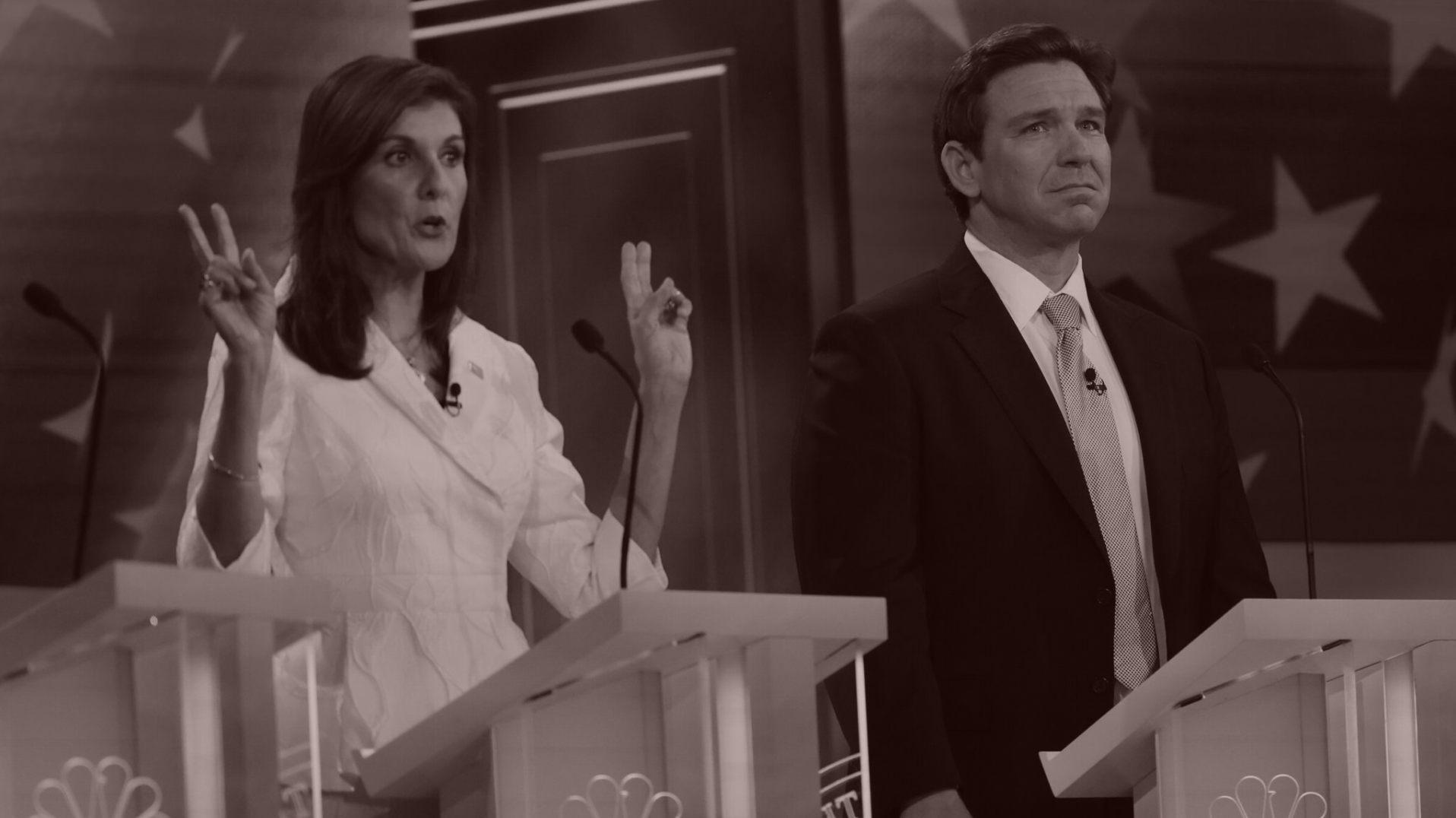
It hasn’t worked. Try as the TV networks might to hype up “Election Night in America” next week, the truth is that this is a snoozer of a primary, irrelevant to the general public, and followed with interest only by hard-core news addicts and Republicans within driving distance of a Hy-Vee or Kum & Go. Each night, the primary is routinely the third or fourth story on the network evening news broadcasts—the most-watched television news shows in the country, and a good indicator of how little appetite there is for Ron DeSantis or Nikki Haley with national audiences. But even for political insiders, there’s really not a lot to say, not a lot to cover. I glanced at Politico’s homepage today, which in past cycles would be absolutely swamped by Iowa coverage with just a week until the vote. I had to scroll down past stories about Lloyd Austin and Israel and congressional redistricting to find an actual story about Iowa, which is pretty remarkable. The story itself was a simple “What we’re watching” preview, asking the question: Will it be a Trump blowout, or could he face some serious competition?
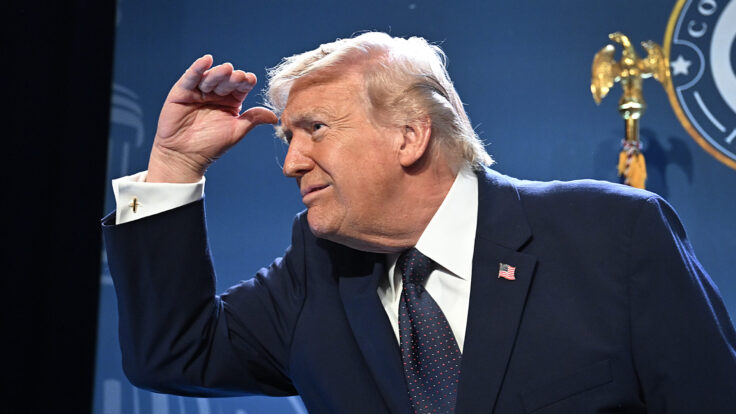
Come. On. This is the least competitive caucus race since 2000, when George W. Bush routed his opponents in Iowa—and that rout was only a 12-point win. Trump is on pace for a 25-point victory or more. Trump has carefully—and smartly—managed his exposure this cycle, skipping televised debates and limiting his appearances in Iowa. Strikingly, his opponents have mostly refused to attack him head-on. Trump’s absence from center stage, and the lack of interaction between the frontrunner and his rivals, has deprived the press of the he-said, she-said excitement that typically dominates coverage at this stage of a primary. The campaign matters, of course. It feels like the fate of the country is at stake in November. But we don’t have to pretend that this primary is anything but a dud.
“The lack of drama is self-evident,” said Jonathan Martin, the senior political columnist at Politico, now covering his fifth presidential campaign. “Trump’s dominance of his own party, and the coat of armor put around Joe Biden to ward off any major primary threat, is hugely significant for reasons that are equally self-evident. It just doesn’t make for a lot of suspense about what that Saturday night Ann Selzer poll is going to have.” That Selzer poll—a high-quality poll from The Des Moines Register and NBC News—usually drops the weekend before caucus day. Steve Kornacki of NBC News said it will drop later this week. Sure, there’s a chance it might show Trump with something less than the 32-point lead over DeSantis that he held in the Selzer poll from December, and maybe Haley will have moved past DeSantis into second place. But no one in the press, and not a single Republican in Iowa, believes Trump will lose next week. |
|
|
| For people trying to make this race a story, the best-case scenario is that Haley surges into a sturdy second place next week, sending DeSantis back to Florida after his remarkable collapse this year, and then capitalizes on that momentum in New Hampshire, where she has been climbing in the polls. But as I wrote late last year, everything has to fall Haley’s way from there, in the long slog between New Hampshire and South Carolina, her home state, where Trump is now more popular than she is. Back in 2000, Bush got a scare in New Hampshire, too, from John McCain, who became a media darling for a month. But Republican primary voters had other ideas, and Bush thumped McCain by 12 points in South Carolina weeks after his New Hampshire boomlet.McCain, at least, was willing to attack Bush directly, unlike Trump’s challengers today, who pick and choose when to deliver the mildest of criticisms, taking pains not to piss off the MAGA base. Granted, Haley has been chiding Trump about the “chaos” he leaves in his wake. But over the weekend in Iowa, she told one G.O.P. audience that, “For those that want me to hit Trump more, I’m just not going to do it.”
Ten years ago, following the 2012 campaign, I published a study for Harvard University’s Shorenstein Center about the ways Twitter had forever changed campaign coverage. I found that while much has changed since Tim Crouse wrote The Boys on the Bus, about the traveling press corps back in 1972, one characteristic of mainstream campaign coverage has endured over the decades: an obsession with the almighty horse race. That is, the daily question of who’s up, who’s down, and who attacked whom. This cycle, with Trump in cruise control and none of his rivals throwing elbows, what’s to cover?
“We’re covering reality. The reality is that Trump built the biggest lead of any non-incumbent in Iowa because he kept getting indicted,” said Dave Weigel, Semafor’s veteran road-warrior political reporter. “In 2015-2016, which I think most people will agree was the most exciting, traffic-generating modern primary, Trump would say something and his rivals would scramble to react, because they expected his bubble to pop eventually. When it did, surely, one would benefit. This cycle, his rivals generally tried to avoid talking about him unless they were defending him, and with him 30-40 points ahead, it raised constant questions about what the point of this was.”
Before the 2020 Democratic caucuses, there were more than 2,000 candidate events in Iowa between all the candidates. This time? Axios calculated there have been less than 400 campaign visits from Trump, DeSantis, Haley and Vivek Ramaswamy. In 2020, the Iowa Democratic Party credentialed more than 2,600 members from the press from 26 countries to cover the caucuses. If the Iowa G.O.P. beats that number this year, I’ll buy them some pork chops.
Iowa just matters less, and so does New Hampshire, and so do Nevada and South Carolina. The issue set is nationalized, the media environment is more splintered than ever, Trump is running in absentia—and left by the wayside are a bunch of candidates who can’t figure out how to do anything about it, or just choose not to.
Browstein told me that covering this campaign “feels like we are at some kind of event where everyone in the room is doing their best to ignore what’s going on around them, like a crack in the floor that everyone pretends not to notice. From the outset, it’s been clear that only a handful of Republican candidates on the periphery of the race were willing to make a forceful case against Trump. The rest of them, including the two principal alternatives, DeSantis and Haley, have been willing only to go so far and no farther. And that’s created a kind of going-through-the-motions quality to this race, which I think has made it really difficult for the press.” |
|
|
| Trump’s skipping out on the Republican debates will be remembered as the wisest strategic decision of the primary. Not only did it allow him to avoid any arrows from his opponents or get tripped up by debate moderators, it made his rivals look small. The undercard debates still delivered bigger-than-usual ratings for the TV networks, at least compared to their usual primetime numbers. But without Trump onstage, the debate ratings were dismal compared to the megawatt primary debates of 2016, and barely kept pace with those of 2020’s Democratic primary debates.About 13 million people watched the first Fox News debate in August. Back in 2016, 24 million viewers tuned into Fox to watch Trump pop off in the first debate. It’s not hard to explain the decline. Americans are sick of political news. The problem of “news avoidance” is now rivaling revenue models as the singular challenge for newsrooms. In 2016, Trump was new and entertaining. Now, he’s old and tiresome—and unpopular. So is Biden. No wonder regular people aren’t tuning in. It’s hard to sell products people don’t want to buy.
That 2016 Fox debate also made Megyn Kelly a household name, after she sparred with Trump in Cleveland. In fact, the 2016 campaign catapulted a lot of journalists to a level of national celebrity newsrooms hadn’t seen since Woodward and Bernstein made it to the big screen. Katy Tur, Maggie Haberman, David Fahrenthold, Hallie Jackson, Jim Acosta, Jonathan Swan, Nate Cohn, Robert Costa, Olivia Nuzzi, Josh Dawsey—all of them became media stars, and almost all of them landed book deals and better contracts with their employers. This election? It’s hard to become a star covering the 2024 campaign. Sure, reporters have been working around the clock, following Ron and Nikki to Pizza Ranches and sourcing up in Mar-a-Lago, but the story just isn’t there. The main characters—Trump and Biden—are known commodities, the major scoops few and far between. If there are big developments in the G.O.P. race, they’re usually emanating from a federal courthouse, not a town hall in Pella.
Who are the stars of 2024? Dasha Burns of NBC News, who has landed a number of exclusive interviews and is well-sourced in DeSantis world, is at least one name that comes to mind. But it’s harder now to become reporter-famous because TV news has been losing its attentional powers for years, and American voters are increasingly getting their news and information from social media feeds, short-form video, podcasts, and push alerts. Multiplatform partisan content creators like Brian Tyler Cohen and Ben Shapiro now have more reach than most national reporters. Underscoring the challenge for traditional media, a poll from Morning Consult last year found that only 40 percent of Republican voters consider debates “very important” to their decisions. That’s an eye-popping number for those of us who covered the 2012 Republican primary, when every burp and hiccup in a televised debate would lead to tectonic shifts in the polls.
This cycle, what’s the incentive for a Republican to sit down with a reporter from NBC or The New York Times? To reach primary voters, you’d be better served doing an interview with Charlie Kirk or the Nelk Boys or Tucker Carlson’s Twitter show. For a campaign, getting airtime on mainstream news broadcasts used to be the centerpiece of media strategy. That’s been a declining priority for years, and now it’s something a candidate does only if he or she absolutely needs to, like when DeSantis tumbled so far down in the polls he was forced to start going on CNN, a network he had mocked and ridiculed for years.
My view is that many of us in the press were unprepared for the fact that this Iowa race would not resemble the last one, or the one before that. Most journalists working today have only known competitive primaries in their careers. The first presidential race I covered for CNN, in 2008, was the most raucous, thrilling, and unpredictable in our lifetimes—until the one after that, and the one after that. Iowa is supposed to be the Super Bowl of politics! But not this time. And the sooner we get this stage of the race over with, the sooner all of us can focus on the coming war of attrition between the two men who were always going to be the nominees, who were always going to write the country’s next chapter. |
|
|
|
| FOUR STORIES WE’RE TALKING ABOUT |
 |
| Ackman’s Revenge |
| On Bill Ackman’s P.R. battle royale, ESPN’s megadeal, and more. |
| WILLIAM D. COHAN |
|
 |
|
 |
|
 |
|
|
|
 |
 |
|
|
| Need help? Review our FAQs
page or contact
us for assistance. For brand partnerships, email ads@puck.news. |
| You received this email because you signed up to receive emails from Puck, or as part of your Puck account associated with . To stop receiving this newsletter and/or manage all your email preferences, click here. |
| Puck is published by Heat Media LLC. 227 W 17th St New York, NY 10011. |
|
|
|