|

|
|
Hello, and welcome back to The Best & The Brightest.
It’s snowing here in D.C., but it’s much worse in Iowa, which has shaken up our schedule this week. Tomorrow, you’ll get Peter’s reportage on the Iowa caucuses, followed by Tara in New Hampshire on Wednesday, and Tina on Thursday. (Plus, a few pre-caucus notes from Peter and Tara in tonight’s edition, below the fold. And keep an eye out for Tara’s campaign notes in a special episode of The Powers That Be, publishing overnight, and on Somebody’s Gotta Win tomorrow.
📖 Also also: Tina’s book, The MAGA Diaries, drops tomorrow. It’s about her past life inside the conservative activist apparatus, and her escape from it. I’ve been peeking inside the galleys Tina gave me a couple months ago, and to say I can’t fucking wait is an understatement. Which is why I preordered two copies of the book. It was an accident born of my enthusiasm, but I’m not canceling either because, as any author will tell you, preorders are absolutely crucial to landing on the bestseller lists. Which, in addition to acquiring an excellent read, is why you should also preorder Tina’s book here.
Tonight, we have a full plate, with Abby Livingston’s report from Capitol Hill and then my follow-up interview with David Scheffer about South Africa and Israel at The Hague.
But first, a few notes from Peter and Tara as the voting in Iowa begins…
- Trump warning signs: It’s difficult to draw general election conclusions from a Republican caucus dominated by the most hard-core partisans, but I’ll be keeping an eye on a few swingy Iowa counties tonight for some clues about how Trump might perform in November against Joe Biden. Yes, most of the press will be watching the suburban counties outside Des Moines, like Dallas and Story. But I’m also going to be looking at Dubuque and Scott counties in the east, along the Illinois border.
They’re composed of traditionally Catholic, working-class river towns that were once big manufacturing hubs. Dubuque is one of those blue-collar counties that swung from Obama to Trump back in 2016. In 2020, Biden narrowly won the slightly more suburban Davenport, while Trump held on to Dubuque by only 3 points. Trump also did well in both counties in the 2016 Iowa caucuses, winning Dubuque and barely losing Scott County to Marco Rubio. If Trump’s showing with Republican voters is soft in these places, which resemble battleground counties from the rest of the country, that should offer a glimmer of hope to the White House.
If Trump loses either county to Ron DeSantis or Nikki Haley tonight, or if either of them come closer to Trump than his statewide margin, that’s a sign that Republicans in traditional Trump strongholds are queasy about renominating him in 2024. Come November, those voters might be open to Biden… or at least sitting the election out rather than voting for Trump again. —Peter Hamby
- DeSantis options: Obviously, Trump is going to win the Iowa caucus: The latest Des Moines Register poll shows him at 48 percent, Haley at 20 percent, and DeSantis at 16. Because of the messy nature of the caucus process, however, we might not know for days who came in second and how decisively. Iowa G.O.P. chairman Jeff Kaufmann said they won’t declare a winner tonight, perhaps fearful of any blowback, and instead will feed the results to the media and let them decide. Second place is the “real race,” after all, for the donor, media, and consultant class, so this is critical intel that will likely determine how DeSantis rolls into New Hampshire, where he’s a distant third to Haley, or if he even rolls at all. DeSantis’ current campaign schedule has him flying down to South Carolina tomorrow before heading to the Granite State. DeSantis told NBC News today: “We’re going on with this. … It’s all about the accumulation of delegates.” Heard that one before…
If DeSantis loses to Haley, after his super PAC Never Back Down spent some $200 million on a ground operation in Iowa, there will be real questions about whether it’s worth it to invest in a ground game in the state. After all, Haley only set her sights on Iowa after Labor Day, and then cobbled together an operation with the help of the Kochs’ Americans for Prosperity network.
Meanwhile, we should also learn something about Republican voter engagement this cycle, given the horrific weather blanketing the Iowan tundra. The Register poll showed just 32 percent of voters are extremely enthusiastic about voting for Haley. But her voters are clustered in suburbs and city centers, where the roads have been better cleared, as opposed to the more rural areas that run MAGA red. —Tara Palmeri
|
| And now the view from Abby on the Hill… |
|
A MESSAGE FROM OUR SPONSOR
|
|
|

|
Protect patients against PBM abuses. Across the country, policymakers, regulators, patients, doctors, pharmacists, and others agree on the solution to lower drug costs. It’s time for Congress to pass strong PBM reforms.
Learn More.
|
|
|
| Shutdown Math, Trump Endorsements & More |
|
The Iowa caucuses mark the official beginning of campaign season. To have it take place the same week as a potential government shutdown is certain to make for yet another nutty week on Capitol Hill. Herewith, what we are expecting from the Puck bunker…
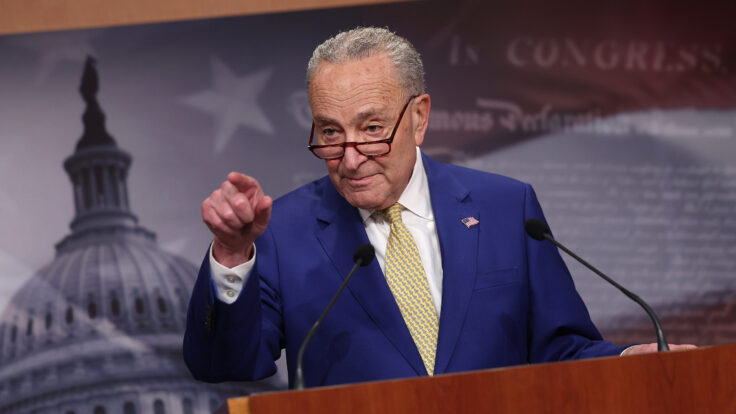
- More shutdown math complications: On the brink of a partial government shutdown this Friday, Chuck Schumer and Mike Johnson announced a deal for a short-term spending bill that they must pass this week. Short-term spending bills have averted many past would-be shutdowns, but here’s the pattern I’ve observed during the last six months: Leaders come out of a recess or a weekend with a plan, only to have it fall apart during the weekly House G.O.P. conference meeting the morning after fly-in day. Moreover, each week delivers a new complication to Johnson’s margin. The latest problem is that Republican Rep. Hal Rogers will likely miss votes this week after a car accident, as Punchbowl noted.
- Let the Trump endorsements rip…: As Republicans hash out their presidential nominee in Iowa tonight and New Hampshire next Tuesday, members who have yet to endorse Trump may feel more pressure from the former president. If Trump wins big tonight, there may be a sense that the train is leaving the station. If he doesn’t, he will almost certainly be turning the screws on reticent members to shore up his support before New Hampshire. Congressional endorsements aren’t that consequential in the delegate battle, but they are important behind the scenes when campaigns rush into a state without an infrastructure. Also on members’ minds: They are in their own primary season, and choosing to not endorse him could create a mess in the states where the congressional primaries are on the same day as the presidential contests.
- Alabama Mean Girls taking shape?: One of those states is Alabama, which is hosting a Republican member-vs.-member primary on Super Tuesday between Jerry Carl and Barry Moore—the result of a court-ordered map redraw. Carl announced last week that he raised $550,000 last quarter. Moore has yet to release his numbers. Still to come is the filing of F.E.C. reports at the end of the month—wherein we discover who among their colleagues is taking sides by way of donations. Also of note here, Carl is an appropriator, which is an important committee assignment in a state that is rebuilding its bench on that front after the retirement of former Senate Appropriations Chairman Richard Shelby last term.
|
|
|
| Last week, ahead of the hearing of South Africa’s case against Israel at the International Court of Justice at The Hague, I brought you a conversation with my friend David Scheffer, the former U.S. ambassador at large for war crimes and a founding father of the International Criminal Court. I normally wouldn’t return to someone I just interviewed the very next week, but there were two things that made me break a rule I didn’t know I had. The first is that so many of you wrote in about David’s interview to say how much you appreciated his perspective and depth of knowledge, and how much texture it added to your understanding of these most charged of issues. The second is that I watched most of the six hours of hearings at the I.C.J. on Thursday and Friday, and had lots of questions myself, including: What did David make of the arguments presented by the dueling parties? So I gave him a call, again.
Our conversation, which has been edited for clarity and length, is shorter than last week’s, but I found it to be just as revelatory. I hope you do, too. |
|
A MESSAGE FROM OUR SPONSOR
|
|
|
|
Protect patients against PBM abuses. Across the country, policymakers, regulators, patients, doctors, pharmacists, and others agree on the solution to lower drug costs. It’s time for Congress to pass strong PBM reforms.
Learn More.
|
|
|
| Julia Ioffe: How did you think the hearings went?
David Scheffer: I can sit here and argue the merits of the South African case. I can argue the merits of the Israeli rebuttal, but I think in the balance of things, in terms of literal law, Israel probably had the edge in the argument.
Why is that?
Israel was bringing forth several of the points that we had talked about in our previous conversation, but they produced them quite effectively. Namely, they reminded the court that the South African application was devoid of the reality of a war—just devoid of it—which is implausible for the argument that South Africa is making. Israel made the point that they are responding to the October 7th attack. They’re acting in the defense of Israel. And they are, in fact, seeking to prevent further genocide, having identified what occurred on October 7th as genocide. So they’re actually complying with the Genocide Convention in responding to the threat to Israel and its people from Hamas.
Now, I say that, of course, fully recognizing that the point South Africa made—though it didn’t make it in the context of warfare—is that the scale of the Israeli assault on Gaza and the Palestinians is totally disproportionate to what happened on October 7th. That point was not really made by South Africa. In other words, South Africa has to accept that something happened on October 7th that would merit a response, and then it would argue the response is disproportionate to the threat. But they didn't make that argument, at least not explicitly, and the judges cannot ignore that problem in the South African argument.
However, we must not understate the importance of South Africa's holistic point, which is that it is not logical under these circumstances for what is happening in Gaza to be identified as entirely justifiable under international law. Their hook to make that argument is the Genocide Convention. Why? Because it’s the Genocide Convention that gets them into the courtroom. And Israel is bound to be there under the Genocide Convention. South Africa could have brought the argument of aggression to the I.C.J., but Israel might not have appeared in the courtroom if it had, because there was not a convention that forced Israel into the courtroom. So the Genocide Convention is the hook.
And that's what makes it rather difficult for South Africa because then they have to prove, literally, genocide as opposed to going into the courtroom and saying there's an armed conflict and that Israel should be judged with respect to the crime of aggression and with respect to war crimes, maybe even crimes against humanity. But they can’t do that. They have to just stick with genocide, and because of this, I think they are perhaps purposely not talking about the armed conflict context. Because once they raise that point, then they’re admitting that there is a war. And the rules of war then apply. |
|
|
| I was surprised that the South African presentation didn’t start with the argument about the incitement to genocide. Would it have made more sense for them to start with incitement before describing the effects of the war?
Yeah, that’s a very good point. They could have done that, and that would have emphasized to the court that we really are here legitimately arguing about the Genocide Convention.
Now, it is interesting if you look at their application, there is a very fulsome list of incitement statements. I thought the Israeli rebuttal to all of that was perhaps the weakest part of the Israeli rebuttal because what they said was, “Oh yes, there are these people saying these things, but what really matters is what is the official government policy, what is said within the war cabinet room. And on that account, all of the instructions say, ‘Do not violate the Genocide Convention. Comply completely with international humanitarian law.’” But that is a weakened argument in the face of the fact that the foot soldiers of the I.D.F. are hearing all of these rather inciteful statements while they’re preparing to go down there [to Gaza]. And of course, those kinds of statements also impact the Israeli population itself, and much of that population is communicating with their sons and daughters and husbands and fathers who are in the I.D.F., so you can’t separate that from what is called “official government policy.” And, unless I missed this, I don’t think the Israelis demonstrated what we might call sort of a public denial of those incitement statements.
Last week, just before the I.C.J. hearing, the Israeli attorney general said something like, “Hey, guys, can you shut up? Because you’re really undermining our case here.”
Right. And I thought that that statement by the attorney general, as necessary as it was, came so late that it almost fortifies the South African argument that there’s a lot of incitement going on.
Well, that and, to your point, it’s hard to point to a different official Israeli policy that’s written down somewhere when the prime minister and the defense minister are saying these things, and say that the incitement is not coming from the government.
Exactly. You know, it’s so interesting because it is the easiest thing for a government to do in these circumstances, from October 7th onwards, to discipline its officials and get the rhetoric straight about what we’re doing and not to leap to the politically advantageous incitement rhetoric, which is very tempting. And if that rhetoric were to happen, then you immediately shut it down—publicly. And that, I think, is another very interesting thing about Netanyahu. This feeds into the whole argument that he’s stoking the legitimate fears of his own people to perpetuate his power. |
|
|
| Was there anything you saw in the two days of hearings that surprised you or that you didn’t expect?
Let me put it this way. I was not surprised by how vigorous the Israeli rebuttal was on so many issues, including the key argument they made, which was, “How can we be charged with genocide when we have been issuing evacuation notices? We’ve been dropping tons of leaflets. We’ve been requesting that civilians move to safer areas. If we had genocidal intent, we could have ignored all of that and just struck with abandon at the Palestinian people. Which we argue we have not done.” I thought that was a very, very good Israeli argument, as well as a very detailed accounting of the humanitarian assistance they are getting through.
What did surprise me was what I thought was a real weakness in the South African presentation. They could have at least orally made a far more empathetic statement with respect to October 7th, a far more insightful statement about the reality of Hamas. They completely ignored the reality of Hamas and what Hamas’s ideology is. The smarter lawyer would have said, “I’m not trying to be evasive, Your Honors. I come to you with a fair assessment of what has occurred in Gaza. And part of that fair assessment is, yes, we recognize the issues of Hamas, we recognize October 7th, but the Israeli response has been grossly disproportionate to the threat and has resulted in genocide.” That’s what I was waiting for as an argument by South Africa, but it didn’t come. |
|
|
| People toss around the numbers of the dead in this war. 1,200 dead in Israel, 23,000 dead in Gaza, including militants. Do the raw numbers play a role in determining whether a genocide has in fact occurred?
Numbers do come into it, yes. In the law we talk about, “Have you reached the gravity level yet?” We use the word “gravity,” particularly in the International Criminal Court. It’s the magnitude.
This is an argument I’m developing on the sidelines here, which is: I think there are weaknesses in international law. One of the weaknesses is that we don’t quite know how to calculate the metrics of a genocide or of crimes against humanity. The metrics on war crimes are pretty good because we’ve got fairly specific rules on how to use military power in warfare. That’s been the case ever since the Hague Conventions at the turn of the 20th century. But when it comes to the metrics of death, of destruction of property—that becomes a judgment call for whatever particular court you’re standing in front of and how those particular judges see that issue. The International Criminal Court sometimes turns away certain cases that come to it simply on the issue of gravity. They say, “Yeah, it’s just not large enough yet.”
The numbers that have erupted in Gaza would fit within a genocide analysis. Even if one were to demonstrate that, of the 23,000 people the Hamas health ministry says have been killed in Gaza, let’s say even 10,000 of those are Hamas militants, you’re still looking at 14,000, 15,000 or so deaths, with a huge number of those being women and children. It would be implausible for that not to constitute genocide under the proper evidential standards. In other words, that would pass the gravity test.
Just because it’s such a big number?
Yeah, it’s such a large number. Under the U.S. interpretation of the Genocide Convention, it needs to be a substantial part of the population. In Srebrenica, the 8,000 killed constituted a substantial part of the Bosnian Muslim population of Bosnia at that time. I think that [Gaza] number could be argued to be a substantial part of the Palestinian population. That would be a fair argument to me. But in order to get to genocide, you do have to pair the action with the specific intent.
Now, bear in mind, specific intent can be proven inferentially, in terms of looking at the entire actions of the Israel Defense Forces and of the government and tacking facts and statements and all sorts of things together. I think that’s good for the Genocide Convention to have that ability to show inference of intent, because usually the masters of genocide do not document their intent. Usually, it’s an inferential exercise, and we need that tool in the Genocide Convention to prove mens rea.
If you were a judge sitting there on the I.C.J. panel last week, how would you rule?
I would rule on some provisional measures, recognizing that no one is reaching the merits yet on this issue. Those provisional measures would not be exactly those that South Africa has put forward—but, if I were a judge, I would instruct Israel to fully comply with the Genocide Convention in its military operations against Hamas in Gaza, period. That said, I would not agree to a provisional measure that says, “Cease fire,” because that deprives Israel, essentially, of the right of self-defense. It’s basically telling Israel to stand down and I think that’s a bridge too far. But it would still be a very powerful signal, a very powerful instruction to Israel that they cannot take any action that violates the Genocide Convention.
I would further require that Israel cease all public statements or statements within policymaking discussions that could reasonably be construed as incitement to genocide and that government officials publicly reject all statements that could be construed as incitement to genocide, that the government of Israel explicitly reject any of those statements publicly. And that Israel preserve all evidence of its military operations and policy decisions from October 7th onward.
I would also consider a provisional measure that, in order to minimize the possibility of charges of genocide, that Israel cease using 2,000 pound bombs and unguided munitions—dumb bombs.
Here’s the other thing. Can I just tell you my dream here?
Yeah, go for it.
What is lacking in this entire exercise is any state party to the Genocide Convention bringing the State of Palestine to the I.C.J. on the charge of commission of genocide on October 7th. Palestine is a party to the Genocide Convention. It’s a state party. Israel is a state party. If you want to have a balanced approach to this entire issue, there should be a parallel case in front of the I.C.J. that brings the State of Palestine, which in this case, exhibited its destructive and deathly power through Hamas, to the court to seek judgment on the genocide on October 7th. We’re still missing that component. Without that, I think it’s less likely that the judges will act blind to October 7th. In my view, they will not ignore the reality of October 7th, and that will possibly influence how they view the provisional measures proposed by South Africa.
Israel could bring those charges to the I.C.J. Why do you think they haven’t?
Israel has not recognized the State of Palestine, so it would be sort of contradictory for it to bring Palestine to the court, but certainly many other countries could. I think it would be a fair distribution of analysis and of scrutiny to the facts that have unfolded since October 7th for Palestine to also be before the court. That would be helpful because the judges have to factor in that Israel is claiming that it’s doing what it’s doing in Gaza because of the need to defend Israel and to prevent further genocide. The only way to unpack that argument is to have a clear understanding of October 7th, and that means bringing Palestine into the jurisdiction of the court for that examination. |
|
|
| That’s all from me for this week, friends. Tune in tomorrow for Puck’s coverage of the Iowa caucuses—and don’t forget to order Tina’s book. I’ll see you back here next Tuesday. Until then, good night. Tomorrow will be worse.
Julia |
|
|
|
|
FOUR STORIES WE’RE TALKING ABOUT
|

|
Ackman’s Revenge
|
|
On Bill Ackman’s P.R. battle royale, ESPN’s megadeal, and more.
|
|
WILLIAM D. COHAN
|
|

|
|

|
|

|
|
|
|

|
 |
|
|
|
Need help? Review our FAQs
page or contact
us for assistance. For brand partnerships, email ads@puck.news.
|
|
You received this email because you signed up to receive emails from Puck, or as part of your Puck account associated with . To stop receiving this newsletter and/or manage all your email preferences, click here.
|
|
Puck is published by Heat Media LLC. 227 W 17th St New York, NY 10011.
|
|
|
|