{{ 'now' | timezone: 'America/New_York' | date: '%b %d, %Y' }} |
|
|
Hello, and welcome back to Line Sheet. Tonight: What in the world is going on at J.Crew? The mall brand
turned cool a few years ago, but a round of layoffs has many people in New York asking if the sales are as good as the hype. (This is why you upgrade to Puck’s Inner Circle, people.) Up top, a bit on Bode’s slo-mo strategy, the latest in Les Wexner news, and a quick note on all the model stuff in the Epstein files.
Tomorrow on Fashion People, my guests
are Elissa Santisi and Francesca Keller. Elissa is a famous (and famously cool) stylist, Francesca is an actress, producer, and maker of hilarious TikTok videos, many of which star Elissa. We discuss Elissa’s life in fashion, Francesca’s experience of Elissa’s life in fashion, their shared fame, Phoebe Philo, and so much more. (Requisite
reading: Alyssa Vingan’s New York Times piece on the duo.) Listen here and here. |
|
|
A MESSAGE FROM OUR SPONSOR |
Sharing its name with the French term for the liminal moment linking late afternoon and early evening, Cinq à Sept
brings the intriguing tension between day and night to an advanced contemporary collection. Inspired by the hours between 5 and 7 p.m., when city streets are awash in the warm glow of the vanishing sun and office desks are abandoned for cocktails and as-yet unknown possibilities, Cinq à Sept embodies a deliberate balance between sophistication and ease, youthful daring, and confident allure. |
|
|
Mentioned in this issue: J.Crew, Brendon Babenzien, Elodie David,
Pieter Mulier, New York Fashion Week, Yoyogi-Uehara, Phoebe Philo, Bode, Carolyn Bessette Kennedy, Wes Anderson, Kevin Ulrich, Skims, Collina Strada, Ralph Lauren, Eckhaus Latta, Benjamin Talley Smith, Celine, Nikolai von Bismarck, The Row, Maryam Nassir Zadeh, Abercrombie & Fitch, Emily Adams, and more… |
Three Things You Should Know…
|
- Les’s
(second-to-last?) stand: Les Wexner, the pioneering retail executive who turned Victoria’s Secret, Bath & Body Works, and Abercrombie & Fitch into icons of consumer culture, testified in front of members of the House Oversight Committee regarding his relationship with Jeffrey Epstein on Wednesday. A video of the closed-door deposition, which took place at Wexner’s home in New Albany, Ohio, a town he developed himself, is
available on the G.O.P. Oversight Committee’s YouTube channel, despite the fact that they originally said it would be made available via transcript only. The most revealing bit, from what I have had time to review, is that Wexner denied ever meeting late Epstein accuser Virginia Giuffre, who once said Wexner sexually abused her (but eventually backtracked the
accusation).
Prior to the deposition, Wexner released a statement outlining his version of how he met Epstein and ended up working with him, and his testimony mimicked the note. “Over the years, I have been the subject of outrageous untrue statements and hurtful rumor, innuendo, and speculation,” he wrote. “Let me state from the start: I was naïve, foolish, and gullible to put any trust in Jeffrey Epstein. He was a con man. And while I was conned, I have done nothing wrong and have
nothing to hide.”
Maybe so, but there’s no denying that Wexner made Epstein very rich. In the statement, Wexner made no mention of the “gang stuff” that Epstein referred to in communications to Wexner, nor did he mention his sister, mother, ex-girlfriend, and former business associates, all of whom Epstein called out in his notes to Wexner as people he essentially dealt with for the executive. However, Wexner did say he vetted Epstein with Bear Stearns’ Ace
Greenberg and Jimmy Cayne. He also explained why he granted Epstein power of attorney—which has been one of the great mysteries of their relationship.
Early on, Wexner explained, Epstein was simply a friend with benefits. “Epstein offered me advice here and there while explaining that giving individual financial advice was not his focus and refusing to accept compensation,” Wexner wrote. “He said he was assisting me as a favor. Little did I realize that, from the
very start, Epstein was conniving to gain my trust. As my financial resources and time demands continued to grow, I formally hired Epstein to manage my personal finances. Because my public company and other duties required my full attention, I provided Epstein with a power of attorney so he could execute transactions quickly, without constantly requiring my signature.”
As someone who wrote a
book about Wexner—a shy man who lacked confidence in his body when he was young—this tracked for me. What makes less sense is how Wexner could have worked so intimately with someone for 20 years and known nothing about his illegal activities.
After the testimony, a spokesperson for Wexner said that he “honestly answered every question
put to him today by the committee,” and that “Mr. Wexner reiterated that he has no knowledge of, and did not participate in, Epstein’s illegal conduct.” He answered so honestly, it seems, that at one point during the deposition his lawyer leaned over to him and whispered, “I’ll fucking kill you if you answer another question with more than five words, okay?”
This may not be
the last time the 88-year-old Wexner takes the stand: He’s also been called to testify in a case involving a former Ohio State University doctor accused of rape by students over the span of 30 years. Wexner was on the school’s board of directors during much of that period. More to come, I’m sure. - The modelizers: One of the most interesting details about the Epstein files, at least to me, is how few big fashion industry power players were mentioned.
There are reasons for this. Epstein mostly advised wealthy people in the U.S., and most major fashion execs are European. Also, luxury fashion only became a truly giant, global business in the mid-2000s, around the time of Epstein’s first prosecution. Finally, as Peter Hamby pointed out on Friday’s episode of The Powers That Be, a lot of the guys engaging with Epstein and Ghislaine Maxwell were massive dorks. And while not every executive in fashion is
smart, they tend to be able to hold a conversation.
Anyway, the one fashion-adjacent subset in the files is modeling agents, and our ace researcher Maya Tribbitt recently combed the documents to figure out the scope of the role that the modeling industry played in facilitating Epstein’s behavior. (As readers may remember, he often posed as a model recruiter for Victoria’s Secret.) Obviously, the late French model scout Jean-Luc Brunel was at the center of
the correspondence between Epstein and the modeling world, with more than 4,000 mentions in the documents including duplicates. But there was also Model Management founder Faith Kates, who “retired” from the agency in December (another 4,000 mentions). Meanwhile, hundreds of other emails show Epstein procuring models from scouting agents (like Daniel Siad) all over the world for unclear purposes.
We all know that modeling has historically
been, by and large, an exploitative industry. But the Epstein files underscore why more reform is still necessary. I reached out to Kates regarding her relationship with Epstein but have yet to hear back. As for Siad, he told a French television station that Epstein “took advantage of my trust. He’s a gentleman, he knows how to talk, he’s a diplomat. I wasn’t in a position to know that this man was dangerous.” - The Bode way: I remember a Bode show
during Paris Men’s Fashion Week several years ago where the models walked so slowly I couldn’t even pay attention to the clothes. It was annoying, but also fitting for Emily Adams’s brand, which likes to move slowly—and that is, runway shows aside, a good thing. She stages fashion shows and opens stores when she wants to. This week, for instance, she debuted an outpost on the ground floor of an apartment building in Tokyo’s Yoyogi-Uehara neighborhood. Naturally, it was
designed by Green River Project, the interiors firm run by her husband and frequent collaborator, Aaron Aujla, who designs rooms fit for a Wes Anderson film. (I’m sure he would bristle at that description faster than you can say “Popeye magazine.”)
|
- Bode
undoubtedly scored some funding to fuel this retail expansion—there are stores in New York, Los Angeles, and now Tokyo—but it also doesn’t feel rushed. Rather, the beginning of a 20-year path to something bigger, akin to what The Row achieved over the same span, but without relying so much on the wholesale market. Also, Bode is a lifestyle brand, which means the potential for growth is far larger than a fashion pure play: homegoods, hotels, etcetera. If you want to anoint someone heir apparent
to Ralph Lauren, it’s no doubt Bode. Don’t ask me about revenue numbers for at least five years.
|
And now on to the main event… |
|
|
Menswear designer Brendon Babenzien’s exit at J.Crew is a signal that a recent stretch of
buzz-building at everyone’s favorite mall brand is giving way to the realities of retail at scale. |
|
|
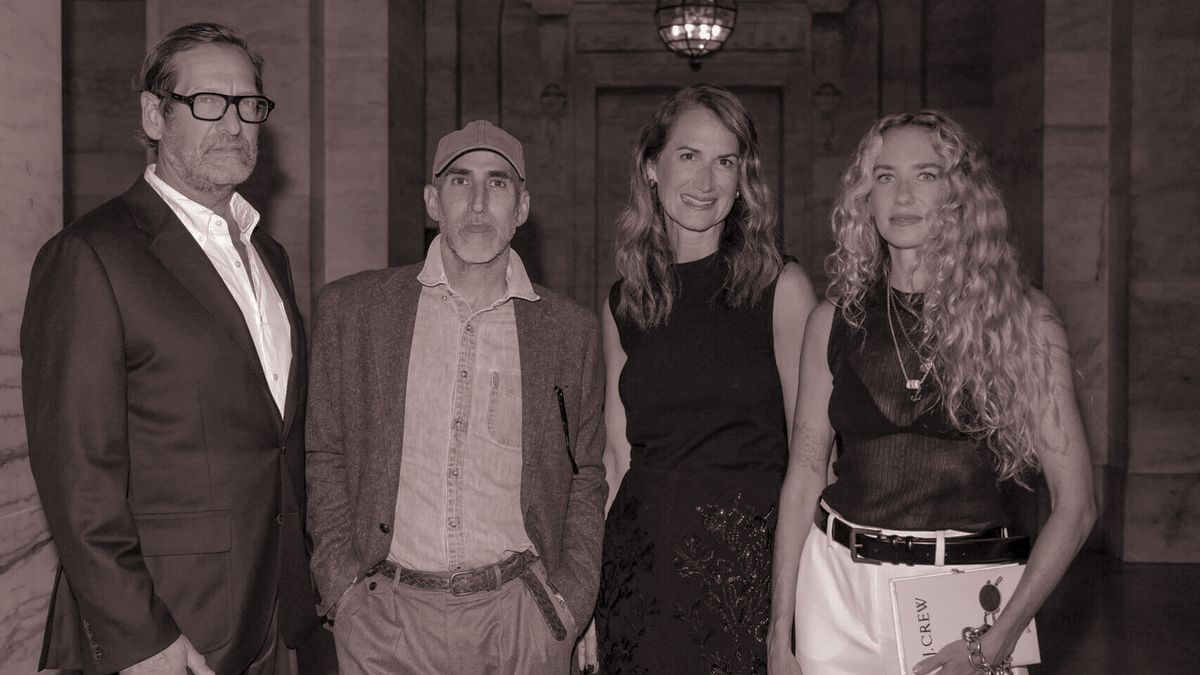
During New York Fashion Week, the team at J.Crew once again managed to hold the conversation while steering
clear of a runway. At the Olney Gleason gallery on Tuesday night, the privately owned brand celebrated the “rollneck remix,” a collection of limited-edition jumpers rendered in the style of that straight-out-of-Singles ’90s cotton knit, by various indie labels—from Collina Strada to Eckhaus Latta. Several versions sold out almost immediately, just in time for the start of the shows, where creative director Olympia Gayot was a front-row fixture in her perfect Lee
jeans.
|
|
|
A MESSAGE FROM OUR SPONSOR |
Sharing its name with the French term for the liminal moment linking late afternoon and early evening, Cinq à Sept
brings the intriguing tension between day and night to an advanced contemporary collection. Inspired by the hours between 5 and 7 p.m., when city streets are awash in the warm glow of the vanishing sun and office desks are abandoned for cocktails and as-yet unknown possibilities, Cinq à Sept embodies a deliberate balance between sophistication and ease, youthful daring, and confident allure. |
|
|
Gayot, a former stylist who got an early start at the well-loved denim label Earnest Sewn, has been the
not-so-secret weapon in the recent J.Crew renaissance. Guided by C.E.O. Libby Wadle—a Mickey Drexler disciple who survived several failed C.E.O.s before convincing the board that she could run the thing herself—J.Crew has managed to become the “cool” mall brand, employing tastemaking elites, such as Parisian art director Franck Durand and the photographer Sean Thomas, and collaborating with niche, beloved labels including Maryam
Nassir Zadeh, Alex Eagle, and Araks.
There’s plenty to like about this incarnation of J.Crew. It’s not like Gap or Old Navy, which don’t matter to fashion people beyond their historical relevance. (See: the Oldgap_ Instagram account.) The clothes are simple and nuanced, the brand hires cool models, and the stuff doesn’t look tacky. But positive sentiment does not always equal positive
sales, especially in the low-margin game of mass retail, which is inevitably lousy with markdowns. And despite an image overhaul led by Wadle and Gayot—and, to a lesser extent, outgoing menswear designer Brendon Babenzien and board chair Kevin Ulrich—the company has not addressed the problem that plagues almost all mid-priced
brands in this market: It’s nearly impossible to make a profit without considerable scale.
J.Crew stopped publicly reporting financial results after restructuring its debt through a pandemic-era Chapter 11 bankruptcy filing, but revenue—which is approaching $3 billion across J.Crew, Madewell, and J.Crew Factory, I’m told—is now heavily weighted to the off-price channel, according to people with access to the financial figures. A person close to senior management told me that off-price,
which the brand refers to as the “value” channel, was performing well. But this person also stipulated that this segment relies on a different customer than the full-price channel, where the team has worked hard for the past six years to reduce reliance on the markdown cycle.
Meanwhile, once fast-growing sister brand Madewell has collapsed after missing the mark on loungewear during the pandemic, and a subsequently disastrous tenure with an unchic C.E.O. who didn’t understand how to make
the jeans look good. And while J.Crew’s men’s category is the healthiest part of the parentco’s business, it’s still tiny compared to women’s—which has been described to me as “tanking.” A source close to Wadle pushed back on that, saying they are making the progress they expected in a tough women’s market. According to data provided to me by research firm Consumer Edge, sales at J.Crew—across the full-line and off-price channels, in-store and online—were down every month for the past 12 months
ending in January, in some months by more than 10 percent. (Consumer Edge’s data was culled from 40 million U.S. credit cards.) This data, of course, doesn’t account for all revenue taken in by J.Crew, and isn’t reflective of productivity or profitability. But it’s an indicator, nonetheless.
Anyway, was this all the pretext for Babenzien’s sudden announcement, this past week, that he was exiting the business? Or why several employees on his team were let go in a round of
layoffs, which a source close to leadership described to me as minimal and a beginning-of-the-year house cleaning? |
The answer may be simpler than expected. J.Crew, which has debt holders, needs to sell sooner
rather than later, even if they aren’t currently in discussions to do so. The brand missed a window a few years back, when revenue was up and buzz was intense, and it needs to thin out significantly to lure a buyer this time around. In this strategy, it would make sense to merge the men’s and women’s brand identities—from the campaigns to the Instagram accounts. And, of course, it would be Gayot who would win out in that competition.
Babenzien, who also runs, owns, and designs the label
Noah, was never a full-time employee, and spent what many viewed as minimal time in the J.Crew offices. Certain employees also described his relationship with still-new C.M.O. Julia Collier, who hailed from Skims, as tense—although I’m not sure it would have made a difference if they were besties. Collier was a big get for Wadle and the board, and could easily be poached. Gayot was almost picked off last year after Banana Republic offered her a job. These two women will get
buyers to notice J.Crew while Wadle ensures that the finances are in order. In the meantime, there was speculation this week that the group might turn Madewell into a subbrand of J.Crew at some point. |
|
|
A capsule collection with the uber-talented “denim whisperer” Benjamin Talley Smith is not
going save Madewell, but I’m told that folding Madewell in isn’t in the cards, either. Designer Steven Cateron, who arrived at the tail end of former president Adrienne Lazarus’s tenure, is finally getting his footing, and the new product, which has yet to land in stores, is promising.
There aren’t many potential buyers for J.Crew, but the tighter Wadle makes it, the easier it’ll be to find one. And when that happens, don’t expect J.Crew to throw chic
parties at galleries in Chelsea. So you better grab your rollneck while they’re still starry-eyed enough to create them. |
My interest in advertising campaigns is heightened this season, perhaps because they showcase so many debut
collections, including Loewe, Jil Sander, and Celine. Stefano Gallici’s first Ann Demeulemeester campaign has also arrived, shot by Nikolai
von Bismarck and styled by Elodie David. [WWD]
I honestly think the idea of owning a piece of Carolyn Bessette Kennedy’s wardrobe is a little creepy, but worth browsing this selection for The RealReal and Poshmark inspiration.
[Fashion Auctioneers]
Phoebe Phorever. [T magazine]
I, too, am obsessed with the way Pieter Mulier
layers his tees. [X]
Reformation is funny with this Laura Wasser (the Hollywood divorce lawyer) collaboration. [Reformation]
Brunello Cucinelli beat analyst expectations in 2025.
[WWD]
Annie Leibovitz is the new face of Givenchy. (Shot by Collier Schorr.) [Instagram] |
Until tomorrow,
Lauren
P.S.: We use affiliate links because we are a business. We may make
a couple bucks off them. |
|
|
Puck founding partner Matt Belloni takes you inside the business of Hollywood, using exclusive reporting and insight to explain the
backstories on everything from Marvel movies to the streaming wars. |
|
|
Puck’s daily art market email, anchored by industry expert Marion Maneker, offers unparalleled access to the mega-auctions and galleries,
elite buyers and sellers, and the power players who run this opaque world. |
|
|
Need help? Review our FAQ page or contact us for assistance. For brand partnerships, email ads@puck.news. You received this email because you
signed up to receive emails from Puck, or as part of your Puck account associated with {{customer.email}}. To stop receiving this newsletter and/or manage all your email preferences, click here. |
Puck is published by Heat Media LLC. 107 Greenwich St., New York, NY 10006 |
|
|
|