{{ 'now' | timezone: 'America/New_York' | date: '%b %d, %Y' }} |
|
|
Greetings from Los Angeles, and welcome back to In the Room. I’m heading to the Los
Angeles Coliseum on Saturday for the MLS season opener between LAFC and Inter Miami. If you’re going, give a holler.
In tonight’s issue, some final thoughts on the Brendan Carr–Stephen Colbert contretemps—a characteristically Trumpian sideshow that has inspired a lot of liberal angst, but belies the true reasons for late night’s demise. Indeed, where would late-night comedy be without all this drama?
🎙️ Plus, on
the latest episode of The Grill Room, Julia and I assessed the state of CBS—and the media industry writ large—in the Trump II era, from the Colbert fallout to Anderson Cooper’s stunning exit from 60 Minutes. We also unpacked the early numbers from Peacock’s “Legendary February,” the steep implications of Paramount’s renewed pursuit of WBD, what a WBD–PSKY merger could mean for CNN, and much, much more. Follow The Grill
Room on Apple, Spotify, or wherever you prefer to listen.
Also mentioned in this issue: Graydon Carter,
Will Lewis, Emma Tucker, Tina Brown, Mark Guiducci, Jimmy Kimmel, Jon Stewart, Radhika Jones, Seth Meyers, and more…
But first… |
-
Vanity Fair kumbaya: Mark Guiducci is gearing up to host his first Oscars party, one of the major perks of the gig. This year’s event will be held at the Los Angeles County Museum of Art rather than the Wallis Annenberg Center in Beverly Hills, presumably to manage costs, and Mark has opted to cut the guest list in half—another budget-minded measure, or, more charitably, a return to the “curated exclusivity” of the party’s heyday, before it became an
all-inclusive way-stop for every major and minor celebrity en route to more elite gatherings. Mark will ask guests to put stickers on phones, S.V.B.-style, and restrict press access to the red carpet.
I’ve also learned that Graydon Carter, the magazine’s legendary longtime editor and the party’s creator, will be joining Mark as a “table captain” at the dinner that takes place during the award ceremony, and will gather together members of his robust network. Mark has also
invited the other former editors, Tina Brown and Radhika Jones, though their attendance is T.B.D. It’ll be quite a reunion should they decide to R.S.V.P., though I assume Graydon and Radhika will sit at different tables. - Withering Will: Disgraced ex-Washington Post publisher Will Lewis is taking yet another turn in the barrel this week thanks to a new
postmortem on his tenure, from New York’s Charlotte Klein. The piece underscores his isolation from the Post newsroom, which began around the time of “People are not reading your stuff”-gate, as well as the rank and file’s revulsion to his general demeanor. “The basic experience of running into Will in the elevator is he looks
unwashed, unlaundered, unironed, unshaven,” one editor told Charlotte. “Just doesn’t inspire confidence.”
Notably, the article reiterates what I’d reported last week: that Jeff Bezos had been souring on Will for months. Bezos, who is famously data- and evidence-oriented, chafed at Will’s ill-defined, notional ideas for how
to fix the paper, and rejected a plan to shore up the company’s finances because, per one senior editor, it was “not based on any data.” When Will was forced to turn to layoffs in November, Bezos told him the cuts needed to go further, which explains why they didn’t arrive until this month—and why they were so severe. - And finally… Emma Tucker is seeking to hire a Wall Street Journal culture reporter who can “deliver trenchant,
well-observed coverage of society power players and their proclivities, reporting lively and prescient news-features and delectable trend stories and profiles that are one step ahead of the group chat.” A compelling job description, to be sure, but what I really appreciate is that it acknowledges something platform executives recognized long ago: The center of gravity has moved off social media and into private messaging.
|
|
|
While Trump sics the F.C.C.’s attack dog on the late-night shows, he’s giving
Colbert, Kimmel, and Meyers the relevance they’ve been steadily leaching over the past decade or so. While democracy’s defenders will correctly cry foul, you have to ask: Where would late-night comedy be without Trump? |
|
|
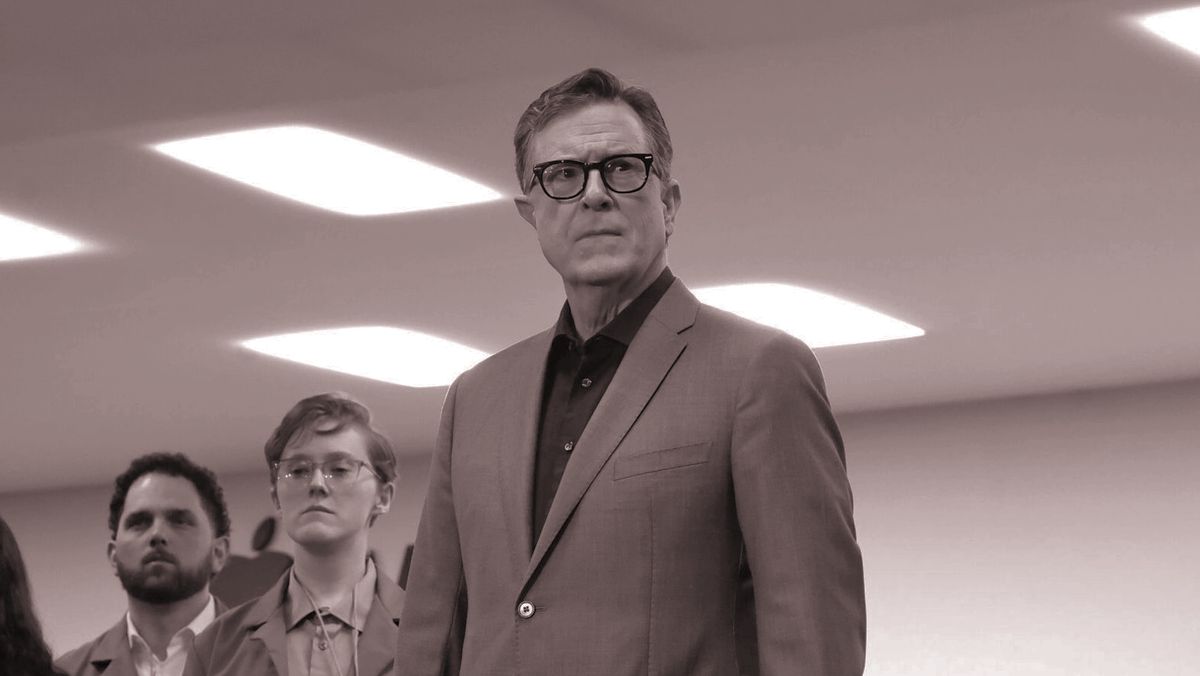
On Wednesday, days after Stephen Colbert insinuated that the top brass at CBS had
censored his show amid pressure from President Trump’s Federal Communications Commission, the agency’s provocatory chair, Brendan Carr, took another twist of the knife: “Look, I get it,” he said at a press conference. “It’s tough to be Colbert. He’s had what he probably views as a long and distinguished career in the
limelight. He sees that that limelight is fading, is coming to an end. That’s got to be a difficult time for him. I get it.”
The chairman’s taunt, while characteristically catty and churlish, did hint at a perhaps underappreciated subtext of this saga—and, indeed, the Trump administration’s broader war on late night, from Colbert to Kimmel. Every time the White House interferes directly or indirectly with the genre, the nation’s angst-ridden liberal commentariat asserts
that America’s sacred satirical tradition is under siege. In truth, however, satire is thriving—it’s just not thriving on TV. And the reasons for that can hardly be attributed to Trump.
Before you @ me or respond to this email by telling me to go fuck off… yes, the F.C.C. pressure on late night is a bad thing for an ostensibly democratic country. Yes, it’s unsettling how quickly spineless Hollywood executives have self-censored their platforms to protect
shareholder value. And, yes, the Orban-esque vibes here are… not great! All that said, any narrative that pins late night’s demise on Trump and Carr wildly misses the mark. This is a business model that’s been quietly collapsing for well over a decade, a casualty of a declining distribution platform, shifting consumer habits, and, to a lesser degree, its preoccupation with Trump himself.
If anything—as was the case with cable news—Trump kept late night on life
support well past its expiration date. In his perversion of political norms, he offered comedians a sense of purpose, urgency, and moral righteousness—which also played out, for better or worse, at certain news networks. Tempted by ratings and celebrity, a generation of comedians cast themselves as the second coming of Jon Stewart. After a rickety start, Colbert found his voice as a nightly anti-Trump tribune. Kimmel discovered the virality of righteous indignation. Seth
Meyers honed the “Closer Look” into a kind of MSNBC-with-jokes explainer. The defiance felt poignant, for a moment. |
Go
Gentle Into This Late Night
|
In retrospect, this was a bait and switch. Trump was already so baroque, absurd, and, most
importantly, shameless that the glib wisecracking had started to feel inert. By the time he returned for a second term, the #Resistance vibes had fizzled, the White House itself became the meme generator, and late night’s PG-13 zings suddenly seemed like a lagging indicator of the culture. Nevertheless, late-night hosts continued to lean into politics: The monologues got more earnest,
the lawmaker interviews got longer, the applause lines got more self-satisfied. And the viewing audience kept drifting elsewhere.
Late night’s battles with the F.C.C. represent the last gasp of this dynamic. Kimmel’s temporary suspension drove record-high ratings to Jimmy Kimmel Live!, which then quickly returned to Earth. The same is happening now with Colbert’s Late Show, which will shutter entirely in May. But the audience for talk-show comedy has already migrated to
a younger generation of social influencers, many of whom graced the pages of Vanity Fair this very week. As that piece noted, the linear late-night shows struggle to get even a tenth of the audience of their legendary forebears. “Because who’s sitting around at 11:35 watching TV anymore,” the piece’s author, Joy Press, asked, “if you even have a TV?”
Their YouTube monetization strategies haven’t moved the needle either.
But this highlights yet another underappreciated aspect of Trump’s war against the media: It’s limited to a theater that is increasingly irrelevant to the broader public. The administration is targeting these comedians and their networks in part because they’re the only ones they can target. The F.C.C.’s authority over broadcast licenses gives Trump leverage over ABC and CBS that he doesn’t have over
the stars of YouTube, Instagram, TikTok, and Spotify. He’s fighting yesterday’s battle, which should give the champions of free speech and political satire some solace. Anyway, all of this will be over in a few years. |
|
|
Puck fashion correspondent Lauren Sherman and a rotating cast of industry insiders take you deep behind the scenes of
this multitrillion-dollar biz, from creative director switcheroos to M&A drama, D.T.C. downfalls, and magazine mishaps. Fashion People is an extension of Line Sheet, Lauren’s private email for Puck, where she tracks what’s happening beyond the press releases in fashion, beauty, and media. New episodes publish every Tuesday and Friday. |
|
|
A professional-grade rundown on the business of sports from John Ourand, the industry’s preeminent journalist,
covering the leagues, players, agencies, media deals, and the egos fueling it all. |
|
|
Need help? Review our FAQ page or contact us for assistance. For brand partnerships, email ads@puck.news. You received this email because you
signed up to receive emails from Puck, or as part of your Puck account associated with {{customer.email}}. To stop receiving this newsletter and/or manage all your email preferences, click here. |
Puck is published by Heat Media LLC. 107 Greenwich St., New York, NY 10006 |
|
|
|