{{ 'now' | timezone: 'America/New_York' | date: '%b %d, %Y' }} |
|
|
Greetings from San Francisco, and welcome back to In the Room. I’m in the Bay for 24
hours of meetings ahead of Sunday’s big game. Looking forward to breaking Peking duck with many of you in Chinatown tonight… Ourand is paying!
In tonight’s issue, a look at today’s long-foretold extinction event at The Washington Post, which I’ve been previewing here for weeks. It was a somewhat anticlimactic denouement of a slow-motion car crash that’s had the newsroom in agony for… well, honestly, a couple years. While the benevolent-ruler era of owner
Jeff Bezos’s stewardship of the paper has been over for some time, this professional slaughterhouse actually runs the legit risk of impacting his legacy.
Sure, the quarter-trillionaire has somewhat understandably spent a couple of years trying to distance himself from his ink-stained wretches on K Street—the responsibility for hundreds of thousands of people and trillions in shareholder value can require a cordon sanitaire from a news organization—but Washington
is a town built on history, where everyone has a long memory and a penchant for unkind, often vindictive gossip. And what went down today, fairly or not, is going to play a whole lot worse than any fulfillment workers being forced to urinate in a Dasani bottle during their shift. The industry was already mortally imperiled, but Bezos looks like an aloof owner who bequeathed his company to a feckless overlord, who in turn magnified various unforced errors. As for what comes next, that’s
the focus of tonight’s issue…
🗓️ Programming note: Washington Post executive editor Matt Murray will be my guest on next Tuesday’s episode of The Grill Room. Regardless of what you might think about today’s mass layoff event, you gotta hand it to Matt for facing the music. For what it’s worth, he’s not going to sugarcoat it…
🍸 Meanwhile, on the latest episode, Jason Zengerle joined me for a deep dive into his
new book, Hated by All the Right People, which traces Tucker Carlson’s evolution and his strategic use of outrage to fuel his influence. We also explored the broader impact of conservative media on American political discourse and whether Carlson may pursue elected office. Follow The Grill Room on Apple,
Spotify, or wherever you prefer to listen.
Also mentioned in this issue: Josh D’Amaro, Bob Iger, Rich Greenfield, Dana Walden, Nelson Peltz, James Gorman, Lachlan Murdoch, Bari Weiss, Peter Attia, Jeffrey Epstein, Jeff Bezos, Will Lewis, Marty Baron,
Ashley Parker, Meredith Kopit Levien, Karen Saltser, and many more...
But first… |
-
D’Amaroland: Congrats to Josh D’Amaro on securing the keys to the Magic Kingdom—a long-anticipated end to the second Iger succession story. His Experiences division is the most significant part of the business, accounting for 60 percent of Disney’s profit and 80 percent of its value, per MoffettNathanson. It’s also the most stable division. As Rich Greenfield
told my partner Matt Belloni, “The entire Disney investment thesis rests on the power of theme parks and cruise ships, and virtually all the company’s capital is being spent to expand in those areas.” The film and television business faces a much more uncertain future, which partly explains why Dana Walden is only
getting the consolation prize as president and chief creative officer.
Alternatively, there’s the Nelson Peltz explanation. In an interview with the Journal, the activist investor and perpetual thorn in Iger’s side suggested that Bob strategically picked Josh in order to stay close to the company: “Iger needs a reason to stay on,” Peltz said curtly. “And if he put the person in charge of entertainment as the C.E.O., he wouldn’t have an excuse to stay on.” In
fact, Iger is staying on only through the end of the year. Moreover, Peltz’s slight ignores the fact that this succession process was really run by board chairman James Gorman.
In any event, both Josh and Dana will be well compensated: Josh will make $2.5 million a year with a target annual bonus of $32.5 million, on top of a one-time $9.7 million bonus. Dana will make $3.75 million a year with a target annual bonus of $23.25 million, on top of a $5.25 million
retention bonus. Congrats, and good luck, to both. - Jimmy’s world: Speaking of Disney, as Ourand has previously noted, this week’s earnings report put a new stand-alone value on ESPN: $30 billion, a useful data point if and when D’Amaro decides to entertain offloading the linear business. The report also noted that ESPN will have an option to reacquire the NFL’s 10 percent stake in the business in 2034, while the league will have an option to increase
its stake to 14 percent.
ESPN was Disney’s central growth engine during many of Iger’s glory years, and his reign is synonymous with the growth (and eventual slippage) in Bristol: Monday Night Football, the CFP, the landmark NBA deal, etcetera. D’Amaro will have a much more unsentimental view about the business. Meanwhile, a cadre of media observers long-shorted ESPN chairman Jimmy Pitaro’s chances in the Disney succession sweepstakes because he seemed like the
sort of executive asset who might one day credibly take ESPN public—Iger’s own Laz or Gunnar. Now that Josh is on his throne, that will be the next chapter of palace intrigue in Burbank. - Fantastic Mr. Fox: Another notable data point from media earnings week: Lachlan Murdoch says Fox News added 200 new advertisers in the last quarter—a healthy number on top of the 350 clients it added last
year. As I noted this time last year, the influx of blue-chip advertisers to Fox is not only a business development, but a byproduct of a political and cultural shift that has mainstreamed the once-polarizing cable news network. Indeed, per Lachlan, more Democrats now watch Fox News than either CNN or MS NOW.
It’s true that Fox News boasts once-unimaginable primetime viewership—nearly 2.5 million. The truth, of course, is that many are really paying to reach an audience of one… or, more accurately, a
veritable Gang of 50 or so that penetrates the Oval. Whereas this coveted airspace was once the province of erectile dysfunction medication, it’s also become a plum spot for corporate reputation burnishing—taking to the small screen a corporate affairs and influence peddling business that Jim VandeHei brilliantly created at Politico and perfected at Axios, and which many of us have copied since. What’s old is new again… - The Bari
report: Bari Weiss is standing by her newly hired contributor and wellness influencer Peter Attia despite the revelations about his sordid correspondence with Jeffrey Epstein, which he apologized for earlier this week. (I won’t reprint the remarks here, but feel free to look them up; Attia’s name appears more than 1,700 times in the Epstein files.) Bari’s defiance isn’t surprising, given her long-standing rejection of “cancel culture,” but
this is yet another controversy that is testing her reputation with her staff.
Perhaps no one expects Weiss to capitulate to the protestations of the internet, decency, or concerned citizens, but this flap seems like the most poignant example of her heterodoxy. Weiss has many talents, and both digital provocation and political immortality are high among them. At some point, though, these festering micro-scandals are likely to grate on the gatekeepers of the Ellisons’ inner
sanctum. And the conventional bet is that the moment will come around when, or if, regulators in the U.S. and Europe approve Netflix’s deal for WBD’s Studios and Streaming division. Anyway, I have a feeling that the rank and file inside will be typing Command-F if more of these files make their way to the public. - And finally… The New York Times Co. stock fell more than 6 percent on Wednesday after the company reported modest digital subscriber
growth in line with projections and relatively moderate guidance going forward. Moreover, the Street doesn’t seem to love the Times’s emphasis on video. But given what went down today at its erstwhile rival, A.G. Sulzberger must be pouring himself a vegan smoothie…
|
|
|
When Bezos bought the Post in 2013, he said, “You can’t shrink your way
to relevance.” Today, however, his newspaper is attempting to do just that and then some—shuttering entire sections, laying off 300 reporters, and pulling back on crucial reporting. Is a comeback possible, or has K Street officially entered its late Ottoman era? |
|
|
Rarely does such a sharp and jarring industrial juxtaposition present itself in a single winter
morning, but such was the case on Wednesday. Earlier today, The New York Times Company announced its solid, if unspectacular, fourth-quarter earnings results: 450,000 more digital subscribers, which has the company ready to cross the 13 million threshold early this year; revenue of $802 million; adjusted EBITDA of around $192 million. Yes, the NYT stock dropped on the NYSE, but it rebounded later in trading hours as investors recognized that C.E.O. Meredith Kopit Levien remains
on track to reach her stated goal of 15 million subscribers by the end of 2027.
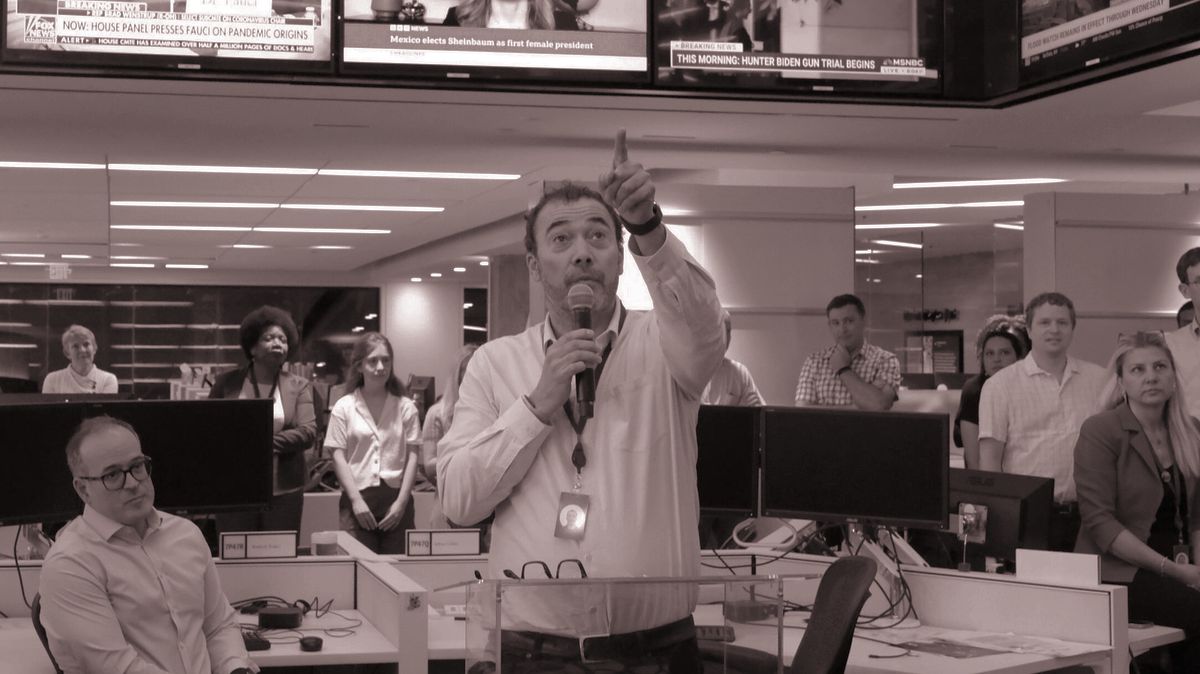
Around the same time, by comparison, Washington Post executive editor Matt Murray informed staff, via Zoom, that the paper would begin a devastatingly broad and long-anticipated round of job cuts, including more than 300 of the newsroom’s 800 journalists
and more still on the business side. The Post would shutter entire sections—sports, books, the photography department—while drastically reducing both its local and international coverage, Matt said. Meanwhile, the Beltway institution would reorient itself around core coverage areas like politics, national affairs, national security, business, science, health, and wellness—a sorta proto-Politico, which is having its own headaches, by the way. (Story for another time…) “We can’t
be everything to everyone,” Matt wrote in a memo, stating the obvious. “But we must be indispensable where we compete.”
The reaction from Post staff and alumni was a collective convulsion of uninhibited grief and anger—a legit trauma bond on a scale unseen in any of the previous rounds of layoffs that the paper has been forced to endure. Former executive editor Marty Baron called the Post’s demise “a case study in near-instant, self-inflicted brand
destruction.” Former Post reporter Ashley Parker called it a “murder,” and “the latest attempt to kill what makes the Post special.” Throughout the day, X effectively served as a forum for affected journalists to announce their terminations and commiserate.
Jeff Bezos, the Post’s owner, views these cuts altogether differently: as a necessary step to reverse years of hundred-million-dollar revenue losses and reestablish a
sustainable business model. After all, he never suggested that the Post was a philanthropy or 501(c)(3)—a surprisingly obvious point that has often been lost on many of his charges. But since buying the paper, Bezos has long emphasized the importance of sustained profitability, perhaps as a cudgel to get the historically bound business to address the realities of the modern news market. On Wednesday evening, a source close to Bezos told me, “The entire industry is going through
generational disruption. Bezos is trying to save the Post. It needs to be rebuilt for the world we live in today.”
For their part, the majority of current and now former Post staff I spoke to on Wednesday don’t necessarily reject that thesis, though they are highly dubious about Bezos’s altruism and plan. When he bought the Post in 2013, he had said, “You can’t shrink your way to relevance”; in this decade, they point out, the Post has undergone
multiple rounds of layoffs and buyouts nominally enacted in the service of rebuilding the paper for relevance. On the newsroom floor, there’s a broad consensus that Bezos, a centibillionaire and historic entrepreneur, has simply stopped caring about the fate of the trophy asset he bought for a mere $250 million, and today was the ultimate manifestation. (The Post did not comment for this story.) |
One of the great challenges of the Post saga, as any journalist knows,
is that the truth is rarely simple. And this story in particular is nuanced and complex, featuring bouts of selective narration on all sides—including from some of the storytellers who are now sadly exiting the building for the final time.
A persistent fiction in American media, as broadly evidenced today, is that The New York Times Company and the Post still operate on the same plane. Yes, they are intertwined in the public lore and history, and the Grahams
and Sulzbergers weathered many wars together during the Nixon era and beyond. But the Times made nearly a billion bucks this quarter and earned a couple hundred million in operating profit. The Post is private, of course, but industry guesswork suggests that the business generates perhaps a couple hundred million in top-line revenue per year, weighted down by those staggering losses. The Grahams operated the company like a
regional powerhouse, and had been willing to let it slide into the maw of local-news economics before Bezos entered the picture. Any assertions otherwise are fanciful memories and counterfactuals.
The illusion of a veritable rivalry with the Times was fortified, for a time, by the surge in subscribers that the Post enjoyed in the Trump I era, when scoop machines like Josh Dawsey and Parker, herself, were churning out
palace intrigue from inside the White House. Millions of new customers signed on to support the paper’s declaration that “Democracy Dies in Darkness.” But like many corporations under the withering gaze of the second Trump administration, the Post pivoted—repositioning into a more supine editorial posture to ostensibly cater to a smaller, Economist-inflected audience while alienating just about everyone else. Cancellations skyrocketed, and the new readership hasn’t
arrived.
Recent chapters in media history have also taught us that the Post’s Trump I gains were probably always going to be temporary or illusory. Sure, former C.E.O. Fred Ryan failed to diversify the business, but it’s unclear whether such measures would have even been successful. The Times, with its superior brand, was already pacing ahead in the battle for educated liberal mindshare among paying audiences—a market that turned out, as has been the
case with streaming, to be smaller and less forgiving than once imagined. Meanwhile, a new generation of companies was dicing up the professional web into affinity-centric brands that catered to hyper-specific audiences. By the time Post C.E.O. Will Lewis got Punchbowl-curious, the deal would have cost Bezos more than his original acquisition.
Lewis famously promised not to sugarcoat the bad news with his newsroom when he arrived at the Post,
but he wasn’t entirely honest either. With a few exceptions, legacy media brands from Yahoo to MTV to Forbes are irreversibly getting smaller and more focused—and not all of them are going to make it. (Local historians will recall that The Washington Post Company sold once-venerable Newsweek to the Harman family in 2010 for a buck.)
It may have been heartbreaking when Murray announced today that the sports and books departments
would be shuttered, but how could that have been a surprise? Those content areas, which are challenging to monetize, have long been colonized by other insurgents. This wasn’t a murder—it was the sad result of an escalating cold war between management and talent that had led to a total breakdown in communication over irreversible changes in the industry, all exacerbated by distrust over other squabbles: the Kamala Harris endorsement saga, Sally
Buzbee-gate, this new Opinions guy, etcetera. Understandably, as Bellow once wrote, everyone is blind with rage.
Whatever Bezos’s designs on the paper, there seems to be a near-universal rejection of Lewis—perhaps the most hated man in Washington since Dan Snyder (or James Buchanan)—who was conspicuously absent from Wednesday’s call and sent no memo. Before Matt ended his call, several current and former Post
reporters had reached out to note his absence, asking, “Where’s Will?” One posited that his refusal to announce the layoffs himself was “a dereliction of leadership,” to which another responded, “So what else is new?”
Will still maintains Bezos’s support, I’m told. Then again, it’s hard to imagine who else would want the job. |
|
|
A professional-grade rundown on the business of sports from John Ourand, the industry’s preeminent journalist,
covering the leagues, players, agencies, media deals, and the egos fueling it all. |
|
|
Puck fashion correspondent Lauren Sherman and a rotating cast of industry insiders take you deep behind the scenes of
this multitrillion-dollar biz, from creative director switcheroos to M&A drama, D.T.C. downfalls, and magazine mishaps. Fashion People is an extension of Line Sheet, Lauren’s private email for Puck, where she tracks what’s happening beyond the press releases in fashion, beauty, and media. New episodes publish every Tuesday and Friday. |
|
|
Need help? Review our FAQ page or contact us for assistance. For brand partnerships, email ads@puck.news. You received this email because you
signed up to receive emails from Puck, or as part of your Puck account associated with {{customer.email}}. To stop receiving this newsletter and/or manage all your email preferences, click here. |
Puck is published by Heat Media LLC. 107 Greenwich St., New York, NY 10006 |
|
|
|