 |
|
Happy Sunday, and welcome back to Dry Powder.
|
|
The I.P.O. market is showing signs of life, but is this a false spring, wedged between a mini-rally and a looming recession? In today’s issue, a close look at this phenomenon, some notes on Blackstone’s slow Q1 and broader P.E. anxieties, and thoughts on MillerKnoll C.E.O. Andi Owen’s now-infamous “pity party” rant.
But first…
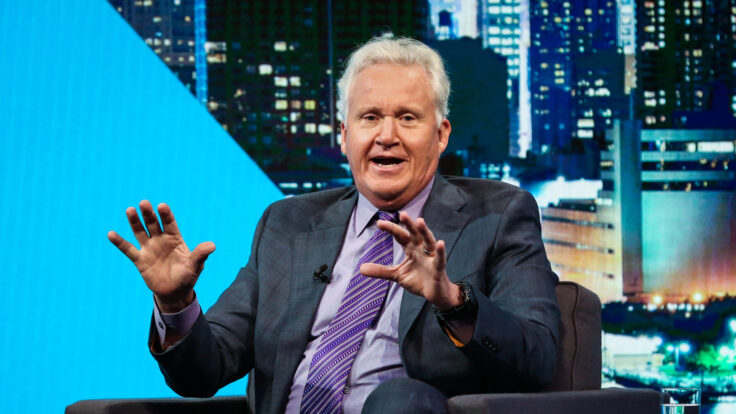
- The news just broke that Jeff Shell, the C.E.O. of NBCUniversal, is leaving his job immediately after he admitted that he had “an inappropriate relationship” with a female colleague. Shell is the second NBCU C.E.O. of the last three to leave the company abruptly. The other being Jeff Zucker, who was relieved of his duties after Comcast started buying the company a decade or so ago. Zucker worked for GE, and Comcast replaced him with Steve Burke, Shell’s predecessor. We don’t know the details of what exactly Shell did, of course, but it must have been egregious enough to require an internal investigation and his immediate dismissal.
Call me crazy, but to my way of thinking, Shell’s sudden departure makes it all the more likely—inevitable?—that the idea I’ve been harping on for a while here, the combination of David Zazlav’s Warner Bros. Discovery with NBCU, will happen. To be clear, the two companies won’t merge anytime soon. The reverse Morris Trust rules require two years to pass before WBD can sign a deal. But that’s only one year from now, and given how long it can take these deals to be negotiated and papered up, the departure of Shell might as well be considered the kick off to the process.
|
|
|
| After a long, fallow period, the I.P.O. market appears to be demonstrating some of its own rites of spring: SeatGeek, the event ticket marketplace, quietly filed to go public, following Chia Network, a crypto firm. I’ve been wondering whether this is a new pattern, post-SPAC denouement, or merely an aberration. And, alas, I’ve come to the conclusion that it’s a false bloom, a moment between a post-correction mini-rally and a looming recession that most analysts predict is more likely than not. Capital and credit markets are still tight amid rising interest rates that have cooled the I.P.O. pipeline and pushed many investors into cash or the bond market (it’s been a long time since I could write that).
Sure, there is always a new generation of companies seeking to go public through the mechanism of the traditional I.P.O. That’s one of the things that makes American capitalism great—the ability of an entrepreneur to take his or her idea, turn it into a successful company, and then go to the public equity markets to find new investors and experience the rarified highs of a bigtime liquidity event.
What is not beautiful, of course, is the Wall Street I.P.O. process itself, which is essentially unchanged after decades of the same old, same old, and even after the euphoric pandemic era experiment with SPACs went sideways. Of course, inertia works to the advantage of the Wall Street underwriters and their favored institutional clients at the expense of dopey retail investors, who seem to get suckered every time. The truth of the matter is that Wall Street is essentially an oligopoly, controlled by a few big powerful banks who like the status quo just the way it is and who have no interest or incentive to change. The I.P.O. process, itself, epitomizes this reality.
A few pioneers over the years, such as “auction I.P.O.” godfather William Hambrecht, have tried to take on the establishment. (Google went public via an auction I.P.O.) In 2017, Spotify went public through a so-called direct listing, a brilliant wrinkle that became momentarily trendy. But only transcendent companies have the opportunity to operate this way—and those that don’t need the money an I.P.O. usually brings. The vast majority of companies that go public do so for two reasons: they want and need the money, either for corporate expansion or to pay off earlier investors. So it’s Wall Street’s way or the highway.
And what that means is Wall Street will take minimal risk, collect big fees—often as much as 7 percent of the money raised—and then allocate the bulk of the shares to their favorite institutional investors, who will inevitably hope for a big pop in price after the I.P.O. starts trading so they can then offload their shares, often lickety-split, to ravenous retail investors, hoping the stock will go up from there. That rarely happens of course. For every Google, Amazon and Apple, there are probably one hundred Allbirds and Rivians—high-flying, hot I.P.O.s that crash and burn once the smart money gets out.
That calculus always seems to benefit the insiders, the venture capital or private-equity firms, or the founders. The venture-capital investors in Coinbase, for instance, took their money and ran after the I.P.O. and its bigtime pop. Who was left holding the Coinbase bag? Retail investors. The stock is down 83 percent from its all-time high. Keep that reality in mind as the next round of hot I.P.O.s begins. |
|
|
| Blackstone, the world’s largest alt-asset manager, reported a slower than expected Q1, less profit, and a lower shareholder dividend amid a global slowdown in dealmaking activity. It’s not all bad news, of course. Sure, assets under management grew somewhat less than analyst expectations, but they still climbed to just shy of $1 trillion. So what to make of the persistent anxieties surrounding the private equity industry, which is gingerly adjusting to higher interest rates after gorging for a decade on unthinkably cheap capital, courtesy of the Federal Reserve?
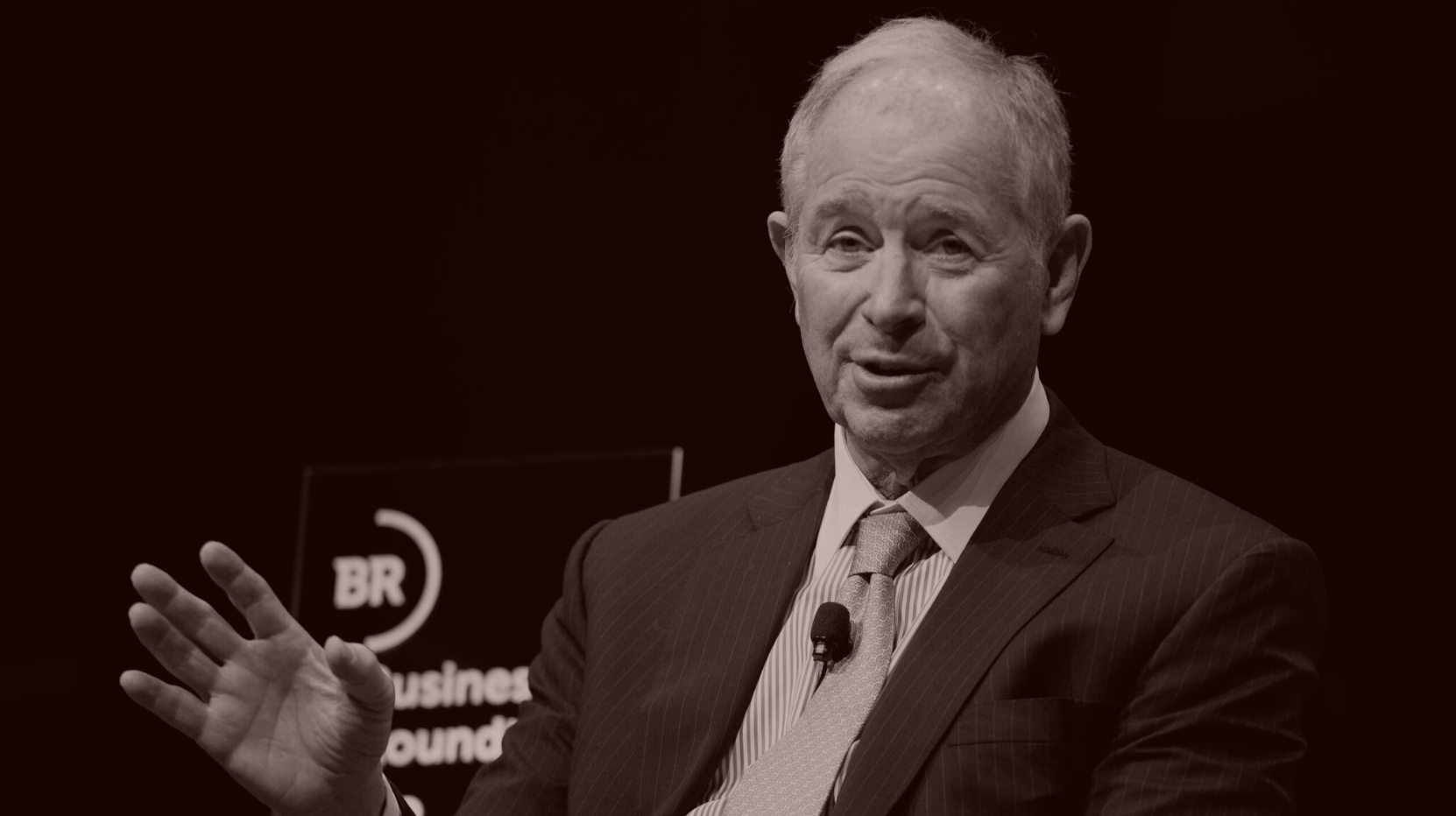
Frankly, if there is one sector of bigtime finance that I don’t worry about, it’s private equity—nowadays known as alternative asset management since many of the industry’s chief practitioners, such as Blackstone, Apollo and KKR, manage far more private debt capital than private equity capital. For instance, something like $400 billion of the $550 billion that Apollo manages these days is private credit, not private equity. Meanwhile, these firms are run by some of the smartest folks around and have built themselves up over the last 40 years into the most powerful forces on Wall Street. Indeed, the big alt-asset managers are often the Wall Street banks’ largest clients. If Steve Schwarzman wants to go to the U.S. Open—Steve’s a tennis player—he’ll have no problem getting a seat in a JPMorgan Chase box.
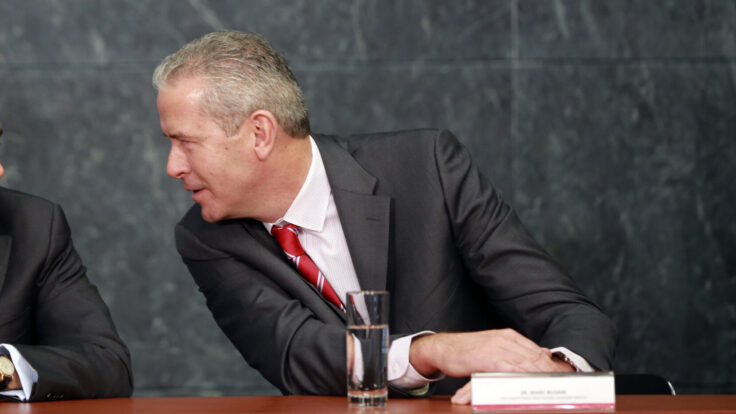
And these guys typically understand risks in ways that most other bankers can only dream about. What happened at Silicon Valley Bank, in March, is not going to happen to Apollo, I can assure you. (As always, this isn’t investment advice.) First of all, Apollo has long-term investors, not short-term depositors, and their money is locked up nine ways till Sunday. And the firm knows how to get paid properly for the risks it’s taking. Buying mortgage-backed securities and Treasuries at the top of the market and then not hedging that interest-rate risk is virtually unimaginable at Blackstone, Apollo and KKR. Marc Rowan, the Apollo C.E.O., would fire anyone who made that mistake.
Yes, private equity deals have stalled in this higher interest rate environment, but not because these firms have run out of dry powder. It takes two to tango. And at the moment, private sellers are still adjusting to the realities of the new pricing environment. Interest rates are up; equity markets are down, credit is harder to come by, and all this leads to lower valuations. And if you’re on the board of a formerly highflying company—Allbirds, for instance, whose stock is down 95 percent from its November 2021 I.P.O.—it’s very hard to agree to sell the company to a private equity buyer for cash, and then perfect that loss for shareholders—at least until every remaining option has been exhausted.
Obviously, private equity would love to scoop up some of these fallen angels at such severely depressed prices: the industry’s coin of the realm, after all, is about leveraging operational expertise and fiscal responsibility to restore brands and businesses. And there probably is a role for private equity to play with a generation of venture-backed companies that grew too fast and too large, partly in order so that the earliest investors could offload them to the public markets and perfect their windfall. (BuzzFeed, which my partner Dylan Byers wrote about on Friday, is another prime example. Again, not investment advice, people…)
But as I said, it takes two to tango. So dealmaking in private equity land will stay subdued until sellers come to the grips with the new reality. But the big alt-asset managers have diversified into so many different areas where capital is needed—startups, private credit, distressed investing—that their companies will continue to steamroll on. So far this year, Blackstone’s stock is up 18 percent. Don’t forget, these guys are playing three dimensional chess while everyone else is playing checkers. |
|
|
| If you’re wondering why Andi Owen—the C.E.O. of MillerKnoll, the publicly-traded, $1.6 billion high-end furniture company—hasn’t been fired yet after her infamous “pity city” rant, well, so am I. Honestly, it’s hard to imagine what Owen was thinking during the 81-second Zoom video of her chastising employees who were supposedly worried about their small bonuses, while she walked off with a 2022 compensation package of around $5 million. The video has since been posted on social media, naturally, likely by one of those disgruntled employees, and has gone viral.
In the video, Owen starts off with the usual corporate pabulum and then says that she wants to address “head on” the concerns that she has been hearing about the upcoming potentially puny bonuses. (The MillerKnoll stock is down 45 percent in the last year.) Her tone of voice eventually changes from officious to condescending. Instead of worrying about their bonuses, she admonishes, “Get the damn $26 million”—whatever that refers to, nobody outside the firm seems to know. She continues: “Spend your time and effort thinking about the $26 million we need and not thinking about what you’re going to do if you don’t get a bonus. Alright? Can I get some commitment for that? I would appreciate that very much.” She then finished it all off with a bizarre flourish. “I had an old boss who said to me that you can visit Pity City but you can’t live there,” she said. “So people leave Pity City, let’s get it done.”
Owen, who has since apologized to her employees, should have known better. She has been the C.E.O. of the company since August 2018 and helped effectuate the merger between Herman Miller and Knoll to create MillerKnoll. Before that, she worked at the Gap for 25 years, rising up to become the president of Banana Republic. It should go without saying that corporate leaders need to be inspirational during company-wide communications, not derogatory or condescending. And Owen had to know that her Zoom broadcast would be recorded—and then released on social media, if she stumbled, as she did.
What to do? On the one hand, Owen sent around a quick email of apology: “I feel terrible that my rallying cry seemed insensitive. What I hoped would energize the team to meet a challenge we’ve met many times before landed in a way I did not intend and for that I am sorry.” As George Costanza would say, “That’s nice, that’s very nice.” But has Owen lost the respect of the troops and of her ability to motivate them? I know I would be hard-pressed to still have faith in a leader who at the same time that she made total compensation of $5 million—including $173,000 for use of a private jet leased by the company—was calling the rank-and-file in for worrying that there will be no bonuses at all and then admonishing them to just move on. Honestly, the labor market, with unemployment still below 4 percent, is way too tight for that kind of attitude from the top. |
|
|
|
| FOUR STORIES WE’RE TALKING ABOUT |
 |
|
 |
| Bidenland Travelogues |
| A Biden inner circle denizen on the re-election, Hunter, DiFi, and more. |
| TARA PALMERI |
|
 |
|
 |
| D.C. Leak Postmortem |
| Beltway insiders on the biggest intel breach since Snowden and WikiLeaks. |
| JULIA IOFFE |
|
|
|
|
|
 |
|
|
|
Need help? Review our FAQs
page or contact
us for assistance. For brand partnerships, email ads@puck.news.
|
|
|
|
Puck is published by Heat Media LLC. 227 W 17th St New York, NY 10011.
|
|
|
|