Welcome back to The Varsity. I’m John Ourand, typing this from the
Acela for a quick trip to New York for a Puck dinner with some leaders from across the industry at The Golden Swan—a reservation none of them would be able to procure without the sorcery of Alex Bigler, our V.P. of creative strategy.
Meanwhile, nearly every call I’ve had today focused on the YouTube TV–Disney battle. You know, the one where all the Disney-owned channels have been dark on the popular streaming service for five days and counting.
One unique—and
overlooked—aspect of this deal is that YouTube TV subscribers have lost access to ABC across the country. In past disputes with traditional cable and satellite distributors, a company like Disney could only pull the signals of its owned-and-operated stations. That would allow local affiliates, owned by the likes of Sinclair or Nexstar, to stay live. But in disputes with virtual distributors like YouTube TV, all ABC programming in every market goes dark, which is a powerful lever for
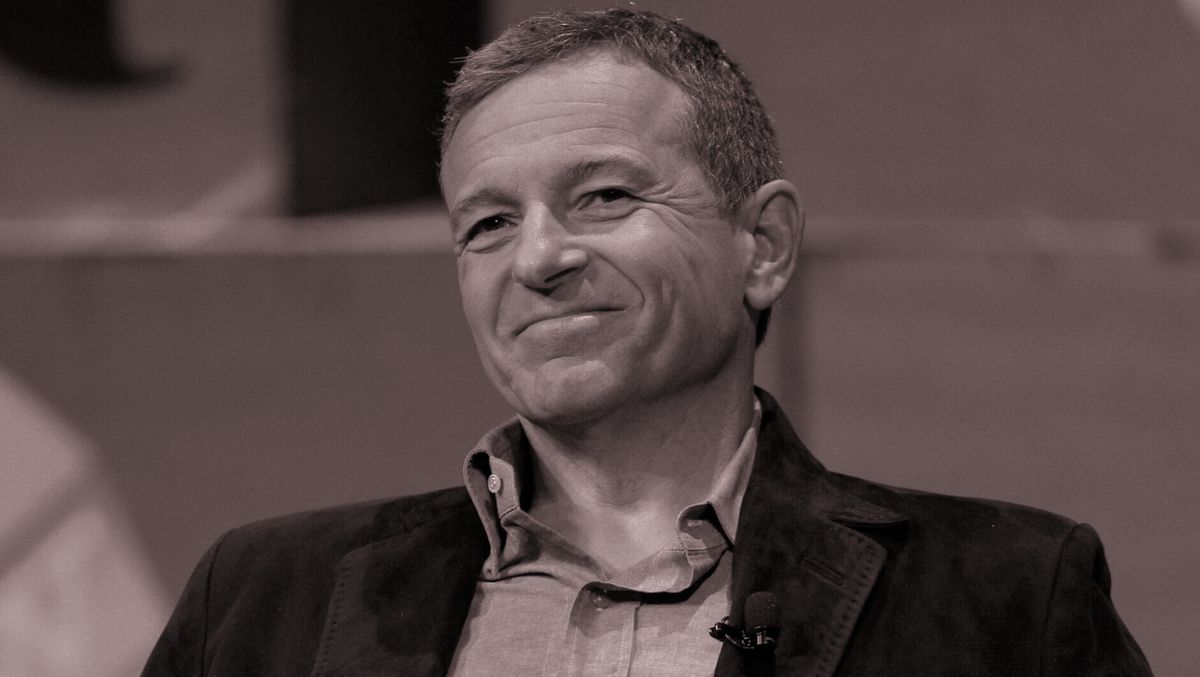
Bob Iger and company.
Julia Alexander has much more on the impasse below, and she dives into the real reasons these two have not yet been able to squash their beef. Julia’s work is only available to Inner Circle subscribers, so make sure to upgrade to read every word before you’re replaced by A.I. It’s worth it.
Take it away, Julia… |
That’s the number of ads featuring Travis Kelce that have aired during nationally
televised NFL games this season, according to Sportico. For comparison, more than 110 ads featuring Kelce appeared during national games in just the first three weeks of the 2023 season. Considering that he’s one of the most famous athletes in the world, and engaged to maybe the most famous person in the world, you’d think
Trav would be wholly ubiquitous and unavoidable, but that doesn’t seem to be the case—not during TV commercial breaks, anyway. Maybe the Kelce bubble finally popped, or maybe, now that he’s got that $100 million podcast deal from Amazon—and a breadwinning fiancée—those State Farm checks have lost some of their appeal. In any event, I don’t think we need to break out the tiny violins. |
- Good news for Toronto’s sports monopolists: Greetings to all my equally devastated Toronto Blue Jays fans. It was a great series and a bitter loss, but at least Tony Staffieri, chief executive officer of Jays owner Rogers Communications, is seeing the upside. Sure, the company’s stock slipped 5 percent in the days following Game 7, but it’s up 25 percent so far this year, and the Blue Jays’ deepest playoff run since its 1993 World Series win is
ideal momentum.
The Jays, which Rogers has owned in full since 2004, are just one piece of their sports empire. The company also owns 75 percent of Maple Leaf Sports & Entertainment, the corporate parent of the Raptors (NBA), Maple Leafs (NHL), Argonauts (CFL), and Toronto FC (MLS). Rogers also controls Sportsnet, Canada’s equivalent to ESPN. In short, Rogers owns the rights to some of Canada’s most-watched sports, plus the various teams that capture most of the
country’s attention, and the network on which people tune in. Go Canada? - Dave Portnoy’s continued absence: Dave Portnoy is supposed to anchor college football broadcasts as Fox’s resident digital superstar, so it would help if he actually appeared on Big Noon Kickoff. And yet, as college football enters its 11th week, Portnoy recently announced on his podcast that he’s heading to Mississippi to film
an episode of The Barstool College Football Show and will miss another episode of Big Noon. Not exactly a shrinking violet, Portnoy called out Big Ten’s leadership for not wanting to engage with him, and doubled down on his commitment to Fox by calling the network an “incredible partner.”
In any case, it’s hard to imagine that Fox is pleased. Over at ESPN, the Pat McAfee magic is helping College GameDay reach new viewership heights, in part
because of on-campus gimmicks like the student field goal kick for hundreds of thousands of dollars and jumping off the top diving platform at the University of Miami. Sure, viewership is up for Fox—president of insights and analytics Michael Mulvihill tweeted that Big Noon Kickoff is up 19 percent in the 11 o’clock hour year over year—but it’s an open
question as to whether Portnoy can become central to the broadcast if he’s constantly fighting with the league that Fox’s show is named after. (By the way, his Michigan bit is getting old...) - Disney’s creator leverage: Disney is breaking out the big guns and deploying some novel offensive strategies in its carriage dispute with YouTube TV. In this particular back-and-forth, Disney has recruited some of its biggest
personalities—Mike Greenberg, Stephen A. Smith, and even Chicago meteorologist Cheryl Scott—to issue 15-second videos about the dilemma, pointing fans to a website that blames YouTube for their abrupt absence from the service.
It’s worth noting how Disney’s approach to a battle with YouTube is intentionally
YouTube-centric. These hosts and personalities aren’t just newscasters or commentators, but creators in their own right. They’re leaning on the kind of parasocial relationship that has made YouTubers—and, by extension, YouTube itself—so powerful. We’ll see whether it works. At least Disney is finally doing something beyond posting strongly worded tweets.
|
And speaking of Disney versus YouTube… |
|
|
The nearly week-old Disney–YouTube TV carriage dispute is arguably a microcosm of
the broader challenges facing legacy mediacos as old-world distribution channels give way to streaming, and as social video eats the world. |
|
|
Like death and taxes, carriage disputes are a perennial fact of life in the TV business. I’m not
going to attempt to predict when the battle between Disney and YouTube—which began October 30, when ESPN and ABC were pulled from YouTube TV—will end. After all, most contract fights are resolved quickly and then immediately forgotten. But in many ways, the power dynamics surrounding YouTube TV’s relationship with the channels it carries are unique. And, like the government shutdown, this could become more complicated than most observers expect.
After all, while YouTube TV generates a
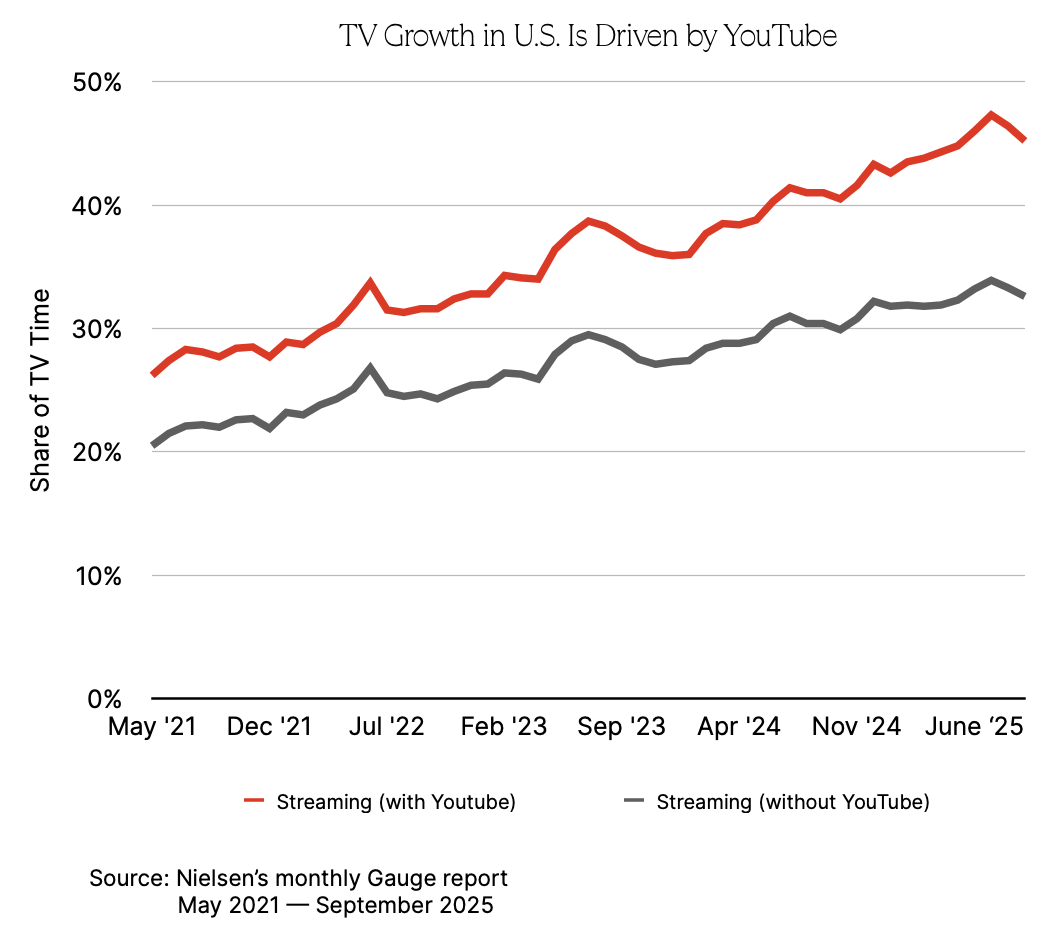
fraction of the overall revenue flowing into YouTube proper, it’s also now the fourth-largest TV provider in the United States. Meanwhile, YouTube itself accounts for just under 13 percent of all viewing across all TV screens in the U.S., up two points since last year, according to Nielsen. In other words, Disney probably needs YouTube more than YouTube needs Disney.
Another factor: YouTube’s grip on the sports ecosystem is already strong and poised to grow stronger. In
2024, more than 35 billion hours of free sports content (live and on-demand) was watched on YouTube, according to the company, up 45 percent year over year. And while ESPN’s number one star, Pat McAfee, loves his Disney partnership, he’s also invested in growing his audience on YouTube. Less than two months ago, The Pat McAfee Show surpassed 1 billion social media views in a single month for the first time and “delivered the show’s most-watched September ever across
ESPN and YouTube,” according to ESPN. Meanwhile, more live games are moving to YouTube, with the NFL’s recent Chiefs–Chargers matchup driving 19 million total global views. As reported here, German football league Bundesliga has even struck rights deals with individual YouTubers to broadcast live games on their channels.
Then there’s the impact of shortform content on viewership habits. In the first half of 2025, videos under a minute in length accounted for more than 76 percent of views
of sports content, according to a report from Tubular Labs. This includes highlights, player interviews, podcast clips, and reactions. Tubular’s data is in line with findings from WSC Sports—a platform where users can create highlight clips with an assist from A.I.—which recently reported that the creation of vertical videos increased by 700 percent for the 2025 MLB season, compared to the 2024 season, while horizontal video creation dropped by more than 14 percent.
It’s conventional
wisdom that modern audiences prefer to watch highlights and player interviews rather than full games during a regular season. (Just ask Adam Silver…) But that obscures another problem for carriers. Those clips—which fans once consumed via shows like SportsCenter, which were historically available mostly through a cable provider—are now free on YouTube.
This doesn’t mean that YouTube C.E.O. Neal Mohan wants to extend the blackout, and
potentially damage YouTube TV’s business by dragging out a carriage dispute with a major content supplier. However, he’s definitely interested in using that leverage to fight for new products, like a sports-centric skinny bundle, which is something that his competitors already have. (Fubo TV, for example, which is now owned by Disney, offers a $55-a-month sports-only subscription, which is about 35 percent cheaper than YouTube TV’s offering.) This would require YouTube to ingest
its partners’ content—i.e., plug their streaming-only content into the YouTube TV ecosystem.
There’s a template for this. Just last month, NBCUniversal and YouTube struck a deal that saw the former create a new NBC Sports channel that will carry Peacock content inside YouTube TV. And YouTube should be looking to create more subproducts that increase engagement opportunities. To wit: It’s not a stretch to imagine YouTube introducing shortform clips within YouTube TV for fans
who want to catch up with sports content while also watching a game in the background. If YouTube can build these sorts of features, they will have even more leverage in future carriage negotiations, and certainly at the expense of their media partners. Disney and ESPN are presumably envisioning that scenario, too. |
Of course, Disney still has a strong hand to play in its negotiations with YouTube. ESPN
is crucial to YouTube TV customers, who have more choice than ever, but it’s time for Disney executives to think beyond the live TV service. While the likes of MrBeast, Dude Perfect, and Ms. Rachel are ostensibly YouTube’s primary attraction, a considerable amount of viewers’ time on the larger V.O.D. platform is spent watching premium content uploaded by Disney, NBCUniversal, Netflix, etcetera. In fact, according to research conducted by Digital i,
seven of the top 10 YouTube channels by reach in the U.S. in the first half of this year are curated by legacy media brands. It’s that potent combination that helps account for the explosive growth of YouTube on TV sets over the past four years. |
Based on these figures, it seems at least conceivable that networks like ESPN or ABC might
get a little creative and flex during a carriage dispute by taking their YouTube channels private for a few days. But that’s easier said than done. If Disney goes dark on YouTube TV permanently, it risks losing just under a reported $2 billion a year in revenue—about 20 percent of its entire cable business. Forgoing views on YouTube could impact additional digital
advertising revenue and hurt subscriber engagement, too.
This is the reality facing Bob Iger as he countenances a new chapter for his company. Carriage disputes are no longer battles between partners like DirecTV and Disney, which are equally reliant on each other for their businesses. YouTube, a company that generated $10 billion in advertising revenue this past quarter alone, and a subsidiary of a company that pulled in more than $100 billion in revenue in the same
period, is no such equal.
Still, if Disney wants to strengthen its hand, or just demonstrate its worth to YouTube’s wide-spanning content universe, Iger and Jimmy Pitaro might want to think about how they can squeeze YouTube as a whole, instead of just one part of the business that isn’t crucial to analysts or shareholders. And maybe they should start with the upsides of the partnership. ESPN brings in whitelisted advertising, creating more brand safety
for YouTube at a time of heightened concern around “A.I. slop”—and those clips are turned into Shorts, which keep people scrolling. Moreover, actually achieving a skinny sports bundle on YouTube TV, and ingesting Disney+ or Hulu content, will only better train YouTube’s own models about audience demand, all while building products that further integrate YouTube TV and YouTube. This is inevitably YouTube’s future, so while Disney undeniably needs YouTube, Mohan still needs Disney, too. |
Thanks, Julia. See you all on Thursday.
John |
|
|
Puck sports correspondent John Ourand and a rotating cast of industry insiders take you inside the executive suites
and owners boxes where the decisions that shape the entire sports business are made. You’ll hear interviews with players, network execs, and everyone in between. The Varsity is an extension of John’s private email for Puck by the same name. New episodes publish every Wednesday and Sunday. |
|
|
Ace media reporter Dylan Byers brings readers into the C-suite as he chronicles the biggest stories in the industry:
the future of cable news in the streaming era, the transformation of legacy publishers, the tech giants remaking the market, and all the egos involved. |
|
|
Need help? Review our
FAQ page or contact us for assistance. For brand partnerships, email ads@puck.news.
You received this email because you signed up to receive emails from Puck, or as part of your Puck account associated with {{customer.email}}. To stop receiving this newsletter and/or manage all your email preferences, click here. |
Puck is published by Heat Media LLC. 107 Greenwich St., New York, NY 10006 |
|
|
|