Welcome back to The Varsity. I’m John Ourand, writing from Washington,
but intently fixated on Midtown Manhattan, where MLB owners are currently meeting, in part, to determine their labor strategy over the next year. On one hand, owners like David Rubenstein and Dick Monfort have gone public with their hopes for a salary cap. On the other hand, MLB has a ton of momentum—from attendance to TV ratings to really just general buzz around the game. As The Athletic’s Evan Drellich
wrote this morning, “For the next 12 months, the most important question in baseball will be how ready the sport’s leaders are to risk that momentum.”
In today’s issue, Julia Alexander dives into Apple’s new deal with MLS, and how hard it was for the promises of the initial partnership to survive its honeymoon
phase. As you surely know by now, you need to be an Inner Circle member to access Julia’s work. Members can click here to upgrade.
Take it away, Julia… |
- Life of
Pablo: Few people in sports media have had a better year than Pablo Torre. In August, the former ESPN reporter struck a licensing deal with The Athletic for his podcast, Pablo Torre Finds Out. The next month, he broke the massive story of L.A. Clippers owner Steve Ballmer’s alleged attempt to circumvented the NBA salary cap by having a company he funded “endorse” star player Kawhi Leonard. (Both Ballmer and Leonard have
denied wrongdoing.) Torre has also become a reliable presence on MSNBC, where he’s discussed the sports news of the day on Morning Joe, All In With Chris Hayes, The 11th Hour With Stephanie Ruhle, etcetera.
Now, Semafor’s Max Tani
reports that Torre may land an “expanded role” at Versant, new parentco of the now-rebranded MS NOW. Though Tani doesn’t suggest what that role could look like, Versant is also home to Golf Channel, a personal favorite of
C.E.O. Mark Lazarus, and the newly announced USA Sports. If a deal goes forward, it would be another example of traditional media companies seeking inroads with younger audiences by partnering with creator-journalists and personalities in the digital space. (See also: Fox Corp’s acquisition of Red Seat Ventures and Tubi’s new digital creator channels.) Versant would be smart to leverage new talents like Torre to transform itself into a legit cross-platform media play. - Portnoy’s team defense: Dave Portnoy dropped a couple of gems while barreling through the usually staid environs of CBS Sunday Morning last weekend. The Barstool honcho mused that his raucous media venture has “always had a pretty good moral compass” and that making jokes where the aim “is to hurt people’s feelings, that never flew with us.” A little bit of an eye roller from the guy who sits atop an organization that runs a recurring
feature called “Guess That Ass.” Media Matters has a deeper, if still not exhaustive, exploration of Barstool’s alleged and reported incidents as further evidence of its moral compass.
- Halo, goodbye: Sky Sports recently launched Halo, a TikTok channel dedicated to highlighting women’s sports—before
promptly shutting it down three days later. The initial idea, according to Sky, was to “build a welcoming community for female fans, whether casual or committed, through fun, trend-led, and relatable content.” Great idea! But the execution left a little to be desired, as commentators quickly called out Halo for its cringe-inducing, and perhaps unintentionally sexist, TikTok formats.
As I’ve written before, there is massive, unmet demand for women’s sports content. And during its brief
life, Halo offered a useful case study in how, and how not, to lean into social video trends when micro-targeting particular audiences and communities. In short, authenticity is the coin of the realm on TikTok, and the algorithm is designed to highlight what viewers want, not necessarily what well-intentioned social media marketers think they want. The most effective social posts involve invigorating game highlights, charming player interviews, and anything starring
Caitlin Clark or Alexia Putellas.
|
|
|
It’s obvious why Apple decided to pay a premium to walk away from its
10-year, multibillion-dollar MLS deal several years ahead of schedule. But with a different dance partner, the league could see its footprint expand significantly in the U.S. |
|
|
You don’t need a background in rocket science to understand why Apple’s Eddy
Cue decided to pull the plug on its 10-year, $2.5 billion Major League Soccer deal three years early. The partnership likely wasn’t bringing in enough subscribers to Apple TV to justify the rights fee, and I doubt it was drawing significant new audiences to MLS, either. Last week, when Apple announced it would phase out its MLS Season Pass add-on, that turned out to be a prelude to the broader restructuring.
Under the terms of the
revised deal, Apple will reportedly pay $200 million for the 2026 season, $107.5 million for the transitional February-May 2027 “sprint” campaign (MLS is shifting its season schedule to begin in July instead of February), and $275 million for the 2027-28 and 2028-29 seasons, which works out to an extra $50 million or so more than the league
would have otherwise received over the same period under the terms of the original deal, per Sportico. In other words, Apple is paying a premium for an expedited divorce. |
|
|
A MESSAGE FROM OUR SPONSOR |
Forever at the top of its game, the trailblazing BMW 7 Series. Engineered to win. Learn more at
BMWUSA.com |
|
|
The initial deal, announced in 2022, provided MLS with much-needed capital. But when
you’re a league in growth mode, having the cash to make splashy investments (like Inter Miami bringing over Lionel Messi) doesn’t really matter if you’re alienating potential fans. On Apple TV, MLS was always going to have a limited audience, a problem compounded by the emphasis on its upsell package, MLS Season Pass, without which subscribers would only be able to view a small number of free matches.
In the two years since the deal went into effect, Apple moved away from
that original strategy in an attempt to attract more viewers. In addition to sunsetting MLS Season Pass, it made a few games available to stream inside EA’s FC mobile app, and offered the Apple TV app in the Android Store for the first time. Plus, MLS committed to multiple international broadcast deals, including Sportdigital in Germany, SkyK in South Korea, and SpoTV in Southeast Asia—all areas where Apple TV operates. But the desired viewership never materialized.
It’s a lesson that
other leagues, including UFC, have learned through their own trial periods in the streaming space. In fact, the failure of the MLS-Apple deal highlights one of the more important revelations executives have had about streaming. When the hype cycle cools and tech-forward innovations become regular businesses, the magic promise fizzles out, too. Apple and MLS, much like UFC and ESPN+, proved that just because you build it, that doesn’t necessarily mean viewers will come. |
In July, MLS revealed that games were “averaging 120,000 unique viewers” during its
most recent season. That would seemingly represent a 50 percent year-over-year audience increase. But “unique viewers” isn’t the same as the “average minute” metric that is generally used to gauge audience in the U.S. For comparison’s sake, when the Premier League’s season kicked off on NBC Sports in August, it ranked as the league’s most watched opening weekend ever in the United States, with 850,000 total average viewers.
Naturally, people want to
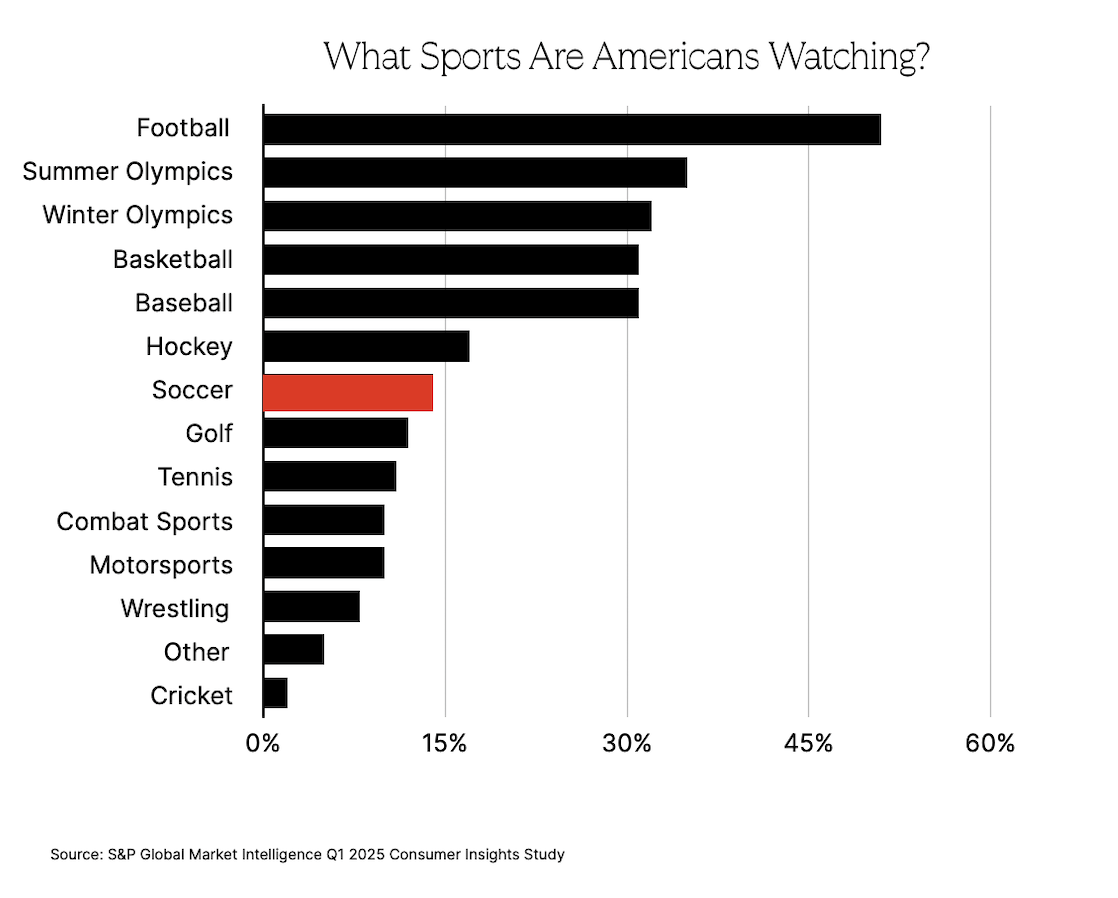
know if the viewership woes are an MLS issue or an Apple issue. It’s a little bit of both. Soccer is growing in the United States, and MLS is absorbing some of that attention share—but not enough to make it stand out in a crowded sports marketplace. Earlier this year, an S&P consumer insights study revealed that soccer was the seventh-most-popular sport in the U.S., but 76 percent of that audience was exclusively watching FIFA men’s matches—i.e., the World Cup and other
international play. (Half of that audience also reported watching FIFA women’s games.) These findings were in line with Nielsen’s own recent ratings report, which found that the Premier League is still the most popular soccer league in the country. |
Meanwhile, it’s hard to totally ding Apple for this, but both parties—and, to be fair,
many players across the industry—seemed to blindly indulge in the belief that streaming platforms, given their accessibility, would necessarily generate audience growth. But whereas Netflix, Prime Video, and even Peacock and Paramount+ have built-in audiences for sports and general entertainment, Apple was never going to boost engagement and attention to the degree that was needed to justify the price. Last year, the MLS learned this the hard way when viewership for the MLS Cup final
dropped 47 percent year over year across broadcast and linear at Fox and Fox Deportes, even though the matchup involved two top-market teams. |
|
|
A MESSAGE FROM OUR SPONSOR |
Forever at the top of its game, the trailblazing BMW 7 Series. Engineered to win. Learn more at
BMWUSA.com |
|
|
Sure, this might seem like a broadcast and linear problem, but it capped a
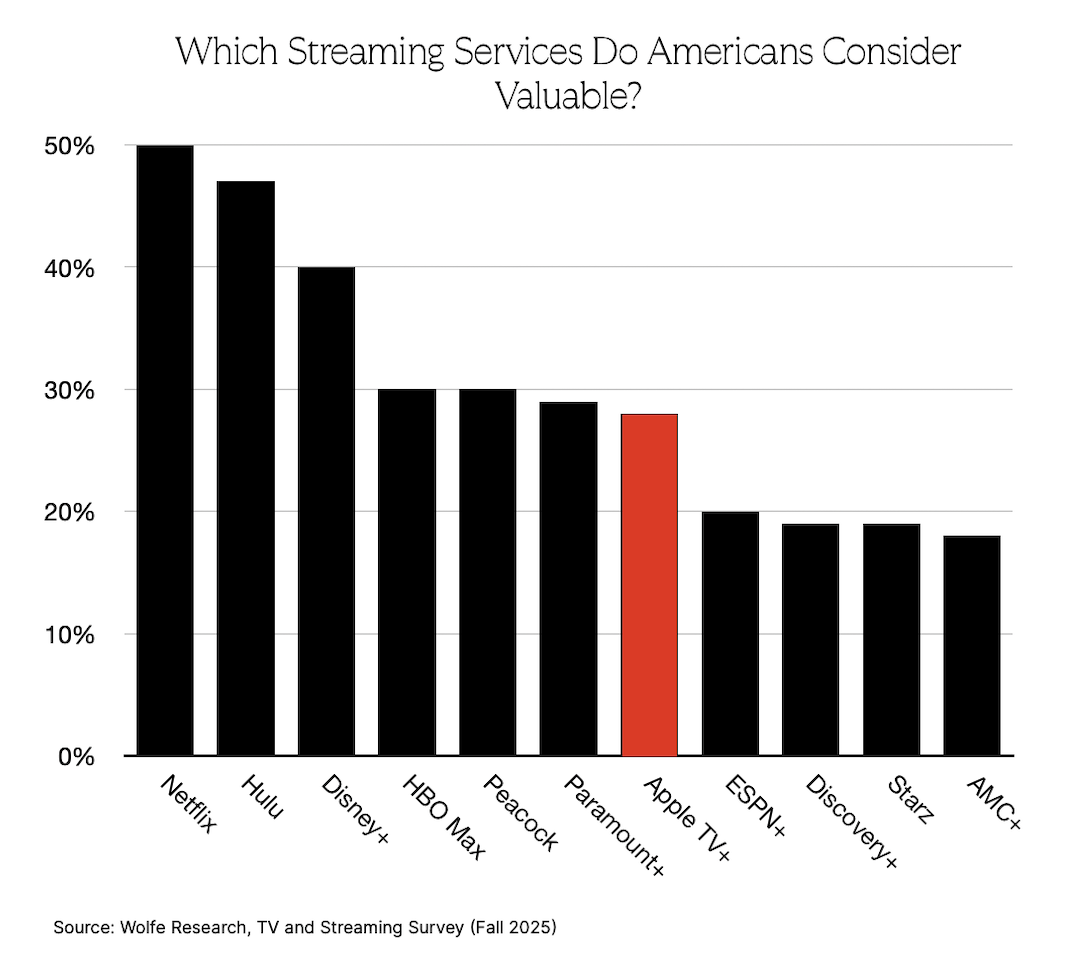
season in which MLS moved to Apple for regular season games, and many industry insiders believed that Apple handicapped overall viewership by isolating casual viewers. Meanwhile, a recent study from equity analysts at Wolfe Research found that Apple TV+ ranked as only the seventh-most-“valuable” service among major general and premium S.V.O.D. platforms. That puts Apple TV+ closer to Starz and Discovery+ than Netflix and Hulu. |
In many ways, the end of the MLS-Apple TV+ deal was foreshadowed by the UFC-ESPN+
divorce. Jimmy Pitaro’s first attempt at a D.T.C. streamer signed deals with the NHL for more than 1,000 regular season games, scooped up La Liga soccer matches, and inked an agreement with the UFC. But even though the ESPN president wanted to stay in business with UFC principals Dana White and Mark Shapiro, the bloodsport’s executive team decided to make a change. They wanted more money, obviously, but also a larger audience, and
Paramount+ (and CBS) provided that. |
While the MLS hasn’t become America’s answer to the Premier League—something that Cue
had obviously hoped for—it’s not a bad asset. More than 11 million fans attended games this year, the second-highest number in league history. Inter Miami is valued at more than the Premier League’s West Ham United, and other pre-retirement players like Luis Suárez are following Messi into the league, which helps draw more international viewers. Plus, the new summer-to-spring season will align the schedule with those of other major soccer leagues, which might help MLS net
some of those fans.
MLS probably won’t get another company to cough up $2.5 billion for 10 years of exclusivity. But it will have suitors. Commissioner Don Garber might prefer top dollar, but if MLS actually wants to reach the maximum number of American sports fans, that will require a broadcast partner or a top-tier streamer. I suspect that, all things considered, the two most likely suitors will be Comcast and Paramount.
When it comes to soccer in
the U.S., Comcast (Peacock and NBC) and Paramount (Paramount+ and CBS) are the most leaned in. Paramount recommitted to being the domestic home of the UEFA Champions League back in 2022, extending its contract through 2030. Sean McManus, the former head of CBS Sports, noted at the time that UEFA was a key subscriber and engagement driver for Paramount+. And soccer is also important to Pluto TV, Paramount’s free ad-supported streaming service that accounts for about 1 percent of
total TV time in the U.S., per Nielsen’s Gauge Report. David Ellison has proven he’s not afraid to shell out for sports rights, and MLS, seated next to UEFA, could be a key player in his streaming strategy.
Meanwhile, look at how the NBA is benefiting from its deal with Comcast, which has helped catalyze a 92 percent year-over-year increase in viewership in the season’s first two weeks of national games, and its biggest audience since 2013.
Brian Roberts also clearly sees an opportunity in soccer: In addition to the Premier League in the U.S., and Spanish-language rights for matches featuring Team USA all the way through next year’s World Cup, Comcast also launched the World Soccer Ticket for $85 a month, which brings almost every major soccer league together in one plan for diehard fans.
This deal could work wonders for both parties: It would increase MLS’s audience by putting high-profile games on NBC
while also driving regular season viewing on Peacock alongside EPL games. With Apple, MLS never really had the opportunity to test how large the sport could become, signing away that opportunity in exchange for a big fee. A Comcast deal might give it a chance to reset the score. |
Thanks, Julia. See you all on Thursday.
John |
|
|
Ace media reporter Dylan Byers brings readers into the C-suite as he chronicles the biggest stories in the industry:
the future of cable news in the streaming era, the transformation of legacy publishers, the tech giants remaking the market, and all the egos involved. |
|
|
Puck sports correspondent John Ourand and a rotating cast of industry insiders take you inside the executive suites
and owners boxes where the decisions that shape the entire sports business are made. You’ll hear interviews with players, network execs, and everyone in between. The Varsity is an extension of John’s private email for Puck by the same name. New episodes publish every Wednesday and Sunday. |
|
|
Need help? Review our
FAQ page or contact us for assistance. For brand partnerships, email ads@puck.news.
You received this email because you signed up to receive emails from Puck, or as part of your Puck account associated with {{customer.email}}. To stop receiving this newsletter and/or manage all your email preferences, click here. |
Puck is published by Heat Media LLC. 107 Greenwich St., New York, NY 10006 |
|
|
|