{{ 'now' | timezone: 'America/New_York' | date: '%b %d, %Y' }} |
|
|
Happy Tuesday, everyone, and welcome back to The Best & The Brightest. I’m Peter
Hamby.
Tonight, I have some notes and fresh data on one of the buzziest storylines emerging from last week’s elections: young men flipping back to Democrats after giving their votes to Donald Trump in 2024. The reasons were the same ones that drove Trump’s victory in the cohort last year: basic economic worries about the cost of groceries, gas, and rent. Of course, off-year results in blue-leaning states and cities don’t suddenly mean young men are in Democrats’
corner—but they do hint at Trump’s paying the price for seeming more interested in his ballroom than the cost of living. |
|
|
Last year, Instagram launched Teen Accounts, which default teens into automatic protections. Now, a stricter “Limited
Content” setting is available for parents who prefer extra controls. Instagram will continue adding new safeguards, giving parents more peace of mind. Learn more. |
|
|

| Leigh Ann Caldwell
|
|
- Utah redistricting
backfires: A Republican attempt to shore up all four of Utah’s House seats failed last night when a judge rejected a proposed map that would have divided Salt Lake City across each congressional district. The judge said the city should be included in its own district, possibly enabling Democrats to pick up a seat in the conservative state. It was the latest blow to Trump’s efforts to gerrymander red states to pick up as many Republican seats as possible. As my colleague Abby
Livingston wrote in a great piece yesterday, even the Republican redraw in Texas that set off the nationwide redistricting frenzy could backfire—especially if Republicans perform as poorly in the midterms as they did in last Tuesday’s election.
- Grijalva will get her day: The House will finally come back into
session tomorrow after Speaker Mike Johnson kept lawmakers away for 55 days amid the government shutdown. Johnson also announced that he will finally swear in Adelita Grijalva, the Arizona congresswoman-elect who won a special election to replace her late father, Rep. Raúl Grijalva, in September. Johnson refused to swear her in while the House was out of session—even though he was the one keeping it that way. Grijalva is expected
to become the 218th signature required to force the Justice Department to release the Epstein files.
The House will also vote on the Senate bill to fund the government through January 30, alongside three appropriations bills. The legislation is expected to pass, which means the government could reopen as early as tomorrow night if the president signs the bill immediately. The House Freedom Caucus has already come out in support of the measure, which would be mind-boggling
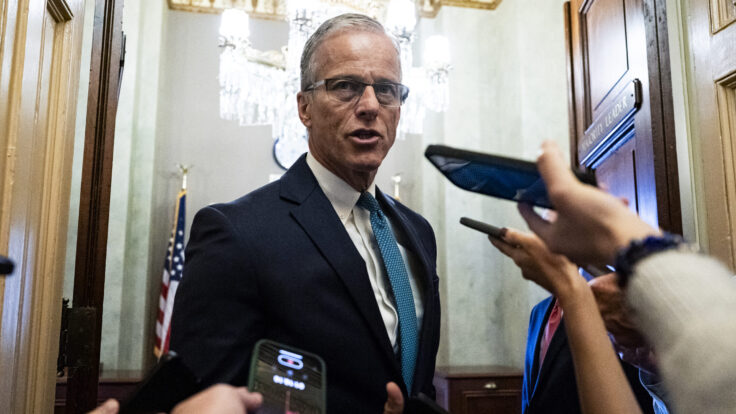
under any other administration, given the far-right group’s typical opposition to funding bills. Perhaps an even more interesting question is whether any Democrats will support the measure. Their votes probably aren’t necessary—Johnson will attempt to whip his entire conference to back the Senate agreement—but some Democrats in swing districts might calculate that voting yes is good politics. Most House Democrats, however, oppose the deal that eight Senate Democrats struck with Senate
Majority Leader John Thune—especially because Johnson hasn’t committed to holding a vote to address expiring Affordable Care Act subsidies, which Thune promised as part of the deal in his chamber.
|
|
|
Hell hath no fury like a young man scorned. Gen Zyn swung right for Trump in 2024, but last
week’s elections show they’re beginning to question whether the president can make life more affordable. Whether Democrats can keep them remains to be seen. |
|
|
In hindsight, the election in Virginia last week could have been called for Abigail
Spanberger at 4 p.m. on Tuesday. Turnout numbers were coming in from Virginia Tech, in Blacksburg, and they were blowing the doors off. By that afternoon hour, turnout had already surpassed 2024 presidential levels at all three of Virginia’s Tech’s campus precincts—a shocking threshold for an off-year election for governor.
Youth turnout soared at William & Mary and James Madison University, too. “That's when I knew this was going to be a tsunami,” said Chaz
Nuttycombe, the Virginia elections analyst and founder of State Navigate. “There were a lot of activated younger Democrats who I think disliked Kamala Harris last year but came out for Spanberger.” Turnout didn’t reach presidential levels everywhere, but the total vote number in Virginia far outpaced the governor’s race four years ago, boosting Democrats up and down the ballot. |
|
|
Instagram Teen Accounts default teens into automatic protections for who can contact them and the content they can
see.
Nearly 95% of parents say Teen Accounts help them safeguard their teens online. And we’ll continue adding new protections, giving parents more peace of mind. Explore our ongoing work to keep teens safe online. |
|
|
Nuttycombe’s final survey of the race on November 3—showing Spanberger with a 13-point lead over Republican
Winsome Earle-Sears—turned out to be one of the most accurate polls of the cycle. She ultimately won by 15 points. That victory was just one on a blowout night for Democrats amid a national political environment that was even more toxic for Donald Trump and Republicans than most observers had believed. In New Jersey, Mikie Sherrill won the governor’s race by 13 points. In California, Gavin Newsom’s Proposition 50 redistricting
measure won by almost 30 points. And in New York City, democratic socialist Zohran Mamdani dispatched his closest rival, Andrew Cuomo, by nine points. |
A key reason for all these victories was youth turnout. Young women, consistently the most liberal of any age
and gender group in the Trump era, showed up and voted blue, reaffirming their position as the cornerstone of the Democratic base. But the bigger storyline was the return of Gen Z men to the Democratic fold. Spanberger won men under 30 by 14 points, exit polls found. Sherrill won them by 10. In New York, Mamdani capitalized on a young and highly educated electorate, winning Gen Z men by a massive 40-point margin. And in California, where Newsom made the election almost entirely about Trump,
young men voted yes on Prop 50 by a mind-boggling 52-point margin.
Trump, of course, narrowly won young men in 2024, after they had voted Democratic for decades. That shift unleashed enough takes and analysis to melt an OpenAI data center, as chin-stroking pundits opened YouTube to scrutinize male-fronted podcasts as if they were Henry Morton Stanley setting out for the Congo. Among the keywords: Bros! Rogan! Barstool! Misogyny! Crypto! Gaming! UFC! Zyn! These
explanations were not totally off-base—culture was a part of Trump’s success—but the young men who broke with the Democratic Party were, like everyone else, primarily concerned about high prices, and believed that Trump would help their bank accounts and possibly lift them up in a hard-to-access economy.
“With young men in ’24, Trump and MAGA influencers spoke more directly to their concerns, and [young men] were more likely to think he would have a positive impact on their lives,” said
John Della Volpe, the director of the Harvard Youth Poll and C.E.O. of SocialSphere, which studies youth voting patterns. The perception was that Trump “listened better than Democrats.” But the lesson of last week was that Trump seemed more interested in his new ballroom than the cost of housing. “He is not as in touch with these young voters as he was when he was campaigning,” Della Volpe told me. “Democrats were the ones listening and connecting the
dots.”
Young men’s concerns about the economy aren’t all that complicated, Della Volpe said, citing his ongoing focus group projects and polling of Gen Z. They’re about groceries and gas prices first, then rent, then jobs. “There is also huge concern right now about A.I. with young men, and that cuts across educational cohorts: Blue collar, white collar, college or not—everyone is concerned about instability in the workforce.”
So much about last week’s election was different from
last year—with a different unpopular president in the White House, Trump’s media cheerleaders and podcaster buddies mostly ignoring the G.O.P. candidates on the ballot, and elections taking place only in a handful of Democratic-leaning states and cities. But young men moved decisively left, Della Volpe said, for one big reason: The economy is still not working in their favor. He pointed to Jack Ciattarelli’s debate moment in New Jersey, when the Republican was asked to
grade Trump’s performance as president. Ciattarelli responded with an “A”—an answer Sherrill would subsequently use to bludgeon her opponent. “That is the same moment in reverse as Kamala Harris on The View saying she wouldn’t do anything differently than Biden,” Della Volpe said. “Young men do not trust Trump anymore on the economy.”
Della Volpe shared data with me from his SocialSphere
tracking poll, which measures youth sentiment every month, to prove the point. In February, after Trump’s inauguration, he had a 50 percent approval rating among independent young men, with 34 percent disapproving. That support has now collapsed. In October, SocialSphere found that only 31 percent of independent young men approved of Trump—a 36-point net shift in just eight months. Trump’s support has
also collapsed on an existential question for young men: Do you expect Donald Trump’s presidency to make a positive or negative difference in your life? In January, 55 percent of young men answered “positive” in the SocialSphere poll. By October, just 24 percent of young men said the same—with 47 percent saying he was making their lives worse. |
Della Volpe, and plenty of smart Democrats, have been making another key point since last Tuesday: Just
because young men voted for the Democrats this year doesn’t mean they are suddenly reliable Democratic voters once again. Like Latino voters, these days young men are firmly a swing bloc. “It means they are available and they want to hear from you,” Della Volpe said. |
|
|
Of the four campaigns that concluded last week, Mamdani probably cribbed most from Trump’s dude-targeting
playbook. The mayor-elect talked relentlessly about making everyday life more affordable—and he went everywhere to do so, agreeing to interviews with podcasters, video creators, and local news sources alike, all while producing his own, often funny, shortform content that could be distributed across platforms and formats. He didn’t just appear on podcasts and YouTube shows, though. Thanks to his charm and workhorse passion, Mamdani also gave viewers the sense that the hosts actually liked
him, a dynamic that was key to Trump’s new-media success last year.
Take Mamdani’s October appearance on Flagrant, Andrew Schulz’s podcast. As The New York Times put it, Mamdani passed a key test: Can you hang with the boys? “With Mamdani, you could tell that the guys on Flagrant were clearly favorable to him,” said Charlie Sabgir, the research and strategy lead for the Young Men Research Project, which
launched post-2024 to study the cultural and political habits of young men. “So, yes, part of the success is doing those kinds of interviews, but part of it is how you perform on those platforms, and if they like you, it offers people watching permission to vote for you.” The Flagrant guys, he said, gave the candidate credit for running with “actual ideas, rather than just against something.”
Some Mamdani fans on social media pointed to his win as proof that socialism is
the answer to winning back disaffected young men. But there are plainly limits to how much Mamdani’s 40-point margin with those voters can be replicated in parts of the country that don’t have a Sweetgreen on every other block. For one, the 34-year-old Mamdani benefited by running as a party outsider and a democratic socialist, allowing him to wrangle voters disaffected by the two-party system. Younger voters are famously distrustful of both Democrats and Republicans—a dynamic that worsened for
Democrats during the last presidency, with Biden’s obvious decline and inability to deliver short-term wins on the economy. Mamdani’s insurgent branding worked in a ranked-choice citywide primary and a three-way general election. But running and winning as an independent—socialist or otherwise—would be a structural impossibility in most statewide elections with party primaries, and an obvious political handicap in red and purple states where socialism remains a four-letter word.
New York
City, too, is far more liberal and more educated—meaning, yes, more tolerant of D.S.A. radical chic—than the other states that held elections last week. In Manhattan, for instance, 68 percent of residents have at least a bachelor’s degree, and in Brooklyn, where Mamdani banked a huge number of votes, 46 percent have college degrees, according to the Center for an Urban Future, a New York think tank. In Virginia and New Jersey, about 43 percent of residents have a college education, and the
percentage is even smaller in presidential battleground states like Pennsylvania (36 percent) and Nevada (28 percent). Mamdani didn’t just win by connecting with educated lefties—he spent just as much time trying to win over service workers in the Bronx and taxi drivers in Queens—but his appeal to extremely online news-and-politics junkies was a crucial part of his victory. The matcha-sipping Depop men of Bushwick and Williamsburg who voted for him are no exception. Less discussed from
the exit polls? Cuomo won with voters who didn’t go to college. And outside of New York City, the national electorate is ruled by voters without degrees.
Trump cruised with young men in 2024 because of how much he ran up the score with dudes who didn’t go to college—the type of voter that doesn’t follow politics closely in nonpresidential years. Remember: 174 million people voted in the 2024 election. Only about 18 million people voted in the four big races last week. Democratic
margins were big, but raw vote totals mostly paled in comparison. In California, despite the big winning spread for Newsom and his allies, youth turnout in the Prop 50 race was only about half what it was in 2024, according to the analytics firm Optiq Data. “We have to be careful on lessons from one off-year into a midterm and then into a presidential,” Della Volpe cautioned. In other words, the
results last week from blue-leaning states and cities don’t suddenly mean young men are in their corner. Or, as Dhaaruni Sreenivas put it on Twitter last week: “The men that are swinging right on the presidential level had no idea there was even an election yesterday lol.”
Among the Gen Z men who cast ballots in Virginia and New Jersey, there were probably fewer MJ Lenderman fans and Frantz Fanon readers than there were in Greenpoint. But
they made up about the same share of the electorate, 7 percent, according to exit polls. While Spanberger and Sherrill didn’t lean into the podcast circuit like Mamdani, they shared with him a relentless commitment to talking about prices and affordability—not about free buses or taxing the rich, but groceries, electricity bills, and healthcare costs. They hammered the same message over and over again, no matter the venue. Yes, Spanberger went to football tailgates and homecoming events at
HBCUs, but her campaign didn’t microtarget young men specifically or calibrate their daily talkers based on segmented universes of voters. As with Mamdani and Sherrill, the high cost of living was the verse, chorus, and bridge of every public appearance, regardless of who was in the audience.
In this sense, the Spanberger campaign was ruthless about their media strategy and decisions on where to spend their time. In a media environment where any stray utterance could be taken out of
context by the MAGA media—in Spanberger’s case, a few meandering remarks on trans issues threw her off message for about a week—the campaign was happy to decline press interviews. Any media opportunity that wasn’t about prices or healthcare or housing was usually a pass.
“We were operating in a chaotic information environment in which the competition for voters’ attention was intense,” said Connor Joseph, a spokesman for Spanberger’s campaign. “That’s why it was critical
that we remained extremely disciplined in communicating an affordability message to all Virginia audiences, no matter if they were young or old—and no matter the demographic.” In other words, if a 20-something man in Virginia this year happened to hear a single stray comment about Spanberger, whether on YouTube or listening to a podcast in his car or anywhere in his crowded media diet, the campaign was simply maximizing the chance that the remark would be about the cost burdens of modern life—an
implied reminder of Trump’s broken promises. |
|
|
Need help? Review our
FAQ page or contact us for assistance. For brand partnerships, email ads@puck.news.
You received this email because you signed up to receive emails from Puck, or as part of your Puck account associated with {{customer.email}}. To stop receiving this newsletter and/or manage all your email preferences, click here.
|
Puck is published by Heat Media LLC. 107 Greenwich St., New York, NY 10006 |
|
|
|