{{ 'now' | timezone: 'America/New_York' | date: '%b %d, %Y' }} |
|
|
Hello, and welcome back to The Best & The Brightest, your daily political dispatch from Puck. It’s
foreign policy Thursday, and I’m your host, Julia Ioffe. My household and I are currently doing battle with some kind of medieval plague I brought back from London (a brutal flu that’s ravaging the city), so my colleague John Heilemann is pinch-hitting today. Earlier this week, John spoke
with retired Air Force Major General Steven Lepper, a longtime military lawyer, about the White House’s potentially illegal campaign of terror in the Caribbean. Lepper, who served for nearly four decades, explains why the boat strikes may be even worse than they appear. |
|
|
Instagram Teen Accounts default teens into automatic protections for who can contact them and the content they can
see.
Nearly 95% of parents say Teen Accounts help them safeguard their teens online. And we’ll continue adding new protections, giving parents more peace of mind. Explore our ongoing work to keep teens safe online. |
|
|
But first, some notes from me… |
- “NATO
calls me Daddy”: It’s been a rough week for transatlantic relations—which, given the last year, is really saying something. First, the White House unveiled its National Security Strategy, which declared that it “wants Europe to remain European” and called for “cultivating resistance to Europe’s current trajectory within European
nations” (emphasis mine). Then came Trump’s interview with Politico’s Dasha Burns, in which he called the Europeans “weak.” Between the two, even if you knew nothing about modern geopolitics, it would be hard to tell that the U.S. and Europe were historical allies.
What struck me weren’t just the
blood-and-soil dog whistles in both the strategy and the interview (the president singled out Sweden and Germany as “beauties”). It was also the continued alignment in how Trump and Putin think about the world—and, specifically, Europe. The constant complaints about how Europe isn’t Europe anymore, and that the wrong people on the Continent are having babies, are standard right-wing fare—as is the idea that America should no longer be Europe’s security umbrella. What’s
new is that the leaders of the U.S. and Russia are thinking these thoughts in tandem.
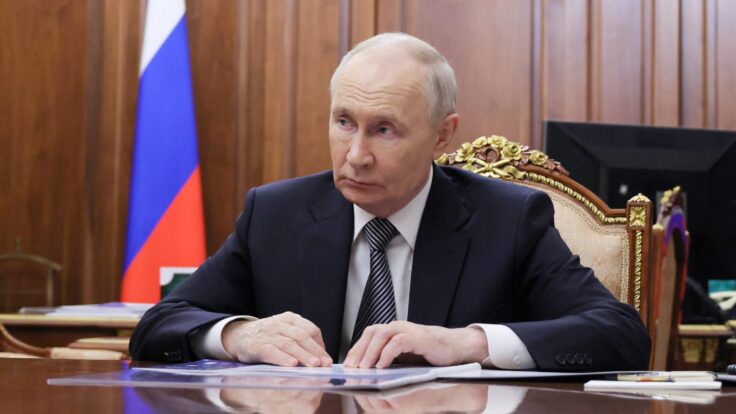
In fact, over the last year, Moscow has succeeded in peeling Washington away from Europe, and its rhetoric has shifted noticeably with Trump’s return to office. From February 2022 until January 2025, Moscow talked about waging war in Ukraine against “the collective West”; now, Putin and other Russian elites speak of a reasonable, pragmatic Washington—and “the party of war” in Europe. “Europeans are at an
ideological dead end when it comes to Ukraine,” a source close to the Kremlin told me last summer, just before the summit in Anchorage, adding that Brussels wanted to see the war in Ukraine continue at all costs. Compare that to Trump’s National Security Strategy, which castigates “European officials who hold unrealistic expectations for the war” and demands that NATO stop expanding. I remember spending Trump’s first term explaining, ’til I was blue in the face, why Putin preferred him in
office. This is why.
|
Now, on to Heilemann and Lepper… |
|
|
A chilling conversation with retired Air Force Major General Steven Lepper, a former top
military lawyer, about Trump’s legally dubious boat strike campaign, the dangers of an unfettered Department of Defense, and why he expects the worst is still to come. |
|
|
Shortly after his return to the White House, Donald Trump and his new secretary of Defense,
Pete Hegseth, fired the top military lawyers of the Army, Air Force, and Navy. Hegseth had long made clear his contempt for judge advocates general—the military professionals who advise troops and commanders on the laws of war—referring to them as “jagoffs” in his book. At the time of the firings, Hegseth said he wanted lawyers who wouldn’t be “roadblocks” to troops carrying out orders. In retrospect, of course, it seems obvious that the self-proclaimed “secretary of War” had
been laying the groundwork for precisely the sort of extralegal campaign that the military is currently executing in the Caribbean, where at least 22 alleged drug boats have been struck and at least 87 people have been killed off the coast of Venezuela.
Retired Air Force Major General Steven Lepper—who rose to the heights of military law in his 35-year active-duty career, culminating in a four-year stint as deputy judge advocate general of his service—was among those who
saw it coming. Following Hegseth’s purge, he co-founded the Former JAGs Working Group in response to what the group has called Hegseth’s “systematic dismantling of legal guardrails.” In fact, Lepper argues that the killing of two survivors of an initial boat strike on September 2 was worse, in some ways, than a war crime, because the United States had not been engaged in a war to begin with. On the contrary, Lepper said, it’s just murder. (The administration argues it is engaged in a lawful
campaign against “narcoterrorists,” but has not made public its justification nor disclosed any evidence against the targets.) |
|
|
Last year, Instagram launched Teen Accounts, which default teens into automatic protections. Now, a stricter “Limited
Content” setting is available for parents who prefer extra controls. Instagram will continue adding new safeguards, giving parents more peace of mind. Learn more. |
|
|
Lepper’s worries have only continued to grow. He joined me recently on my Impolitic podcast to
discuss what JAGs actually do, why they matter, why the boat strikes were exactly the kind of thing they feared at the outset, and why they fear there’s much worse to come. As always, this excerpt from the conversation has been edited and condensed for clarity, or you can listen to the whole thing here. |
John Heilemann: Let’s start here.
What does the judge advocate general do? What kinds of powers do they have?
Steven Lepper: The judge advocate general, or TJAG, is the senior uniformed legal officer at each of the military services. As deputy judge advocate general, my responsibility was to basically manage a force of lawyers, civilian attorneys, and paralegals who together constitute the Judge Advocate General’s Corps of the Air Force. We advise commanders, we advise individual military members, and we
practice multiple areas of the law that are relevant to what we do as a military. We have an area of specialty called operations law, and that’s the area of law that applies to situations like the ones we’re talking about today. These are folks who are trained, particularly in international law, to provide advice to everyone, from commanders to the trigger-puller, on what their rights and obligations are under the laws of war.
Got it. Now, tell me why you think the
administration’s campaign of airstrikes against alleged Venezuelan drug boats is not legally justified.
This administration has essentially recharacterized the nature of the illegal importation of drugs and the people who are doing it. They’re arguing that this is a non-international armed conflict, which means the United States, as a sovereign state, is fighting a non-state entity. For this to actually qualify as a non-international armed conflict, that entity has got to be
armed. The threat has to be one of military force—and it’s not. The administration is trying to establish an equivalency between drugs and bullets, such that the threat that is posed by drugs is somehow equivalent to the threat posed by bullets. International law doesn’t recognize that, and frankly, it puts us on a very, very slippery slope. If we consider the use of military force against drug dealers to be lawful, then who’s next? What other kind of contraband or substance brought into the
United States would justify us using force against them?
What [the Former JAGs Working Group] has argued is, since this is not a non-international armed conflict, the laws of war actually don’t apply. You have to look at this as a law enforcement operation in which deadly force is being used. We are serving as judge, jury, and executioner of criminals who have previously been interdicted on the high seas. They’ve been arrested, their drugs have been seized, and they’ve been prosecuted and
given due process. We’ve eliminated all legal protections, and we’ve gone straight to using armed force. [The group’s] discussions over the past several days have been focused on interpreting the laws of war as a framework within which to analyze the targeting of these two survivors on a boat on September 2.
The strikes weren’t a matter of enormous controversy for some number of months. Does it surprise you that there weren’t more members of Congress who were driving hard at the
potentially legally and strategically problematic nature of the Venezuelan campaign?
I don’t think many people in Congress or otherwise had the perspective that we did. We saw the guardrails crumbling as a preview of really bad things to come down the road. Let’s set the stage here: The inspectors general were being fired; the judge advocates general were being fired; the chairman of the Joint Chiefs of Staff; the chief of naval operations. The TJAGs being fired was, frankly, a
whisper in this cacophony of firings of everybody responsible for providing oversight of the federal workforce, the executive branch—the career people who had the expertise, background, and tenure to be able to actually do the job the executive branch is supposed to do. A lot of those folks at senior levels were fired. So I think we were lost in the background noise, and it was only after we started connecting the dots for them that they recognized how significant firing the TJAGs actually was.
We’re not here because of an order that Hegseth gave on September 2 to strike a boat twice. We’re not here because of Signalgate, which is now also in the news. We’re here because right after Hegseth took over, he decided that he wasn’t going to let the law hold him back—and he didn’t, and he violated it. And here we are. |
The laws of war allow you to attack an enemy. You’re legally sanctioned to kill an enemy combatant;
you’re not legally sanctioned to kill a criminal. The police forces around the United States are not immediately legally sanctioned to say, Oh, there’s a drug dealer on the street corner, I can go shoot him in the head. That’s effectively what the government is doing right now about Venezuela’s boats, even without presenting evidence.
That’s exactly right. There’s a thing called a combatant privilege, which insulates members of the
military from prosecution for killing people on the battlefield. What the administration is trying to do here is create an illusion that the Caribbean is a battlefield, and that narco-traffickers are combatants—and it’s an equivalency that just doesn’t exist. It can’t stand up. That’s why the absence of the [Office of Legal Counsel] legal opinion [on the legal basis for the strikes, which is classified] is so important. My colleagues and I would love to see the legal rationale being used as
the justification for all of this. |
|
|
In this instance, where would a JAG have inserted himself or herself in a way that might have kept
the second strike from happening?
After the first strike, you have to start asking questions, because now you’ve dropped a very large weapon on a very small boat in a very large body of water. And those three factors, depending on exactly how the weapon struck the boat and where the boat was in this large body of water, will create additional facts that you have to process. In this particular case, according to the reporting, when the smoke cleared and the boat was on fire, the
surveillance video had a picture of something on the water. More facts that are coming out suggest the picture looked like a boat that was still afloat but probably not navigable—and that there were two survivors who, at some point, were on board, either before, during, or after the strike.
Then you open the aperture and have to look at the rest of the water around it: Where was land? Where were other boats? Apparently, there was a radio one of the survivors had. What was the chatter on
the radio? All these facts create a picture that then everyone in the room considers when asking whether a second strike is appropriate. In this case, the JAG should have looked at this picture and recognized that, at first blush, these were two survivors, out of 11, on a boat that was disabled. That’s the definition of a shipwreck. Under those circumstances, the first response should have been, This is a shipwreck. These are two survivors who are out of the fight. And unless there are other
facts that suggest otherwise, they are no longer legitimate targets.
Admiral Bradley basically said they had an order to sink the boat—and that the boat wasn’t sunk after the first strike, so they sank the boat. He apparently didn’t regard the existence of these two shipwrecked individuals as relevant to carrying out his order, which was to sink the boat. Meanwhile, Democratic Rep. Jim Himes says that what he saw on video was two individuals in clear distress without any
means of locomotion, with a destroyed vessel floating in the water. What do you make of Bradley’s justification for a second strike?
That convinces me even more that this is murder. The facts you just described fit within the definition of shipwrecked. Even if they could call back to their forces to get rescued, they are still shipwrecked, and they are no longer targets. Not only are they no longer targets, but the obligation of everyone, including the U.S. Navy, is to pick them
up and rescue them. If we take that approach to these two survivors on a boat, how can we argue that our downed airman is somehow protected under the law? There’s a reciprocity thing here that we need to think about as we look at these cases. And quite frankly, it was always something that I considered when I looked at scenarios like this and gave my commanders advice. I always looked at least one time at how what I was advising the commander to do would affect how our forces would be treated
under similar circumstances.
Do you think it matters at all if Hegseth did not give this order directly? Does that change his responsibility for the second strike of those two shipwreck survivors?
It’s clear he set the conditions for what happened, whether he issued an order or not. Oral, written, or not, he set the conditions for what happened there—starting with the firing of the TJAGS, etcetera. Whether that would be sufficient to hold him criminally
responsible, that’s a good question. Congress is starting down that road right now, and our group has called for it to investigate this thoroughly, compile a record, and collect evidence. Because, quite frankly, in the short term anyway, that may be the only way that evidence will be collected. That may be the only way that an investigation will occur. Otherwise, the people responsible for investigating this as a crime would be the Department of Justice and the U.S. military—and I’m not sure
either of them is going to be asked to do that. |
|
|
Join Emmy Award-winning journalist Peter Hamby, along with the team of expert journalists at Puck, as they let you in on the
conversations insiders are having across the four corners of power in America: Wall Street, Washington, Silicon Valley, and Hollywood. Presented in partnership with Audacy, new episodes publish daily, Monday through Friday. |
|
|
Unique and privileged insight into the private conversations taking place inside boardrooms and corner offices up and down Wall
Street, relayed by best-selling author, journalist, and former M&A senior banker William D. Cohan. |
|
|
Need help? Review our
FAQ page or contact us for assistance. For brand partnerships, email ads@puck.news.
You received this email because you signed up to receive emails from Puck, or as part of your Puck account associated with {{customer.email}}. To stop receiving this newsletter and/or manage all your email preferences, click here.
|
Puck is published by Heat Media LLC. 107 Greenwich St., New York, NY 10006 |
|
|
|