 |
Welcome back to The Best & The Brightest, I’m Tara Palmeri.
Happy White House Correspondents’ Dinner weekend, the beating heart of D.C.’s social scene—a time to let loose, bump into administration officials and B-list celebrities, as well as sources and clients. Try to have fun, even if you didn’t score an invite to every party in town.
Also: A very warm welcome to John Heilemann, who’s officially joining Puck and The Best & The Brightest team. He’ll anchor a special Sunday evening column called “Impolitic.” I’ve always admired John’s reporting and writing, and can’t wait to devour what he whips up each week.
In tonight’s edition, my candid conversation with Republican political strategist and Trump’s private pollster John McLaughlin. We debate how Trump’s criminal trial could affect his poll numbers and his beef with the latest NBC poll showing a Biden micro-bump. Plus, what Republicans can do to peel away Democratic voters, the R.F.K. Jr. factor, and much, much more. (For my extended conversation with McLaughlin, check out the latest episode of my podcast, Somebody’s Gotta Win. Earlier this week, my wonderful colleague Abby Livingston came on the show to unpack how the motion to vacate could play out for Mike Johnson.)
But first, a few notes on the Trump veepstakes and the post-McConnell K Street shuffle…
- Noem’s abortion shift: In the weeks since I reported that Trump has removed anti-abortion crusaders from his V.P. shortlist, it sure looks like Kristi Noem may be trying to edge her way back into contention. Earlier this week on CNN, the South Dakota governor distanced herself from her own state’s laws, which essentially outlaw abortion except to save the life of the mother, saying those laws were created “decades before I became governor.” (She’s vociferously endorsed them in the past.)Noem, a longtime defender of controversial “heartbeat” anti-abortion legislation, added: “I may be pro-life, but that doesn’t necessarily mean that I’m a dictator and that I get to decide that. Donald Trump recognizes the constitutional authority of the states. And I love that.” We’ll see if there’s any impact. My sources inside Mar-a-Lago say that Trump remains wary of the political liability created by potential V.P.s who come from “heartbeat” states, also including Sarah Huckabee Sanders and Doug Burgum, and would rather avoid the headache.
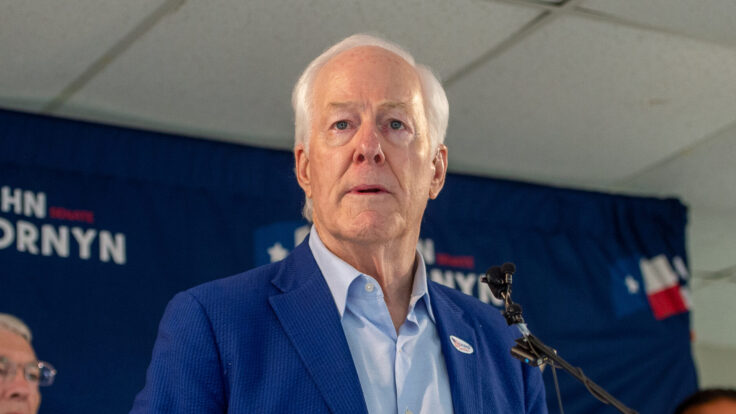
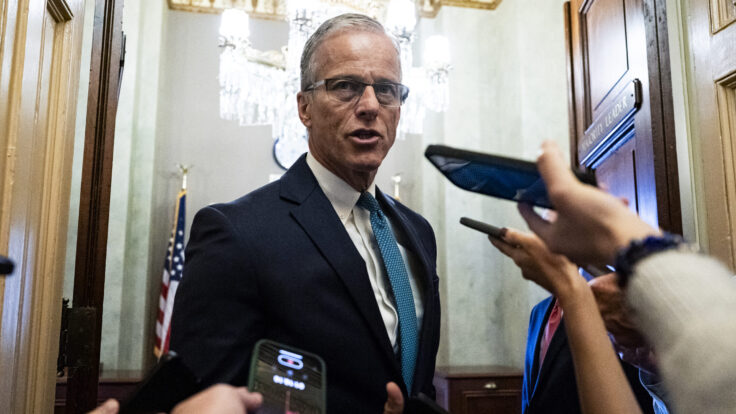
- McConnell afterlife aftershocks: Just how large will Mitch McConnell loom as leader emeritus once he passes the torch to John Cornyn or John Thune? It should be a smooth handoff, by all accounts, with McConnell planning to step back this year, before his term ends in 2026, allowing some members of his staff to transition to the new leader’s office. But that’s not to say the changing of the guard is without drama.The whispers during the lunchtime rush at Tosca are about whether McConnell could break Susan Collins’ heart and demand the chairmanship of appropriations—arguably the most powerful Senate committee—as an avocation while he rides out his twilight years. “Collins has wanted to be appropriations chair her whole life, but McConnell could take it from her,” said a Republican Senate source. As a consolation prize, Collins could take HELP (Health, Education, Labor, and Pensions) or the intel committee or one of the other chairmanships which would become available if Trump wins and plucks easily confirmable senators like Marco Rubio for his cabinet.
Appropriations would certainly be a way for McConnell to get revenge on a colleague like, say, Rick Scott, who tried to challenge him for leader in 2022. “I would sit there and hold the purse strings: ‘I’m smart and crafty. Remember when you screwed me?’ Boom,” said the Senate source. For now, it’s a guessing game. “The leader has deliberately not made a decision,” said McConnell spokesperson Scott Sloofman. Meanwhile, basking in the glow of the passage of the $95 billion foreign aid bill, McConnell has done a bunch of interviews and taken questions at pressers and teased, “I might even start hanging around in the halls answering questions.”
|
| Now, here’s Abby Livingston with an update from the Hill… |
|
|
It’s hard to overstate how January 6 continues to haunt everyday life on Capitol Hill, guiding the actions of those who were present. To wit: During my standard perusal of the latest campaign finance reports, it seems that many former and outgoing Republican members donated to candidates who either held the line that day, or voted to impeach Trump in the insurrection’s aftermath. Here’s where the money is flowing…
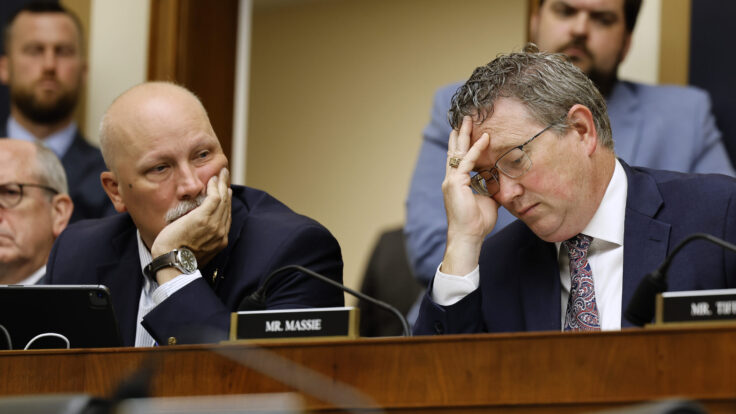
- Meijer’s solidarity squad: Three former members of Congress are running in the Michigan Republican Senate primary: Justin Amash, Peter Meijer, and (the other) Mike Rogers. Rogers, a former House intel chairman who retired in 2014, had the most congressional member donations—including from former House colleagues like Cathy McMorris Rodgers, retired pals Greg Walden and Dave Camp, and former colleagues John Boozman and Marsha Blackburn, who are now senators. Senate donations also included Marco Rubio, Jerry Moran, Dan Sullivan, and, most notably, Mitch McConnell.But it was long-shot candidate Peter Meijer’s congressional donors who caught my eye: Tom Rice and Senator Bill Cassidy. Meijer’s brief House career was punctuated by his impeachment vote against Trump following the insurrection; he lost his first reelection attempt in 2022. Rice, who was first elected in 2012, endured the same career fate after his impeachment vote. Cassidy also voted for impeachment. As for Amash? He picked up donations from Warren Davidson and Thomas Massie.
- Saluting Dunn: Speaking of Tom Rice, the former South Carolina rep. surfaced in another F.E.C. report, this time in support of Democrat Harry Dunn, the Capitol police officer who held the line on January 6 and testified about his experience during the House committee investigation. Dunn is running for the open seat in Maryland’s 3rd district—safe Democratic territory. Republican Adam Kinzinger, who served on the committee, also donated to Dunn, as did the committee’s then-chairman, Democrat Bennie Thompson, along with Dick Durbin, Cory Booker, Eric Swalwell, and Mike Thompson. I’ve combed through thousands of F.E.C. reports over the years, and I can’t recall ever seeing one with both Democratic and (albeit retired) Republican donor members appearing on the same receipts page.
|
|
|
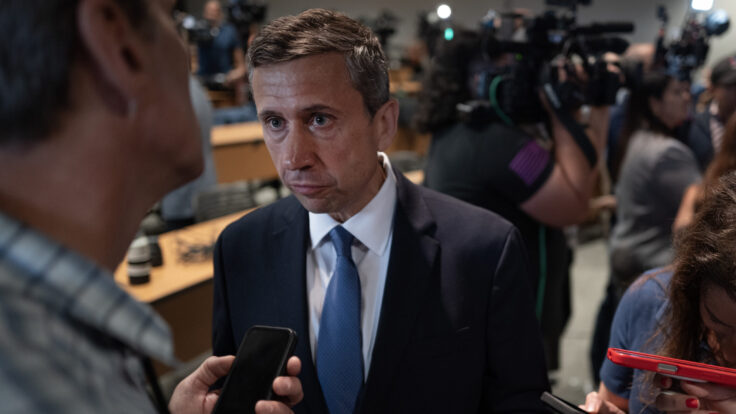
| The long friendship between Republican strategist John McLaughlin and Donald Trump dates back to 2011, when the then-future president was considering ditching his gig on The Apprentice to run for office. Trump, picking up early signals of the changing political winds, had begun deploying increasingly racially charged attacks on President Barack Obama, questioning everything from his college grades to his citizenship status. Notably, it was around this time that Trump reached out to McLaughlin to see how he might fare as a candidate, himself. In the end, he decided that he didn’t want to give up his show, but McLaughlin has been his private pollster ever since.Over the years, of course, McLaughlin has occasionally painted a rosier picture for his client than the numbers actually justified. But there’s no question he was on the money in 2016, when his private polling showed Trump either closing in on or beating Hillary Clinton in Pennsylvania, Michigan, and Wisconsin, just 10 days before the election. McLaughlin also accurately predicted Trump’s national popular vote numbers for 2016 and 2020, and his dismissive view of Trump’s primary challengers this cycle was clearly vindicated, too. One can only imagine what it’s like to be a pollster for Trump, who likes to claim at rallies that McLaughlin tells him he polls better than Lincoln or Washington. (McLaughlin, for the record, says he’s never told Trump any such thing.)
Back in the ’80s, McLaughlin launched his career working for Ronald Reagan’s go-to pollster, Arthur Finkelstein. As McLaughlin pointed out in our conversation, which has been edited for length and clarity, that biographical detail has a certain resonance today: “I can tell you that Trump’s numbers in the 2024 primaries—which were historic, record wins—were better than Reagan’s in the ’80s,” he told me. Also, Benjamin Netanyahu is another McLaughlin client… a little more on that, and much more, below. |
|
|
| Tara Palmeri: I’m always fascinated by how public polling differs from the polling that candidates receive internally. Now, everyone in Washington is talking about Biden’s 2-point bump. NBC’s poll shows Trump at 46 percent to Biden’s 44 percent nationally, with 10 percent undecided. Your poll has Trump at 49 percent to Biden’s 45 percent, with 7 percent undecided. Why are you getting different numbers? John McLaughlin: Well, it’s not apples to apples. NBC did a poll of registered voters; we screen for likely voters. The universe of registered voters, or eligible voters, in the country would be more than the 160 million who voted in 2020. We model our polling after a turnout like 2020.
This time, we didn’t move ahead in the national popular vote until Biden decided to surrender Afghanistan to the Taliban. Since then, Trump’s been leading in the national popular vote, or running even. In our last national poll, he’s up 49 to 45, which is significantly better than we were doing in 2016 or 2020 at this point.
Because there’s such low enthusiasm for the election, there’s been an argument that Biden will win because likely voters will come out, as opposed to just registered voters. Do you agree with that?
No. The NBC poll, I disagree with. Trump has the more enthusiastic base, which is why he’s still ahead when they poll these third-party candidates. A lot of Biden’s voters are based on anti-Trump sentiment. And if he can’t drum up the anti sentiment, he doesn’t have much of a record to run on.
You say that third parties will have a significant influence. The NBC poll shows Robert F. Kennedy Jr. taking more from Trump than Biden. Before that poll, public polling showed him taking more from Biden than Trump. Why is there a shift?
Because Biden was bringing back some of those pro-choice voters that he had in the Democratic Party, and he was taking them from Kennedy, not from Trump. Trump’s vote total didn’t go down in my poll [when we added Kennedy as an option], anyway.
Why are those pro-choice voters coming back now? Is it because of the ban in Arizona and Trump clarifying his position on abortion?
Well, Trump’s position has always been clear on abortion.
Not really. He came out finally and said he stood for states’ rights, and then the next day there was the all-out ban in Arizona.
Well, he put up a video [saying he favored states rights], but on the other hand, he was saying that in Alabama there should be exceptions [for life of the mother, rape, and incest]. And Trump is for those exceptions—he’s always said that. What happens when Biden pulls back some of his base? Kennedy is left with more Trump voters. However, those Trump voters don’t really know where Kennedy stands. He would end fossil fuels, right? He’s been weak on immigration. He’s been weak on crime. When you realize he’s a traditional liberal, he’ll end up taking more from Biden than from Trump.
If you’re Trump, do you want R.F.K. on the debate stage?
The question is whether Kennedy is scoring or not in the polls. For Kennedy to score that high in the polls, he’s got to take more votes from Biden. He’s not going to take them from us. So leave out the Kennedy part. I don’t think Biden wants to debate Trump at all. I don’t think he’s going to debate Trump. And with or without Kennedy, we want to debate Biden.
Kennedy is on the ballot in Michigan, which is a battleground state. What impact do you think that’s going to have?
I think Trump’s ahead in Michigan because Biden wants to ban gas-powered cars and trucks.
How much is he ahead, according to your polling?
I’m not going to release that, but we’re ahead.
Come on.
The Real Clear Politics average in Michigan looks good.
So, up by 3 points?
I would say that’s a very accurate forecast.
You’ve never projected that Trump would win the popular vote, but you were right in 2016 when you predicted he would get 46 percent and in 2020 when you predicted he’d get 47 percent.
Right. We were always battling for an electoral vote win, where we could lose the national popular vote but still win. While everybody was saying there was a Hillary lock in 2016, we were saying, “No, we could win a close race.” And President Trump proved us right. We were barnstorming up to five different states a day, and he was focused on those battleground states where we could get our votes out. And by 78,000 votes out of the 139 million in 2016, we were able to win at the Electoral College. In 2020, we were still battling for pretty much the same battleground states. And by 44,000 votes out of 160 million, Biden was able to pull it off.
So how should we be looking at public polling? Is it all about the battleground states? Do these national matchups even matter?
I think you should be looking at the battleground states, and even the battleground counties. We had a strategy in 2016 that I think the Democrats caught on to. When you read David Plouffe’s book, A Citizen’s Guide to Beating Donald Trump, you see that he understands why: When Donald Trump asked me in the summer of 2016, “How are we going to win? All these national polls have us losing,” I said, “We are going to bring out new voters to the electorate. We’re going to bring out working-class voters who were making less than $60,000 a year, who were one paycheck away from destruction, and we’re going to bring them out in the key battleground states,” which Donald Trump did. Turnout was 9 million more voters in 2016 than it was in 2012.
Plouffe talked about pivot counties—the over 200 counties where Obama won and then Trump won. [The Democrats] focused on those counties, within those battleground states, where they were registering new voters. They were going to make it easier for them to vote, they were going to have drop boxes, they were going to ballot harvest, and you were going to see increases in voters. |
|
|
| Who is Trump losing from his 2016 coalition? Because he obviously lost some people in 2020 to Biden.The people who are dead, that’s who we’re losing right now, because we’re doing better. We’re performing better with voters than we did in 2016, without a doubt.
With who, specifically?
There’s 4 or 5 percent of voters in these polls who voted for Biden in 2020 who are now voting for Trump in 2024. A quarter of them are Black, a quarter of them are Hispanic. Their average age is 35. They’re younger, they’re more diverse. And by the way, Biden knows it, so he’s focused on trying to win those voters back. They’re spending a great deal of time trying to win African American voters back in Georgia and North Carolina. We’re doing everything we can to keep those votes in Nevada.
What are you doing to keep those voters?
The campaign reaches out to them. You’re doing social media, you’re doing voter outreach. The Trump campaign is speaking directly to those voters. Our super PAC has been advertising on African American radio, and the Biden campaign is trying to get those voters back.
The race is tightening a bit. Who’s Trump losing?
Actually, we’re holding our vote in our polls. Biden is getting back some of the votes that he was losing—say, pro-abortion voters, who he should have had in the first place, but he was losing them on inflation.
Who’s Biden losing?
What I call “safety moms.” You’ve got the suburban, independent, and Democrat moms who are saying illegal immigration is bringing criminals into the country, fentanyl is out of control. They’re worried about their children’s safety. They really are. They’re also upset about inflation. Even though the Biden people are telling them inflation’s gone down, they’re spending more on a trip to the supermarket. [Biden’s also losing] working-class minorities.
Do you really think you’re going to be able to hold on to the Black and Hispanic vote?
Republicans have won 20 percent of the Black vote in statewide races. I’ve done it in Georgia with the governor’s race. That’s how Brian Kemp got elected by 8 points. You have middle-class voters who support charter schools, which the Biden Department of Education does not. You have African American voters who work in law enforcement who want to send their kids to charter schools. So if you want opportunities for your children and you happen to be African American, you have to seriously look at voting for Donald Trump—and it’s happening. |
| Courtroom Backlash & The Abortion Effect |
|
| How is the hush-money trial impacting voters? It’s taken away from our narrative. We’d like to be talking about President Trump’s record versus Biden’s record. Instead, we have to talk about how he has to be in Manhattan every day. This is unprecedented in America. When you look at the poll we published last week, 66 percent of all voters say politics has played a role in these indictments.
How is the trial impacting women and independents?
Well, right now, in a way, it’s making Trump a sympathetic figure. Because they’re saying, “If they could do this to him, they can do it to anybody.”
Obviously, an acquittal is Trump’s best-case scenario. Give me your worst-case scenario.
I mean, the worst-case scenario for us, is to put Trump in jail. I mean, they’re not kidding around. This is serious stuff. They’re trying to take away his wealth.
Does the trial make independents less likely to vote for him?
It’s made him sympathetic. [The Justice Department is] trying to make him the Nelson Mandela of America.
How does abortion rank in your polling?
It comes up in single digits [as the most important issue]. Our poll shows a quarter of voters saying inflation is the most important issue. Almost half the voters say the economy is the most important issue. You get immigration in double digits. On abortion—because it’s a state-by-state decision, and most states have not changed their abortion laws, and other states have referendums—it’s not quite the issue that the Biden Democrats want it to be.
How is Trump polling on abortion?
Based on national polls, I think most voters are happy with their states deciding.
Early voting is a huge issue. How do Republicans feel about it, and will they use it?
Republicans have anxiety about the 2020 election, about how early voting was conducted, particularly the drop boxes and these paper ballots where they were taking them away after Election Day. No other country does that.
You’ve been Netanyahu’s longtime pollster. The conventional wisdom post-October 7 is that if the election were held today, he’d lose.
I think he’s more worried about winning a war than winning an election. For the vast majority of Israeli voters, it’s always been a challenge between security versus cost of living, as their top issue. Right now, it’s security.
Do you think Israel will play an outsized role in the U.S. election?
We’ll see. There’s division within the Democratic Party. There’s not in the Republican Party. In the Democratic Party, there are forces at work that are not just anti-Israel. When you have Democrat activists holding rallies and chanting and teaching people how to say, “Death to Israel!” and “Death to America!” you’ve got a big problem. As the campaign goes on, that’s going to be a bigger problem for Joe Biden. |
|
|
|
| FOUR STORIES WE’RE TALKING ABOUT |
 |
|
 |
| VandeHei in Full |
| A conversation with the Politico & Axios co-founder. |
| DYLAN BYERS |
|
 |
| Inner Beautycounter |
| Chronicling Gregg Renfrew’s bid to wrestle back her company. |
| RACHEL STRUGATZ |
|
 |
|
|
|
 |
 |
|
|
| Need help? Review our FAQs
page or contact
us for assistance. For brand partnerships, email ads@puck.news. |
| You received this email because you signed up to receive emails from Puck, or as part of your Puck account associated with . To stop receiving this newsletter and/or manage all your email preferences, click here. |
| Puck is published by Heat Media LLC. 227 W 17th St New York, NY 10011. |
|
|
|