{{ 'now' | timezone: 'America/New_York' | date: '%b %d, %Y' }} |
|
|
|
Hi, and welcome back to Line Sheet. We’re going on day four of 100 degree-plus weather here in Paris. It is
wild. I managed to finally meet Thistle Brown, stylist and maker of my favorite sunglasses, last night at a gorgeous Left Bank dinner that he and his can-do C.E.O., Paul Lachman, organized. (I was honored to be seated with the grown-ups. Justinian!)
I’ll have more from Heat Week (and men’s shows) in the coming days. Right now I invite you to escape for a minute and check out
Style Analytics data queen Molly Rooyakkers’ latest findings (available to Inner Circle members only), which reveal how luxury brands are faring on social media in 2026. Perhaps unsurprisingly, engagement is down overall—and even when a post pops, it doesn’t necessarily
translate to sales. And yet there are still brands winning on Instagram and the like. Molly reconciled the data so you don’t have to.
Up top, a bit of intel you won’t get anywhere else on Emmanuel Gintzburger’s exit from Versace, a report on the next Vogue World location, and a look at Jay-Z’s truly novel merch strategy.
Tomorrow on Fashion People, my guest is retailer, designer, creative director and hotelier
Alex Eagle. We discuss her fascinating career, from the early days in the fashion closet of Harper’s Bazaar and her turns as merchant to forming her own, namesake fashion brand and, now, acting as a creative mind behind St. Clement, the new hotel from Soho House founder Nick Jones. (Read more about it
here.) We also talk shopping, since we both did some at Bicester Village, the genuine retail marvel where we recorded the conversation in front of a live audience. Thanks again to Bicester Village & Co. for organizing, and to Jess Christie for fairy-godmothering. Listen
here and here.
Also mentioned in this issue: Andrea Guerra, Anna Wintour, Charles Porch, Celine, Lorenzo Bertelli, Jay-Z, Condé Nast, Stefano
Cantino, Drake, Maison Margiela, Matthieu Blazy, Schiaparelli, Richard Dickson, Dolce & Gabbana, Patrizio Bertelli, OpenAI, Miuccia Prada, Justin Bieber, Everlane, Sophie Bille Brahe, and more. |
Three Things You Should Know…
|
- Why
Versace’s C.E.O. quit: Everyone knew that Versace C.E.O. Emmanuel Gintzburger would never remain at the brand long-term after it was bought by the Prada Group, but company insiders also indicated that he was pretty much welcome to stay until his contract expired at the end of 2027. But Gintzburger apparently didn’t want to be a lame duck. His scope of work has been reduced significantly, and the Prada Group is run by a strong C.E.O., Andrea Guerra, who also
manages the brands. And then, of course, there are the Bertellis, who are as involved as ever. Lorenzo, the son of Patrizio Bertelli and Miuccia Prada, has already been installed at Versace as chairman.
I suspect they’ll replace him with an Italian executive who has experience within Prada. Dolce & Gabbana exec Stefano Cantino was originally pegged for
the job, and they’ll probably find someone with a similar profile and range of experience. - Vogue World on the Embarcadero?: According to a report in the San Francisco Chronicle, Vogue global editorial director Anna Wintour recently visited the newspaper’s home city to
start planning 2027’s Vogue World. (This year’s event is in Milan on September 22, the first day of Fashion Week.) According to people at Condé Nast, this is all but confirmed.
It makes sense: Meta, Apple, Google, Anthropic, OpenAI, etcetera, are all important Condé Nast advertisers, and Gap Inc. is there, too. I am sure that Richard Dickson would be thrilled to come out on a float in the middle of the performance. Finally, San Francisco is still emerging from its
homeless-on-the-streets, billionaires-in-the-office-towers pandemic blues, and Vogue World offers a chance to validate the turnaround. (And in typical Condé fashion, it also gets to overstate its place in the world. The peninsula, of course, is the one place where the Newhouses aren’t that rich, crazy as it sounds…) Anyway, I am supportive of this idea. They should serve Bi-Rite ice cream and Dandelion Chocolate. I just don’t want to know how they plan on incorporating
A.I., though we know that OpenAI’s head of partnerships, Charles Porch, will be involved. - Jay-Z’s stealth fashion reach: Jay-Z’s takeover of New York City, with two pop-ups celebrating the 30th anniversary of Reasonable Doubt, is pretty remarkable. Roc Nation even skinned the out-of-service subway station recently used by Chanel for Matthieu Blazy’s first Métiers d’art show. It’s a massive
project, and they’ve already sold out of 35 SKUs of the merch, from apparel to CDs. So even when a musician hasn’t labeled his merch as a fashion brand, à la Drake or Justin Bieber, you have to remember that they sell more clothes each year than many of your favorite designers do.
|
|
|
|
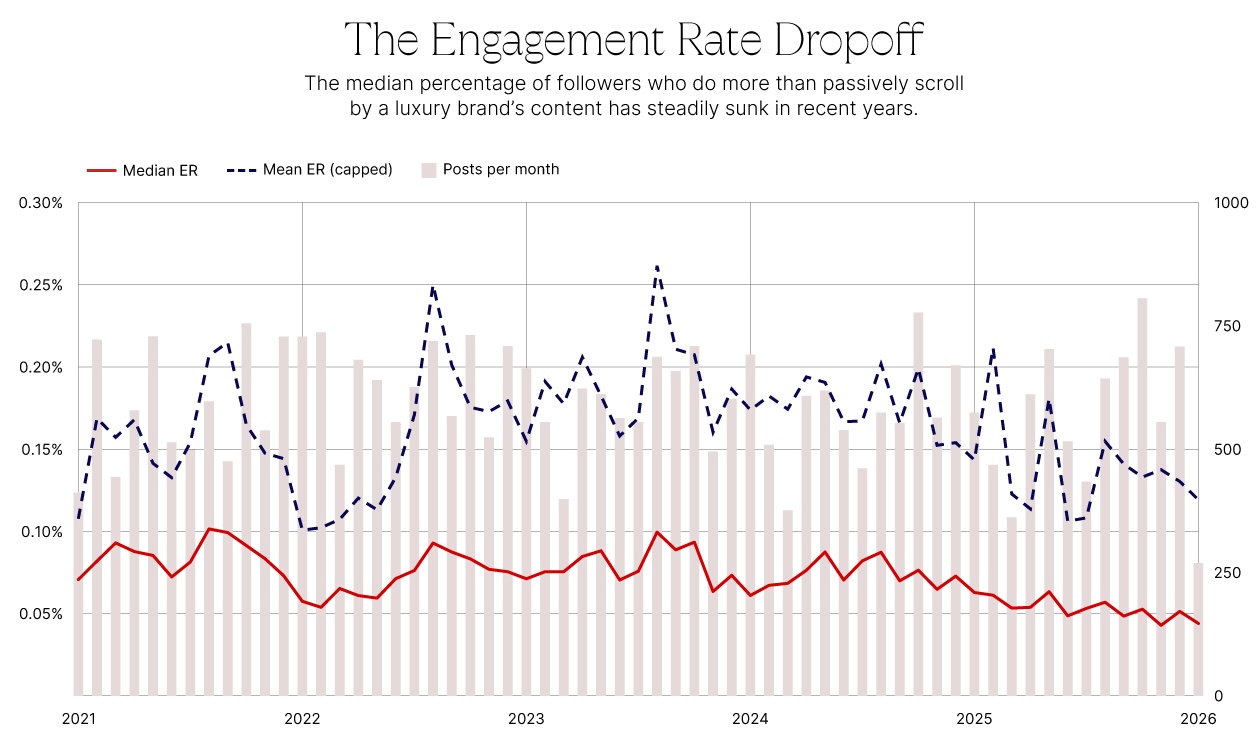
The rate at which consumers like and comment on luxury fashion content is collapsing,
forcing brands to scramble to update their well-thumbed marketing playbooks. |
|
|
|
Inside luxury fashion, marketing teams all seem to be having the same anxiety: The pressure to go viral—or to
use the current term of art, win the moment—has only intensified. But budgets are tighter than ever, fans are fave-ing and sharing appreciably less, and engagement rates are depressing. For luxury brands, the share of likes and comments relative to an account’s followers used to be between 1 and 3 percent, according to Dash Social. But that benchmark has
weakened alarmingly. Quid, the social listening platform, found that Instagram engagement declined 17 percent year over year across the platform, suggesting that audiences are fatigued or, perhaps, just passively scrolling. At the same time, algorithms increasingly reward paid rather than organic posts.
So what kind of
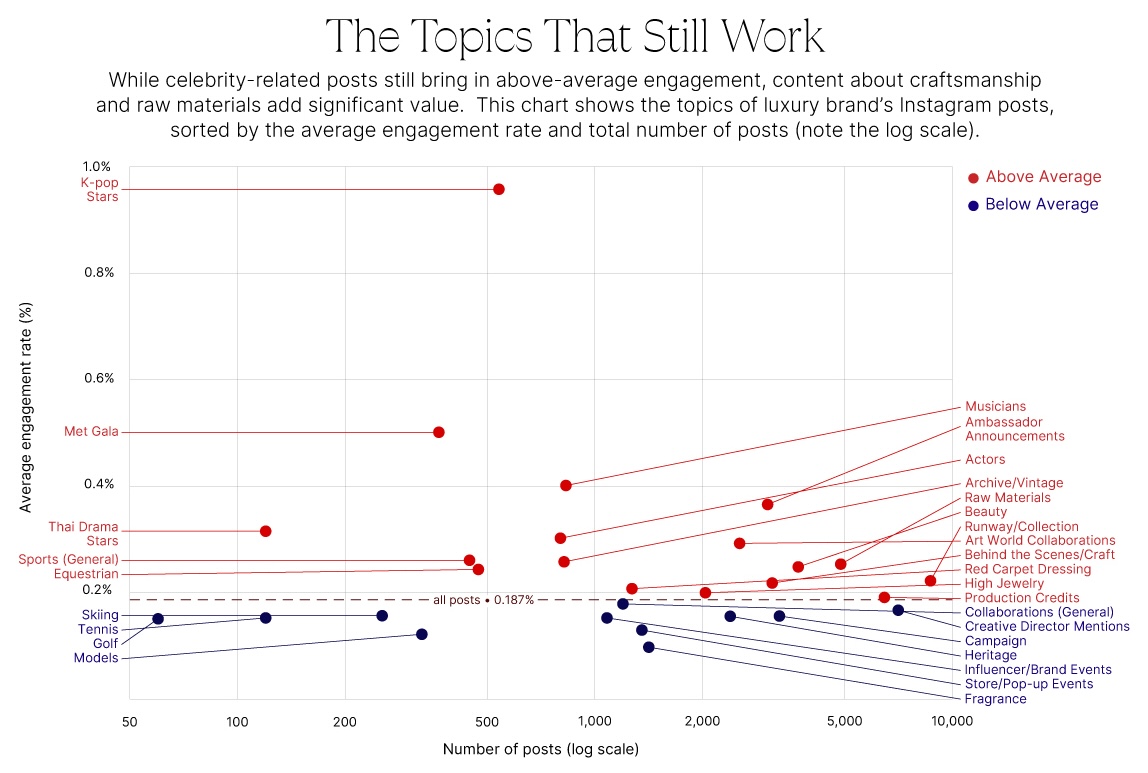
content still breaks through? I analyzed five years of Instagram activity from 20 luxury fashion brands: Dior, Louis Vuitton, Chanel, Prada, Miu Miu, Hermès, Loewe, Schiaparelli, Maison Margiela, Loro Piana, Balenciaga, Celine, Fendi, Valentino, Moncler, The Row, Burberry, Gucci, YSL, and Chloé. In all, the dataset of 36,076 posts allowed me to identify the topics, personalities, and posts that consistently cut through the fatigue. |
To be fair, engagement on Instagram is flopping for just about everyone. Across the 20
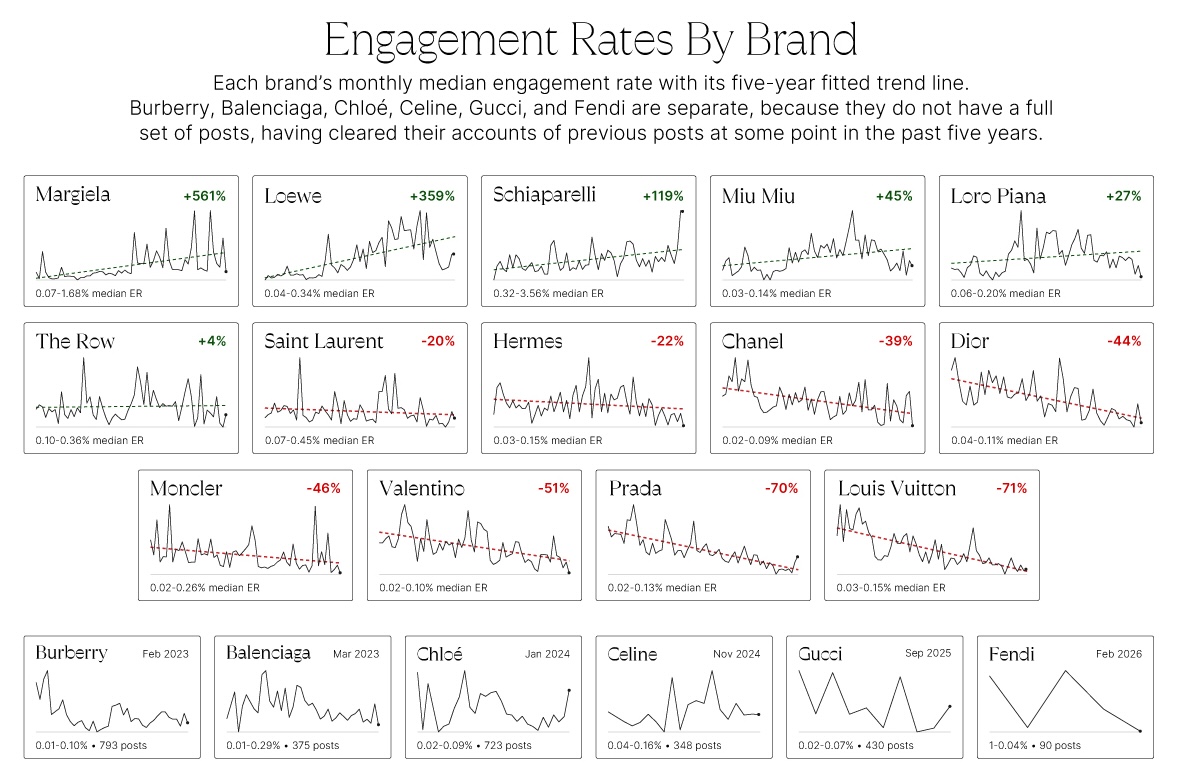
brands, the median engagement rate has dropped roughly 37 percent over the past five years, even though the brands are posting as much as ever. |
A small portion of the decline is just simple math. Many luxury houses have added millions of followers
during this period. When audiences grow faster than likes and comments, engagement rates inevitably fall. Still, several tracked brands managed to increase engagement and deepen audience interest. |
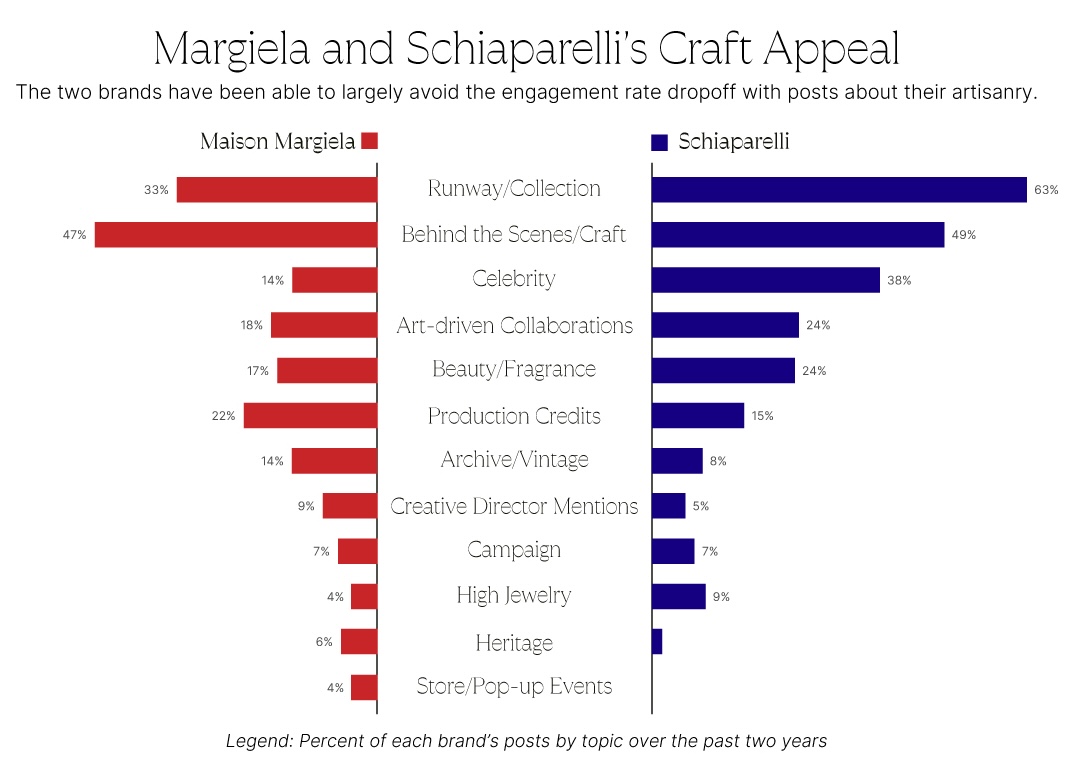
Over the five-year period, Margiela and Schiaparelli had the strongest and most consistent engagement growth.
Notably, the two houses relied on remarkably similar strategies—showcasing craft, ateliers, archives, and the clothes-making process. The message was concise: Their clothes are valuable because of the painstaking craftsmanship, institutional memory, and level of care that goes into preserving them.
Schiaparelli, in fact, folded craftsmanship into almost every post. A celebrity appearance or runway piece often served as an entry point to see the original sketch, the patternmaking, or a
close-up on the construction of a neckline. Margiela opened both its physical and digital archives, encouraging people to read them folder by folder, allowing hungry fans to explore the inner workings of their brand via great content. Margiela also turned the logistics behind a runway show into compelling video content, such as documenting teams carefully packing collections before they left for the runway. |
That message arrives at an opportune moment. Luxury consumers—and even aspirational luxury
shoppers—understand quality better than ever before. They also have unprecedented access to products that can resemble luxury goods from across a room. In that environment, brands have to do more than present beautiful products. They have to explain why those products deserve your attention and, ultimately, your money. Craft, of course, is not every brand’s native language. Let’s see what else works. |
The dataset also helped explain why luxury brands continue to invest so heavily in dressing celebrities,
particularly K-pop stars. Those partnerships reliably boost engagement by mobilizing well-organized fan bases capable of driving earned media value. Whether that attention translates into brand affinity or sales is another question: It mostly reflects devotion to the celebrity rather than to the house itself—but that’s a topic worth exploring separately. |
More revealing are the topics that consistently outperform average engagement while strengthening the brand’s
identity—art world collaborations, stories about craftsmanship and raw materials, high jewelry, along with archival content that does more than push a new collection. Unlike celebrity campaigns, these posts don’t rely on borrowed audiences. Instead, they require the brand to make its own case for why its clothes deserve attention.
Yes, budgets remain constrained, audiences are fatigued, and engagement continues to decline for almost everyone. But the
houses holding their audiences are winning by showing their work and demonstrating its value. This content comes from inside the house and ultimately gives shoppers a reason to spend four figures on a pair of jeans. In a market where the customer is more fluent in quality than ever and a convincing dupe is one tap away, that’s the whole game. |
Sophie Bille Brahe, the leading provider of diamonds and
pearls for women who used to shop exclusively at Everlane but luckily worked at a startup that had a decent exit before it all went A.I., is launching high jewelry just in time for Couture week in Paris. [Instagram]
I really liked this lookbook. [Our Legacy
Spring/Summer 2027]
I am sooooo excited for the Celine show on Sunday because I am still a fashion dork! [Instagram]
Arket is the best thing about the H&M Group and they need to start shipping to the U.S. [Bloomberg]
|
Until tomorrow,
Lauren
P.S.: We use affiliate links because we are a business. We may make
a couple bucks off them. |
|
|
|
Puck founding partner Matt Belloni takes you inside the business of Hollywood, using exclusive reporting and insight to explain the
backstories on everything from Marvel movies to the streaming wars. |
|
|
|
Puck’s daily art market email, anchored by industry expert Marion Maneker, offers unparalleled access to the mega-auctions and galleries,
elite buyers and sellers, and the power players who run this opaque world. |
|
|
|
Need help? Review our FAQ page or contact us for assistance. For brand partnerships, email ads@puck.news. You received this email because you
signed up to receive emails from Puck, or as part of your Puck account associated with {{customer.email}}. To stop receiving this newsletter and/or manage all your email preferences, click here. |
Puck is published by Heat Media LLC. 107 Greenwich St., New York, NY 10006 |
|
|
|
|