 |
|
Happy Sunday, and welcome back to Dry Powder.
|
|
Are we beginning to see signs that Zaz, Gunnar & Co. are turning the Warner Bros. Discovery battleship around? In today’s issue, why I think the markets misread WBD’s third-quarter earnings, plus thoughts on BDT & MSD Partners’ empire-building exercise and how S.B.F.’s conviction is reverberating across the crypto landscape.
|
 |
| Zaz-Adjusted EBITDA |
| An examination of the hidden green shoots at WBD. Plus, notes on the latest maneuvers at BDT & MSD Partners, and how S.B.F.’s downfall is reverberating through the crypto universe. |
|
|
|
| I’m not sure what spooked investors about Warner Bros. Discovery’s third-quarter earnings, but whatever it was sent the stock down 19 percent on Wednesday. Frankly, I don’t have any concern about WBD beyond its pre-existing challenges, many of which plague its whole industry: WBD has too much debt, too much leverage, a barely breakeven streaming business, and a linear TV unit suffering from a declining advertising market. This has been the story since the company was created in April 2022.
Since WBD started trading, its stock is down 59 percent. It now has a market value of around $25 billion and market capitalization of $68 billion, including $43 billion of net debt. And WBD will, justifiably, continue to struggle as an equity play as long as its leverage remains so high. No matter how you slice it—and even with a weighted average coupon of 4.6 percent, and with long-dated maturities—$43 billion is still a lot of debt. Heavy cake.
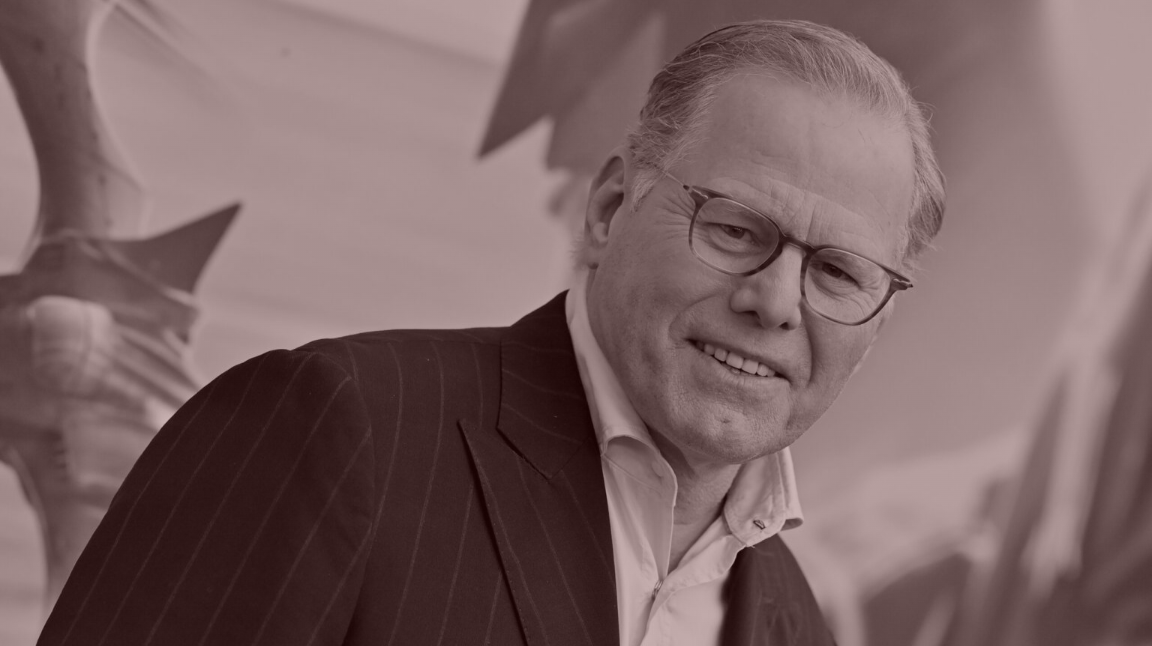
And yet, I read the third-quarter earnings differently than the market. This is not investment advice, but it seems to me David Zaslav and C.F.O. Gunnar Wiedenfels are starting to turn the WBD battleship around in the face of the strong headwinds rattling the industry. I’ve often described WBD as a publicly traded leveraged buyout. And it is, and will continue to be, until it pays down more of its debt. That’s the bad news. The good news is that Zaz & Co. are paying down that debt. In fact, since the start of the WBD journey, according to Zaz, the company has paid down $12 billion of debt and is generating “over $5 billion in free cash flow” at the moment. (The market may have overreacted on Wednesday; the stock was up 5 percent on Friday, but still was down 13 percent for the week.)
Gunnar further clarified that WBD will still hit its projected leverage ratios, at the levels he had stated a few times earlier in the year. “We said we were going to be less than four times levered,” Gunnar said on the earnings call. “We will be less than four times levered comfortably.”
The path to under four times leverage can proceed in one of two ways: WBD either has to have more EBITDA (the denominator) or less debt (the numerator), or both. WBD has proven that it can pay down debt. It has not yet proven, however, that it can meet its EBITDA guidance, without going all “Adjusted EBITDA” on us. When LightShed’s Rich Greenfield suggested to Gunnar on the earnings call that he seemed to be telling Wall Street he was reducing WBD’s projections for next year beyond what he had previously discussed, Gunnar jumped in with a correction, albeit in the hedge-y lexicon of a public markets C.F.O. “I did not intend to guide down EBITDA for next year relative to where we are today,” he said. “The only reason I brought this up is we had guidance out there of hitting our leverage target range by the end of next year. And again, based on the early indications that we’re seeing from how the market is developing right now, I’m just not confident to stand here today and say, ‘Don’t worry about it. We’re definitely going to hit that range.’ Now, if you have a view on ad market recovery, and if you think there is an ad market recovery in 2024, we’re going to have a great year. I’m just not in a position right now to provide firm guidance to that.”
Sounds to me like 2024 EBITDA, or the dreaded Adjusted EBITDA, is going to be a challenge to achieve, even if WBD is still able to pay down its debt using some of its $5 billion in free cash flow. (It paid down $2.4 billion of debt in the third quarter.) But, as in any leveraged buyout, the financial alchemy really begins to catalyze when both the debt gets paid down and the EBITDA increases. That’s when the equity value explodes. To me, it looks like WBD has half that equation working for it, but not the other half. At least not yet. |
|
|
| Part of the problem for Zaz and Gunnar is that they can’t talk about EBITDA without sticking that dreaded word “Adjusted” before it. Alas, until you lose the “Adjusted,” your publicly traded LBO is still going to trade lamely. “Adjusted EBITDA” is code for “You can’t handle the truth.” According to Gunnar, WBD is still targeting “Adjusted EBITDA” for 2023 in the $10.5 billion to $11 billion range, which is in line with what WBD has been talking about all year, but doesn’t seem to be increasing in any meaningful way despite all the cost cuts that Gunnar has been gunning for.
Zaz touted the fact that WBD’s Adjusted EBITDA for the third quarter was up to nearly $3 billion, from $2.4 billion in the third quarter of 2022, a 22 percent increase. WBD’s “Adjusted EBITDA” for the last 12 months, ended September 2023, was $10.3 billion, which was $545 million more than the “Adjusted EBITDA” for the 12 months ended June 30, a respectable run rate increase of 5.1 percent.
But guys, you’re not fooling anyone with the “Adjusted” part of the equation here. As I see it, Zaz would get more mileage from investors by reporting EBITDA for the third quarter as what it actually is: $2.1 billion, as compared to the meager $43 million for the second quarter of 2022. That’s an impressive turnaround, and while the trend might not get you to the promised land of $10.5 billion to $11 billion, it’s going to give WBD more credibility than continuing to “adjust” for a variety of gobbledygook add-backs.
Investors also seemed to not like what Zaz & Co. had to say about the ongoing declines in the linear TV advertising market, which Gunnar described as “challenging,” and it certainly has been that. In 2021, WBD’s pro forma linear TV ad revenue was $10.4 billion (as if the combined company had existed then). In 2022, it was a pro forma $9.6 billion, a 7.7 percent decline. In the last 12 months, ended September 30, the ad revenue was $8.6 billion, $1 billion less, and a decline of 10.4 percent. That is a problem, and WBD, like its competitors, recognizes it. Gunnar predicted the fourth quarter of 2023 would be better. Without providing any numbers, he said WBD’s ad revenue in the fourth quarter would be helped by improving ratings on its “core networks” plus more favorable network “upfront” deals that it had previously cut for 2023 and 2024. We’ll see.
Investors also didn’t love that WBD’s streaming subscribers settled in at 95.1 million, down some 700,000 from the second quarter of 2023. Zaz chalked that up to “one of our lightest original content schedules in years, in part due to the strike constraints” and a “further decline in the overlapping Discovery Plus subscriber base” with Max. There was, however, some good news on WBD’s streaming front in the third quarter: profitability, for the first time. (An Adjusted EBITDA of $111 million, as opposed to an Adjusted EBITDA loss of $634 million in the same quarter last year.)
What’s it all about, Alfie? I think WBD is in better shape than it’s getting credit for at the moment from equity investors, who definitely overreacted to the negative aspects of the third-quarter earnings report without stepping back and looking at the improving overall picture. Zaz is a perennial optimist of course, which is just one reason why he is the company’s C.E.O. Here’s the way the Zaz put it on Wednesday: “I am very pleased with the strong financial results that our company delivered in Q3, underscored by 22 percent growth in Adjusted EBITDA and over $2 billion in free cash flow, putting us on track to meaningfully exceed $5 billion for the year and contributing to our nearly $12 billion in debt paydown to date. Among the highlights, our direct-to-consumer business had another profitable quarter with $111 million of Adjusted EBITDA and launched its new live-programming offerings with CNN Max and the Bleacher Report add-on, which are showing early signs of contributing to increased engagement and lower churn on Max. We’ve made great strides in just 19 months and are excited to continue building on this strong momentum, as we focus on driving future growth and creating long-term value for our shareholders.”
That’s very nice, Zaz, but if you really want to make believers out of equity investors, you are going to have to keep paying down your mountain of debt and start ratcheting up your EBITDA. Do that, and the equity market will reward your experiment, and maybe even in time for the April 2024 two-year expiration of restrictions on your original Reverse Morris Trust transaction. And that’s where you’ll want to be—in a position of strength with increasing EBITDA and decreasing debt—just in time to think about your merger with NBCU, or, if that doesn’t work out with Brian Roberts, you can settle for Paramount Global. By then, absent another buyer—of which there don’t seem to be any—Shari will be more than ready to do a deal with you. |
|
|
| Byron Trott and Gregg Lemkau, co-C.E.O.s of BDT & MSD Partners, are on a recruiting binge of high-profile bankers, including Dina Powell and, most recently, Juliet de Baubigny, which is no surprise, really, given their individual pedigrees and reputations. Between Trott, Lemkau, and Michael Dell (the MSD part of the equation and the founder of Dell Technologies, the computer company, who has a net worth of around $67 billion these days), we’re talking about individuals with very deep pockets, connections up the wazoo, and formidable reputations. If Michael Dell decides he wants to be a force in the boutique investment banking business, I certainly don’t see anything that is going to hinder him, considering he could buy and sell Lazard, my old firm that’s been around for 175 years, all day long (Lazard’s market value these days is a mere $3 billion).
Trott and Lemkau, of course, are former pre-I.P.O. Goldman Sachs bankers. Trott, famously, is Warren Buffett’s favorite Wall Street M&A adviser, who left Goldman and started his eponymous firm in 2009. He has a net worth, reportedly, of $2.5 billion. Lemkau left Goldman in November 2020, and then joined Dell’s MSD Partners. Earlier this year, Dell and Lemkau decided to join with Trott to create the oddly named BDT & MSD Partners to advise on M&A deals and make investments in various companies for whatever reasons. It’s looking more and more like a merchant bank of days gone by, one that both advises clients and invests alongside them in their companies, with a focus on family-owned companies. BDT & MSD Partners, for instance, recently invested in Under Armour, the athleisure company, and in National Amusements, the holding company for Shari Redstone and her family’s ownership stake in Paramount Global.
Given their pedigree, and their success, and Dell’s deep pockets, it’s no surprise the trio has been able to attract the likes of Powell and de Baubigny. Obviously, I know Powell pretty well at this point. I talk to her occasionally, when she’s not too busy serving on the board of directors of Exxon or helping to get her husband, David McCormick, elected to the U.S. Senate from Pennsylvania. She’s a huge catch for Lemkau and Trott. She’s not an M&A banker in the classic sense that she’s an expert M&A practitioner. Even she would admit that. Rather, she’s more in the mold of a “Relationship Manager,” someone with incredible contacts in business, government, and the media, and knows how to get inside doors that are closed to mere mortals. She’s a great connector, and will no doubt prove to be a huge asset for Lemkau and Trott in expanding the firm’s range of contacts. Dina can open the doors, Lemkau and Trott can walk through them and execute the assignments. Kind of perfect if you think about it.
I don’t know de Baubigny, but she’s got a gold-plated résumé. She worked for nearly 18 years at Kleiner Perkins, the venture capital behemoth, and then another five years as a general partner at Bond, a newish San Francisco investment firm. What she’s going to do at BDT/MSD is not clear to me, unless the firm plans to start making venture capital investments, which would be a pretty savvy move considering how out of favor startups are these days. On the other hand, it’s exactly in this environment, when valuations for new ventures are much lower than they have been, that new fortunes can be made. As Trott’s old client Warren Buffett, likes to say, it’s time “to be fearful when others are greedy and to be greedy only when others are fearful.”
If de Baubigny is joining BDT/MSD to start using Dell’s tech connections, as well as her own, to make venture capital investments, that seems like a smart and well-timed move to me. That doesn’t make it any easier, of course, to know what startups will turn into the next Google or Microsoft rather than the next WeWork, but figuring that out is likely how de Baubigny will earn her pay at her new firm. |
| Finally, Some S.B.F. Ripple Effects… |
|
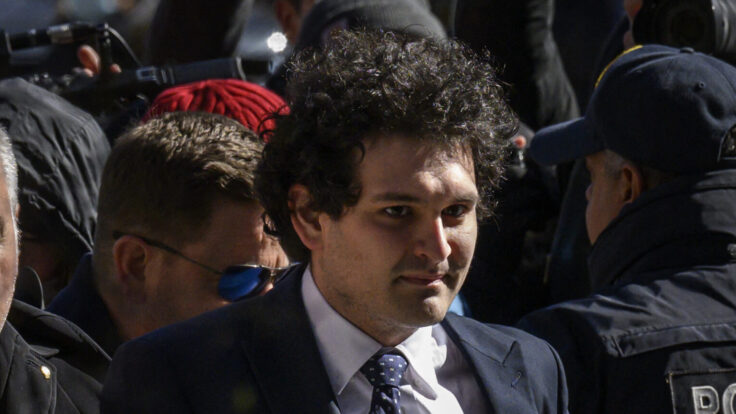
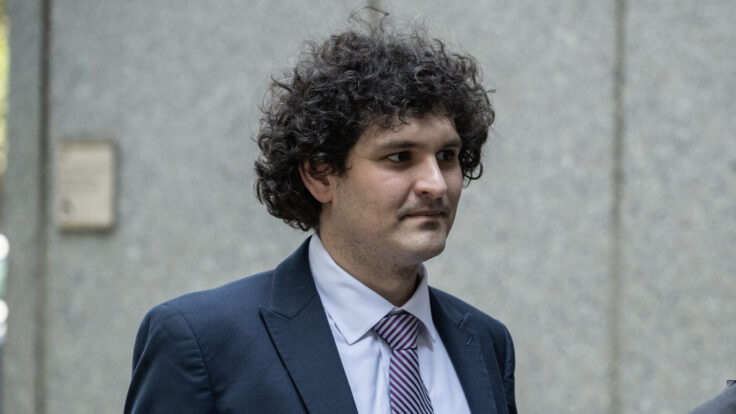
| I’ve been wondering what effect, if any, the conviction of Sam Bankman-Fried has had on the market for all things crypto. I’d say it’s a tale of two cities, so to speak. On the one hand, Bitcoin has exploded in the last month, up 38 percent, and is now trading at around $37,000 per Bitcoin. A year ago, Bitcoin was trading at around $17,000, so it’s up 118 percent in the past year. It’s one of the best performing assets of 2023, there’s little doubt about that. While its collapse, from $69,000 per Bitcoin two years ago probably has a lot to do with S.B.F.’s humiliation, the cryptocurrency seems no longer tied to him or to his conviction. Bitcoin seems to be rising again in price in anticipation of the Securities and Exchange Commission’s likely approval of a Bitcoin ETF that BlackRock is hoping to make available to investors as soon as it is permitted to do so.
Like Bitcoin, Ethereum, another of the few legitimate or quasi-legitimate cryptocurrencies, has also had a good month since the S.B.F. trial started. The price of Ethereum is up 32 percent during that time. I’m not sure what’s driving this price movement, other than it often trades in sympathy with Bitcoin. Solana, the third of the Big Three cryptocurrencies, has exploded in the last month, too. It is up 178 percent since S.B.F.’s trial began. Then there is FTT, the FTX-related token that S.B.F. created and was pretty much left for dead in the wake of his arrest and the FTX bankruptcy filing. In the last year, since that bankruptcy filing, the FTT token has increased 58 percent. But in the last month, since the start of S.B.F.’s trial, FTT is up 339 percent. I haven’t the slightest idea why people would be buying a definitional shitcoin, but there you have it. People are weird.
There have also been surprising upward movements in the price of Coinbase’s stock. So far in 2023, it’s up 177 percent, valuing the company at $22 billion. It’s still some 73 percent below its peak valuation of two years ago, but nevertheless it seems to have come back from the dead, along with the revivals of Bitcoin, Ethereum, and Solana.
There has been fallout, however. Most of it seems to be occurring in the once white-hot market for crypto-adjacent phenomena, such as NFTs. A leading indicator of the collapse of the market is the valuation of OpenSea, which is the still-private trading exchange for NFTs. Since March 2022, the trading volume of NFTs on the OpenSea platform has plunged 80 percent. It is laying off some 50 percent of its employees as it refocuses on a new strategy by making a direct connection to its customers (whatever that means). Weekly NFT sales have dropped to around 23,000, from about 176,000 at the start of the year, while the weekly sales value has declined to $62 million from $118 million, according to Market Tracker. Meanwhile, OpenSea’s valuation has collapsed to $1.4 billion, from $13.3 billion, 90 percent less.
Coatue Management, one of OpenSea’s biggest investors, recently announced a drastic reduction in the valuation of its initial $120 million investment in OpenSea, which it says is now worth only $13 million. In 2022, Coatue and Paradigm, another venture capital firm, led OpenSea’s $300 million Series C round. The Series B round into OpenSea, in July 2021, valued the company at $1.5 billion, slightly higher than what the company is valued at today (at best). That round was led by the always brilliant Andreessen Horowitz and included the likes of Hollywood tycoons Michael Ovitz (an a16z friend of the house), Kevin Hart, and Ashton Kutcher. Andreessen Horowitz also participated in OpenSea’s Series A round, of $23 million, in March 2021. Katie Haun was the partner at Andreessen Horowitz who was leading the charge for OpenSea. At the time of the Series B round, she said, “The team at OpenSea realized early on the need for an open, cross-blockchain marketplace where anyone can buy, sell and create digital NFTs, which is why they are one of the most important companies in crypto today. We are thrilled to double down on this team, their technology and overall vision, as they continue to provide the best user experience for today's creators, buyers and sellers, in one platform.”
In early 2022, Haun left Andreessen Horowitz and started her own venture capital firm, Haun Ventures. She raised $1.5 billion fairly quickly, one of the largest venture capital funds ever raised by a woman. That landed her on the cover of Fortune. She was also a board member of Coinbase and of OpenSea. Haun’s former Andreessen Horowitz partner Chris Dixon replaced Haun on the OpenSea board, in July 2022. But Haun was also an investor in the OpenSea Series C round, which valued the company at $13.3 billion.
I was hoping that Haun, whom I have interviewed many times over the years and who is a force of nature, would talk to me about the declining fortunes of OpenSea, and what it means for the NFT marketplace as well as the promise of Web3, both in the wake of the conviction of S.B.F. But her longtime spokesman, Rachael Horwitz, did not respond to a request for comment.
Haun, a federal prosecutor before becoming a venture capitalist, did take to X/Twitter on November 3, after S.B.F.’s conviction, to write that, based on her understanding of his crimes and the sentencing guidelines, she thought S.B.F. would be spending “decades” in prison. “With the charges S.B.F. has been found guilty of, the judge could theoretically impose any sentence at his discretion up to the combined statutory maximum, which by my math is around 115 years,” Haun wrote. So the fallout from the FTX disaster is still being felt, not only for S.B.F. personally, but also for the products and services that he and his cohort helped to create and to hype. |
|
|
|
| FOUR STORIES WE’RE TALKING ABOUT |
|
|
|
|
|
 |
|
|
|
Need help? Review our FAQs
page or contact
us for assistance. For brand partnerships, email ads@puck.news.
|
|
You received this email because you signed up to receive emails from Puck, or as part of your Puck account associated with . To stop receiving this newsletter and/or manage all your email preferences, click here.
|
|
Puck is published by Heat Media LLC. 227 W 17th St New York, NY 10011.
|
|
|
|