For one of its biggest movies ever, Amazon MGM is betting on a Ryan Gosling sci-fi tentpole from the Spider-Verse guys. And while it has most of the markings of success—positive early buzz, a plot you can distill for your friends—the definition of success is quickly changing.
Presuming Project Hail Mary’s early social media buzz correlates to strong anticipation, five elements of traditional indicators of success remain to varying degrees: an ensemble cast, a marquee director, an easy elevator pitch, strong reviews, and the promise of big-screen escapism. And so far, Project Hail Mary has at least three of those five.
Photo: Courtesy of Amazon MGM Studios
Rarely has a film’s title so aptly matched its commercial aspirations. Opening on March 20, Project Hail Mary is likely to define Amazon MGM Studios’ yearlong plunge into mainstream global theatrical distribution. Directed by Phil Lord and Chris Miller (Into the Spider-Verse, 21 Jump Street) and starring Ryan Gosling as a high-school science teacher sent into space as the only hope to prevent an extinction-level calamity, the movie is the tech giant’s attempt to show the industry that it deserves to be embraced as a major theatrical player and can do what the legacy studios mostly can’t: launch a nearly $200 million-budgeted, non-franchise, sci-fi crowdpleaser toward actual commercial success. While not technically an original—its Drew Goddard–written screenplay is an adaptation of Andy Weir’s bestselling 2021 novel—PHM is the closest thing to a franchise-free, one-and-done global blockbuster that Hollywood has attempted since Tenet in 2020.
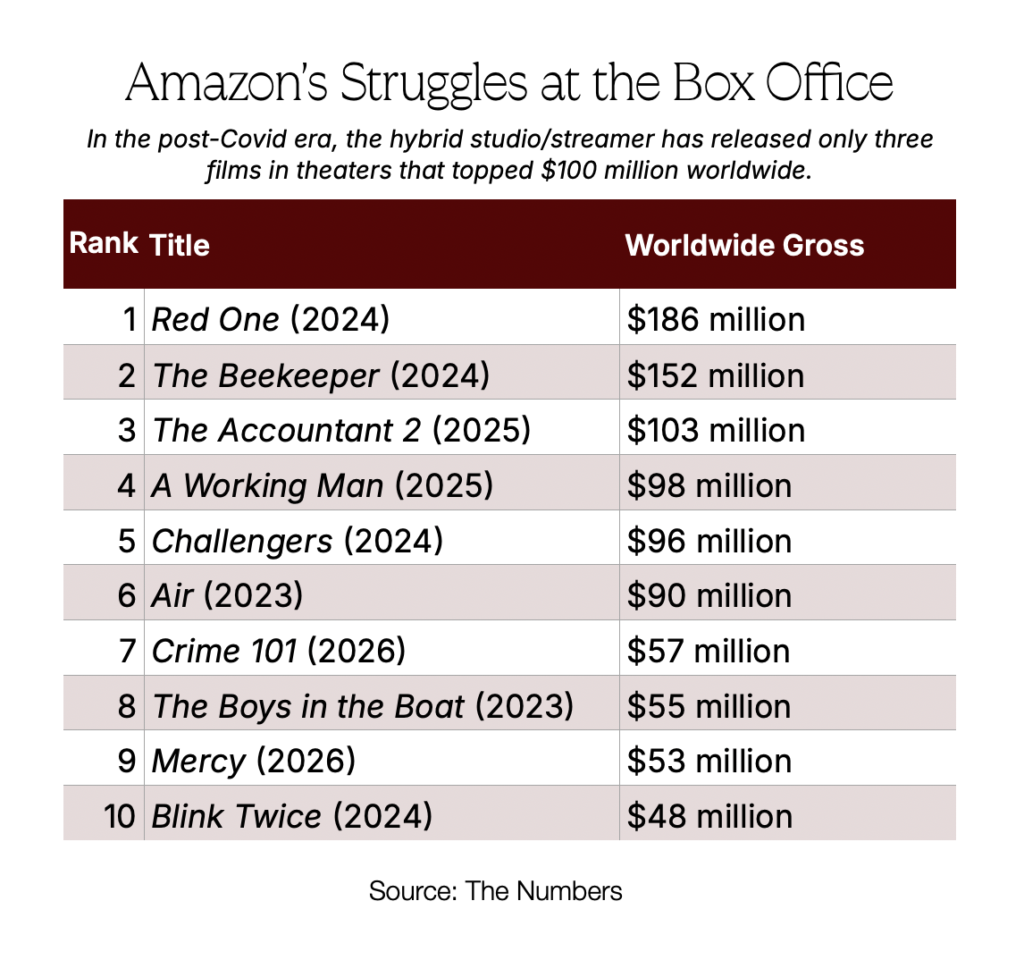
But what does success look like for such a film in 2026? Tenet, which grossed $366 million worldwide for Warner Bros., was kneecapped by Covid. Red One, Amazon’s own $250 million-plus Dwayne Johnson–and Chris Evans-starring holiday comedy, which was beset by miserable reviews and a shorter-than-hoped-for theatrical window, barely cracked $185 million worldwide in late 2024. And then there’s F1, the Apple-produced and WB-distributed Brad Pitt movie, which brought in a truly aspirational $630 million worldwide but was based on an iconic brand and I.P.
Currently tracking to open at about $50 million domestic, perhaps Project Hail Mary could end up closer to Lionsgate’s The Housemaid, an R-rated, female-skewing erotic thriller also based on a buzzy bestselling book and released by a mini-major studio, which has pulled in $385 million worldwide since its December premiere. But I assume that Amazon has greater ambitions for its much more expensive, PG-13, and stereotypically all-quadrant sci-fi flick. (The gross production budget was $248 million, according to an internal Amazon document, but tax credits from the U.K. and elsewhere brought it down to just under $200 million.)
Presuming Project Hail Mary’s early social media buzz correlates to strong anticipation, five elements of traditional indicators of success remain to varying degrees: an ensemble cast, a marquee director, an easy elevator pitch, strong reviews, and the promise of big-screen escapism. And so far, Project Hail Mary has at least three of those five. It’ll probably fly into theaters with strong reviews, an easy-to-explain plot, and the promise of providing a P.L.F.-worthy good time at the movies. After that, though, its promise gets flimsier.
Gosling has never quite been a butts-in-seats opener—he had plenty of support on Barbie, and The Fall Guy underperformed. While The Martian (also based on an Andy Weir novel) surrounded Matt Damon with Jessica Chastain, Donald Glover, Kristen Wiig, Michael Pena, and Chiwetel Ejiofor, Project Hail Mary is more just the Ryan Gosling show. And while Lord and Miller also directed solid crowd-pleasers Cloudy With a Chance of Meatballs and The Lego Movie, they aren’t exactly Nolan or Ridley Scott, at least not yet.
But Project Hail Mary doesn’t need a perfect five out of five if other elements overcompensate accordingly. And there’s a case to be made that the popularity of the novel, or at least its association with The Martian, could make up for the potential shortcomings. And if the film clicks, it’ll be the consensus pick for general moviegoers between March 20 and April 24, when Michael comes out. For the record, in a healthy ecosystem, a well-received Project Hail Mary would and should thrive alongside The Super Mario Galaxy Movie and other smaller-scale potential sleepers like The Drama and The Mummy.
The Matter of Size
So what must Hail Mary make to be considered a success? The answer requires a brief history lesson. I began 2015 with a list of 10 commercially promising live-action originals, including Dwayne Johnson’s San Andreas and Brad Bird’s $190 million Tomorrowland. By early 2016, I would grimly note that Warcraft stood out merely by being among the few big-budget tentpoles that were merely a new-to-cinema adaptation as opposed to a remake of, reboot of, or sequel to an existing franchise. By the end of 2016, just three years after Gravity soared to $724 million and two years after Interstellar legged out to $677 million, Sony was considered to be making a risky bet by spending $90 million–$110 million on the outer space romance Passengers, starring Jennifer Lawrence and Chris Pratt. The movie grossed $303 million worldwide despite mixed reviews.
Hollywood never actually stopped trying to make new-to-you movies—projects that, while not entirely original, are sold more as their own thing. For example, The Black Phone, while based on a short story by Joe Hill, was sold by Universal and embraced as an original horror flick. In such cases, marketing invites fans of the book even while promotionally prioritizing big-screen FOMO value regardless of source awareness. Before Tenet, Hollywood’s last such attempts at even a mega-budget new-to-you adaptation would probably have been the $150 million The Meg and the $175 million Ready Player One in 2018, as well as the $170 million Alita: Battle Angel in early 2019. Then Covid hit, expectations in China decelerated, and overseas box office became less certain even for high(er) domestic grossers.
Anyway, the old-school 2.5x-the-budget rule of thumb would mean that Project Hail Mary must haul in about $500 million worldwide—below F1’s $632 million and The Martian’s $631 million from 2015. That gross would essentially tie Project Hail Mary with the $475 million (sans inflation) global finish of 2015’s San Andreas, which reigns (give or take F1) as the top-earning live-action original to come out of Hollywood in the past decade. That film cost $110 million and arrived in theaters when a halfway-decent The Rock vehicle could top $100 million in China without breaking a sweat.
In the end, PHM’s success will be determined by whether it matches global revenue benchmarks that would have been unquestionably considered good enough a decade ago, even without the presumed post-theatrical riches of P.V.O.D. So an outcome anywhere between San Andreas and The Martian would be nice, and anything closer to Interstellar ($677 million in 2014, sans reissues) and Gravity ($724 million in 2013) would be superb. After all, Project Hail Mary can’t rely on a safety net from China. While a helping hand is still possible (Alien: Romulus topped $100 million in the Middle Kingdom in August 2024), Hollywood has dialed back its expectations, thanks to a decade-long public embrace of local releases and a stingier Chinese government.
Amazon Prime?
Project Hail Mary has one obvious ace in the hole: the marketing and cross-promotional power of a company that enables more than 8 million consumer transactions a day in the U.S. and has enough levers to pull to ensure relative long-term success if the film is well-received and doesn’t outright embarrass itself on the global stage. Even so, the company’s theatrical track record, while artistically ambitious, thus far does not yet reflect such advantages. For example, WB’s The Accountant earned $156 on a $44 million budget in 2016, but its Amazon-released sequel barely topped $100 million on an $80 million budget.
Sure, the accepted strategy is for Amazon to leverage the prestige and awareness of a theatrical release to give a jolt to less surefire or presold titles (like Saltburn, Challengers, and American Fiction) in hopes of bigger Prime Video viewership. But if Amazon wants to be seen as a major theatrical studio, it can’t constantly wave away otherwise underwhelming performances due to eventual (and theoretical) streaming value. That’s doubly the case when discussing the kind of big-budget spectacles that Hollywood still prioritizes, like Project Hail Mary or this summer’s Masters of the Universe.
Amazon’s Mike Hopkins assembled a film team under Courtenay Valenti to compete in theaters. Now they need to deliver. Heck, merely doubling the reported budget (around $380 million worldwide) would mean that Project Hail Mary will have earned as much as over 40 percent of the studio’s current combined 2023-26 theatrical box office revenue (around $945 million). And even many of its “hits,” like Air (which was not MGM-affiliated but earned $90 million globally on a reported $70 million budget in early 2023), were merely considered as such on a curve. Should it fall short of unquestionable rate-of-return grosses, success for Project Hail Mary might be the extent to which Amazon can still argue it’s a win while keeping a straight face.
Correction: A previous version of this article misidentified the screenwriter of The Martian. It is Drew Goddard, not Drew Pearce.
Didn't get an email? Check your spam folder and confirm the spelling of your email, and try again. If you continue to have trouble, reach out to fritz@puck.news.
Didn't get an email? Check your spam folder and confirm the spelling of your email, and try again. If you continue to have trouble, reach out to fritz@puck.news.
Member Exclusive
Get access to this story
Create a free account to preview Puck’s full offering, including exclusive articles, private emails from authors, and more.