 |
|
Welcome back to The Best & The Brightest. I’m Tara Palmeri.
|
|
Happy (almost) New Year. I’m sure you’re all trying to take one last deep breath before a very hectic 2024 begins. I certainly am. But for those who are still tuned in, don’t miss my latest episode of Somebody’s Gotta Win, with friend-of-the-pod Alex Thompson, in which we talk about the lowlights and highlights of 2023, plus our predictions. I was also on MSNBC’s Deadline White House today with Symone Sanders breaking down the latest ruling to boot Trump from the ballot in Maine, and why none of his G.O.P. opponents will use it against him.
Speaking of predictions: For today’s email, and a little end-of-year fun, I dialed up more than a dozen sources across the country—from Ritchie Torres and Steve Schmidt to Lindsey Graham and Roger Stone—to get their top forecasts for 2024.
But first, Abby Livingston’s report from the Hill…
|
| Capitol Hill Hunger Games & The Spreadsheet of Shame |
|
| One of the more interesting sociological exercises in House politics is analyzing the monthly D.C.C.C. dues sheet, which illustrates in graphic detail how much Democratic members are contributing to the party’s election efforts, but also doubles as a ritual shaming exercise. The document, emailed to chiefs of staff at the beginning of every month, provides instant insight into the laggards and overachievers angling for leadership.
Among those non-leadership members in good standing, who have paid their dues in full, are Reps. Don Beyer, Jason Crow, Jim Himes, Jared Huffman, Raja Krishnamoorthi, Foreign Affairs ranking member Gregory Meeks, and Mark Pocan. On a less cheerful note, the spreadsheet reveals that 35 members—I won’t name names—haven’t paid any dues. It’s worth mentioning, of course, that while the party technically assigns goals to “frontliners” (the party’s term for vulnerable members), hardly anyone actually expects them to contribute to the D.C.C.C. Their unspoken marching orders: The best service you can do for the party is to raise as much money as you can to win your race.
The dues sheet has other purposes, of course. When Democratic members are locked in leadership races, or hopeful for a prime committee assignment, it’s often the very first thing colleagues examine when deciding whom to support (alongside factors like seniority). It’s also worth noting that we’re only halfway through the current election cycle, and not all members pony up at the same time: Some choose to pay early, others wait until the election is closer at hand, etcetera. Members can also pay it forward by campaigning on behalf of vulnerable colleagues, raising for the committee, or transferring money to vulnerable candidates directly.
Dues goals are not uniform, and are based on committee assignments (Appropriations is a magnet for fundraising, while others are far less attractive to donors) and rank (leadership and chairs are expected to contribute more than the average rank-and-filer). To wit: It was no surprise that Hakeem Jeffries was by far the top fundraiser in the party, raising more than $96 million year-to-date for the D.C.C.C and his colleagues. D.C.C.C. Chair Suzan DelBene has so far raised about $33 million, which would make sense given her post.
The numbers drop off sharply from there, with whip Katherine Clark raising $14 million and conference chair Pete Aguilar responsible for $5 million. That’s in line with expectations from past leadership regimes, although it says something about the lingering fundraising power of Nancy Pelosi that the speaker emerita, even after passing much of her Rolodex to Jeffries, still raised nearly $11 million, herself. |
 |
| 2024, According to the Experts |
| Lindsey Graham, Chris Sununu, Debbie Dingell, Ritchie Torres, Steve Schmidt, Roger Stone, and many other experts of varying stripes explain what’s going down next year. |
|
|
|
| The new year hasn’t even begun, and yet we already know it will be riddled with nightmarish, highway-accident-rubbernecking uncertainties, at least politically. Will Trump wrap up the Republican primary quickly or be drawn into a longer battle with Nikki Haley through Super Tuesday? Can Mike Johnson, the untested and underwhelming House speaker, manage the various juggling acts of his new job—impeachment, immigration, Israel, and Ukraine—while keeping the government open and preserving his party’s control of the chamber? And then there are the outcomes of Trump’s four criminal cases and 91 felony charges, and a rebooted Biden impeachment process, followed by a general election between two aging and unpopular candidates.
To help interpret the political tea leaves, I called up numerous D.C. insiders to glean their visions of 2024. Among them: Senator Lindsey Graham, Governor Chris Sununu, and Representatives Debbie Dingell, Brendan Boyle, Ritchie Torres, Kelly Armstrong, and Pat Ryan. Florida whisperer David Jolly and Trump confidant Roger Stone considered what’s next for the DeSantii. Iowa guru David Kochel, New Hampshire native son Matthew Bartlett, and South Carolina oracles Robert Godfrey and Katon Dawson offered predictions on the primaries. CNN legal analyst Elie Honig weighed in on the Trump trials. Senate experts Joe Hack and Jonathan Kott previewed the future of Congress, Manchin, and beyond. And finally, a doomsday scenario from the man without a party, Steve Schmidt.
Wanna know what’s gonna go down in ’24? Here’s what the pros think… |
|
|
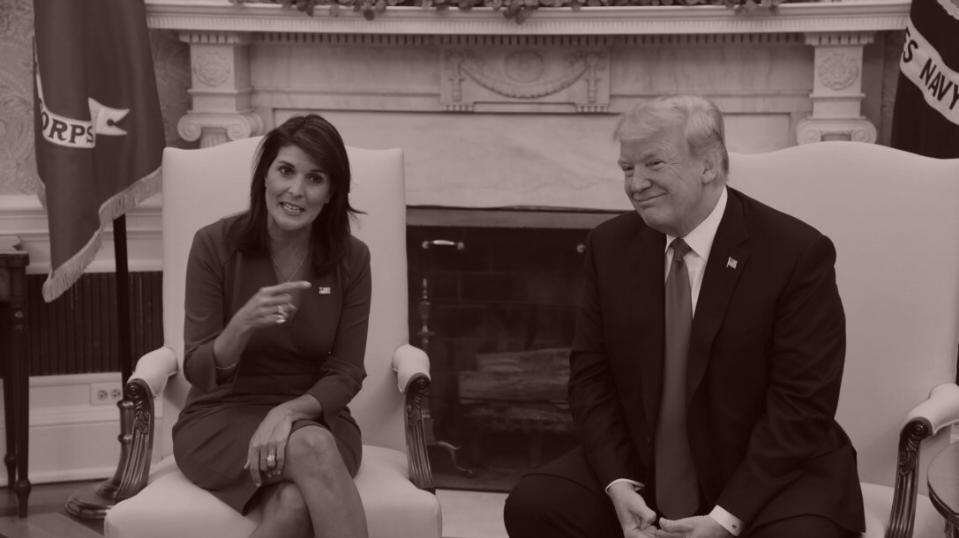
| The first Republican primaries, in Iowa and New Hampshire, are likely the final chance for DeSantis or Haley to prove they are legit contenders. Blowout losses will likely nuke their candidacies, but a close enough finish for either could provide the fundraising momentum to set up a race, at least through Super Tuesday. Trump will win Iowa, everyone concedes, but that assumption also lowers the bar for a challenger to exceed expectations and change the narrative—especially if swing voters in New Hampshire continue to gather support behind Haley. “The problem Trump has is that expectations have gone through the roof,” said Iowa expert David Kochel, who ran the Iowa ground game for Mitt Romney and was a strategist to Iowa Sen. Joni Ernst. “He seems pretty fixed at 50 points; if he performs under 50, that doesn’t help.” But, he continued, if any candidate finishes within 15 points, “New Hampshire might just say: Iowa, you did it again, we’re going to fix this.”
New Hampshire strategist Matthew Bartlett, who worked for former senator Kelly Ayotte, predicted that Trump’s ceiling in his home state could be as low as the mid-40s, which could leave Haley with room to run to 30 percent or so in the primary. “The next day it’s going to be abundantly clear that [the winner] is Trump, and crystal clear that the Trump alternative is Nikki Haley,” Bartlett predicted. “There will be money, support, and momentum from the sidelines coming in for Haley. It will be a two-person race.” He continued: “But for how long? Can her momentum sustain until Super Tuesday, or will the Trump juggernaut roll on?”
Expectations are lower in Haley’s home state of South Carolina, although there is a growing hope that she could build enough support to stay in the game. “The home state dynamic will definitely benefit her, particularly if she has all of the trappings of strong performances in New Hampshire and Iowa,” said Robert Godfrey, her former deputy chief of staff, who has not picked a side in the race. “I do think that this is a state where she can get within single digits of the front-runner, depending on how things go in the two earlier states. And if she finishes within single digits in South Carolina, it changes the conversation heading into the Super Tuesday states.”
Katon Dawson, a former South Carolina Republican Party chairman who endorsed Haley early on, said the state’s former governor might overperform by capturing center-right Republican women in South Carolina who don’t tend to vote in primaries. “They showed up pretty good when Nikki Haley won the first governor’s race,” he recalled. “She almost beat [all of her challengers] outright on the first ballot. It was amazing to watch.” |
|
|
| The most significant known unknowns in the election will be the outcomes of Trump trials, which will be hanging over these early primary fights. But Elie Honig, a former federal and state prosecutor and current CNN analyst, rolls his eyes at the liberal fantasy that Trump will be spending part of the election season puttering around Mar-a-Lago with an ankle bracelet.
In Honig’s estimation, there will be only one trial before the election, most likely special counsel Jack Smith’s federal election interference case in D.C. If that one gets sidetracked, he expects the Mar-a-Lago classified documents case to take precedence, or maybe even the forgotten and long-shottish New York hush money case. He was adamant that there is no chance we’ll see Fani Willis’s sprawling RICO trial, in Fulton County, before November. “Whether he’s convicted or not, Trump will not be locked up before the election,” Honig said. “If he is convicted, he will remain free until his appeals are done.”
In the meantime, the real action will shift to the Supreme Court’s three upcoming “monster rulings” on 1) whether Trump can be disqualified from state ballots, under the 14th Amendment, for inciting an insurrection; 2) whether he is immune from prosecution for actions taken as president; and 3) the validity of charging Jan. 6 defendants (and Trump, himself) under a federal law that makes it a crime to obstruct an official proceeding (like certifying Biden’s election). “Law students in the year 2124 will be studying what happened this year,” Honig said. |
| Biden’s Impeachment Hall Pass |
|
| Members from both parties that I spoke with were highly dubious that the Republicans will manage to impeach Biden for three critical reasons: the House G.O.P.’s ultra-slim majority (a two or three vote margin at any given moment); the lackadaisical pace of the investigation, compounded by White House slow rolling; and perhaps most importantly, a lack of compelling evidence, as my partner Tina Nguyen reported at length yesterday.
Democratic Congresswoman Debbie Dingell, who represents Michigan’s 6th district, predicted that the Republicans won’t have the necessary votes to impeach. Republican Congressman Kelly Armstrong, who represents North Dakota’s at-large district, suggested that it depends on their margin after the committees finish their report, which will likely take until the end of the first quarter. “It will be tough,” Armstrong conceded, citing Rep. Bill Johnson’s retirement, the lingering question of when Gavin Newsom will schedule a special election to replace Kevin McCarthy, and who fills George Santos’s former seat. “Between illness, injury, or more retirements, who the hell knows?”
Meanwhile, Senator Lindsey Graham said his chamber is still waiting to see if the House can connect the dots on impeachment. “I don’t know, they found some certainly shady business dealings with shell corporations [tied to] Hunter Biden and his brother; now connecting it with President Biden, I guess that will be the task, but certainly [it looks like] unusual business activity,” he said. “We’ll see how it all plays out. I think most Americans believe there was certainly a lot of influence peddling; whether or not they connect is yet to be determined.” |
|
|
| With Democrats defending eight vulnerable Senate seats this cycle—including in Ohio, Montana, and West Virginia, all of which Trump won—the upper chamber is almost certainly the Republicans’ to lose. In fact, those three seats alone are enough to hand Republicans the majority. “I feel real bullish about the Senate,” said Graham. “I think Arizona will definitely be in play because of the border, and if we continue like we are with the economy upside down and the world on fire, it could be a very good year. But we have to run on something other than [the Democrats are] doing bad.”
Graham thinks that successful G.O.P. messaging should focus on energy independence, taming inflation, controlling the border, and putting out fires around the world. He also intimated the importance of candidate selection. So I asked about MAGA firebrand Matt Rosendale, who is running against safe bet Tim Sheehy in Montana. “We have to nominate people who have the best chance of winning,” he answered diplomatically. “I think Sheehy is doing well, and Rosendale fell short before.”
The former Republican Senate chief of staff, Joe Hack, now with The Daschle Group, went even further than Graham, suggesting that the open Michigan Senate seat is also in play. “Yes, there are strong Democratic incumbents—but there are only so many ticket splitters, and outrunning Trump’s margins in these ruby red states is an increasingly tall order,” he said. “If Mike Rogers prevails as the Republican candidate in Michigan, look for his heavyweight status and a depressed Arab-American vote to tank Elissa Slotkin. And keep an eye on Pennsylvania and Arizona—it could be a very good night for Senate Republicans.”
Meanwhile, Democratic Rep. Brendan Boyle of Pennsylvania predicted that it will be a much narrower victory for Republicans, resulting in a 50-50 Senate, adding that his colleague Sen. Bob Casey will win reelection over David McCormick (currently on his second attempt after falling short in the 2020 G.O.P. primary to Dr. Oz). He also thinks that Democrats will pick up 12 seats in the House. Even Rep. Armstrong admitted that the House is more of a coin toss for the G.O.P., confessing, “I’m a pessimist, and usually right.”
Hack, the former chief of staff to Nebraska Sen. Deb Fischer, predicted an even slimmer Democratic House majority, and suggested that Republicans would take the Senate and Trump would win the White House. Swing district Rep. Pat Ryan, who won his last two elections in New York’s Central Valley by a few thousand votes, expects that Democrats will take back the House by reclaiming the seats Republicans picked up in his backyard in 2022. His message: “G.O.P. control of the House has led to nothing but chaos, division, and dysfunction.” |
|
|
| While nearly every Republican I spoke to agreed that Trump would be the nominee—except for Governor Chris Sununu, fresh off his endorsement of Haley—there are a wide range of thoughts about how the general election will play out. Rep. Boyle, naturally, said he thinks the race will come down to his home state, where he expects Biden will win by 1.8 percent, pushing him over 270 electoral votes. Rep. Dingell also envisions a close contest, one that will hinge on the virulence of Trump’s rhetoric on the trail. “The presidential will be tight and down to the wire,” she said. “But if former President Trump continues his ‘vermin’ and ‘poisoning our blood’ rants, many people’s current anger will understand the reality of electing someone with this much hate, and Democrats will win the presidency.”
Democratic congressman Ritchie Torres of New York, who has been one of the most vocal supporters of Israel in the Democratic caucus, predicted that October 7 probably won’t be the deciding factor for most voters in 2024. “The concerns that weigh most heavily on Black and Hispanic voters in the Bronx are the economy nationally and safety locally,” Torres said. “I am confident that Democracy and abortion will motivate progressives and women to come out and vote for President Biden. … The greatest concern I have is about turnout among communities of color. An improved economy would be helpful.”
Of course, there are all the usual doubts about the accuracy of general election head-to-head polling, especially this early, and particularly as voters become harder to reach. John Della Volpe, director of polling at the Harvard Kennedy School Institute of Politics, said he expects that his business will have to adopt new technologies to contact younger voters, while also updating their demographic models and focus group testing. He also predicted the death of the 30-second ad. “Bots, trolls, discussion boards, social media influencers, podcasters, YouTubers—and not media consultants—will have an outsize impact on shaping public opinion in 2024,” Volpe said.
Steve Schmidt, who helped launch the insurgent Dean Phillips campaign against Biden (but is now once again a free agent), predicts chaos and even violence at the Democratic convention, like in 1968. He also expects that Democrats will have to have a reckoning over Biden’s age. “The Rose Garden strategy won’t hold,” Schmidt said, referring to the president’s strategy of campaigning largely from the White House. Schmidt, as can be his want, painted a dystopian vision: “The world is entering 2024 with many more wars getting underway than it was a year ago. It will grow more violent. The political environment in the United States will grow completely crazed over the year.”
As for what Joe Manchin, the ultimate Democratic spoiler will do, Jonathan Kott, his former senior adviser, predicted that “he will play a key role in mobilizing moderate voters for the 2024 election.” Kott now represents the 501(c)3 associated with Manchin’s daughter Heather, who I reported last week has been telling donors that she had raised nearly $30 million for her father so that he can run for president on the No Labels ticket. When I asked who he will be mobilizing moderates for, Biden or himself, Kott responded: “TBD.” |
|
|
| Former Representative David Jolly expects that DeSantis will try to make a run for Rick Scott’s Senate seat once he jumps out of the race. “Being a Senator at least keeps him in the game,” Jolly said, remarking that it was difficult for Jeb Bush and Mike Huckabee to run for president as former governors. DeSantis’s term is up in 2026, two years before the next presidential election. “He was once the most popular governor of Florida, with the hottest hand in politics nationally, who is returning to Tallahassee a little humiliated.”
DeSantis will likely have a much less supportive legislature after he engaged in line item vetoing while pushing through politically difficult votes on a six-week abortion ban and permitless concealed carry. “I think he could beat Rick Scott. The wild card is the fact that he’s now taken on Trump, and if Trump comes out hard for Rick Scott, it complicates things. If DeSantis endorses Trump quickly, at least he can hug him, even if Trump has already endorsed Rick Scott.” (Trump endorsed Scott for reelection this month.) Jolly admits it’s a wild prediction, but a fun one. But he suspects that might explain why Scott is currently airing ads in Florida despite not having any real competition.
Roger Stone, a Trump confidant and DeSantis hater, has long floated the Lady Macbeth theory about Casey DeSantis. He predicts her rise to the Florida governorship next, dubbing her “Jillary,” a mashup of her given first name, Jill, and Hillary Clinton, whom Republicans have turned into the ultimate ambitious female villain. “If Ron DeSantis challenges Rick Scott in 2024, it will look like exactly what it is: rank opportunism,” Stone said.
Instead, Stone thinks DeSantis’s donors need a breather after this recent roller coaster, and he won’t have the financial ammunition to take on the deep-pocketed Scott. “I stand by my prediction that Casey will run for governor,” he told me, “so that Ron can use the governorship for the fundraising leverage it would provide for a challenge to Marco Rubio or a race for an open U.S. Senate seat in 2028 if Rubio elects not to run.” |
|
|
|
| FOUR STORIES WE’RE TALKING ABOUT |
|
|
|

|
 |
|
|
|
Need help? Review our FAQs
page or contact
us for assistance. For brand partnerships, email ads@puck.news.
|
|
You received this email because you signed up to receive emails from Puck, or as part of your Puck account associated with . To stop receiving this newsletter and/or manage all your email preferences, click here.
|
|
Puck is published by Heat Media LLC. 227 W 17th St New York, NY 10011.
|
|
|
|