Welcome back to Wall Power. I’m Marion Maneker.
Julie
Davich is at the helm tonight with a brief tour of SITE Santa Fe International and a look at the market for dinosaur fossils, a meteorite from Mars, and an Apple-1 computer motherboard. Just a reminder: You can reach her at JDavich@puck.news if you have tips or comments.
|
|
|
A MESSAGE FROM OUR SPONSOR
|
Your weekly dose of wonder. Our global specialists are connoisseurs and market experts in 40 countries and
70 collecting categories. They will be your guides, exploring the significance and journey of an extraordinary work with those who know it best.
LISTEN NOW
|
|
|
 |
Julie Brener Davich |
|
Once Within a Time in Santa Fe
|
It says something about the stature of SITE Santa Fe International, now in its 12th edition, that
Cecilia Alemani is the fourth curator of the event to have also led the Venice Biennale. This year’s International, which opened last week, is the first iteration in seven years and more robust than ever, with more than 300 artworks by around 50 local and international artists across 14 venues. The timing is also fortuitous: As I recently
wrote, institutional interest in contemporary Native American art has never been higher.
SITE’s executive director, Louis Grachos—who returned to the nonprofit, non-collecting institution in 2021 after serving in the same role from 1996 to 2003—was “adamant in the vision of bringing the International back to the global art stage, but also back to its original roots,” Alemani told me. There is an abundance of local artists, many of whom are likely not yet on your
radar. And given what we know about Alemani’s 2022 Venice Biennale, they probably won’t stay unknown for long.
The International’s title is Once Within a Time, borrowed from a work by the experimental filmmaker and Santa Fe native Godfrey Reggio. Artists were given descriptions of 27 characters connected to the American Southwest—mythical creatures, historical figures, local heroes, artists, writers, and healers—and asked to respond to them. Alemani’s dense
curatorial statement can make it hard to grasp what that entails—until you see it all come together.
|
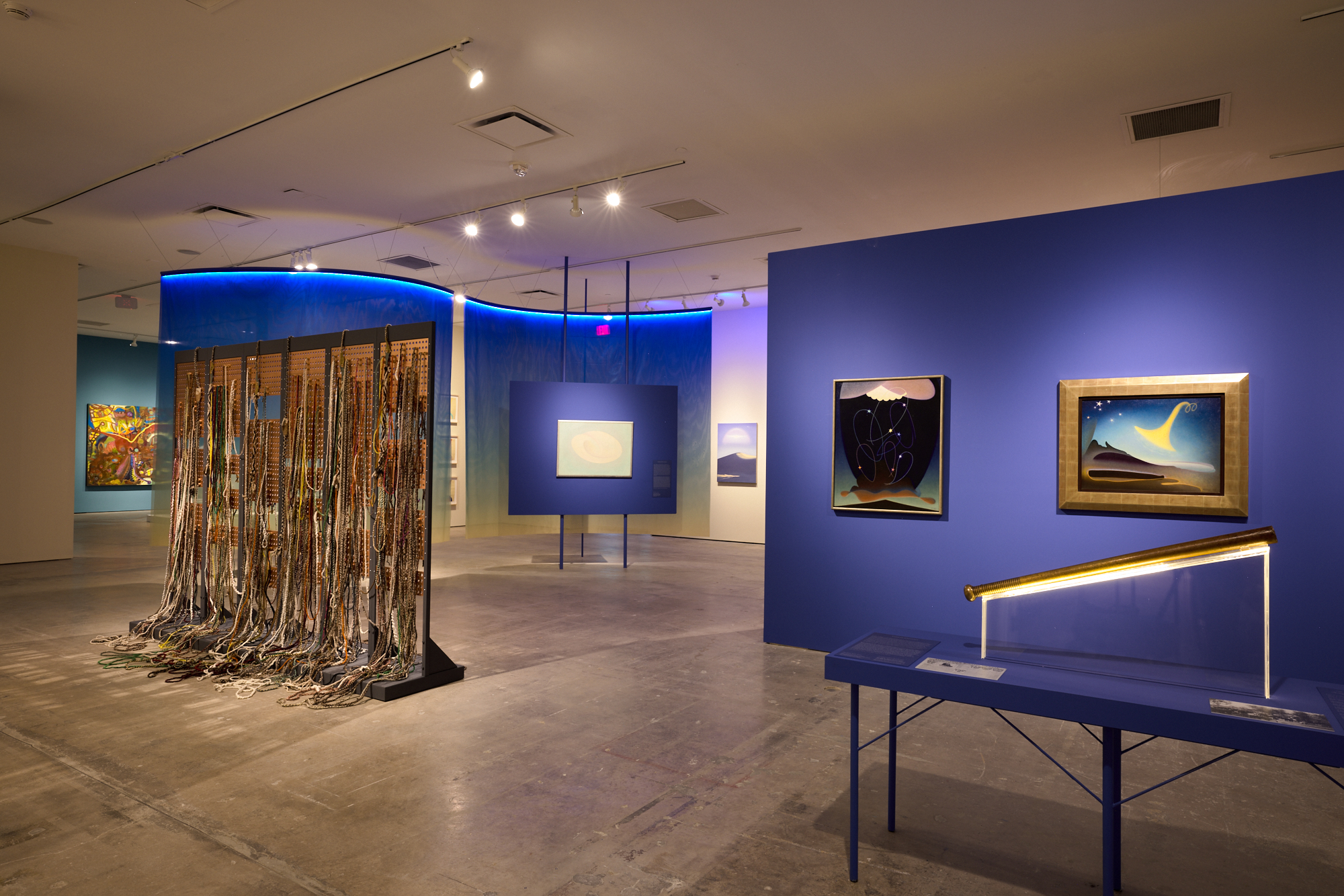
Installation view of In Touch With Light, SITE Santa Fe International, 2025. Photo: Brad
Trone
|
One section of the main exhibition, called In Touch With Light, addresses New Mexico’s reputation as
a place of healing—but also as the site of uranium mines and atomic bomb tests. A room filled with mystical landscapes includes works by Florence Miller Pierce and Agnes Pelton from the 1930s and ’40s, as well as a recent painting by local artist Diego Medina, a member of the Piro-Manso-Tiwa tribe. These are shown alongside a 2022 copper-and-fiber installation by Mexico City–based artist Ximena Garrido-Lecca, whose practice
looks at the effects of extractive industries.
Another section, The Wheel of Telling, focuses on storytelling, and features a handful of small-scale clay sculptures by the late New Mexican artist Helen Cordero, from the 1960s, depicting sitting human figures, mouths agape, with children scampering across their bodies. These are paired with three of Simone Leigh’s iconic female figures—sculptures with wide skirts that address the idea of the body
as a vessel. Nearby, Bahamian artist Dominique Knowles’s monumental abstract canvas, The Solemn and Dignified Burial Befitting My Beloved for All Season, in earthen shades of umber, carmine, and ocher, serves as a backdrop.
Other venues across the city hosting works from the International include the Santa Fe Railyard Park, New Mexico Military Museum, Museum of International Folk Art, and even the Best Daze Cannabis Shop. Outside of the Wheelwright Museum of the
American Indian, two of Raven Halfmoon’s ceramic female sculptures, drawn from Caddo culture, stand as sentinels. And inside the building, there’s a lush installation of small watercolors, drawings, and woven sculptures by Peruvian artist Cristina Flores Pescorán. “What I love about the International,” said Alemani, “is how it has an ambition to be a global biennial, but deeply rooted in New Mexico.”
|
|
|
Now on to the main event…
|
|
|
Demand for rare dinosaur fossils has been heating up, even as the major auction houses
struggle to tame the “Wild West” quality of an immature market without many comparisons.
|
|
|
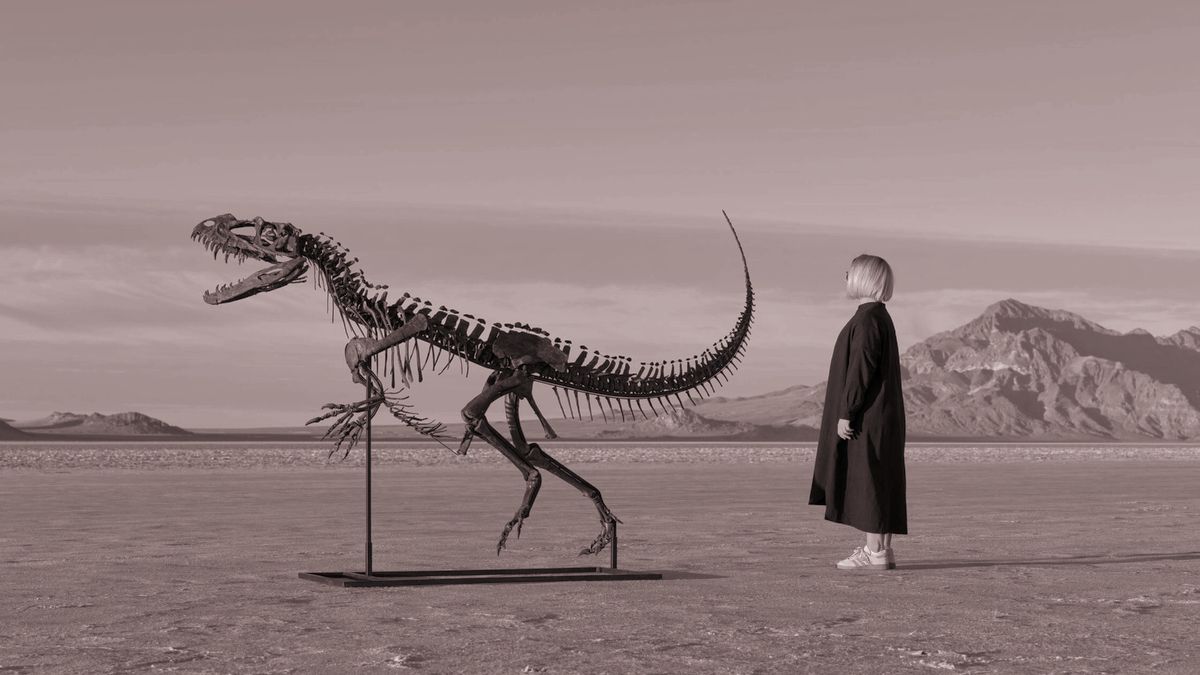
Next Wednesday, Sotheby’s will auction its latest dinosaur skeleton: a 6-foot-tall, 10-foot-wide, 150-million-year-old mounted juvenile ceratosaurus, estimated at $4 million. It’s one of 122 lots in the house’s national history auction, which, along with a pair of online sales—History of Science & Technology and Space Exploration—has, rather aptly, led to the moniker “Geek Week” for this upcoming auction window.
Sotheby’s Science and Technology, or “sci-tech,” department is
relatively new. It was founded by Cassandra Hatton in 2021 to take advantage of growing market demand for natural objects—which, these days, often means dinosaur fossils. Most specimens that arrive at auction come from places like Montana, South Dakota, Utah, and Wyoming, although that’s not why the market is often described as a “Wild West.” Currently, the U.S. is one of the only countries where it’s legal to dig up dinosaur fossils on private land and sell them for profit.
It’s also a relatively new and low-volume market, without the sort of price discovery that typifies other categories.
|
|
|
A MESSAGE FROM OUR SPONSOR
|
Available to listen on Apple Podcasts and Spotify.
LISTEN NOW
|
|
|
Prices and demand for dinosaur fossils are at an all-time high, driven in part by headline-grabbing prices in
recent years and a desire by today’s collectors to own rare and unique objects. The auction market for dinosaur fossils started to pick up in 1997, when Sotheby’s sold a 67-million-year-old T. rex skeleton, Sue, to the Field Museum in Chicago for $8.4 million. (This was also around the time when the Jurassic Park franchise placed dinosaurs firmly in the cultural zeitgeist.) That sale record remained unbroken until 2020, when Christie’s auctioned Stan, another mostly
complete T. rex skeleton, for $31.8 million to Abu Dhabi’s Department of Culture and Tourism for its new natural history museum, which is scheduled to open this year. Naturally, the eye-popping price for Stan brought more examples onto the market.
In total, around 25 dinosaur skeletons have sold at auction since 1997, and 10 since the Stan sale. In 2022, Christie’s auctioned a deinonychus for $12.4 million. That same year, Hatton sold her first dinosaur, a gorgosaurus,
for $6 million at Sotheby’s. Then, last summer, Sotheby’s set a record with the historic sale of Apex, a virtually complete 150-million-year-old stegosaurus fossil. The auctioneer opened the bidding at $3 million, and hammered it down at $40 million, or a total of $44.6 million with fees. A few months later, Christie’s sold a trio of dinosaurs for a combined $15 million. It’s a high-profit category for the market’s big players—which also include Drouot, Koller, and Collin du
Bocage—because estimates are low enough that the houses do not get third-party backers, who would otherwise share their upside.
|
Most multimillion-dollar dinos that come to auction, like Apex, are sold with “full
rights”—essentially the copyright for that particular skeleton. Hatton explained that most of the fossils seen in museums are casts made from originals, which the institutions pay the rightsholder to reproduce. (Stan, notably, was not sold with rights. Its appearance at auction followed a court-ordered dissolution of a business partnership: One partner got the fossil, another got the rights.) There is also a robust private market for fossils, and—as with all categories—certain
factors help determine value.
For dinosaur fossils, one of the most important measures is the percentage of “completeness.” No skeleton is 100 percent complete, and even uncovering half is “a huge deal,” Hatton told me. Sue was about 90 percent complete, and Apex was about 80 percent. (That number is often debated, Hatton noted, given that some excavators create fake bones to increase the completeness percentage.) Skulls, of course, are considered the most important part
of the skeleton, and often come up at auction on their own. Next week, Sotheby’s is offering a pachycephalosaurus skull at an estimate of $800,000.
|
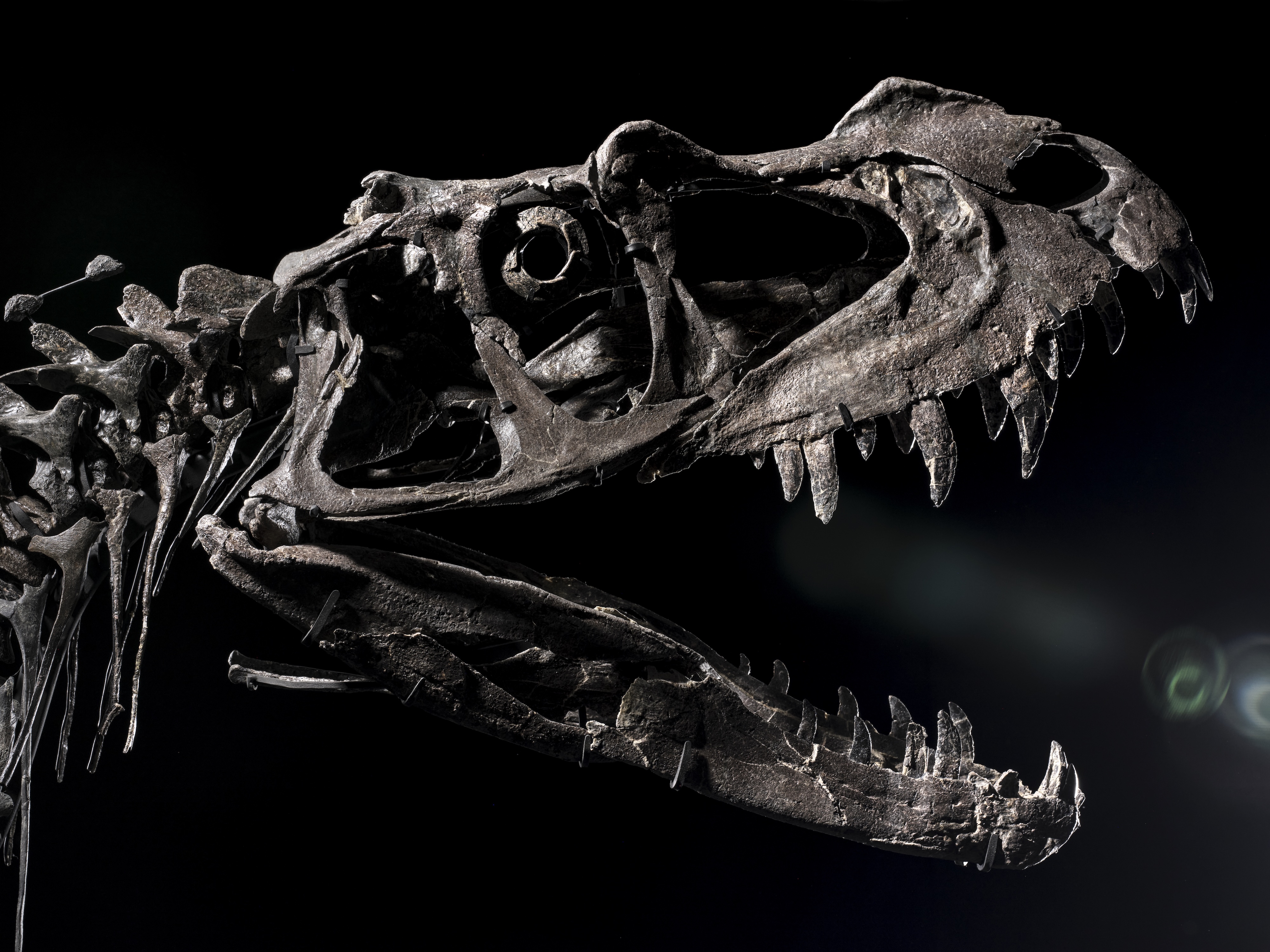
Ceratosaurus skull, excavated in 1996. Photo: Matthew Sherman/Courtesy of Sotheby’s
|
The skull of the ceratosaurus skeleton being auctioned next week is virtually complete. All 57 bones are
represented, some of them paper-thin. This tally does not include the 43 teeth, or the five additional “loose” ones—teeth with roots intact are more prized. The specimen is also notable because only four ceratosaurus skeletons are known to exist, and none are juveniles, so in the argot of the collectibles world, this lot is one of one. Hatton explained that it’s extremely rare to uncover a juvenile dinosaur because their bones are extremely fine, and require just the right conditions to
mineralize. She also told me she won’t auction a dinosaur fossil unless she has personally seen its excavation—or at least its mounting—to verify authenticity.
|
|
|
This particular ceratosaurus was excavated in Wyoming in 1996, and later went on view at the privately owned
Museum of Ancient Life in Thanksgiving Point, Utah. It languished there for three decades, unassembled and unstudied. The museum sold it last year for an undisclosed sum to local fossil preparator Brock Sisson, the consignor for the Sotheby’s sale, who first encountered the specimen as a 16-year-old dinosaur enthusiast when it came out of the quarry.
Hatton was in lockstep with Sisson throughout the mounting process. To mount a skeleton, preparators create a custom armature and manufacture fossils to replace missing or broken ones. Often, these are made by grinding up fragments found at dig sites. Seeing each piece of the ceratosaurus before mounting allowed Hatton to inspect them and confirm their authenticity; she also reviewed photos and other documentation from the original dig site.
Of course, the burgeoning market for dinosaur fossils is not without its
detractors. According to the Society of Vertebrate Paleontology, research on privately owned specimens should be prohibited because the results can’t be replicated. And both The Wall Street Journal and The New York Times have run articles in the past few years highlighting paleontologists’ concerns about the loss of these specimens for science. In response, the auction houses have pointed to the fact that buyers will loan or donate their purchases to institutions, as
Ken Griffin did with Apex, which has been on display at the American Museum of Natural History for four years.
|
During Geek Week, Sotheby’s will also hold an online sale of objects related to the history of science and
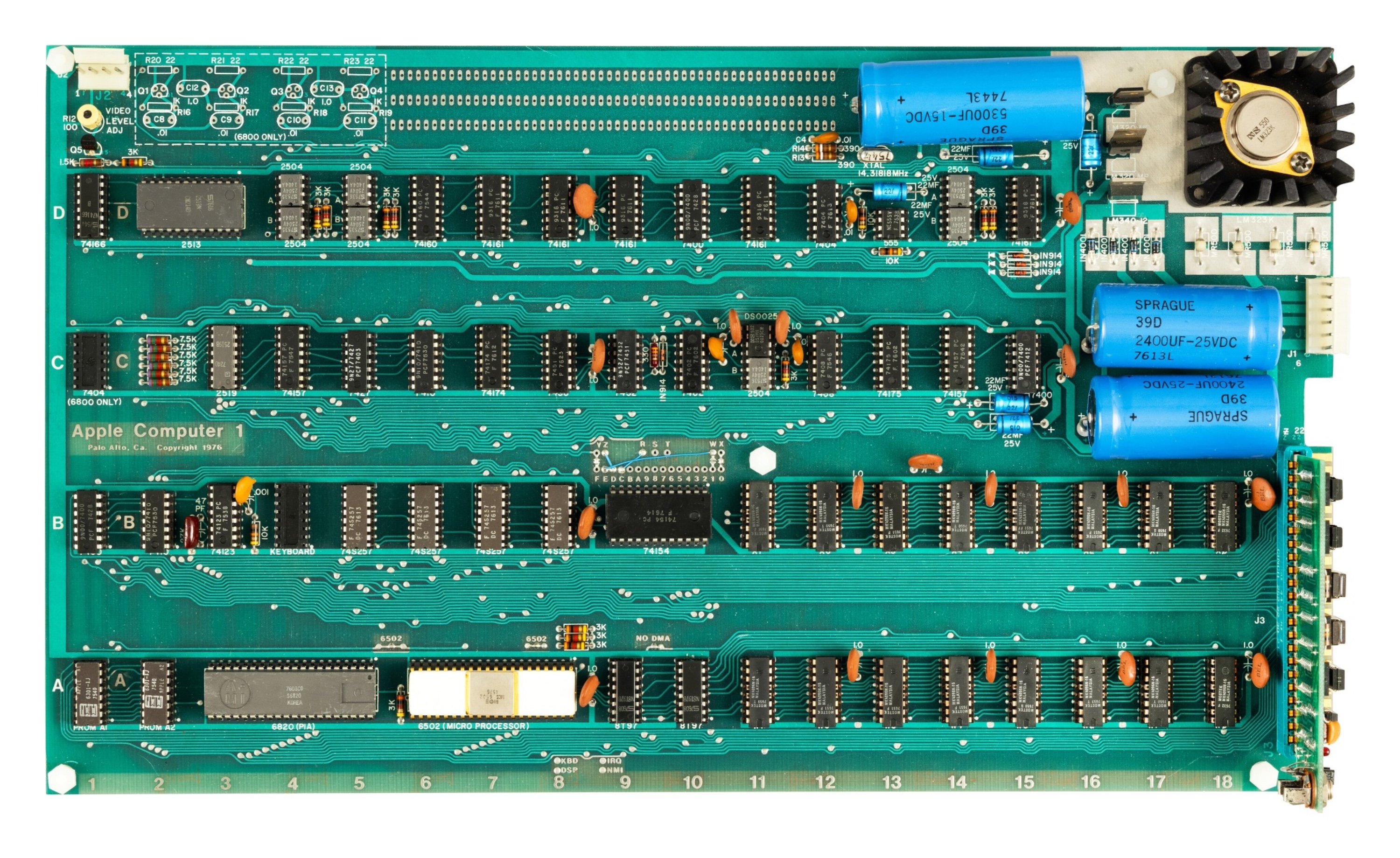
technology—think manuscripts, technical instruments, etcetera. The auction is anchored by an Apple-1 computer, which is estimated at $400,000, and described by Sotheby’s as “the finest operational Apple-1 in existence.”
|
Apple-1 computer built by Steve Wozniak and Steve Jobs (1976). Photo: Courtesy of Sotheby’s
|
It last appeared at auction at Bonhams in 2015—when Hatton was the head of department—and sold for $365,000.
It’s one of the first batch of 50 motherboards that Steve Jobs and Steve Wozniak hand-built in Jobs’s parents’ garage in 1976. After selling those to a local computer store, they built 200 more—one of those second-batch computers sold this past fall at Christie’s from the estate of Paul Allen for a record $945,000. Given that the first-batch computers are even more prized by collectors, especially operational ones, it makes sense that Hatton
called up her former client (or vice versa) to bring this one to auction. Still, the legendary Allen provenance will be hard to beat.
The other highlight of Sotheby’s science sale series is the largest known piece of Mars on Earth—the most valuable meteorite ever offered at auction. Discovered in 2023 by a meteorite hunter in
Niger, the rock weighs 54 pounds and is about 70 percent larger than the next-largest piece of Mars that has been found on Earth. (Of the 77,000 officially recognized meteorites, only 400 are from Mars.) Per the catalogue description, it was “ejected from the Martian surface by a massive asteroid strike, journeyed 140 million miles through space, and hurtled through Earth’s atmosphere before crashing into the Sahara desert.” I asked Hatton whether she thought Elon Musk was going
to bid on it, given his known preoccupation with the Red Planet. She shrugged and said, “Everyone has been asking me that.”
|
Thanks, Julie. Let’s all meet here again on Tuesday.
M
|
|
|
The ultimate fashion industry bible, offering incisive reportage on all aspects of the business and its biggest
players. Anchored by preeminent fashion journalist Lauren Sherman, Line Sheet also features veteran reporter Rachel Strugatz, who delivers unparalleled intel on what’s happening in the beauty industry, and Sarah Shapiro, a longtime retail strategist who writes about e-commerce, brick-and-mortar, D.T.C., and more.
|
|
|
Join Puck’s chief political columnist, John Heilemann, as he roams the corridors of power and influence in America
on this twice-weekly interview show, taking you beyond the headlines with the people who shape our culture: icons and up-and-comers, incumbents and insurgents, moguls and machers in the overlapping worlds of politics, entertainment, tech, business, sports, media, and beyond. The conversations are rich and revealing, unrehearsed and unexpected… and reliably impolitic. A Puck-Audacy joint, new episodes drop every Wednesday and Friday.
|
|
|
Need help? Review our FAQ page or contact us for assistance. For brand partnerships, email ads@puck.news.
You received this email because you signed up to receive emails from Puck, or as part of your Puck account associated with {{customer.email}}. To stop receiving this newsletter and/or manage all your email preferences, click here.
|
Puck is published by Heat Media LLC. 107 Greenwich St, New York, NY 10006
|
|
|
|