Welcome back to Wall Power. I’m Marion Maneker, just packing my bags
for Maine.
The Wallpowers will be on the road next week, but even while I’m declaring “Dirigo” out the car window at passersby, you will still get newsletters. Until then, Julie has an update on the Monterey collector car sales, a report on the Peter Marino–Ronald Lauder pseudo rivalry, and a look at the persistent demand for decorative arts that’s driving a whole separate ecosystem.
A decade ago, Sotheby’s and Christie’s
gave up decorative arts in favor of luxury items as the entry point for their buyers. But demand for the former hasn’t disappeared, even if they’ve diminished in visibility and popularity. Smaller auction houses have taken advantage of that demand, but they face their own challenges, especially since they lack the infrastructure and traffic of the duopoly. Julie explains how it all works. |
|
|
A MESSAGE FROM OUR SPONSOR |
ALWAYS CONTEMPORARY
With a bold silhouette that conveys movement even at standstill, the Range
Rover Sport is striking from every angle.
EXPLORE |
|
|

| Julie Brener Davich
|
|
- Gooding Christie’s
Ferrari makes $25 million: We’re still awaiting the full results from Monterey Car Week, where the auctions closed last night. But one of the big headlines is certain to be Gooding Christie’s successful sale of a 1961 Ferrari 250 GT SWB California Spider Competizione, for $25.3 million. That’s about in line with the $20 million estimate, after
accounting for the 25 percent buyer’s premium.
As a market insider told me before the sales, demand for vintage cars has been declining amid generational turnover. But demand is still strong for the best of the best. To wit: Ferrari only ever constructed three 250 GT SWB California Spiders with lightweight aluminum coachwork, and only two of those were built to full competition specification. Originally owned by racing driver Ernst Lautenschlager, it passed through
several important car collections before coming to market for the first time since 1999.
The other top lot of the week was a 1997 McLaren F1 once owned by Larry Ellison, expected to bring more than $23 million. RM Sotheby’s offered it through its Sealed platform, so the result will not be publicized. We’ll have more on all this later this week. - A Viennese team of rivals: On Saturday morning, I swung by the Peter Marino
Art Foundation, in Southampton, to hear Ronald Lauder speak with the foundation’s namesake about their shared obsession with the Vienna Secession. The two men couldn’t be more different: Marino is a perpetually leather-embalmed architect out of a Tom of Finland sketch; Lauder is the conservative 81-year-old heir to the Estée Lauder cosmetics fortune and founder of the Neue Galerie, his museum of Austrian and German art on the Upper East Side.
But it was clear they are good friends—and collecting rivals. “I wasn’t expecting a comedy act,” a fellow audience member said to me afterward.
At multiple points, Lauder referred to collecting as a “disease” that has afflicted him his whole life. He collects across 10 categories, including German and Austrian art and design, antiquities, arms and armor, medieval art, Italian gold-ground and Old Masters paintings, and, as I learned yesterday, World War II tanks. At one point in his life,
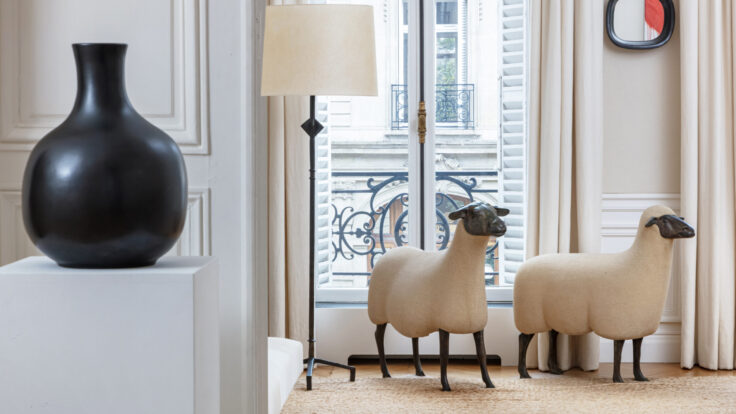
he said, he was acquiring one new object per week. Marino’s own collecting affliction spans similarly diverse categories, from baroque bronzes to Dalpayrat ceramics to Lalanne furniture. He collects deep as well as wide, as evidenced by the exhibition of 90 Wolfgang Tillmans photographs that are the subject of this summer’s show at his foundation.
Both men are also fixated on the Vienna Secession, the fin-de-siècle Austrian art
movement, which has occasionally led them to compete at auction. Marino got hooked on the aesthetic back in the ’80s, when he was in Belgium working on his first high-rise and visited the Palais Stoclet. The Brussels mansion was designed by Josef Hoffmann in the first decade of the 20th century and decorated by artists in his circle; there’s a Gustav Klimt frieze in the dining room, for example. (“I tried to buy it,” Lauder said—referring to the Palais.) At his
foundation this summer, Marino is displaying highlights from his collection, including Klimt and Egon Schiele works on paper, Franz von Stuck paintings, Hoffmann silver, and furniture by Koloman Moser, Otto Wagner, and Adolf Loos. “Welcome to Neue Galerie East,” Lauder joked.
Lauder, for his part, first became obsessed with all things Viennese in his teens, after coming across a tome on Klimt in a book
store. He even learned German, which came in especially handy when he served as ambassador to Austria under Ronald Reagan. “Life for me was always about collecting art,” he said. He and Serge Sabarsky, a dealer and collector, spoke almost daily for four decades, and decided in the mid-1990s that they should open a museum. Sadly, Sabarsky died just as the project was getting started; the Austrian-style café within the Neue Galerie is named after him. Even now,
Lauder is still very much on the hunt. “If any of you know any pieces for sale,” he said, “let me know.”
|
|
|
Now, on to the main event… |
|
|
Regional auction houses have largely taken over the lower end of the
decorative arts category, after Sotheby’s and Christie’s retreated to luxury sales while partnering with the smaller players on prestige collections. Meanwhile, a group of digital rivals has risen up to eat their lunch. |
|
|
Over the last quarter-century, the decorative arts that bewitched earlier generations
have somewhat fallen out of fashion. Back in the ’90s, the Upper East Side was all “period rooms in the sky,” recalled Patrick Sheehan, a top appraiser at Gurr Johns. Today, though, everything from Sèvres porcelain and Puiforcat silver to Louis XVI commodes is down from their highs. Sotheby’s and Christie’s have downsized their European decorative arts teams and consolidated their auction calendars. But even though there are comparatively fewer Regency tables coming to market
these days, there are estates and collections that need to be sold—and the demand on the buyer side is higher than you might think.
As Sotheby’s and Christie’s retreated from the lower end of the “brown furniture” category—“They won’t touch a collection less than $1 million,” said Maria Santangelo, co-founder of the collection management firm Bullimore Partners—a number of smaller auction houses stepped in. Freeman’s Hindman, Toomey & Co., Stair Galleries, and
Nye & Company all hold standalone sales throughout the year, largely transacting in the sub-$5,000 price band. Stair estimates their decorative arts sales total about $6 million to $8 million annually, without fees. Last year, Toomey & Co.’s four Great Estates sales totaled $1.6 million, with fees. “The market has gotten the message that there are arguably better boutique options,” a longtime auction veteran told me. |
|
|
A MESSAGE FROM OUR SPONSOR |
ALWAYS CONTEMPORARY
With a bold silhouette that conveys movement even at standstill, the Range
Rover Sport is striking from every angle.
EXPLORE |
|
|
There’s a clear economic logic for the bifurcation of the market. After all, it costs
as much to catalogue and sell a $50,000 piece of Meissen porcelain as it does a $500 set. “During my whole career, this has been a question for big auction houses,” said Christina Prescott-Walker, a former 35-year veteran of the decorative arts at Sotheby’s. Sotheby’s and Christie’s cycled through various solutions over the decades, including acquiring regional auction houses, opening satellite salerooms, and trying to enforce price thresholds (though specialists can get around
that by grouping several items into one lot, which increases their average lot value). But it was hard to find a low-cost model that worked. “In 2001, I was let go from Sotheby’s with the idea that they weren’t going to sell anything for less than $10,000,” said Colin Stair, who ran Sotheby’s Restoration before opening Stair Galleries, a regional auction house in Hudson, New York. His furniture and decorative arts departments are now run by two Sotheby’s and Christie’s alums,
Muffie Cunningham and Lauren Anderson.
Over the years, the big global auctioneers have developed a partnership strategy with regional players like Stair, where the smaller house sells the lower-value works from more-valuable collections. With the Aso O. Tavitian collection earlier this year, for example, Sotheby’s sold 832 decorative arts objects across two live auctions and an online auction for a total of $15.6 million, with an average
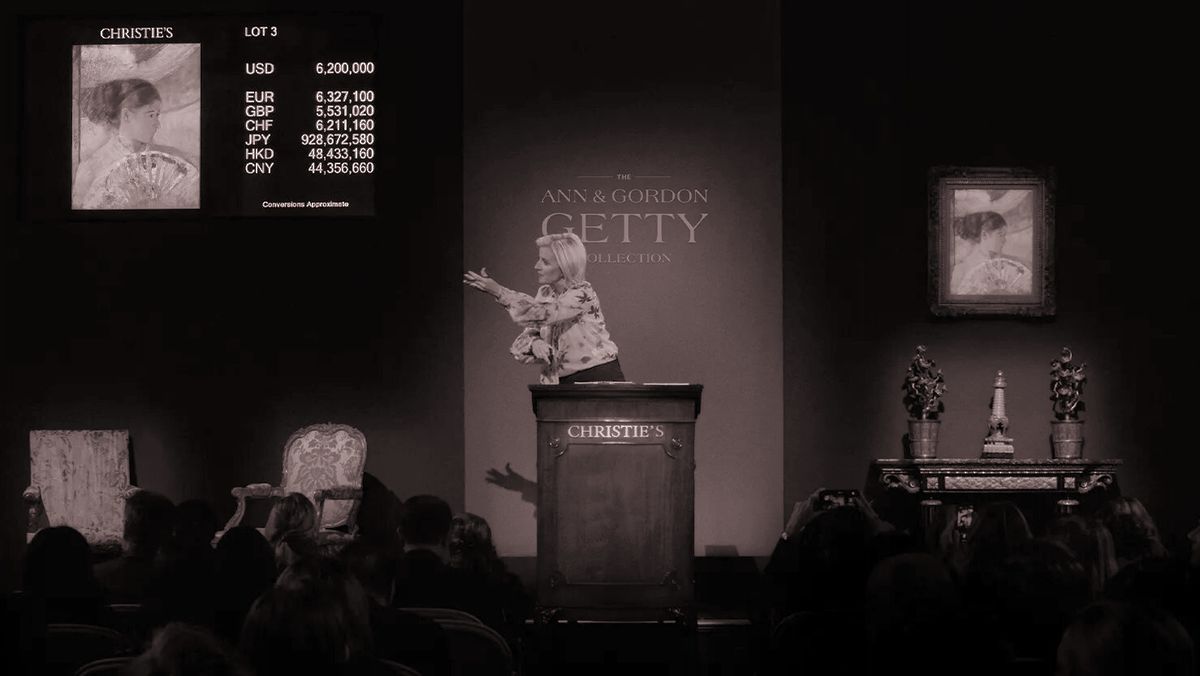
lot value of about $18,800; a few weeks later, Stair sold another 858 lots from the collection for $2.2 million, with an average lot value of about $2,600. Christie’s executed a similar strategy for the Ann and Gordon Getty collection: They sold more than $200 million in a series of 15 live and online sales in 2022 and 2023—then Stair sold another $3.2 million. “Not everything is going to Christie’s and Sotheby’s,” explained Bullimore co-founder Caitlin
Yates. “They’re taking a blended approach.”
In these instances, it’s usually up to the bigger houses to propose a comprehensive plan for dispersal to their clients, either by providing a list of suggested partners for them to consider, or recommending one partner in particular. “We have to offer a full-suite solution to be competitive,” said Victoria Gray, a 22-year veteran of Bonhams. Christie’s recently partnered with Doyle, which is based in New York, on the
collections of Iris Apfel and Lucille Coleman, even displaying in their own galleries some of Coleman’s paintings that will be sold at Doyle this fall.
These alliances have obviously raised the international profile of the regional players, too. Stair has been invited by the auction houses to visit and list property in tandem with them, is given space in their proposal documents, and has even been included in pitch meetings to “fully demonstrate the
integrated partnership,” said Prescott-Walker. Said Stair, “We provide a service that the market demands.” |
And yet, despite the persistent demand for lower- and middle-market decorative arts,
specialty sellers like Stair face their own issues with scale. The regional houses have attempted to solve this problem, in part, by working with third-party online bidding platforms like LiveAuctioneers and Invaluable, which aggregate auctions from multiple houses to massively expand their reach. |
|
|
Indeed, LiveAuctioneers and Invaluable get approximately 5.1 million and 3.4 million
visits per month, respectively, compared to only 1.3 million and 1.9 million for Christie’s and Sotheby’s. In Stair’s big collection sales, like Getty and Tavitian, approximately 80 percent of the 5,000 to 6,000 registered bidders come through third-party platforms—though, interestingly, 90 percent of winning bids are directly through Stair. “They are very powerful for small auction houses,” an owner of a regional house told me.
But ever since LiveAuctioneers was acquired by Auction
Technology Group in 2021, they’ve been raising their fees. They also require the auction houses to use their payment system, while withholding valuable underbidder information. And ATG’s consolidation of the industry isn’t slowing down: Last week, the company announced the acquisition of design marketplace Chairish for $85 million. “They’re vultures preying on us,” someone at a regional house told me.
Maybe, but they’re also providing a service that the regional houses sorely needed but
couldn’t have built on their own; they don’t have Christie’s and Sotheby’s brand reputation to rely on, nor their global reach. But with consolidation of the third-party sites and their increasingly aggressive business tactics, the disadvantages of using them might soon outweigh their advantages. Long-term, the industry isn’t wrong to worry about whether the smaller players might suffer from the barbarians at the gate. Nye & Company has a banner at the top of its website that reads, “Save 3% by
bidding directly with Nye & Company.”
Nevertheless, the regional houses are benefitting from the continued demand for these lower-value decorative arts. The Getty sale at Stair, which comprised over 1,075 lots, was 100 percent sold. Likewise, the Tavitian sale at Stair was 99 percent sold. Both made more than three times their low estimates. It’s not just provenance and marketing, either: Toomey & Co.’s Great Estates sales, which began in 2023, consistently have sell-through rates above
90 percent by both lot and value. “There’s a real shift toward a more layered lifestyle—by both style and value,” said Christie’s international specialist Casey Rogers. Sheehan agreed: “We’re seeing a return to eclecticism in decorating.” |
Thanks, Julie. We’ll be back in your inbox on Tuesday.
M |
|
|
The ultimate fashion industry bible, offering incisive reportage on all aspects of the business and its biggest
players. Anchored by preeminent fashion journalist Lauren Sherman, Line Sheet also features veteran reporter Rachel Strugatz, who delivers unparalleled intel on what’s happening in the beauty industry, and Sarah Shapiro, a longtime retail strategist who writes about e-commerce, brick-and-mortar, D.T.C., and more. |
|
|
Finally, a media podcast about what’s actually happening in the media—not the oversanitized,
legal-and-standards-approved version you read online. Join Dylan Byers, Puck’s veteran media reporter, as he sits down with TV personalities, moguls, pundits, and industry executives for raw, honest, sometimes salacious conversations about the business of media and its biggest egos. New episodes publish every Tuesday and Friday. |
|
|
Need help? Review our FAQ page or contact us for assistance. For brand partnerships, email ads@puck.news. You received this email because you signed up to receive emails from Puck, or as part of your Puck account associated with {{customer.email}}. To stop receiving this newsletter and/or manage all your email preferences, click here. |
Puck is published by Heat Media LLC. 107 Greenwich St, New York, NY 10006
|
|
|
|