{{ 'now' | timezone: 'America/New_York' | date: '%b %d, %Y' }} |
|
|
|
Welcome back to Dry Powder. I’m Bill Cohan. Congratulations to Glenn
Youngkin on his new gig at Red Cell Partners. I suppose that leaves the 2028 presidential finance-guy lane wide open for Dave McCormick…
In today’s issue, investing legend George Noble makes the uber-bear case for A.I. and the current era of “financial euphoria” (“You just sit there,
and it’s like, you want to blow your brains out,” he told me, in case you were wondering about his prevailing mood), and why he’s watching Oracle, in particular, for signs that the end is nigh. How’s that for irony? Plus, up top, a PSKY insider reacts to the antitrust suit filed on Monday by California and 11 other states attempting to block the WBD merger, and yet another blowout quarter for the Street.
Also mentioned in this issue: Rob Bonta,
David and Larry, Araceli Martínez-Olguín, P. Casey Pitts, Rich Greenfield, Jamie Dimon, Peter Lynch, J.K. Galbraith, Tom Keene, Elon Musk, Ted Pick, David Solomon, Abby Joseph Cohen, and… Britney Spears.
Let’s get started… |
- Warner
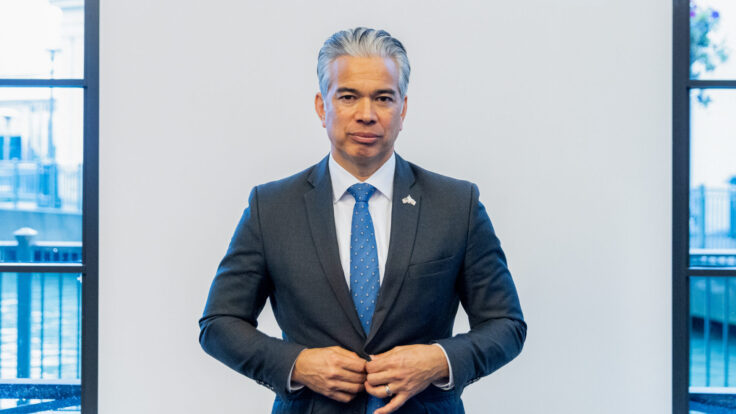
watch, cont’d: Wall Street doesn’t seem all that worried about the lawsuit filed on Monday by Rob Bonta and his coalition of 11 other state attorneys general challenging the Paramount–Warner Bros. Discovery merger. If Bonta’s legal assault had a chance of succeeding, you’d think that WBD’s stock would trade down, on the theory that shareholders would not be getting their money anytime soon. Instead, on Monday and Tuesday, the WBD stock actually traded up, more than
2 percent, to around $27.20—about where it ended up today—slowly closing the gap with the $31-a-share in cash that David and Larry Ellison have promised shareholders in order to absorb David Zaslav’s entertainment empire.
We’ll see. The question now on every deal guy’s mind is whether either of the two Biden-appointed federal judges in the Northern District of California—Araceli Martínez-Olguín or
P. Casey Pitts—will grant Bonta and his merry band of antitrust crusaders the temporary restraining order they’re seeking. The T.R.O. hearing is scheduled for Friday, at 10 a.m. PT, although there will also be a hearing the day before on Bonta’s additional request for a “permanent injunction” against the deal. Bonta has specifically requested that the case be heard by Martínez-Olguín, as he
told my partner Matt Belloni—and, interestingly, I hear that Team PSKY is okay with that choice. (It’s looking like Martínez-Olguín will get the nod here.)
Indeed, someone close to Team PSKY told me that while they are still “trying to figure out the options and implications” of the lawsuit, their preliminary read of the complaint is
that Bonta’s legal argument is pretty thin. (As my partner Eriq Gardner wrote last night, the lawsuit comprises a fairly conventional complaint that the merger will lead to fewer films, canceled projects, and higher cable bills—deliberately ignoring the highly competitive streaming market.) “You literally have to imagine that MGM doesn’t
exist, let alone that it’s part of a $4 trillion company that put out Project Hail Mary,” this person observed, noting that Amazon, Apple, and Netflix all put movies in theaters now.
Moreover, the person close to Team PSKY added, Bonta’s attempt to define a market for anticipated “tentpole” films is an artificially constructed category. “You also have to assume the Michael Jackson movie didn’t happen and Lionsgate doesn’t exist and A24 doesn’t exist, etcetera,
etcetera,” this person argued. “Pretty silly gerrymandering of the market to try to get to 27 percent and 30 percent market shares. That just won’t hold for any court. You also have to assume that the public doesn’t use streaming and that the share of viewing for linear isn’t down to 22 percent versus 48 percent on streaming.” (Bonta keeps insisting that streaming is intentionally not part of his legal argument.)
In this person’s view, the Bonta lawsuit and request for a T.R.O. and
permanent injunction will merely serve to slow things down, which won’t mean much of anything unless the deal continues past September 30, which is when the so-called “ticking fee” starts accruing for WBD shareholders at the rate of $6.7 million a day, or about $650 million a quarter. It’s “so unnecessary to weaponize antitrust this way,” Team PSKY told me. “They totally lose the moral high ground to criticize the D.O.J., just silly.” You do have to wonder why all of Australia, the E.U., Canada,
Brazil, China, and the Department of Justice have all seen the deal one way—and approved it, basically—while Bonta et al. see it another way. Politics, perhaps?
Of course, as LightShed analyst Rich Greenfield emailed me yesterday, this theater is “all moot” if Bonta doesn’t get the T.R.O. But in a posting earlier today, Greenfield wrote that he also believes there is a “high likelihood” the A.G.s will obtain the order. PSKY, he added, “knows this battle
is far from over.” I’m not sure, though, that the merger arbs got the message.
|
|
|
|
A MESSAGE FROM OUR SPONSOR |
|
|
|
- On
Wall Street’s wowza quarter: Our stock market highs may be an A.I. hallucination (more on that below…), but Wall Street banks are enjoying the trip. Goldman Sachs just blew away expectations for the quarter with pretax earnings of $8.6 billion, up 73 percent from the same period last year and 32 percent from the first quarter of 2026. Market-making revenue of $7.7 billion, in particular, was up 40 percent from the first quarter. And given the recent preponderance of big I.P.O.s,
the need for debt capital, and increasing M&A deal heat, it’s no surprise that Goldman’s investment bankers were also firing on all cylinders, with revenue up 20 percent over the first quarter and 55 percent over last year’s Q2.
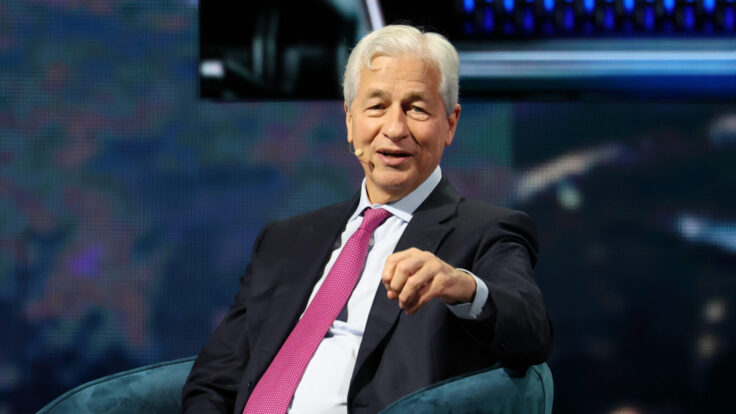
Meanwhile, it was big business as usual for Jamie Dimon, who’s starting to look like he will never leave. Net income
at JPMorgan Chase was $21.2 billion, which does include one-time gains such as the $4.6 billion windfall from the sale of the bank’s stake in Visa. Adjusted earnings were still $17 billion for the quarter and are now roughly $33 billion for the first six months of the year (excluding the one-time items). That puts King Jamie’s money-making machine on track for another year of record earnings. Last year, it had earnings of $60 billion; this year it could be $66 billion. Morgan Stanley and Bank of
America had blowout earnings, too, and bonus expectations will be high.
|
|
|
|
George Noble, the former Fidelity wunderkind, argues that hyperscaler capex, SpaceX
euphoria, and passive investing have created the most dangerous market bubble of his lifetime. The only question, he says, is what gives way first. |
|
|
|
“All these guys are running toward the cliff. You know, My capex is bigger than your capex, and,
If I don’t keep spending, you’re going to keep spending. I don’t want to lose out to you, so I have to keep spending,” the legendary investor George Noble told me earlier this week, describing the madness surrounding this A.I. moment in the market. As a seasoned investor, it’s difficult to know what to do, he conceded. “You just sit there, and it’s like, you want to blow your brains out,” he said.
Noble has been considered a market guru for more than four
decades—from his apprenticeship to Fidelity wizard Peter Lynch to his tenure running the Fidelity Overseas Fund starting in 1984, when he was just 28 years old. In 1985, the Overseas Fund returned nearly 80 percent, making it among the best-performing mutual funds in the country. Since leaving Fidelity in 1991, he has started and closed two hedge funds, and now manages his own investments at Noble-Impact Capital. (Next Wednesday, July 22, George is hosting the Best Stock Ideas
Online Summit, a virtual investor conference, from 10 a.m. to 6 p.m.…)
I check in with George from time to time about the state of the markets—particularly as a way to gut-check my own premonitions that the equity markets are overpriced, valuations and hype are out of control, and we’re on the precipice of a major correction. (This is not investment advice.) Alas, George largely agreed with my assessment in a couple conversations earlier this week that focused on the deluge of
money still flowing into artificial intelligence, and the forthcoming I.P.O.s of Anthropic and OpenAI. “I call this the Britney Spears market,” he told me. “Oops! I did it again.” He was referring obliquely to John Kenneth Galbraith’s A Short History of Financial Euphoria, in which the author memorably wrote, “There can be few fields of human endeavor in which history counts for so little as in the world of finance.”
Indeed, George told me that
he thinks the current A.I. mania and rash of inflated technology stocks could foment a crisis “far worse” than the dot-com bubble of a generation ago. “The sheer size of this in terms of dollars involved, and therefore the impact on the economy when the fallout comes, is going to be much more significant, and there’s this sort of existential imperative,” he said.
In addition to runaway spending on A.I. and data centers, he sees other worrisome signs. A projected federal deficit of around
$2 trillion in fiscal 2026 is starting to look like it could be closer to $2.5 trillion. And since interest rates are likely going up, borrowings to cover the growing deficits will become much more expensive. He’s also noticed that the credit-default spreads on the debt of the hyperscalers and their data centers have widened of late. The SpaceX debt, as Bloomberg TV’s Tom Keene noted recently in a conversation with George, “can’t find a bid.” |
|
|
|
A MESSAGE FROM OUR SPONSOR |
|
|
|
George is intently focused on Oracle in particular. While many of the Magnificent Seven and hyperscalers have
been rewarded by the markets for their infrastructure investment, Oracle stock is down 42 percent during the last year and now has a market capitalization of $382 billion. The spreads have widened on Oracle’s debt, too. George is awaiting the next quarterly earnings report to learn whether the company has pulled back on capex. If so, he said, that will be “a warning sign” that it’s “game over” for the “whole A.I. complex.” |
For Noble, SpaceX remains another critical harbinger. During his recent Bloomberg
interview, George went on a rant about the structure of the company’s initial public offering: Not only was a large portion of the issuance directed to retail investors, but the Nasdaq 100 decided to fast-track the stock into its index just 15 days after the I.P.O., which allowed E.T.F.s and passive funds to buy wantonly. “SpaceX went public at more than 90x revenue, and the insiders who
bought in at a fraction of today’s price are about to start selling their shares,” George warned.
He explained that 20 percent of the locked-up shares will come free in early August, and another 10 percent will unlock early if the stock trades at 30 percent above the $135 I.P.O. price going into the company’s second-quarter earnings report, to be released around the same time. More stock frees up after 70 days, and 90 days, and 105, 120, and 135 days. After the third-quarter earnings
release, another 1.3 billion shares, or 28 percent of the outstanding stock, will become sellable. On December 8, the 180-day lockup expires in its entirety. Our buddy Elon gets to sell his own 6.4 billion shares, or 42 percent of the whole enchilada, in June 2027.
But what happens if professional investors determine that SpaceX is a multitrillion-dollar facade built atop the profitable Starlink entity, and that its true market value instead lies in the hundreds of
billions? More specifically, what happens to those retail investors who bought at the peak $2 trillion valuation? “First, they keep the float tiny,” George continued. “Then they let the index rules force the world to buy at the top. Then they release a flood of insider stock into a crowd of retail buyers who were handed the shares up high. When the price finally breaks the offering level, the people who got in years ago at pennies on today’s dollar will hit the bid, and the exit liquidity is
your retirement account.” He called it “one of the great wealth transfers of my lifetime packed into a fancy narrative.”
George confirmed to me that he is shorting the company—“the most grossly overpriced stock at scale that I have ever seen,” as he put it. He predicted a “crash landing” for SpaceX stock, which he thinks is worth around $30 a share. (Nota bene: Today, for the first time, SpaceX shares
traded down below the I.P.O. price of $135. To quote Britney: Oops.) In a new video, George also called out the C.E.O.s of the three banks that underwrote the offering—Morgan Stanley’s Ted Pick, Goldman’s David Solomon, and JPM’s King Jamie—for their role in the I.P.O.
That shouldn’t matter much, however, since their institutions collectively reaped some $555 million in underwriting fees.
As we approach September and October, a time when markets often correct themselves, I pressed George on his predictions for the next few months. “You and I both know we’re coming into the time of year—August, September, October—it’s the worst time of the year, right?” he said. “But seasonality is not a prediction. It’s a condition.”
He is worried, though. Bond
yields are rising. More supply is coming to market in the form of huge I.P.O.s. He then poked some fun at Abby Joseph Cohen, the former Goldman market strategist, who used to say things like, “The return on equities in the next six months is unlikely to be competitive with a cash alternative.” He said he thinks markets “would do well to be flat over the next six to 12 months. In my opinion—and I could be wrong—we’re not going up, and therefore, door number two and door
number three are either flat or down.”
“Keep in mind, we have not had price discovery on the way up on a lot of this crap,” he added. “It’s forced buying because of the index funds, and it’s retail idiots, right? We’re just chasing momentum. Valuation was not a thing on the way up. Nobody cared, right? And therefore, on the way down, valuation is not going to stop these momentum idiots from selling. It’s not going to stop.”
In the end, I’m worried too that we’re about to go through
another rinse cycle. Retail investors who bought into the hype are especially ripe for getting burned. This is nothing new, of course, as Galbraith reminded us in his Short History: “For practical purposes, the financial memory should be assumed to last, at a maximum, no more than twenty years. This is normally the time it takes for the recollection of one disaster to be erased and for some variant on previous dementia to come forward to capture the financial mind. It is also the time
generally required for a new generation to come on the scene, impressed, as had been its predecessors, with its own innovative genius.” So it’s been, what, about 18 years since the last financial meltdown? Right on cue, it seems to me. |
|
|
|
Puck founding partner Matt Belloni takes you inside the business of Hollywood, using exclusive reporting and insight to explain
the backstories on everything from Marvel movies to the streaming wars. |
|
|
|
Puck’s daily political newsletter from Washington on what’s really happening in this town, from the White House to the Pentagon
to Capitol Hill, K Street, the campaign trail, and beyond. |
|
|
|
Need help? Review our
FAQ page or contact us for assistance. For brand partnerships, email ads@puck.news.
You received this email because you signed up to receive emails from Puck, or as part of your Puck account associated with {{customer.email}}. To stop receiving this newsletter and/or manage all your email preferences, click here. |
Puck is published by Heat Media LLC. 107 Greenwich St., New York, NY 10006 |
|
|
|
|