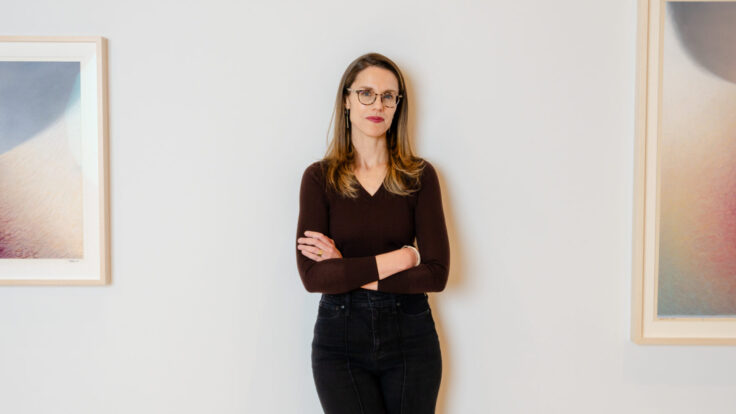
Welcome back to Wall Power. I’m Marion Maneker.
Tonight,
we’re starting the week with a look at Christine Ay Tjoe’s new show at White Cube, her first gallery exhibition in North America. White Cube is looking to broaden her collector base at a time when demand for the Indonesian abstract artist’s works seems to be reaching an all-time high. Elsewhere, the Courtauld just announced a big Wayne Thiebaud show for Frieze week in London this October; Tony Shafrazi is returning to art fairs with a booth at
Independent 20th Century this September in New York; and Julie Davich has details on a Galileo first edition that hits the block tomorrow.
But first, a quick reminder… |
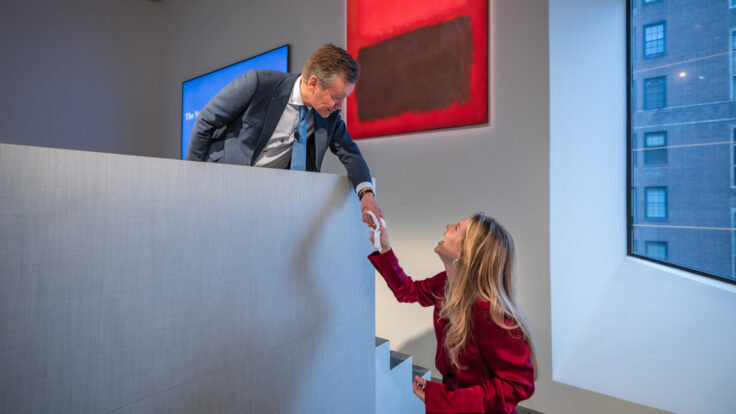
Puck, in partnership with the FLAG Art Foundation, is hosting a (10 a.m. to 4 p.m.)
gathering of key figures in the art world at SECOND in Chelsea on September 15. The one-day event will feature a candid discussion about the current state of the art market and all its key constituencies: artists, collectors, dealers, auction houses, museums, and art advisors.
We’ve previously announced that Larry Gagosian, Nicolas Party, Dasha Zhukova, and Glenn Fuhrman will appear at the event, and we have a host of
additional exciting names to unveil next week. But I wanted to give you all a chance to claim one of the few remaining tickets. We’re keeping the summit small so the conversation stays intimate and forthright. I hope you’ll join us. |
|
|
A MESSAGE FROM OUR SPONSOR |
ALWAYS CONTEMPORARY
With a bold silhouette that conveys movement even at standstill, the Range
Rover Sport is striking from every angle.
EXPLORE |
|
|

| Julie Brener Davich
|
|
- Galileo figaro
magnifico: Tomorrow, Christie’s London will auction a recently rediscovered, 420-year-old first edition of Galileo Galilei’s first-ever book, Dialogo in perpuosito de la stella nuova (Dialogue concerning the new star), with an estimate of £500,000. Only 11 other copies are known to exist, all of them held by institutions—and of those, only seven
are as well-preserved as this version. It was published three decades before Galileo was accused of heresy by the Roman Inquisition for his theory of heliocentrism, but the intellectual climate was already hostile enough that Galileo and his co-author chose to use a pseudonym for the Dialogo. It’s also among four Renaissance tomes from the same European private collection in Christie’s 128-lot sale of Valuable Books and Manuscripts, which also includes a rare first
edition of Pliny the Elder’s Natural History, from 1469, estimated at £400,000.
The world auction record for a Galileo work has stood since Pierre Bergé & Associés sold his final book, Discorsi e dimostrazioni matematiche intorno a due nuove scienze (Discourses and Mathematical Demonstrations Relating to Two
New Sciences), which has been described as the world’s first physics textbook, for €727,919 in 2017. That broke the previous Galileo record of £662,500, which was set at Christie’s in 2010 when the house sold a first edition of Sidereus nuncius from the library of Edward Tufte. Last week, Sotheby’s sold another copy of the same text, but in modern binding, for £406,500.
These prices are notable—but not eye-popping—in the market for historic
scientific documents. In 1994, Bill Gates acquired Da Vinci’s Codex Leicester for $30.8 million in a private transaction. Editions of James Audubon’s Birds of America have sold at Christie’s in 2010 for £7.3 million ($11.6 million at the time) and in 2018 for $9.65 million. Other multimillion-dollar scientific books and manuscripts include a set of
calculations by Einstein, relating to his general theory of relativity, and a letter from Francis Crick to his son revealing his discovery of DNA.
|
|
|
- Tony Shafrazi
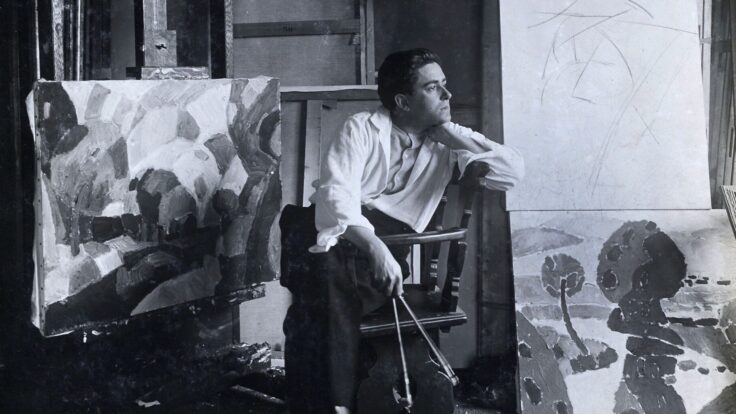
returns to an art fair: Tony Shafrazi’s career in the art world, which began after he graduated from the Royal College of Art in London, has been long and rife with plot twists—the best known of them being when he defaced Pablo Picasso’s Guernica in the Museum of Modern Art in 1974. (The painting wasn’t damaged by Shafrazi’s spray paint.) Two years later, Shafrazi became an art advisor to the Shah of Iran, who was in the process of assembling an astonishing
collection of contemporary art, which established Shafrazi in the center of the art world. In 1978, he opened a short-lived gallery in Tehran. After the 1979 revolution, Shafrazi moved back to New York.
The spray can he deployed on Guernica foreshadowed his success in New York during the ’80s representing graffiti artists like Keith Haring, Jean-Michel Basquiat, and Kenny Scharf. (Though, to be fair, he worked with many other
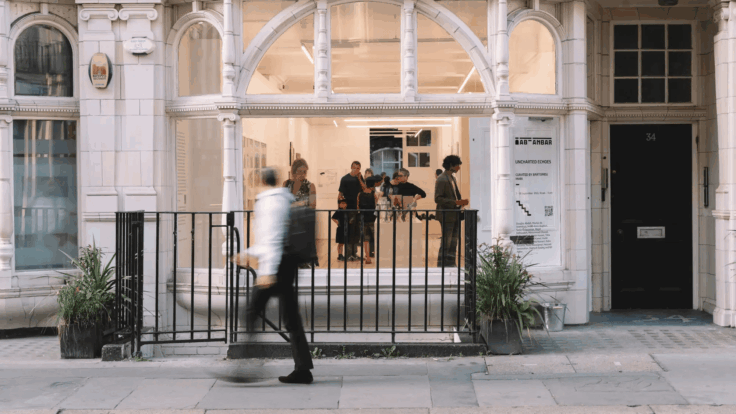
artists as well.) In 2012, Shafrazi mounted a booth at Art Basel, which, in defiance of the fair’s expectation that galleries feature established and vetted artists, showed his own works—a decision that did not amuse Basel’s selection committee. Shafrazi subsequently took a dozen-year hiatus from art fairs, but that will end on September 4-7 at the Independent 20th Century fair, held at Casa Cipriani. Shafrazi’s booth will feature work by Zadik Zadikian, referencing a
show of gold bricks that the artist held at Shafrazi’s Tehran gallery before the revolution.
Other participating galleries at the fair include Salon 94, Sea View, and Jupiter. In addition, Nahmad Contemporary and Skarstedt Gallery will show a curated selection of works by Georges Rouault, and Jeremy Scholar will show work by the Florida Highwaymen, a group of African American landscape painters who got their name by selling their art from the trunks of their cars. - Wayne Thiebaud at the Courtauld for Frieze London: The Courtauld announced this morning that it will hold the U.K.’s first museum show of Wayne Thiebaud’s work during Frieze week in London. Opening October 10, the show will feature important loans of works from the 1960s: Cakes, from 1963, will be featured from the National Gallery
of Art in Washington; on view as well will be Four Pinball Machines, from 1962, which was once sold by Donald Bren to Ken and Judy Siebel, who in turn auctioned it for more than $19 million—a figure that still stands as Thiebaud’s public record. The Courtauld show, which also borrows from the Whitney, the Smithsonian, the Fine Arts Museums of San Francisco, and the Wayne Thiebaud Foundation, focuses on the artist’s role in redefining
the still life for the era of contemporary art.
|
Now, we’re ready for the main event… |
|
|
Indonesian artist Christine Ay Tjoe has been a rising star in Asia for
two decades. But her first U.S. show, at White Cube, offers a comprehensive view of how she grapples with the theme of grief after the death of her father. |
|
|
One of the great themes of abstract expressionism was that artists could depict deep
and strong emotions in a visual language without reference to the physical world. Paired with this idea was the popular image of the artist as a taciturn and complicated person who kept their feelings bottled up inside. No figure better captured this duality than Jackson Pollock, the hard-drinking, paint-flinging artist who recklessly killed himself and a passenger in a car crash because he couldn’t come to grips with his inner turmoil.
All of this came to mind the other
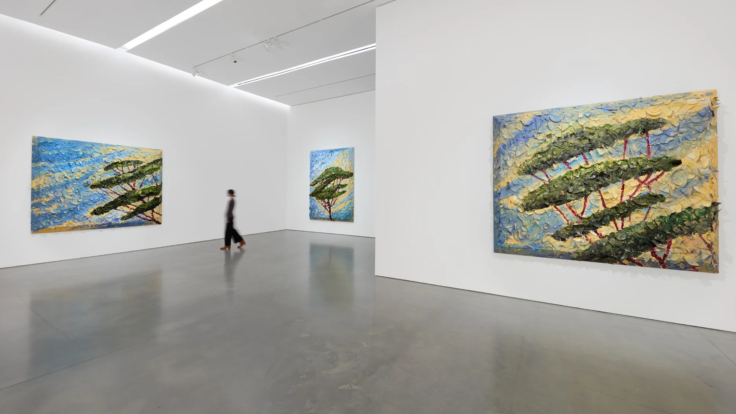
day as I walked to the preview for Indonesian artist Christine Ay Tjoe’s new show at White Cube gallery, Covered and Cover—her debut exhibition in North America, coming two years after Jonathan Cheung donated one of her works, Blue Cryptobiosis #10, from 2021, to the Metropolitan Museum of Art, where it remains. The
show is a collection of 12 canvases that Ay Tjoe, 52, painted in response to the death of her father, to accept her feelings of grief and loss, as well as her family’s emotional reticence. In some ways, the works evoke, some 75 years later, that same image of the heroic painter translating emotions into abstract images because they’re too strong to articulate. But in so many other ways, Ay Tjoe’s work represents the polar opposite of abstract expressionism’s machismo. |
|
|
A MESSAGE FROM OUR SPONSOR |
ALWAYS CONTEMPORARY
With a bold silhouette that conveys movement even at standstill, the Range
Rover Sport is striking from every angle.
EXPLORE |
|
|
Ay Tjoe has already spent two decades as a rising star in Asia, where her work has
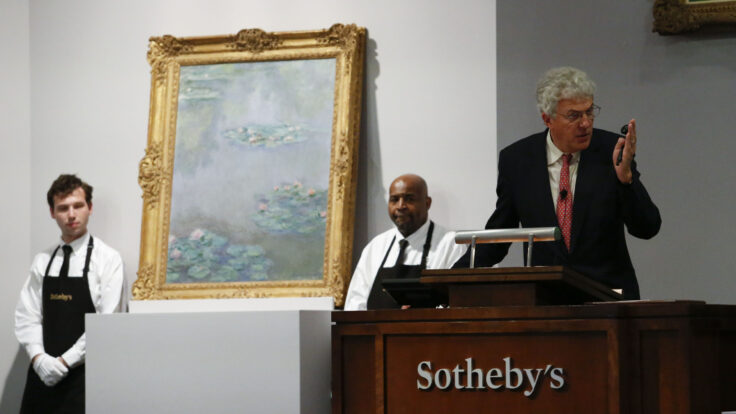
been a mainstay of the Hong Kong auctions. Earlier this year, in a special sale that Sotheby’s held in Singapore, Ay Tjoe’s Lights for the Layer, from 2011, sold for a record price of nearly $2.2 million. That price level was confirmed just two months later when Layer as a Hiding Place #2, also from 2011, sold for nearly HK$14 million ($1.8 million). Indeed, to this point in 2025, Ay Tjoe’s auction sales have topped $6 million, right between her previous highs of $5.5 million
in 2021 and $7 million in 2022, with half of this auction year still to come. The average price for an Ay Tjoe artwork at auction has also shot up this year—to a peak, so far, of more than $750,000. |
The Met’s Ay Tjoe painting has been a great addition to New York, but it’s still just
one work, hanging among other recent contemporary art donations, where it offers the viewer no lateral understanding of what else the artist made during the same period. Without a retrospective, moreover, it’s also hard to get a vertical sense of her work and its evolution over time. I myself had only seen her paintings in passing snippets at auction or in booths at art fairs; an art advisor I know confessed to a similar experience when I ran into her at the Covered and Cover
preview. That’s where the White Cube show really helps: It offers a body of the artist’s work together as one piece. |
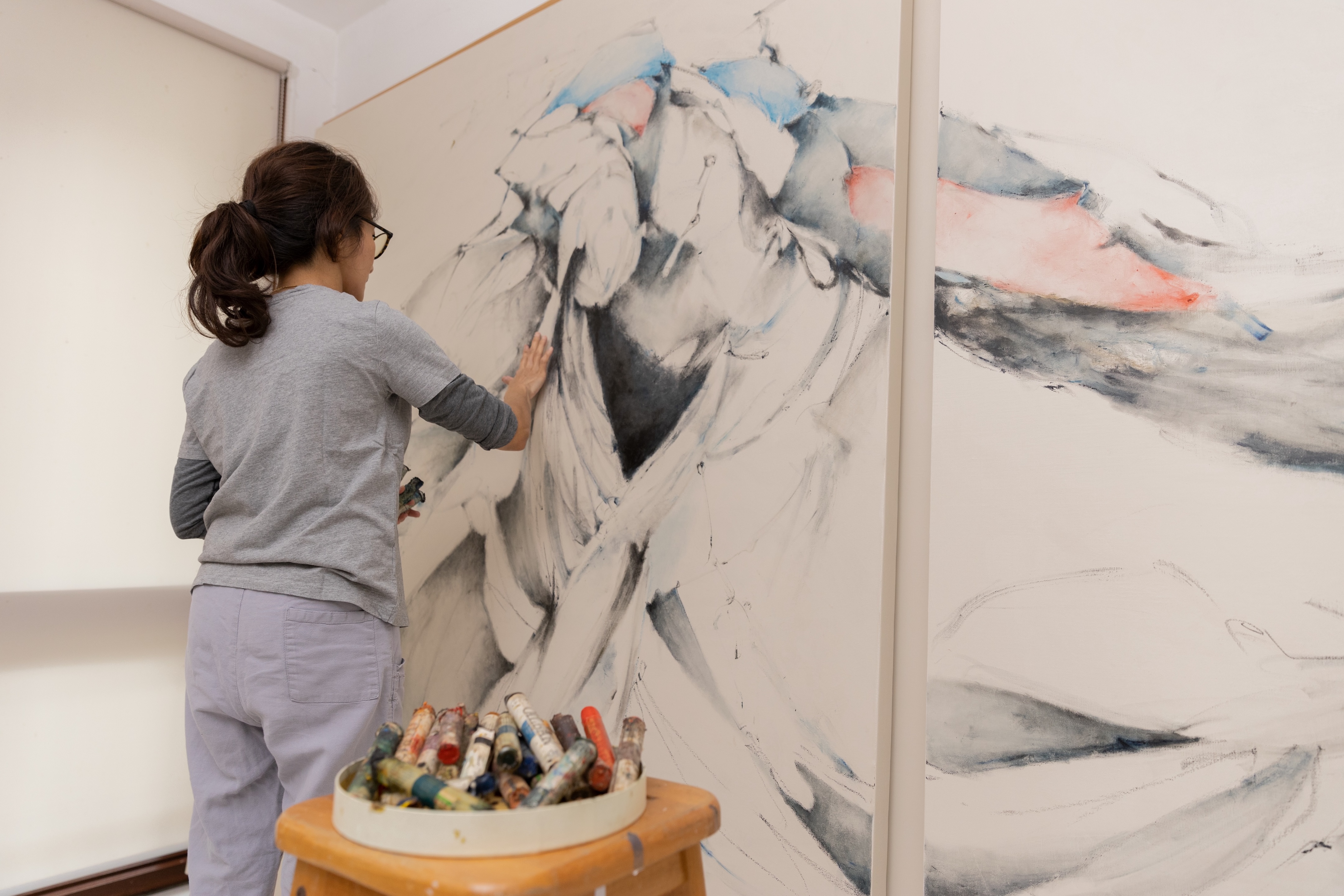
Christine Ay Tjoe, Covered and Cover #10 (2025). Photo: Frankie
Tyska
|
While auctioned lots can give us impressions from various moments in her career, they
offer no larger narrative. More to the point, these lots come to market for a variety of reasons that often give casual observers a misleading impression of the artist’s broader methods and goals. Auction records show a range of very different work from Ay Tjoe, but I still don’t know how to fully make sense of her practice. It’s all abstract, certainly, but as with several other noted abstract artists, like Julie Mehretu, dramatically different works keep surfacing common
themes and gestures.
As it happened, Ay Tjoe herself was at the preview, though she didn’t provide the explanation of the works on view. Her English is halting enough that it made sense for White Cube to have Capucine Perrot, an artist liaison with the gallery, speak about the 12 paintings on Ay Tjoe’s behalf. Plus there was that issue of emotional reticence—I didn’t get the sense that the soft-spoken Ay Tjoe was eager to share the personal pain that inspired these
paintings. |
|
|
Perrot, who also worked on most of Ay Tjoe’s five previous solo shows in London,
explained that the artist’s work is deeply connected to her lifelong passion for drawing. Ay Tjoe doesn’t compose her paintings based upon sketches or preparatory studies. She doesn’t even work on her paintings serially, finishing one before starting another. Instead, she has just enough room in her Bandung studio for 10 to 12 full canvases. When she begins a new series of paintings, she lines the room with canvases and works on all of them simultaneously, making each of a piece with the
others. |
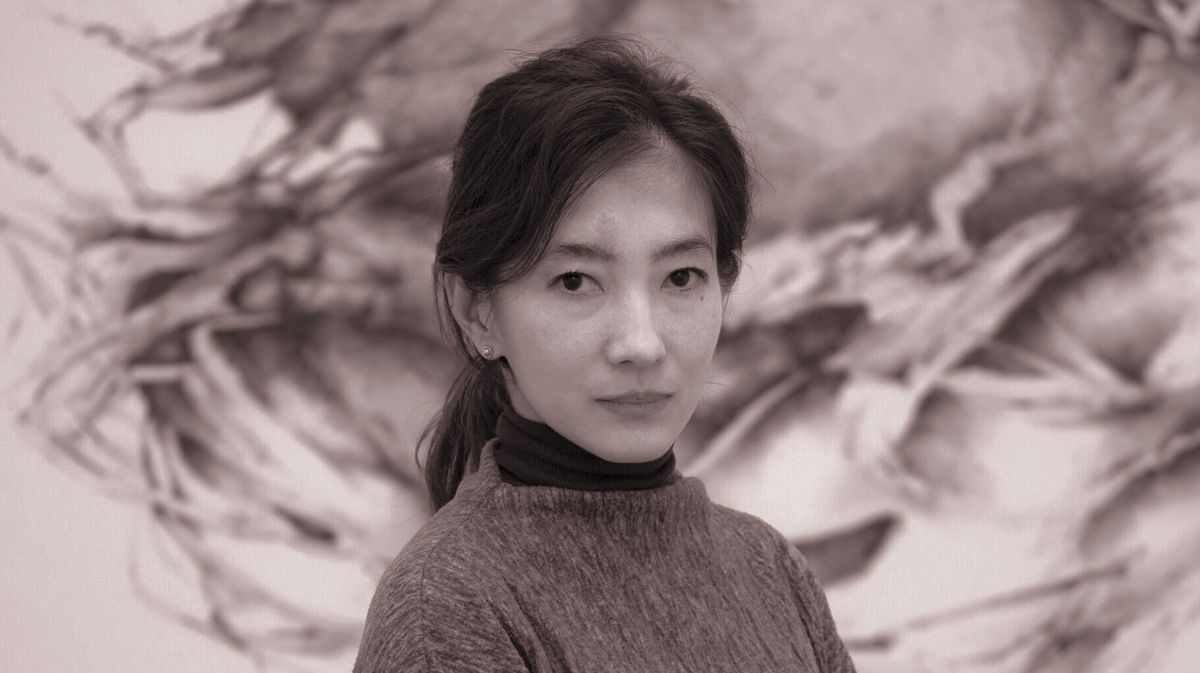
Christine Ay Tjoe in her studio. Photo: David Maru |
Setting her images well within the margins of the beige canvases, Ay Tjoe creates a
clear contrast between the complicated organic forms and the stark background. Her preferred medium is oil bar, a stick of thick, butter-like paint that the artist can apply more like pastels or charcoal. The oil bar allows her to draw on the canvas, then work the pigment in with her fingers to create different saturations and surfaces. Working back and forth among different canvases, the abstract forms she builds by layering thin washes of color are vaguely figurative, like tangled body parts
where glimpses of connected limbs flash before the viewer’s eyes before dissolving into other shapes.
The central theme of Covered and Cover, connected as it is with her father’s death, is concealment: of emotions, of familial tension. The color palette is reds and browns with magenta accents set off by blacks, greys, and the occasional green hidden in the forms, which evoke blood clots. Blood, and its associations with familial ties and a life force that remains after
the death of a parent, is the animating metaphor here. Simple things, like the meaning of life—and family—are what Ay Tjoe is trying to make sense of through her abstract art, and she’s doing it in a way that’s constructive, not destructive. |
That’s it for today, sports fans. I’ll be back tomorrow with the Inner Circle and a look
at ARTDAI’s data for the first half of 2025, which should give us some insight into where the art market stands right now. If you’re not yet a member of the Inner Circle, now would be a good time to upgrade.
M |
|
|
The industry's go-to source for unflinching reporting on the trillion-dollar business of artificial intelligence -
perhaps the single most important technology of our time. Ian Krietzberg, the powerhouse journalist behind The Deep View, delivers twice-weekly insights into the latest dealmaking and breakthroughs in A.I., and how the intersecting worlds of finance, entertainment, media, and politics are being transformed in its wake. |
|
|
Finally, a media podcast about what’s actually happening in the media—not the oversanitized,
legal-and-standards-approved version you read online. Join Dylan Byers, Puck’s veteran media reporter, as he sits down with TV personalities, moguls, pundits, and industry executives for raw, honest, sometimes salacious conversations about the business of media and its biggest egos. New episodes publish every Tuesday and Friday. |
|
|
Need help? Review our FAQ page or contact us for assistance. For brand partnerships, email ads@puck.news. You received this email because you signed up to receive emails from Puck, or as part of your Puck account associated with {{customer.email}}. To stop receiving this newsletter and/or manage all your email preferences, click here. |
Puck is published by Heat Media LLC. 107 Greenwich St, New York, NY 10006
|
|
|
|




_01JZNQ9PX4AH5CMHC6H47MF0PM.jpg "Christine Ay Tjoe, Covered and Cover #10 (2025). Photo: Frankie Tyska")