Greetings from Los Angeles, and welcome back to In the Room. In my previous email, I
reported that Vanity Fair editor Mark Guiducci would drop Olivia Nuzzi from the magazine amid the new allegations about her breach of journalistic ethics. Earlier today, the two parties announced that they had “mutually agreed, in the best interest of the magazine, to let her contract expire at the end of
the year.” Ryan, are you done yet?
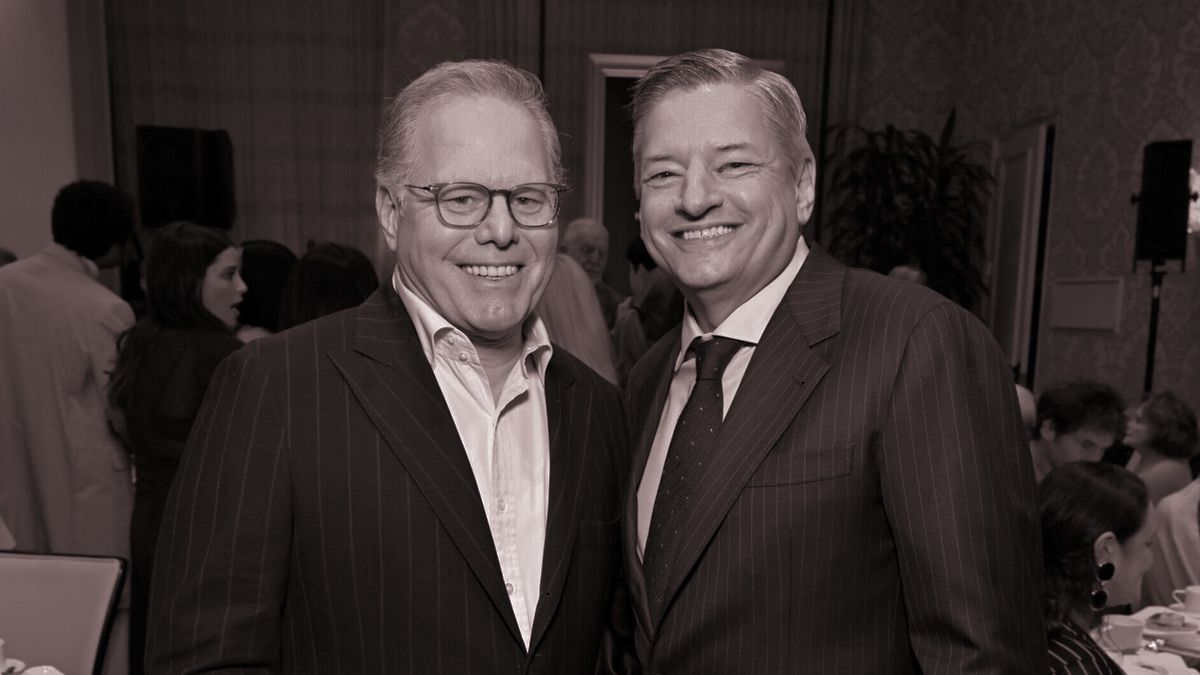
In tonight’s issue, news and notes on Ted Sarandos’s landmark deal for the Warner Bros. Discovery studio and streaming assets, and what it portends for the once-august television brands that have been significantly diminished under David Zaslav’s stewardship. Somehow, CNNers see this as a better outcome than a David Ellison–Bari Weiss takeover. Think
again.
🍸 Plus, on today’s episode of The Grill Room, Julia and I assessed the endless Nuzzi–Lizza saga and its collateral damage: Substack’s structural vulnerabilities, Vanity Fair’s brand calculus, and the reputational fallout for both combatants. We also swapped our Spotify Wrapped revelations and discussed how this annual recap became a marketing juggernaut. Follow The Grill Room on
Apple, Spotify, or wherever you prefer to listen.
🎙️ Bonus: My partner Peter Hamby also invited me on The
Powers That Be, Puck’s flagship podcast, to dissect the Nuzzi–Lizza drama and CNN’s new deal with Kalshi—a harbinger of further integration between news networks and prediction markets that mirrors ESPN’s embrace of sports betting. (Listen here or
here.)
But first, a little CBS scoop… |
-
Waiting for Gutman: Bari Weiss and Tom Cibrowski have managed to lure ABC News correspondent Matt Gutman to CBS News after a protracted back-and-forth negotiation, per sources familiar. Bari began courting Gutman not long after taking the helm at the network. But as of mid-November, Gutman had appeared poised to stay on at ABC. Apparently, Bari and Tom maintained their pursuit and persuaded Gutman to take the leap. He will serve as a high-profile correspondent for CBS News and is
not in line for the Evening News anchor job.
|
|
|
A MESSAGE FROM OUR SPONSOR |
We keep talking about the war for attention, but we’ve been getting it
wrong. McKinsey’s latest research, based on 7,000 consumers worldwide, shows we often confuse “attention” with “consumption.” Real attention is measurable, valuable, and drives a third of media monetization. This new lens reveals what’s been missing: we misclassify “super users,” overlook key segments, and undervalue media that can drive outsized levels of audience focus and intent. The winners already know — it’s quality of attention, not quantity, that matters to consumers, brands, and the media companies that connect them. Are you fighting the right battles in the war for attention? |
|
|
And now, here’s Matt Belloni on how the
Netflix-WBD news is playing in Hollywood: |
|
|

| Matthew Belloni
|
|
- It’s far too
early to start evaluating whether Netflix will be the best steward of a studio and streamer that have been tossed around for so long that it’s become comical to everyone except those who still work there. … But there’s at least an argument that this is the best of three bad outcomes for this company. Despite Ellison’s messaging about “investment,” Paramount buying Warners was a pure consolidation play for him, smashing together two similar film and TV studios, two complementary streaming
platforms, two news divisions, etcetera. Maybe the Ellisons would have put a full slate of Warner Bros. movies in theaters like they promised, but everything else merges and thousands more people are fired. Same with Comcast, basically.
But with Netflix, maybe the better question to ask is, What are they missing? Or, How does Warner Bros. give them what they don’t have now? That’s ultimately why I think Sarandos went so hard after this deal, even though the company
doesn’t need it nearly as much as the others. For the first time, Ted is getting a quality film library, which Netflix knows from engagement data is a primary driver of viewership. A new report from Reelgood reveals the Netflix movie count would increase by 52 percent (from about 4,400 titles currently on the service to 6,629) if it adds just what is currently on HBO Max. And no disrespect to the Russo brothers, but think about how much better those Warner movies are
than what Netflix has been making.
Sarandos is also getting a trove of adaptable I.P. He’s getting a pristine TV brand in HBO, though he and [Greg] Peters wouldn’t say if it will ultimately be bundled with Netflix or appear as an upsell tile. Netflix currently has tons of volume and not a lot of superpremium, so that’s additive. He’s also getting a lucrative TV licensing business in Warner Bros. Television, which can allow Netflix to
expand into producing shows for other platforms. And, of course, he’s getting a theatrical movie studio, which, depending on whom you believe, Netflix either intends to keep as a theatrical movie studio or honor existing contracts while slowly starving it to death. …
All of these will be relatively new things for Netflix, which is scary because they could be screwed up royally or simply sacrificed at the altar of the existing business. But if Netflix jumps through all the hoops to get the
deal done, and actually honors the pledges its leaders made today, maybe it’s not as disastrous as everyone in Hollywood is now trained to expect. The sad reality is that Warner Discovery was destined to be carved up and sold the day the company was created. At least we know Netflix-Warner can’t be worse than AOL Time Warner. Right? Right? [Read Matt’s full
column here]
|
|
|
In the wake of Netflix’s Warner Bros. coup, the folks at CNN are,
perhaps naively, looking on the bright side: They may not have to work for Bari Weiss after all. But times in Spinoffville are going to get tough—and fast. |
|
|
On Friday, shortly after Ted Sarandos announced that Netflix had
reached a landmark deal to acquire Warner Bros. Discovery’s streaming and studio business, a buyside source noted the depressing symmetry of David Zaslav’s three-and-a-half-year journey through the public market. On its first day of trading, in April 2022, WBD opened at $24.08 a share. After news of the Netflix deal broke, it was trading about a dollar or two higher. In that same period, the S&P 500 had grown by 58 percent. “So Zaz stewardship underperformed the market by
that,” the source said. “And he was well compensated for this underperformance!” (To the tune of around $660 million, per CNBC.)
The journey of the Warner assets has been even more dispiriting, particularly on the television side. As readers of this email know, the Warner brands that Zaz is now offloading bear little resemblance
to those he inherited. In 2022, HBO and CNN, once legitimately two of the biggest brands in the world, still maintained some vestige of that stature. But Zaz Max-ified HBO and Licht-ified CNN while preoccupying himself with the more pressing obligations of debt reduction. Sure, in some sense, these channels’ fates had been predetermined by broader economic forces, but Zaz’s misguided stewardship, acknowledged in inevitable strategic reversals, only hastened the fall.
(As a result of our recent acquisition of Air Mail, Zaslav has become a de minimis investor in Puck.)
The next transaction, provided it clears its many remaining hurdles, will accelerate this transformation: At Netflix, HBO is likely to become a prestige tile amid the endless scroll of Netflix content, the Cadillac Margarita on the Chili’s cocktail menu. (We’ll see what Casey Bloys makes of that arrangement.) Meanwhile, CNN, which is not included in the
Netflix deal, will instead become part of the soon-to-be-spun-off, Gunnar Wiedenfels–led Discovery Global—a pumpjack sitting atop a declining portfolio of orphaned TV assets. |
|
|
A MESSAGE FROM OUR SPONSOR |
We keep talking about the war for attention, but we’ve been getting it
wrong. McKinsey’s latest research, based on 7,000 consumers worldwide, shows we often confuse “attention” with “consumption.” Real attention is measurable, valuable, and drives a third of media monetization. This new lens reveals what’s been missing: we misclassify “super users,” overlook key segments, and undervalue media that can drive outsized levels of audience focus and intent. The winners already know — it’s quality of attention, not quantity, that matters to consumers, brands, and the media companies that connect them. Are you fighting the right battles in the war for attention? |
|
|
Unsurprisingly, the majority of CNN insiders impulsively view this as a better
outcome than being owned by David Ellison, who until now had been seen as the frontrunner to acquire all of the WBD assets. Mostly, they seem relieved that they will not have to work for Bari Weiss, the crusading Free Press founder and newly appointed CBS News editor-in-chief who was set to expand her remit to a combined CNN-CBS newsroom if Ellison had landed the deal. (It’s possible Ellison could still buy the Discovery cable assets,
including CNN, though that was never the motivator for his pursuit of WBD.)
“No one was looking forward to all that would come from being under the Ellison/Weiss news regime,” said one CNN reporter. A CNN higher-up called it “a great day for independent journalism.” That’s at least arguably true from an editorial perspective, but it certainly ignores the broader business implications of what it means to be spun out, Versant-style, as a cable company in 2025. |
Like Rebecca Kutler at Versant, CNN C.E.O. Mark Thompson
is now trying to cast his network’s independence in the most optimistic light. On Friday, he sent a pablum-laden note to staff in which he said the deal “will enable us to continue to roll out our strategy to secure a great future for CNN by successfully navigating our digital transition. Both David Zaslav and Gunnar are firm backers of the strategy, and we’ve already agreed to a 2026 budget which includes increased investment for the plan.” Notes like that might be reassuring, if Mark
had anything to show for the aforementioned “digital transformation” beyond a still largely undifferentiated subscription product that too few people seem willing to pay for.
Of course, Thompson’s gloss elides the true effects of being detached from a diversified media conglomerate while still being tethered to the free cashflow of a declining business. And there’s a reason Wiedenfels is the one who’s been tasked with manning this ship: He’s a cost-cutter, and he’s been given a mandate to
prove that the RemainCo can produce cable-era margins without cable-era audiences. In actuality, CNN’s spin puts it on the same course as the rest of the industry’s orphaned cable networks: toward an acquisition by Nexstar or Sinclair, a private equity takeover, or a merger of Discovery and Versant themselves.
Would a Paramount takeover have been better? Sure, it’s not hard to imagine Jake Tapper flipping his shit upon learning that his new boss was going to preempt his
hour for her own town hall with Erika Kirk. That said, Bari remains the rare creative leader in the news industry with actual ambition, and Ellison remains the rare owner who actually wants cable assets. Even Bari’s critics at CNN acknowledged that a combined CBS-CNN could be a relative powerhouse in the news space.
It may yet happen. Netflix still has to secure regulatory approval. And based on my conversations on Friday, Ellison may still try to launch a hostile
takeover. |
|
|
Join Emmy Award-winning journalist Peter Hamby, along with the team of expert journalists at Puck, as they let you
in on the conversations insiders are having across the four corners of power in America: Wall Street, Washington, Silicon Valley, and Hollywood. Presented in partnership with Audacy, new episodes publish daily, Monday through Friday. |
|
|
A professional-grade rundown on the business of sports from John Ourand, the industry’s preeminent journalist,
covering the leagues, players, agencies, media deals, and the egos fueling it all. |
|
|
Need help? Review our FAQ page or contact us for assistance. For brand partnerships, email ads@puck.news. You received this email
because you signed up to receive emails from Puck, or as part of your Puck account associated with {{customer.email}}. To stop receiving this newsletter and/or manage all your email preferences, click here. |
Puck is published by Heat Media LLC. 107 Greenwich St., New York, NY 10006 |
|
|
|