{{ 'now' | timezone: 'America/New_York' | date: '%b %d, %Y' }}
|
|
|
|
Hi, and welcome back to Line Sheet. Today, Malique Morris previews Reformation’s
much-discussed billion-dollar I.P.O. and ponders whether public market investors will buy the company’s tech narrative. As World Cup fever cools, Malique also reveals how important tentpole sports events have become to the Adidas–Nike rivalry. Down below, we’ve got a very special main event from Style Analytics data genius Molly Rooyakkers, who investigates whether luxury
fashion brands have been able to convert K-pop’s superheated fandom and pricey ambassadorships into actual sales.
Mentioned in this issue: Bjørn Gulden, Permira, Jisoo, Jung Kook, Yael Aflalo, Reformation, Phoebe Philo, Rosé, Nike, Adidas, Jimin, G-Dragon, Lingling Sirilak Kwong, Orm
Kornnaphat, and more…
|
Two Things You Should
Know…
|
|
|
|
 |
Malique Morris |
|
- Reformation’s $1 billion road
show: There’s a lot riding on Reformation’s I.P.O. later this month. The company’s projected $1 billion valuation might seem like peanuts in this A.I. economy, or even compared to some of Reformation’s own D.T.C. peers (Warby Parker has a $3 billion market cap). But it's a 412 percent increase from the company’s last known private valuation of $195 million, in 2017—two years before private equity shop Permira acquired the business.Can Reformation raise the $239 million that
the company is seeking from the markets? Tellingly, the company has been talking up its tech angle a lot. Reformation mentioned its Retail X concept—the company merchandises its stores like showrooms, and customers use touch screens to request items to try on—nearly 30 times in its S-1. Alas, fashion companies love to talk up their tech chops, only to discover that mediocre software isn’t enough to sustain growth or fend off competitors—and the sophistry really just frustrates
investors, who could care less about narratives as they assess the underlying fundamentals. Speaking of which: Reformation’s net profits fell by 61 percent in 2025, to $13 million, and the company racked up $12 million in net losses in the first quarter of 2026.
But it’s all gravy for Permira. In June, Reformation took out a $92 million loan to pay out the firm, which will also retain at least 49 percent of the outstanding shares.
- Nike and
Adidas on the pitch: Adidas was probably always positioned to be a standout at the World Cup. C.E.O. Bjørn Gulden is a former footballer, and he’s made the sport an even bigger priority for the brand since the Yeezy era ended. On Sunday, both Spain and Argentina took the field in Adidas kits, and the company sold four times as many jerseys during this tournament as it did amid the 2022 World Cup. Gulden recently
told the Times that Adidas is on pace to generate $1.7 billion in World Cup–related sales.Nike is likewise shifting its strategy from street style cred to a sports-first identity. This year, the company mounted its largest World Cup campaign yet, rolling out 12 weeks of product launches, marketing campaigns, and events. According
to Launchmetrics, Nike’s Media Impact Value related to the World Cup was 70 percent higher than Adidas through the first half of the tournament. (Data for the second half of match play is still being tabulated.) Global sporting spectacles will help determine the next phase of the rivalry, as Adidas and Nike compete for market dominance as well as mindshare.
|
|
|
|
Luxury has mastered the art of monetizing fandom on social media. But turning that fandom
into handbag sales remains a much tougher business.
|
|
|
|
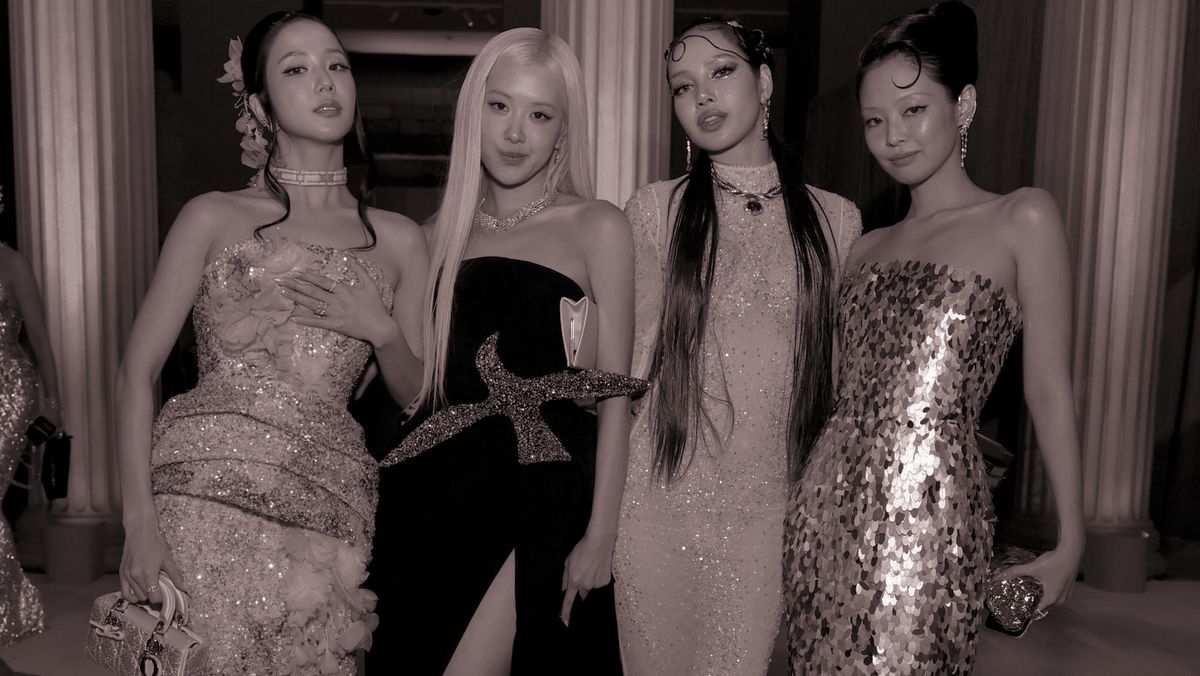
For a content creator, there are few drugs as potent as the serotonin rush of K-pop fan engagement. Whenever
I release a report that features a K-pop star on Style Analytics, my Substack devoted to fashion trends, I know that the comments and shares are about to explode. The same phenomenon appears to be evident in the luxury fashion market. Take last year’s Fall-Winter season, when Dior reportedly generated $88 million in earned media value (E.M.V.) on Instagram
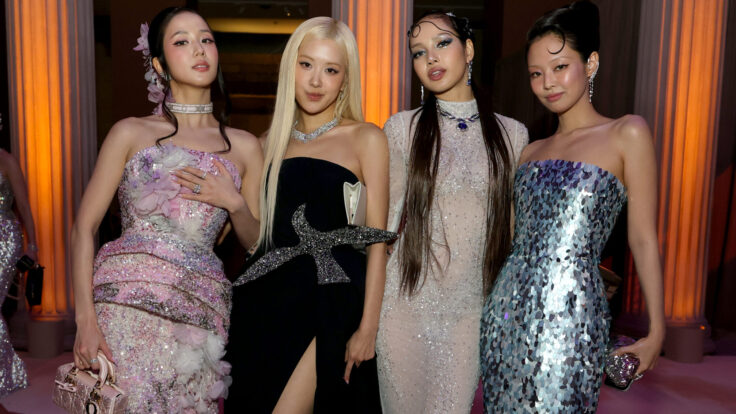
and $51.6 million on Chinese social media platform Weibo, thanks to partnerships with Asia Pacific talent such as Orm Kornnaphat, Lingling Sirilak Kwong, and Blackpink’s Jisoo. The engagement spike feels great—at least until you glance at the comments and realize that almost all of the attention is on the stars rather than the brands they’re promoting.
Sure, hand-wavy metrics like earned media value and media impact value (M.I.V.) can help
justify the enormous budgets behind runway shows, celebrity appearances, and ambassador deals. (Jisoo’s Dior ambassadorship, for example, is estimated to earn her between $10 million and $20 million annually.) But media value is obviously not the same as retail value. So how much of that attention is actually converting into sales?
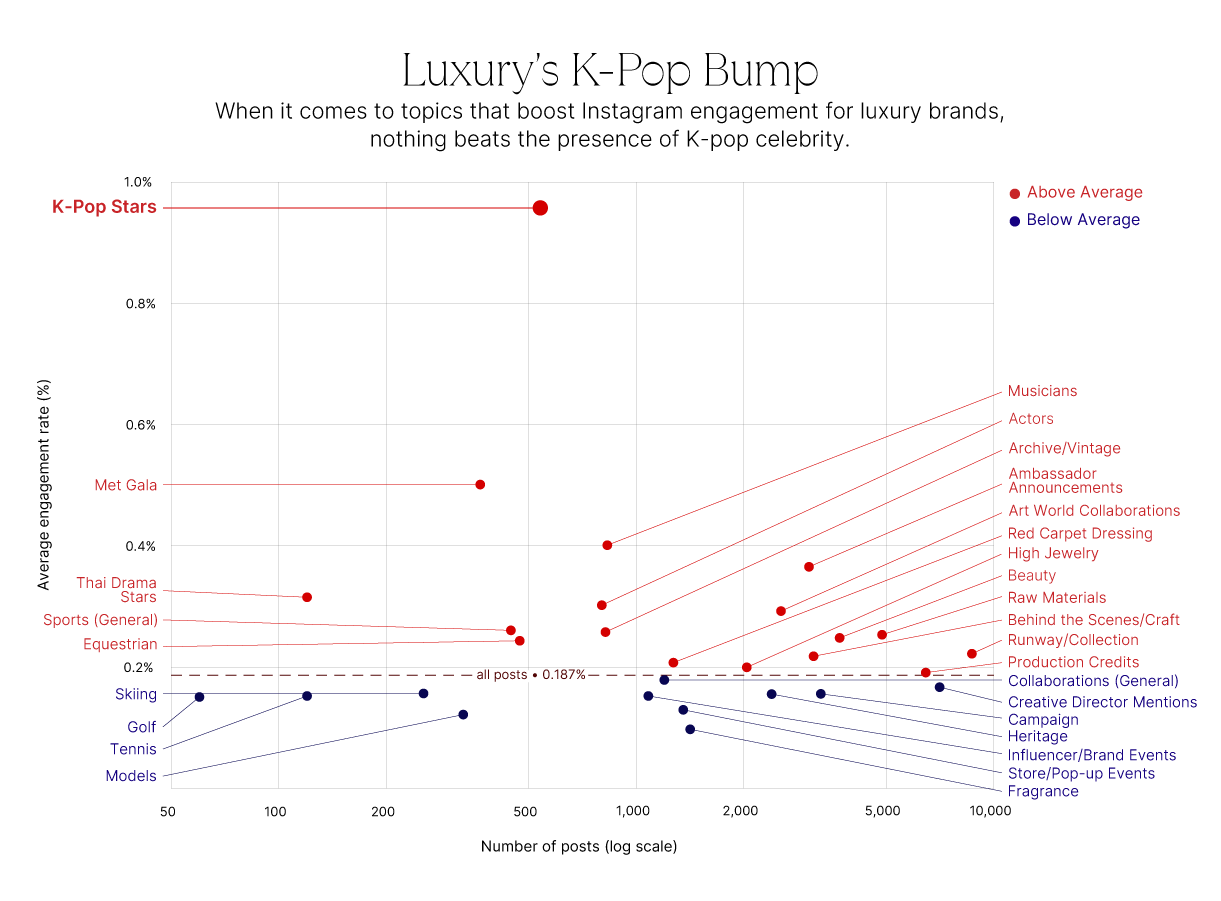
I recently pulled some data for a little clarity on the true efficacy of these ambassadorships, and uncovered that the posts featuring a K-pop celebrity
averaged a 1 percent engagement rate—calculated as total post engagements divided by total follower count. That’s actually not bad: The average engagement rate across all posts in my analysis was just 0.2 percent. K-pop engagement also sat well above the rates for other types of celebrity posts, which averaged between 0.2 percent and 0.3 percent. As expected, K-pop stars also dominated earned media value and media impact value rankings.
|
When K-pop partnerships do produce public sales, however, they tend to be limited releases
customized to the star, and relatively accessible. The South Korean singer and actor Jennie Kim, from Blackpink, developed a Calvin Klein capsule that reportedly sold out in one second and generated $8.6 million in M.I.V. Vogue Business also noted
that her Gentle Monster collaborations have consistently sold out. Meanwhile, her bandmate Rosé’s Tiffany Lock Rosé Edition, a capsule inspired by the star, sold out within minutes of release.
The same logic holds as you dip even further below luxury pricing: G-Dragon’s PEACEMINUSONE x Nike sneakers, customized around his signature daisy logo and retailing around $180,
sold at roughly three times the retail price on the Korean resale market. (His earlier Air Force 1 Para-Noise collaboration reportedly
sold out within hours.) Another recent example is Jung Kook’s Calvin Klein capsule: The brand launched the capsule in May, and management called it the most successful collaboration to date,
citing 99 percent sell-through on Tmall in China and a complete sellout at the Los Angeles pop-up. Parentco PVH even discussed it during their latest earnings call. Indeed, K-pop partnerships actually perform best when the product is near-entry luxury—think eyewear, fragrance, small leather goods, charms, sneakers, caps, and jewelry
capsules. The effect is compounded when fans can instantly identify the item and the connection with the star: Jennie designed this, Jung Kook wore this, Rosé inspired this, etcetera.
|
Despite those lucrative endorsements and all the attendant buzz around them, however, there’s not enough
evidence to suggest that K-pop stars convert luxury consumers. In my own perusal of EDITED Retail Data, which names the products being stocked and selling out across retailers worldwide, the picture was much less conclusive. When I looked at products
promoted by K-pop stars, there wasn’t any reliable sellout spike that jibed with social media trends.
Take the fandom-generated excitement around the butter yellow Chanel Preppy Coco bag that Kim
wore to Chanel’s Spring-Summer 2026 show. After she wore the bag in October, the sellout rate had risen only from 1 percent to 2 percent by December—basically negligible when you consider how Blazy-mania increased the sellout rate for yellow Chanel bags to 7 percent back in May. There are similar patterns within the data. Jimin of BTS was
spotted wearing the Dior Normandie tote in February, but the sellout rate declined from 40 percent in October 2025 to 17 percent this May—despite all the fan videos claiming that everything these stars wear
sells out for the brands.
The absence of a visible EDITED sellout spike doesn’t prove that fans didn’t buy. Luxury sales can also happen through boutiques, regional allocations, waitlists, clienteling, duty-free, brand D.T.C., or private appointments. But it does suggest that the story is more complicated, and the R.O.I. far less conclusive, than many marketers would like to believe. In this sense, K-pop stars are more like distribution infrastructure: They can max out the
metrics you need to report back to your C.E.O., but whether that attention translates to revenue depends on whether the brand has given the fandom something to grasp on to.
|
The E.U. is doing all it can to minimize Chinese-imported fast fashion in the region.
[Financial Times]
Embattled Harvey Nichols will be sold to Frasers Group, Next, or Modella. [ Sky News]
Primark is going on a price-cutting spree.
[ Reuters]
Phoebe Philo will always be fashion’s top choice. [ Magasin]
Yael Aflalo is still a Net-a-Porter
girl. [ WWD]
|
Until tomorrow,
Lauren
P.S.: We use affiliate links because we are a business. We may make
a couple bucks off them.
|
|
|
|
Puck’s daily art market email, anchored by industry expert Marion Maneker, offers unparalleled access to the mega-auctions and
galleries, elite buyers and sellers, and the power players who run this opaque world.
|
|
|
|
Join Emmy Award-winning journalist Peter Hamby, along with the team of expert journalists at Puck, as they let you in on the
conversations insiders are having across the four corners of power in America: Wall Street, Washington, Silicon Valley, and Hollywood. Presented in partnership with Audacy, new episodes publish daily, Monday through Friday.
|
|
|
|
Need help? Review our
FAQ page or contact us for assistance. For brand partnerships, email ads@puck.news.
You received this email because you signed up to receive emails from Puck, or as part of your Puck account associated with {{customer.email}}. To stop receiving this newsletter and/or manage all your email preferences, click here.
|
Puck is published by Heat Media LLC. 107 Greenwich St., New York, NY 10006
|
|
|
|
|