 |
|
Hello, and welcome back to The Best & The Brightest, your Tuesday foreign policy edition.
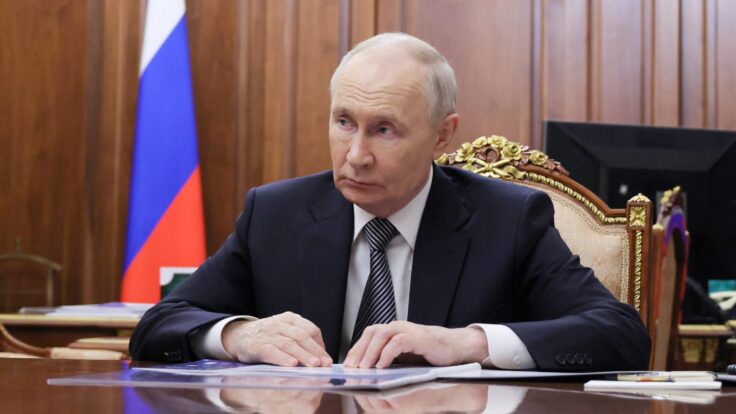
Last week exploded with the most shocking non-surprise in a while: Yevgeny Prigozhin, head of the Wagner mercenary group and the infamous troll farm at the center of Russia’s plot to interfere in the 2016 presidential election, was blown out of the sky just after leaving Moscow in his private jet. His demise was something we all knew was coming after his half-baked mutiny failed—Vladimir Putin has always made clear how he feels about traitors—but the manner in which it happened was nevertheless quite extraordinary.
Earlier this summer, I spoke about Putin to C.I.A. Director Bill Burns on the sidelines of the Aspen Security Forum and he told me that, though he’s always thought Putin to be a better tactician than strategist, “he’s lost some of his tactical finesse.” Well, looking at the way that plane plumb-lined out of the sky in the middle of the Russian analogue of Pennsylvania, I couldn’t help but think that Putin had gotten some of his tactical mojo back.
More on the post-Prigozhin plane-falling fallout in a minute, but first, some quick intel from Abby Livingston on Capitol Hill…
|
| Impeachment Storm Clouds & Shutdown Tea Leaves |
|
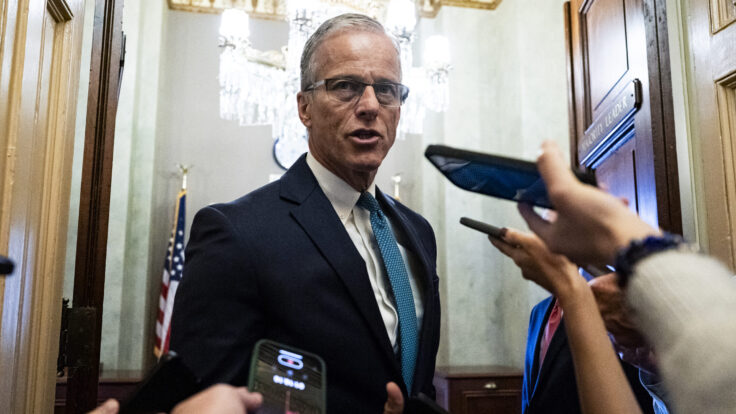
- McCarthy’s Mission Creep: August recess is typically when the summer’s most fiery debates begin to cool off. But that’s not the case this year, as Kevin McCarthy inches closer toward greenlighting the impeachment of Joe Biden. After describing a Biden impeachment inquiry as “a natural step forward,” CNN is now reporting that House Republicans could move on this as soon as late September, on the eve of an expected government shutdown.
Gauging the course of the impeachment effort is difficult, given how geographically separated Republican members are during the recess. The current knitting circle conversations are likely unfolding over member text chains, rather than the Capitol cafeteria. The first real test for the seriousness of this movement—including over the inevitable pushback from vulnerable members who represent districts that Biden carried—will likely be the first House G.O.P. conference meeting during the second week of September. This is always the party’s most restive annual gathering since members return to town saddled with six weeks’ worth of constituent feedback.
- Shutdown Tea Leaves: Meanwhile, several congressional staffers tell me, there is widespread acceptance that a shutdown is inevitable. Some member offices are even planning October travel around the assumption that they’ll be needed in Washington for weekend votes. Of course, it’s fairly routine for the Hill to fret in August about an October shutdown—but this acute level of certainty is not the norm.
One plotline worth tracking ahead of a shutdown is the propriety of hosting fundraisers. During the 2013 shutdown, campaign trackers followed members who attended D.C. fundraisers, and vulnerable incumbents were pilloried for raising money when the government couldn’t even keep its doors open. That dynamic could be heightened this year, among concurrent battles over defense spending authorization and an increasingly troubled Farm Bill.
My early read is that there will be less agonizing this fall over whether fundraising is in good taste, especially after plenty of Republicans brushed off public health concerns to host campaign events during the pandemic. Four years of Trump’s etiquette-breaking may have raised D.C.’s tolerance, too. But as one senior Hill staffer told me, so much is uncertain until a shutdown actually happens, and there’s a clearer sense of how it’s playing beyond Washington.
|
|
|
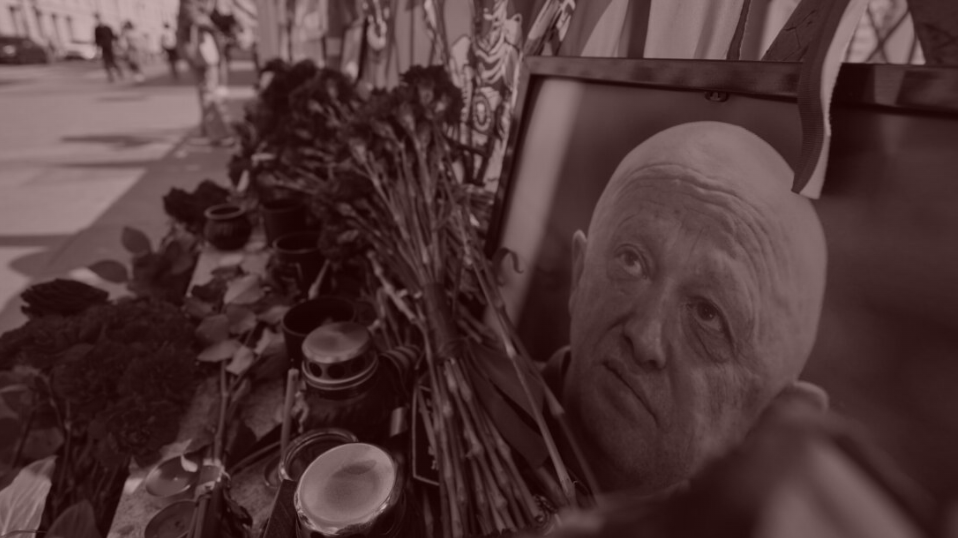
| On the day of Yevgeny Prigozhin’s funeral, journalists spotted his hearse at the Manege of the First Cadet Corps, a classical, Easter-yellow building on one of St. Petersburg’s famous embankments. The gate was blocked by a refrigerator of a man in a black leather jacket and black sunglasses. The building was closed, according to the security detail, “for a private event.” The details of when and where Prigozhin would be buried had been hard to find. The Kremlin was unsurprisingly tight-lipped except to say that Vladimir Putin would not be attending.
By Monday, journalists in St. Petersburg discovered that metal detectors had been installed at the Serafimovskoe Cemetery, where Putin’s parents were buried, and everyone thought that this would be the site of Prigozhin’s interment. Until Tuesday, when three hearses that looked just like the one at the Manege were spotted at a different St. Petersburg cemetery, the Beloostrovsky. They were there with a black BMW bearing the same license plate as a similar car the mercenary boss had used back in the day. But then another BMW, with the same license plate, was spotted at River Palace, the luxury hotel associated with Prigozhin.
Meanwhile, mourners, some bearing Wagner insignia, streamed into a third cemetery—Severnoe—where the national guard was working the perimeter. Someone spotted Prigozhin’s bodyguard, who had somehow not been onboard the doomed Embraer jet. A coffin arrived, but it turned out to bear the remains of Valery Chekalov, one of the Wagner commanders who was with Prigozhin at the time of the crash. Back at Serafimovskoe, TV cameras and a drone flying overhead watched as K9 units patrolled the area and a Wagner hearse pulled in, rumored to be carrying Prigozhin’s body.
Then came the announcement, from Prigozhin’s press service. “Yevgeny Vikotorovich’s funeral took place in a private setting,” it read. “Those who wish to say goodbye can visit Porokhovskoye Cemetery.” While everyone had been chasing hearses around St. Petersburg, Prigozhin had already been buried—next to his father, surrounded by a few dozen friends and family members. It was a fitting end for a man who had a dozen aliases and lived his life on the run.
Though Prigozhin had been a Hero of Russia, the country’s highest military honor, there was no honor guard, no military salute. State television largely skipped over his burial. All he got was police, some bearing anti-drone rifles, densely stationed around the cemetery’s perimeter, blocking anyone who would dare to enter. Among the red roses on the fresh mound of Prigozhin’s grave, someone had left the poem of another son of St. Petersburg, the Soviet dissident Joseph Brodsky, about the Virgin Mary trying to understand if Jesus had been her son or her god, if he was dead or alive. “Dead or alive, woman,” it read, “it’s all the same.” |
| “Everyone Is Already Scared” |
|
| Nearly a week has passed since Prigozhin fell out of the sky and the Moscow elites are still reckoning with what it means for them. Some of them, as I wrote last week, understood the message from Putin quite clearly: If you betray me, I will punish you. “They will all be nullified,” one Moscow friend explained, using the Wagner term for killing someone, “regardless of their closeness [to Putin] or level of trust.”
But the Russian elite is not monolithic. As this friend put it, “The old elite has long ago stuck their tongues in their asses,” using the Russian slang for shutting up. “The siloviki, who are actually in charge, are getting ready to steal all their assets in the coming chaos.”
The old elite are the ones that were called liberals. That is, within the Putinist structure, they were relatively liberal politically: they believed in changing the system from the inside, were classically liberal in terms of economic policy, and oriented toward integration with the West. Naturally, they have been gradually sidelined since the initial invasion of Ukraine, in 2014. After the full-scale war began, they became irrelevant in terms of decision-making power and live in constant fear. Earlier this year, I asked one prominent member of this elite for an interview and this person said that, because they and their family still live in Moscow, “I will not talk to you about anything, not even the weather.”
When I called another member of this old elite, now on vacation in the West, they were scathing in their assessment of Putin’s “crumbling czardom”—a disaster and embarrassment whose end, they hope, is nigh. And they know that many of their friends and acquaintances feel the same, though it’s hard to tell exactly how many. “Many are scared, others are protecting their relatives and themselves,” the source said, “so it’s hard to say how widespread it is.”
“There are lots of conversations but they won’t lead to anything because if you come out and say ‘Ah,’ you know what will happen to you,” this former Kremlin liberal told me. “It won’t be as extreme as what they did to Navalny, but you understand. No one wants to end up under the steamroller. Only kamikazes want to do that.” I asked this source if they thought Putin blasting Prigozhin out of the sky was a lesson to the elite. “It’s not a lesson,” the liberal said. “No one was scared of this, because everyone is already scared.” |
|
|
| Another member of the elite told me that, despite their personal preferences, there was even some satisfaction in Prigozhin’s demise. It was reassurance that, as the Kremlin liberal put it, “the machine still works.”
“If you’re talking about the foreign policy elite, their opinion of [Prigozhin] is highly negative for reasons you understand,” said another source, a Moscow insider. “Neither his style nor his methods appealed to them, these people who are liberally inclined—not in the sense of wanting to give in to the collective West, but in the sense of wanting institutes and brakes. What I don’t hear is that this makes Putin look bad. Why was Prigozhin flying around on his private jet and showing up at the summit of African leaders? It created the wrong impression of Russian power.”
This person continued at length: “The idea that Prigozhin acted the way he did—that he played such an active and externally notable role—it was important to do something with him, especially since it was seen abroad as weakness and a crisis of power. Many people around me say that if he had behaved himself a little more modestly, then it’s possible he wouldn’t have had any problems. But he behaved provocatively—especially after the mutiny. He put Putin in a very uncomfortable position, he put the government in a very uncomfortable position, he put the military and General Staff in a very uncomfortable position.”
This source, whom I’ve known for years, was uncharacteristically circumspect, even hesitant in speaking about Prigozhin’s death—who was behind it, how it happened, and so forth. They crab-walked into every answer, sprinkling in scores of caveats and disclaimers. But they did manage to distill Putin’s conundrum. “People are asking, does this benefit the Kremlin? No one thinks the Kremlin wants to shoot people in a plane down on their own territory,” the insider said, using the cui bono analysis so endemic to Russian thinking. “But sometimes, there are no good options, and you have to do what you have to do.”
Others, like Christo Grozev of Bellingcat, believe that any future mutiny will be one led by the siloviki, possibly in cooperation with the oligarchs. “The takeaway is that the next putsch cannot be half-baked and reactive,” Grozev said. “The next person who does it must have planned it all the way to the offices of the Kremlin, because they know otherwise they will be dead.” And because Grozev accurately predicted, here in Puck, when the Wagner mutiny would take place, I asked him when we could expect the next one. “I expect some major confrontation to come in October, November,” he said. “The elites fear they can be next, they feel they need to act now. The fear of being purged is what will drive it. But they also need to prepare, so that’s what I base my timeline on.”
But Grozev cautioned the wishful thinkers in the West who hope that a putsch against Putin would end the war in Ukraine. “Unfortunately, the people who I’ve talked to, the insiders, they’re saying don’t hold your breath about an anti-war coalition taking power,” Grozev said. “Whoever comes to power will feel obligated to continue the war because of the ingrained belief that if we lose the war, Russia will disintegrate. Even those that hate that Putin started the war don’t want to be responsible for Russia’s disintegration.” |
|
|
| Of more proximate concern, as after the death of any wealthy person, is the fight over the estate. What will happen to Wagner? What will happen to the troll farm and the African countries that Wagner was able to secure as clients? Will Wagner continue to exist under new management or will it be scrapped for parts? “I think the latter,” said Grozev. “The name is so toxic and personally offensive to Putin that he would want it to be dissolved immediately.”
That said, the divvying up of assets has been playing out largely in the open for the last two months, ever since Prigozhin launched his ill-fated march on Moscow. Prigozhin’s media properties, under the umbrella company Patriot, have already been on the chopping block. At one point, it seemed Putin buddy and one-man state media holding company Yuri Kovalchuk would buy it. Then Prigozhin decided to dissolve it rather than let it fall into someone else’s hands.
As for the infamous “troll farm,” a.k.a. the Internet Research Agency, which was named by Robert Mueller as having tried to influence the 2016 election, it will likely be closed, too. “It’ll be easy to find a new owner,” said Roman Dobrokhotov, who runs the investigative reporting outlet, The Insider. “Or you could just dismantle it and no one would notice because there are so many other troll farms already. Every governor has his own troll farm, the presidential administration has one, too.”
Dobrokhotov had an interesting response, by the way, to the opinion voiced by some Russia observers that Prigozhin was taken out not because of his treachery, but because someone else wanted his business. “That’s a theory, but from everything I know about Putin’s world, the money is always secondary,” Dobrokhotov explained. “The primary thing is power and politics. It’s not if you have money you have power. It’s if you have power you have money. It’s never the opposite.” The money, which is taken as profits skimmed from companies whose operating expenses are covered by the federal budget—“the babushki,” as Dobrokhotov put it—is there to secure people’s loyalty, so that Putin can stay in power. “Putin allows people like Kovalchuk and Prigozhin to earn and secure their loyalty,” he explained. “Putin doesn’t need money. He doesn’t spend it. He already has everything he wants.” |
|
|
| The real Prigozhin bounty is the African market, where Wagner helped Russia “capture” various states, like Libya, Mali, and the Central African Republic. “State capture” is polisci speak for infiltrating a country and rendering it dependent on an outside actor. In these cases, these African states have become so dependent on the mercenary company for security that they have become de facto colonies of Moscow.
But even before Prigozhin’s death, the G.R.U., or Russian military intelligence, had been moving in and squeezing Prigozhin out as punishment for his mutiny. On the day of his death, Prigozhin had just returned from Africa, where he had been pleading with leaders to keep his services instead of the G.R.U.’s—which, according to Grozev, had sent their emissaries at the exact same time.
It seems that Andrey Averyanov, a notorious G.R.U. general, has been tapped as the new boss of the African side of the business. In July, he sat at the same conference table as Putin during the African summit in St. Petersburg and introduced himself to the African delegation. That said, Grozev and Dobrokhotov believe that the responsibility for that business will be spread out in order to prevent another mercenary boss from accumulating too much power—and getting crazy ideas in his head.
From the Kremlin’s point of view, however, the business was never really Prigozhin’s to begin with. Wagner had been a G.R.U. project. Wagner fighters trained on G.R.U. bases and were often armed and commanded by the G.R.U. It’s a reminder that nothing in Russia ever really belongs to you. You own something until the state decides to take it away. Prigozhin was just the manager until he proved himself untrustworthy. |
|
|
| That’s all from me—unless Putin decides on another surprise. I’ll see you back here next week. Until then, enjoy the Labor Day holiday.
Julia |
|
|
|
| FOUR STORIES WE’RE TALKING ABOUT |
|
|
|

|
 |
|
|
|
Need help? Review our FAQs
page or contact
us for assistance. For brand partnerships, email ads@puck.news.
|
|
You received this email because you signed up to receive emails from Puck, or as part of your Puck account associated with . To stop receiving this newsletter and/or manage all your email preferences, click here.
|
|
Puck is published by Heat Media LLC. 227 W 17th St New York, NY 10011.
|
|
|
|