Welcome back to Dry Powder. I’m William D. Cohan.
In tonight’s issue, a
look at the next chapter for Comcast and NBCU after the split announced on Monday. Will both halves become M&A targets? Will Comcast merge with Cox/Charter to create a national broadband behemoth? Will Netflix snap up NBCU after losing Warner Bros.? Perhaps, but I tend to believe Brian Roberts when he says the two companies aren’t for sale—especially after what he went through to pry NBCU loose from GE 15 years ago. More on this below…
Also mentioned in this
issue: Michael Saylor, Jim Chanos, Peter Schiff, Mike Cavanagh, Mike Angelakis, Jeff Immelt, Barry Diller, John Malone, Bob Iger, David Zaslav, and more.
But first… |
- Strategy
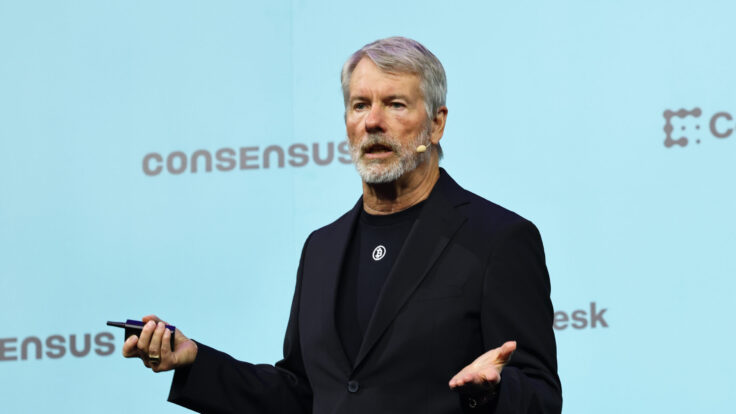
has announced a new… strategy!: Until Monday, Strategy’s Michael Saylor had been all about HODLing the company’s hoard of 847,363 Bitcoins—as in, Holding On for Dear Life to each and every one and never selling. Saylor, of course, has long been the ultimate Bitcoin maximalist and one of its most prolific evangelists. Alas, all that ended this week when the company announced in a filing with the S.E.C. that it had initiated what it is euphemistically calling a BTC
Monetization Program, wherein the board of directors has authorized the company to sell Bitcoin for three purposes: to generate up to $1.25 billion to fund its reserves, to finance preferred stock dividends and interest payments, or to fund purchases of the company’s common stock.
Needless to say, this was big news in Bitcoin land, despite Saylor’s June 1 sale of 32 Bitcoins, for around $2 million, which was intended to alert the market that Strategy had begun to reverse course.
But as I reported last week, Strategy is in a tough spot these days. Saylor paid an average of $75,000 for his Bitcoins, which are now worth nearly $60,000 each—meaning that his $49 billion stash is about $13 billion underwater. And the market is no longer buying the narrative that Strategy should trade at a premium to its net asset value. (Congrats to
Jim Chanos on his premium compression short play.) On Monday’s news, Strategy’s stock fell 8 percent and is now down 75 percent in the last year.
It makes you wonder what’s next for Bitcoin, which is already down more than half since its October 2025 peak. Peter Schiff, one of Saylor’s most outspoken critics, took a
victory lap on X this week: “If Bitcoin was that weak with Strategy buying $17B, imagine how much weaker it will be with Strategy selling.” A good point, indeed.
|
|
|
|
Both David Zaslav and Bob Iger considered splitting up their entertainment conglomerates,
though neither ultimately went through with it. Will Brian Roberts actually go all the way? |
|
|
|
On Monday, shortly after Comcast announced its plan to sever its media and technology businesses, spinning
off NBCUniversal and Sky, I hopped on a call with the company’s top executives to understand their logic firsthand. Naturally, the market had reacted positively to the news, with the stock rising as much as 20 percent before ending the day up around 6 percent. Comcast, after all, has had somewhat of a rough go over the past several years: There’s more competition than ever on the broadband side of the business, cord-cutting and declining viewership have eroded the value of NBCU’s linear TV
assets, Peacock is still losing money, and the synergies between the units aren’t what they used to be. Clearly, something had to be done.
Presumably, the market reaction was driven in part by the expectation that the announced split was actually designed to elicit a bidding process for one or both halves of the company—just as when Warner Bros. Discovery set out to break itself in two and ended up being swallowed whole by Paramount Skydance. But on my 12-minute call
with top Comcast executives, I was assured that’s not the plan.
It was a point that patriarch Brian Roberts and co-C.E.O. Mike Cavanagh had made earlier in the day on a call with Wall Street analysts, replete with the usual programmed questions, about whether the split will result in “potential strategic opportunities” for the spun-off entities. “Absolutely not,” Brian answered. “Definitely not,” added Cavanagh. Of course, Cavanagh then proceeded
to say he wanted NBCU to “build and invest for growth” and touted “the ambition … to pursue opportunities that keep us ahead” and “the freedom now to explore adjacent businesses.” So which is it guys? Deal or no deal? |
“We’ve Made a
Lot of Money”
|
To help illuminate their strategic vision, Brian and Mike offered up some historical context behind Comcast’s
original logic for acquiring NBCU. “When we acquired NBCUniversal more than 15 years ago, the industry looked very different,” Brian explained to the analysts. “At that time, the cable networks were widely viewed as the center of value creation and represented a strong strategic fit with our existing business. At the same time, we saw the potential of a broader media and entertainment platform and invested accordingly, expanding our studios, theme parks, sports, news, and international
businesses, including Sky.” Added Cavanagh, “Where we previously believed that scale and the diversification benefits warranted operating these businesses as one company, we’ve now simply changed our mind about that.”
You can say that again. In my 2022 book about the rise and fall of GE, Power Failure, I documented Brian’s relentless 10-year campaign to get then GE C.E.O. Jeff Immelt to sell NBCU to Comcast. Roberts and Comcast’s Steve Burke, who
was in Immelt’s class at Harvard Business School, played golf and dined with him regularly to ensure Comcast was top of mind. At one dinner at 30 Rockefeller Plaza, relatively soon after GE had bought parts of Universal from Vivendi, Brian told Immelt directly that he wanted to “buy NBC.” But Immelt told him that GE would never sell. Afterward, Roberts was devastated, but Burke told him not to worry and to bide his time.
Burke was right. In the midst of the 2008 financial crisis, when GE
was in danger of going down the tubes because of the near-bankruptcy of GE Capital, Immelt made the fateful call. Roberts scooped up NBCU without an auction, in a two-step deal that valued all of NBCU at around $30 billion—a relative bargain. Roberts took Immelt to the cleaners on that one.
It’s probably fair to say that NBCU was once worth $100 billion, back when it made nearly $10 billion of EBITDA, in 2019. It’s certainly not worth that anymore, considering that all of Comcast
is worth only $85 billion. (Peter Supino, at Wolfe Research, pegged NBCU’s value at $44 billion, or 9x 2027 EBITDA of $5.6 billion.) Still, the NBCU deal has been a great success for Comcast, which was able to get around $10 billion for its stake in Hulu alone—about one-third of what it paid for NBCU altogether. “We’ve made a lot of money,” one Comcast executive told me yesterday about the NBCU deal. “I think we’ve done right by the shareholders.”
Alas, I’m
certain that Roberts felt he had little choice but to move on, given how poorly the Comcast stock has performed in the past year—down roughly 30 percent before Monday’s surprise announcement. Roberts, one of the great media dealmakers of all time, was also effectively sidelined in the battle to acquire all or part of WBD because of Comcast’s weak stock price and some $85 billion of net debt. Those two sobering facts no doubt played a part in the decision to spin off NBCU and Sky into a new,
publicly traded company led by Cavanagh, who has been running NBCU since the defenestration of Jeff Shell three years ago. That will leave O.G. Comcast—the cable, internet, and wireless company with 30 million subscribers—as a stand-alone in the hands of former Comcast C.F.O. Mike Angelakis, who will return as C.E.O. |
Both Mikes have worked with Roberts for years, and he no doubt trusts them completely to steer his family’s
assets for the foreseeable future. On the call with Comcast executives, I was assured that Brian intends to remain “actively involved” with the two businesses, as the controlling voting shareholder of both Comcast and NBCU. But the breakup of Comcast into a media company and a broadband company is also a management succession story, and a damn impressive one, given the quality of the two executives Roberts has tapped. (I have known Angelakis for years, since he was a partner at Providence
Equity. Angelakis had a big role in negotiating Comcast’s initial purchase of NBCU from GE.)
Could the selection of Cavanagh and Angelakis to run the two companies belie Roberts’ true intentions for the assets? Who knows? As my partner Matt Belloni pointed out, Cavanagh “has been running the media business without prior
operational experience at a media company but lots of experience doing corporate transactions.” Angelakis, who previously left Comcast to launch Atairos, a small private equity firm, also has experience with these sorts of transactions. Certainly the media landscape is littered with examples of entertainment companies that talked about splitting themselves up and never did: You may recall Bob Iger’s somewhat fateful interview, three years ago now, with Dave
Faber on the side of a hill in Sun Valley, where he first floated the possibility of spinning off ABC and ESPN. That never happened, of course.
Likewise, a year ago David Zaslav announced the spinoff of WBD’s cable assets from its streaming assets. In retrospect, that announcement merely put the company into play—which may have been Zaz’s plan all along—and resulted in the process of Netflix, Comcast, and the Ellisons’ Paramount Skydance
competing for the company. (Comcast, for its part, never really had a chance in the WBD process, which must have been frustrating for Roberts, given his prowess as a dealmaker. I saw that firsthand 25 years ago while working on the deal for AT&T Broadband, a subsidiary he succeeded in prying out of AT&T despite its not being for sale.)
Supino, for one, isn’t buying what Roberts and Cavanagh are selling. In a note to investors on Monday, he predicted that the company would not, in fact, be
split up. “We believe the breakup plan is strategic to Comcast because it is a legitimately good idea that also strengthens Comcast’s negotiating position with partners who will not want to wait one to two years for an otherwise completed spinout to ‘season’ for tax purposes,” he wrote. He suggested that Charter/Cox could go after the broadband business while Netflix, and maybe Disney, Amazon, and Apple, could go for NBCU, with obvious problems associated with those potential
deals.
Supino was also surprised—as was I—by the laconic nature of such a big and transformative announcement, since it pretty much means the end of the Comcast behemoth as we’ve known it. “A generational conglomerate tracing honored family lines does a strategic 180-degree turn which includes the almost unmentioned resignation of its scion C.E.O., and all we got was 25 minutes with no slides and no open Q&A,” he wrote. Yes, Peter, that was very weird.
Honestly, after what Brian
went through to get NBCU in the first place, I was pretty shocked that he’d made the decision to part with it. But things have changed since he bought NBCU, and I’m sure he enjoys watching and helping his chosen executives succeed. At one point during my call with the Comcast executives, the names of fellow media titans John Malone and Barry Diller came up. It seemed like a telling and perhaps fateful reference. Malone, who is 85, seems to be winding down his
ambitions. Diller, who is 84, remains tireless. He wants to get his hands on CNN, if somehow the Ellisons are forced to sell it. Will Brian take after Malone? Or Diller? Wall Street is still waiting on, and guessing at, his answer. My bet is that Brian—still two decades younger than either man—has a few more acts left before retirement beckons. |
|
|
|
Join Puck’s chief political columnist, John Heilemann, as he roams the corridors of power and influence in America on this
twice-weekly interview show, taking you beyond the headlines with the people who shape our culture: icons and up-and-comers, incumbents and insurgents, moguls and machers in the overlapping worlds of politics, entertainment, tech, business, sports, media, and beyond. The conversations are rich and revealing, unrehearsed and unexpected… and reliably impolitic. A Puck-Audacy joint, new episodes drop every Wednesday and Friday. |
|
|
|
An essential, insider-friendly Hollywood tip sheet from Matthew Belloni, who spent 14 years in the trenches at The
Hollywood Reporter and five before that practicing entertainment law. What I’m Hearing also features veteran Hollywood journalist Kim Masters, as well as a special companion email from Eriq Gardner, focused on entertainment law, and weekly box office analysis from Scott Mendelson. |
|
|
|
Need help? Review our
FAQ page or contact us for assistance. For brand partnerships, email ads@puck.news.
You received this email because you signed up to receive emails from Puck, or as part of your Puck account associated with {{customer.email}}. To stop receiving this newsletter and/or manage all your email preferences, click here. |
Puck is published by Heat Media LLC. 107 Greenwich St., New York, NY 10006 |
|
|
|
|