 |
|
Happy Monday, and welcome back to Line Sheet, which’ll still be fresh in the morning, I promise. I hope those in London are closing out their Bank Holiday barbecuing—or what we call “grilling” in America, where it’s Memorial Day.
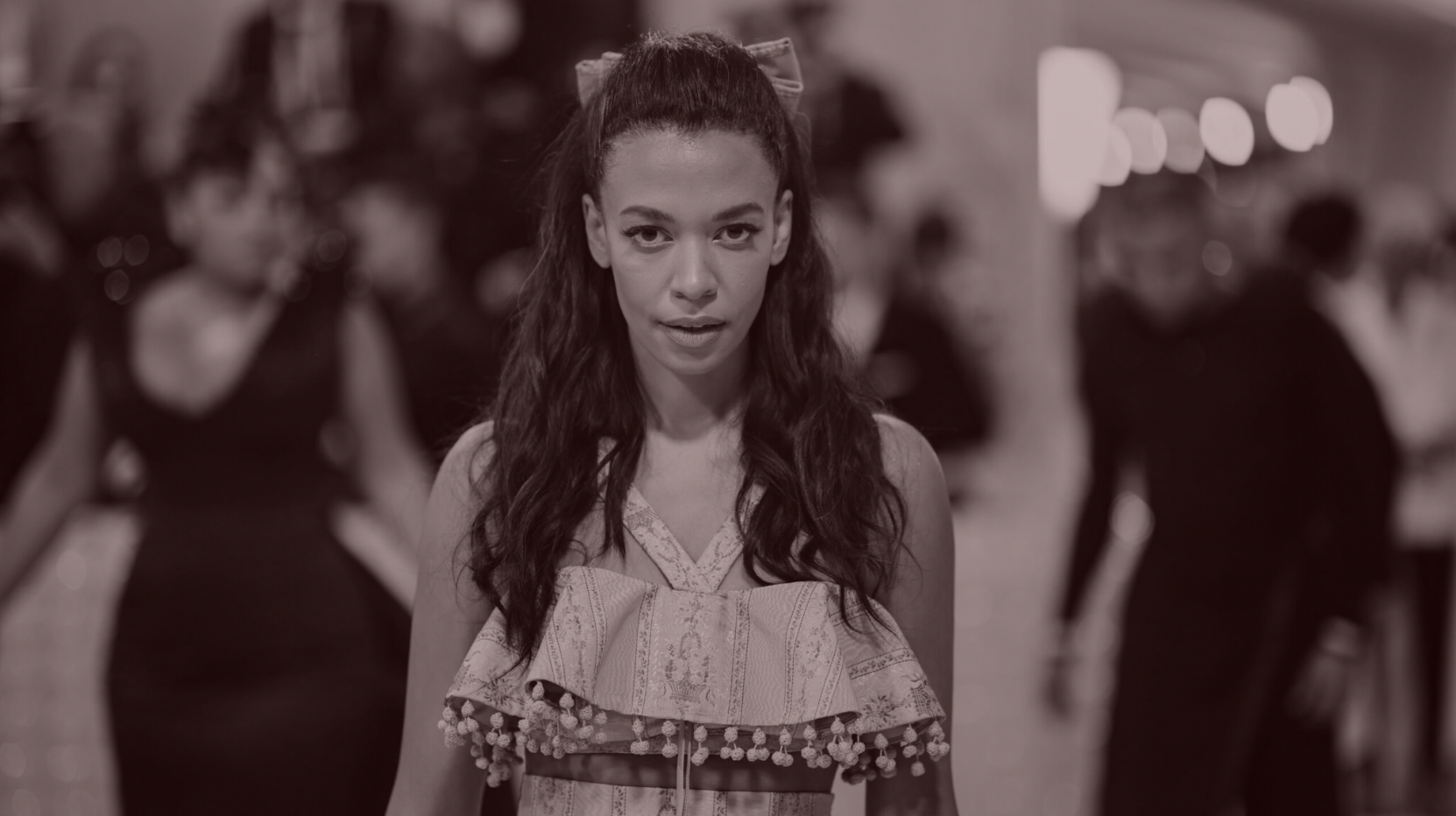
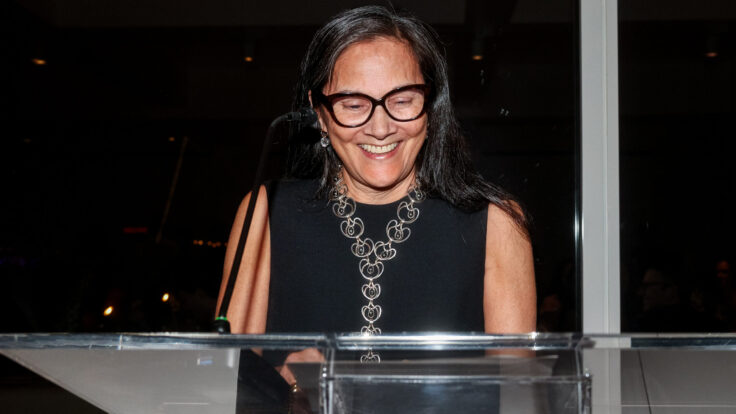
Today, I’m bringing you my conversation with Aurora James, the founder and creative director of Brother Vellies, a 10-year-old New York-based label known for its African-made shoes. Over the past decade, James has emerged as a person of influence, and not only in the fashion industry. With the launch of the 15 Percent Pledge, conceived at the height of the pandemic, she also became a person to watch in the wider world, advocating that every retailer devote 15 percent of their shelf space to Black-owned businesses.
James recently released a memoir, Wildflower, which frankly documents both the dark corners of her personal life and the challenges of running a fashion business as a woman of color here in the U.S. She and I spoke about all of this and more, including the newish controversy around the “Tax the Rich” dress she designed for Alexandria Ocasio-Cortez to wear at the 2021 Met Gala. One of the best words to describe James is “unfazed,” and I think our exchange reflects her general attitude about the fashion business and explains why she’s still bothering with it.
But first…
|
| A Final Word on Succession Fashion |
|
| Say what you will about the clothes themselves. (And many, many people have. I’m so tired.) My personal, if professionally informed, take is that they absolutely got the job done. The men’s looks were more regularly on point (an impeccable five-year advertisement for The Blue Suit, strategic layering and Coats); the women needed a different tailor, but I’ll never complain about the overuse of tasteful (what a loaded word) yellow gold jewelry, the color black, or super 150s tropical wool.
What I’d rather talk about is how fashion labels benefited from being on the show, and what it says about the future of brand placements. Typically, fashion brands don’t pay for these placements, just as they don’t (technically) pay for editorial placements in magazines. Today, I’d argue that, for brands, good TV spots are more effective.
It’s just a matter of where the culture has moved. Print publishing was declining as the impact of television on consumer fashion trends was rising in the late 1990s and the early aughts, particularly with Sex and the City. (Remember that the September 2007 issue of Vogue was the largest magazine ever published.) Loro Piana’s recent full-page advertisement in the New York Times was pretty clever, but I bet that being the brand of choice for Kendall Roy has had a bigger, if difficult to measure, impact. (Ugh, I really loved the piping on the pockets of that $8,895 cashmere-blend overcoat he wore in the last two episodes.)
Sure the trad players—Ralph Lauren, Brunello, Tom Ford—appeared frequently, but costume designer Michelle Matland also featured lesser-known, mid-priced brands like Lafayette148 (Nan Pierce’s stripes in S4E1), L'Agence (Jess Jordan’s chain-link blouse in S3E6) and Gerard Darel (Rana’s plaid coat in S4E9). Youngish American designers including Altuzarra (one of Shiv’s many grey suits; S4, E2), Proenza Schouler (Naomi Pierce on multiple occasions), and Sergio Hudson (Kerry, S4E1) had moments, too.
I just can’t think of another time when such a large swath of consumers would get so much exposure to so much fashion. Of course, the big problem is that you have to look up where the product is from, and most people are too lazy to do that. (@Successionfashion, one of my favorite Instagram accounts, only has 154,000 followers.)
There are, of course, ways to make it a part of the story: Emily in Paris, for instance, is about luxury marketing. (Sorry to all my French and expat friends who hate this show, but I’ll argue for eternity that it’s surprisingly accurate.) About a decade ago, technology firms tried introducing overlays that let you “shop the show.” They didn’t work. And yet, I do think there’s a big financial opportunity here, maybe years in the offing. Show budgets are dwindling. Brands need to sell more clothes. Let’s figure something out! |
|
|
| The first time I interviewed Aurora James was in 2015, at her store at the South Street Seaport, the touristy micro-neighborhood at the bottom of Manhattan that looks like it could be interchanged with any cobblestone historic district in any East Coast town. It was one of those situations where the developer had cleared out the uncool tenants and was offering young brands rent based on a portion of monthly sales, which helped to explain why James could afford a storefront for Brother Vellies, a shoe line she had launched just two years earlier. (At one point, Milan’s famous concept store 10 Corso Como opened a spot there, too. And like most retailers that come from a place other than New York City and try to open in New York City, it closed within two years.)
I was working on a story about the CFDA/Vogue Fashion Fund, following the finalists through the last months of the competition. James would be crowned one of three winners, earning a $400,000 prize. I had gotten to know the designers pretty well at that point, but these are the kinds of interviews where people toe the party line, so I was surprised when James admitted that she wasn’t sure if she was comfortable selling her shoes on Amazon Fashion, the e-commerce giant underwriting the whole thing.
In one way, I could see why she said it: as a journalism major in college and former intern at FashionTelevision, the long-running and beloved Canadian series, she knew how to generate attention. But, as a young designer, would she really want to piss off anyone with nearly half a million customers waiting in line?
James has made a career of pushing buttons—she has some naysayers, who believe that she only pokes the bear when it’s self-serving—and yet the end result is typically net positive. Last week, we connected to discuss her memoir, Wildflower, a book deal she secured in the midst of the pandemic, not long after launching the 15 Percent Pledge, a nonprofit that pushes retailers to devote 15 percent of their shelf space to Black-owned businesses. (Not every retailer that wants to sign the pledge is welcome, but some of the biggest on the list include Nordstrom, Sephora and Moda Operandi.) The book is about a lot of things—James’s life, mostly—but I was surprised by how deep in the weeds she went about the fashion business. So we got into that, and also about why she hasn’t talked to the House Ethics Committee investigating the “Eat the Rich” dress she made for Alexandria Ocasio-Cortez. (Condensed and edited for clarity, of course.) |
|
|
| Lauren Sherman: The first half of the book was so personal, but it also really goes into the depths of how the fashion industry works. How did you convince an editor or publisher that was the right way to do it?
Aurora James: I realized that, for any business decision I made to make sense [to the reader], you’d have to understand how I see the world and why I see it that way. Business is so personal, and yet people want to draw the line. It would have been really easy to write an inspirational business book that just, like, sold to a bunch of corporate partners. A “this is how you survive capitalism” sort of book.
Early on, when you talk about developing Brother Vellies, you mention wanting it to be called a “luxury” brand. Why was that so important to you?
Words shift meaning all the time, and then mean totally different things in different groups as well. My mom would say, “Are you speaking for yourself or are you speaking for your audience, because you have to choose your words appropriately.” For me, I was burdened by some of the appropriation stuff that was happening. And then seeing the care and the level of attention and detail and process and sourcing and everything that went into how we were making a lot of things. I was like, this is literally the African version of all of these videos that I’ve been force-fed out of Italy. The idea of luxury needs to be placed on the humans and the sourcing, and not just the marketing and the ad buys and the casting.
I didn’t know that you were at one point up for the creative director job at Edun, the clothing line Bono and wife Ali Hewson founded with the idea of producing the majority of goods in Africa. They sold a stake to LVMH in 2009, then it went through several designers before shutting down in 2018. I covered that brand from the beginning until the end.
I mean, what a hugely missed opportunity for them.
Well, they have a hard time developing smaller brands, no matter what. In the case of Edun, I think some of the stakeholders had the right idea, but not all of them. At this point, how much of what you make now for Brother Vellies is produced in Africa? You write extensively about many of the different countries you’ve produced in, and how challenging it has been. How has the way you manufacture evolved?
In the beginning, I wanted 100 percent of our production to happen in Africa, no matter what. And I remember one season [the African manufacturers] saying, “This is all too much pressure on us, because we’re still trying to teach a new batch of people how to use scissors for the first time.” And that’s when we started diversifying. There was also one point where that financial person that I talk about in the book said he was no longer funding any production in Africa.
Now, it’s style-specific. All of our vellies [the colloquial word for Veldskoen, the lace-up desert boot that inspired Clarks] are made there; all of our huaraches are made in Mexico; all of our babouches will be made in Morocco. And a lot of it is based in Italy now, too. So it ebbs and flows, but I really want to grow our Vellies business to become 30, 40 percent of the business—that’s what I’m focusing on in Q2, Q3 and Q4 of this year. |
|
|
| You aren’t afraid to call out big corporations, like Target, or executives who work at big corporations, in the book. You use a pseudonym when writing about one major financial executive, and I’m going to give you the courtesy of not naming him here. Why did you change his name? You’re not a person who is afraid of things.
I think because he likes attention.
Anyone who reads the book, who works in the industry, is going to know who you’re talking about.
Totally. Every person who asks me, “Is it him?” I’m like, Yeah, girl.
I’ve never heard anyone else say a bad thing about him. Well, a little bit, but mostly from people who haven’t taken money from him. For those who haven’t read the book, can you explain exactly what happened, and why it was such an important part of the story?
He was always around, that’s part of their job as a lender, to always be around. Before 2016, I always got deposits from our retailers. Nordstrom would give us a deposit, Moda Operandi would give us a deposit. They understood the nature of my business was artisan focused, and unless I give them money up front, they can’t even turn the lights on.
Deposits from major retailers were always super critical to me, especially because I started my business with $3,500 in a flea market. I think when people hear that, they don’t understand, ideologically, how that plays out. So when we ended up getting a purchase order from Net-a-Porter, and they were not able to give us a deposit or didn’t want to or whatever—you know, also tough for the businesses—I was $70,000 short.
I took a loan [from this dude], and it was called a pre-production financing loan. He wanted to back it against my CFDA/Vogue Fashion Fund money, which was way more than the loan was. And because he was always around and a de facto mentor to a program I was in at the time, I trusted it and it was the only contract I never gave my lawyer to look over.
In the end, it ended up costing me a million dollars to get out of it, and three pro bono attorneys—while I watched him subsequently shut some of my friends down. It’s tough, because people really convince themselves that they’re good people. He said to me once, When I met you, you were basically homeless on the street. When he met me, I had just won the Fashion Fund. It’s this revisionist history.
The hard part is, it feels inevitable that if a designer doesn’t have someone who can float them $250,000 at any time, or more than that, this lender and his competitors are the only option. It’s discouraging. Staying in business for 10 years, it’s next to impossible without family money, or access to some sort of capital. Many investors get involved in order to be associated with something glamorous.
Right, and then you’re managing that person’s desire, which is very different from working alongside someone who is going to actually help you grow and scale. Obviously there are some outliers out there. But on my side, I’ve continued to self-fund the business. The autonomy that I have has been so important. I really wanted to take time to get the Pledge oriented and staffed properly. And this summer, I’m taking a month off where I’m just focusing on designing. Listen, I meet with investors every two weeks. And some of them are lovely, but, you know, it doesn’t necessarily mean that that’s the person that you want to take money from and be partnered with forever.
On the Pledge side, we’ve put over 600 brands onto the shelves of our pledge takers over the past two and a half years, which is pretty insane. And for me, a really early question was, Okay, how are the brands paying for this? Because the last thing I wanted to do was just create a flywheel of more income for that same guy that I had to pay a million dollars to. In a couple instances, I was starting to see that happen. And it freaked me out on a level that I had never been freaked out before. So I spent an insane amount of time over the past two years talking to major financial institutions, talking to CDFI funds, and Black-owned banks, and just figuring out economic pathways for these Black businesses to get funding.
And it’s fascinating, because I’ve raised a lot of money now for other brands. I could go out tomorrow and raise $50 million for a beauty brand, but raising money for a fashion brand is a very different situation. It’s a very industry-specific problem that we need to start thinking about from a much broader lens, and something we’ve been starting to talk about a little bit at the CFDA, where I’m on the board.
Let’s jump to the Alexandria Ocasio-Cortez Met Gala 2021 look, which is also depicted in the book. People were so obsessed with how much she paid for it. (It was “rented” for $300, according to the final bill, revised from $1,300—either price is low for a custom-made designer gown.)
In my experience, politicians and royals do pay for products, but they often pay for the cost of goods because they’re made custom, and the designer can charge whatever they want. Why did you not participate when you were subpoenaed by the House Ethics Committee regarding their investigation of whether or not the congresswoman accepted gifts?
If you’re Republican, you’re going to latch on to anything that you can to try to discredit her. The payment just seemed like one opportunity to do that. In terms of participating in the way they want me to participate? I’m happy to answer any questions that need further clarification. [James and Brother Vellies did provide documentation of the payment and other correspondence.]
They have all the documentation necessary to understand the situation. If the House Ethics Committee wants to ask me anything [additional], I’m on board to chat, of course. What’s more fascinating is that people didn’t get [the point of the dress], and I actually enjoy having conversations with those people. People are going to get really upset when women do anything, let alone two women of color.
It would have been a lot more comfortable for both of us to just go into that room and wear, you know, a pretty thing and just have a calm moment. Definitely for me as a designer, right? Let’s focus on the shoes, please. I work really hard on those. But it’s not always about me. It’s about the person I’m dressing and the opportunity. People will do whatever they can to try to discredit fashion and the power that fashion has. |
|
|
| John Demsey may be unhinged on Instagram, but he’s really smart and it makes sense that LVMH-linked private equity firm L Catterton brought him on as a senior advisor, even after his ousting from Estee Lauder Co. last year. [WWD]
I tried to read this piece about the end of “hype” designers on HighSnobiety but it was taken down… weird, I wonder why. Luckily, Eugene Rabkin also published it on his own site. [StyleZeitgeist]
Should I start watching Selling Sunset? Rachel Tashjian makes a case for the fashion. [The Washington Post]
No surprise, but leather goods and shoes were popping last year at Chanel, which reported sales north of $17 billion in 2022, with an operating profit of $5.8 billion. (Something about that capped toe...) And no, I don’t think it’s a hint that Alessandro Michele posted a photo on his Instagram Stories of muse Dakota Johnson with a Chanel bag over her shoulder. But I’m happy to be proven wrong. [Chanel]
This whole thing about Wall Street Journal E.I.C. Emma Tucker being shocked by the supposedly crappy work ethic of the American reporters seems dubious to me as a person who has worked in London, and for multiple U.K.-based companies, and (weirdly) a lot of British people in the U.S. The number of cigarette breaks people take over there… [The Spectator]
A few weeks back, I snickered when my husband sent me photos from an Abercrombie & Fitch east of Los Angeles, where they had printed out pieces of paper that said “As Seen on TikTok” and stuck them on the front of racks holding cheap-looking baby-blue trousers. Look who’s laughing now—Abercrombie’s stock soared last week after the “non-denim bottom trend” helped bump up sales, but also profits, and keep inventory levels down. [Reuters]
Another WSJ. magazine exit announced! [Instagram]
Ron Desantis says his wife would be “on every fashion magazine” if they were Democrats. So, there really aren’t many fashion magazines left to cover, and also that sort of treatment usually doesn’t happen until after someone is elected president. [Florida Politics, h/t Mattie Kahn]
This is a story about a wine shop, but it could be about any of the many fashion brands that don’t pay their vendors and don’t ship their goods. [NY Times] |
|
|
| I got quite a few emails and texts about my link to Jessica Testa’s Thursday’s Styles piece on the still-young Brooklyn designer Elena Velez, who was named emerging designer of the year by the CFDA in 2022.
“This article is insane,” and, “This is insane; just someone whining?!” were two responses. Others more pointedly suggested that Velez didn’t seem to have any interest in selling her clothing commercially until she ran out of money. Look, I don’t have the answer here. I haven’t covered Velez’s business, I’ve only reviewed her collections, which I think are thought-provoking, especially when compared to the overall snoozefest that is young designer fashion in New York right now.
Here’s what I can contribute to the overall narrative. The problem with fashion is that it is a commercial business, and in order to keep moving you need money from somewhere. The problem with young designers is that it can take time to figure out how to turn your ideas into something sellable and—dare I say it—scalable. (And most never do.) This is really the oldest story in the book, and it’s hard for even the most talented of designers to “make it,” whatever definition of that term you’re using. For anyone who wants to think harder about these Big Issues, I suggest reading this 1989 Vanity Fair piece on Marc Jacobs. Some things change, but most stay the same! |
|
|
|
| FOUR STORIES WE’RE TALKING ABOUT |
 |
| Iger’s Vulcan Chess |
| Notes from the Maidstone crowd and Burning Tree delegation. |
| WILLIAM D. COHAN |
|
 |
| Bezos at Sea |
| A conversation encircling the latest mediaworld plotlines. |
| DYLAN BYERS |
|
 |
| DeSantis-Sacks ’24 |
| Charting the PayPal Mafia scion’s ascendency through the G.O.P. |
| TEDDY SCHLEIFER |
|
 |
|
|
|
|
|
 |
|
|
|
Need help? Review our FAQs
page or contact
us for assistance. For brand partnerships, email ads@puck.news.
|
|
|
|
Puck is published by Heat Media LLC. 227 W 17th St New York, NY 10011.
|
|
|
|