{{ 'now' | timezone: 'America/New_York' | date: '%b %d, %Y' }} |
|
|
Welcome back to a very snowy edition of Dry Powder. I hope that you’re staying safe and
warm. I’m Bill Cohan. Go Pats… or Broncos (the team I have in the family pool)!
Today, I return to the deal of ’25—which has quickly become the deal of ’26. Yes, I’m referring to the Ellisons’ endless quest to vanquish Netflix in pursuit of David Zaslav’s WBD… seemingly without succumbing to the inevitable and raising their bid to $34 per share. A pair of dueling proxy statements reveals the latest battle lines, though many
people close to the deal are simply beginning to wonder if the real tension is between father and son.
But first… |
- Don’t
mess with Bezos: For reasons I never fully understood, Amazon invested $475 million in the equity of the December 2024 Saks–Neiman Marcus Group merger, in the form of preferred stock. (Something to do with the company’s commercial deal to sell Saks goods on Amazon, presumably.) And now that Saks Global has filed for bankruptcy, Amazon is pissed. In a recent court filing objecting to Saks Global’s DIP financing, Amazon described its investment in the multibrand conglomerate as “presumptively
worthless” after “Saks continuously failed to meet its budgets, burned through hundreds of millions of dollars in less than a year, and ran up additional hundreds of millions of dollars in unpaid invoices owed to its retail partners.”
The filing also claimed that Saks pulled off its August 2025 liability management exercise without receiving Amazon’s required consent in advance. “Notwithstanding Saks’s disregard for the consent rights Amazon had bargained for just nine months
before,” the filing states, “Amazon engaged in settlement negotiations with Saks and the parties reached a settlement whereby, in exchange for Amazon’s retroactive consent to the LME transaction, Saks, among other things, provided Amazon with a guarantee” that it would do something like $475 million in business with the online retail giant. In December 2025, Saks “breached” this commercial agreement and then, a few weeks later, filed for bankruptcy. (A spokesman for Saks Global declined to
comment on the Amazon filing.)
It’s not every day that you see an equity holder in a failed L.B.O. go on the record with its complaints. Amazon’s attorneys at Latham & Watkins also wrote that if Saks Global fails to “resolve Amazon’s concerns,” the company will seek to have an examiner appointed to figure out what went wrong, or will pursue other remedies, such as petitioning the bankruptcy court to shorten the period wherein Saks Global has the exclusive right to file a plan of
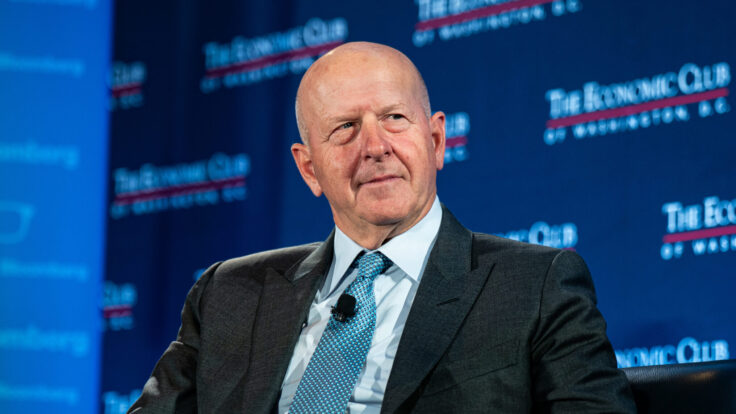
reorganization—a coveted right of the debtor in Chapter 11. This case just gets weirder and weirder. - Solomon’s Trump gig: You wouldn’t necessarily expect to see David Solomon, the exalted C.E.O. of Goldman Sachs, who was rewarded with a pay package of $47 million in 2025, sharing the stage with not one, but two Trumps: Don Jr. and Eric. But the trio appear to be coming
together at the upcoming World Liberty Forum, the brainchild of World Liberty Financial, the DeFi blockchain company co-founded by the two eldest Trump boys in 2024. “Finance should be reliable, open, and built for how the world works today,” World Liberty claims on its website. “We’re here to make that vision real for everyone, everywhere, by laying the foundation for what matters most.” Of course.
The collective value of the World Liberty Financial tokens is about $5 billion, with the
Trump family’s cut being worth about $1 billion, according to the Center for American Progress. (The think tank has been calculating on a daily basis how much Donald Trump’s net worth has increased since his second inauguration: $1.8 billion and counting. You can follow along for yourself here.) The invitation-only World Liberty Forum will be held at Mar-a-Lago on
February 18. A spokesman for Goldman explained that David is speaking at the forum about the U.S. economy and the “macro” environment more generally, and that it fits in with his schedule since he was already going to be in Florida during that time. “U.S. officials and other C.E.O.s will be there as well,” he said.
Also onstage with the Trump sons will be the likes of Michael Selig, the chairman of the U.S. Commodity Futures Trading Commission; Gianni
Infantino, the president of FIFA, who recently awarded Trump his well-deserved “FIFA Peace Prize”; Jenny Johnson, the C.E.O. of Franklin Templeton; hedge fund manager Dan Loeb; and our very own Gerry Cardinale, the founder of RedBird Capital and a small shareholder in Puck. Have
fun, everyone!
|
And now, on to the main event… |
|
|
As the Netflix conquest of Warners looks more like a fait accompli, a new Paramount Skydance
preliminary proxy statement once again argues for the supremacy of its bid—and with a couple of new persuasive arguments. But is PSKY’s reluctance to raise its bid a sign of an Oedipal test, or the inevitable realization that it’s time to move on? |
|
|
At this point, everyone knows what needs to happen for the Ellisons to persuade the
board and shareholders of Warner Bros. Discovery to break up their deal with Netflix and submit to the skylords at Paramount Skydance. In the simplest of terms, Larry has to write a check for an additional $12 billion or so to raise the family’s bid to $34 per share, as well as commit to covering certain incidentals, such as the $2.8 billion breakup fee that WBD will owe Netflix. And yet, it hasn’t happened. Instead, for the past six weeks and counting, the Ellisons have chosen
to wage a multifaceted and superficial seeming tender/proxy/P.R. war.
Their latest move landed this week. According to a preliminary proxy statement filed on January 22, PSKY continues to argue that its $30-a-share, all-cash bid for all of WBD is superior to Netflix $27.75 all-cash bid for WBD’s Streaming and Studios business, plus the value of the Global Networks equity stub that WBD shareholders will retain. In filing its proxy statement, PSKY announced that it was extending its tender
offer another month, to February 20. It also announced that only 168.5 million WBD shares had been tendered, roughly 6.8 percent of the 2.5 billion shares outstanding and far short of the 51 percent needed to win a proxy fight or convince the WBD board that shareholders prefer PSKY over Netflix. |
|
|
Every so often you reach a moment that demands an important conversation. When it arrives, Glenmede is ready with
sophisticated wealth and investment management solutions delivered with the personalized service you deserve. LEARN MORE |
|
|
In addition to its hostile tender offer, PSKY is also mounting a proxy fight to replace some WBD board
members. The PSKY preliminary proxy statement does not indicate whom the company intends to nominate as directors. It does, however, urge WBD shareholders to reject both the WBD-Netflix merger agreement and the spinoff of Global Networks. The statement also asks shareholders to reject the WBD change-of-control executive compensation plan that would put something like $600 million into David Zaslav’s pocket (and enrich C.F.O. Gunnar Wiedenfels to the tune of $140
million) as part of the Netflix deal.
But PSKY’s defense of its bid is a little different this time. The Ellisons are now using WBD’s own valuation information, found in the company’s January 20 proxy statement, against it. That proxy statement revealed, for the first time publicly, the valuation work that its bankers at Allen & Co. and JPMorgan Chase had provided on the Global Networks stub. As I
wrote last week, the range of values ascribed to the Global Networks stub equity is quite wide—between 72 cents a share and nearly $7 a share, based on all kinds of investment banking wampum. PSKY, of course, claims that Global Networks’ equity is pretty much worthless in order to make its bid look like the more fetching of the two.
PSKY
focused in particular on the WBD bankers’ discounted cashflow analysis—“typically considered the gold standard in valuation,” PSKY wrote, correctly, in its proxy—that puts the value of the Global Networks stub at between $0.72 and $1.65 per share. This analysis would value Netflix’s bid at between $28.47 and $29.40 per share overall—less than the $30 per share PSKY is offering. So, you know, the PSKY bid is better. |
Theories abound on Wall Street for why the Ellisons are vigorously defending their current bid rather than
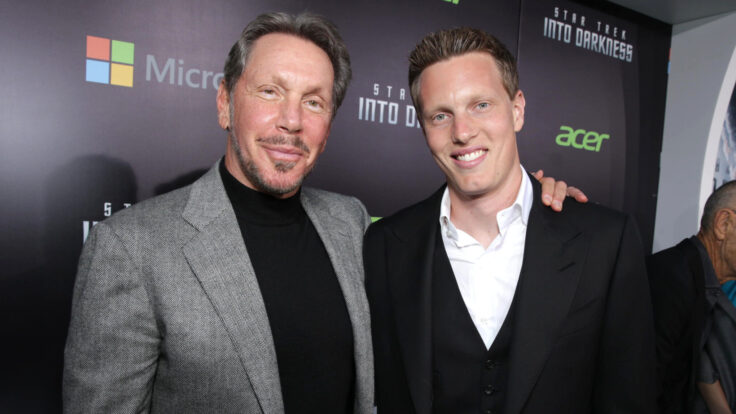
reaching back into Larry’s honeypot, with some speculating that we’re witnessing a bizarrely public Oedipal struggle between father and son. I’m unqualified to weigh in on such psychological matters, but I get the conceit that David Ellison’s father, who is currently worth $230 billion, has staked him in one business after another—including Skydance Media and then Paramount Skydance and now maybe WBD. Without Larry’s extraordinary wealth and his willingness to underwrite his
son’s hopes and dreams, PSKY (market value: $12.5 billion) would never be able to contemplate acquiring WBD (market value: $70 billion). Is his support finally capped at the $40 billion or so that he’s using to backstop the deal?
Meanwhile, it seems like David’s desire to please his father is profound. The opening scene of Reeves Wiedeman’s
profile of the Ellisons, in New York magazine, portrays a younger David at his wit’s end when his acting in Flyboys, which his father helped finance, was met with criticism. He was apparently so deeply upset by the idea that he’d let his father down, financially and personally, that he experienced a bout of atrial
fibrillation serious enough for doctors to shock his heart back into rhythm. Now, perhaps, David requires another type of intervention. There is a view on Wall Street that the PSKY show so far has been “a train with a clown car,” as one executive around the deal told me recently.
Gerry Cardinale, the principal at RedBird Capital, Skydance’s partner in the WBD bid, disputed that framing. For one, he told me, Netflix hasn’t actually “gone all cash”—at least from the
perspective of WBD shareholders. “You still have to underwrite this moving target of this to-be-issued [Global Networks] stock,” he explained. “If you want to talk ‘clown car,’ you look at that stub and how they’ve handled it. That’s the clown car.”
Gerry went on to say that the battle for Warner Bros. comes down to “two things: value to Warner Bros. shareholders, and certainty.” The Netflix deal, he repeated, is uncertain because the equity value of the Global Networks stub is
undetermined. “They haven’t gone all cash,” he insisted. “We’ve gone all cash for 100 percent of the company.” (Usual disclosure: Through a recent transaction, Zaslav is a de minimis investor in Puck; RedBird is a minority shareholder.)
On this front, PSKY does have a colorable argument about the supremacy of its bid. In addition to the emphasis on WBD’s discounted cashflow analysis of the Global Networks stub, PSKY used its recent proxy statement to home in on something it
refers to as a “net debt adjustment.” You will recall that at one point, WBD had been saying that Global Networks would be spun off with $15 billion of WBD’s debt. In its recent proxy, WBD stated that Global Networks will be spun off with $17 billion of debt as of June 30, 2026, and $16.1 billion of debt by December 31. PSKY’s argument, laid out for the first time in the proxy, is that each dollar of debt that WBD unilaterally moves away from Global Networks and onto Streaming and
Studios—presumably so that Global Networks is deemed solvent at the time of the spin—will result in a dollar-for-dollar reduction in the cash that Netflix will pay WBD shareholders. The PSKY message is clear: Don’t be fooled, dear WBD shareholder, by the Netflix jujitsu.
PSKY includes a chart in the proxy that explains how this would work, and argues that it can be done by WBD without its shareholders’ approval. If, for instance, WBD decides to reduce the debt on Global Networks to, say,
around $11.6 billion, PSKY argues that Netflix will reduce its cash bid for WBD to $25.84 per share. If Global Networks were floated without any debt and all of WBD’s debt stayed with Streaming and Studios—an extremely unlikely scenario—then the Netflix bid for Streaming and Studios would be reduced to $21.40 per share. |
|
|
Every so often you reach a moment that demands an important conversation. When it arrives, Glenmede is ready with
sophisticated wealth and investment management solutions delivered with the personalized service you deserve. LEARN MORE |
|
|
There might be some substance to PSKY’s argument, except for the fact that for every dollar less in cash that
Netflix pays WBD shareholders, Global Networks should be worth that much more. But how much more is the key question. For obvious reasons, a Global Networks business spun off without any debt is going to be much more valuable, on an equity basis, than one spun off with $16 billion of debt. Instead, PSKY leans on the lame argument that “the market price of the shares of Global Linear Networks may fluctuate significantly following the completion of the Proposed Netflix Transaction, and
you could lose all or a portion of the value of your investment in such shares.” Well, duh.
PSKY then repeats its long-standing argument that Global Networks could be worth as little as zero per share if larded up with $16 billion of debt, based on the trading of Versant, which has less debt and which PSKY thinks is a better business. In making this argument, however, PSKY neglects to note Versant’s implications for its own valuation. After all, PSKY is pretty much a linear TV
company at this point; if both Versant and Global Networks are given low EBITDA multiples, surely PSKY will eventually be rewarded with a low EBITDA multiple, too. In fact, that may already be happening: PSKY’s stock has fallen some 44 percent since its September 23 peak of $20.86 per share. |
“Is There
a Better Use of Capital?”
|
On some level, PSKY wants WBD shareholders to tender their shares not only because the company believes in
the superiority of its bid, but also to undercut the increasing inevitability of the Netflix deal as the clock ticks down toward the upcoming WBD shareholder vote. But is merging with WBD really in PSKY’s best interest? Rich Greenfield, at LightShed Partners, believes the Ellisons should walk away from the WBD deal and invest their capital elsewhere. On Thursday’s TBPN podcast, Rich said, “The bar in terms of what Paramount has to do to win—that bar is going up and up
and up. And I think the challenge right now is: How badly do they want this? Do they want to overlever the company to get this? Or is there a better use of capital? I mean, it’s not like there aren’t other assets out there.”
In other words, Rich seems to be concluding that PSKY is in the land of diminishing returns at this point, and risks either further embarrassment or a Pyrrhic victory. “There are many ways to attack this beyond buying Warner Bros.,” he said, “and I just think there
comes a point where overpaying for something gets silly and you’re better off finding an alternative. … Because, remember, for Paramount, they need to buy all of these linear cable networks. Because unlike Netflix—remember, Netflix generates $11 billion of free cashflow a year—Paramount has negative free cash. The ability to bid here is very different. These are very different companies.”
It’s hard to disagree. Maybe it’s time for the Ellisons to put us out of our misery. Is that the
lesson Larry is trying to teach his son? |
|
|
Join Puck’s chief political columnist, John Heilemann, as he roams the corridors of power and influence in America on this
twice-weekly interview show, taking you beyond the headlines with the people who shape our culture: icons and up-and-comers, incumbents and insurgents, moguls and machers in the overlapping worlds of politics, entertainment, tech, business, sports, media, and beyond. The conversations are rich and revealing, unrehearsed and unexpected… and reliably impolitic. A Puck-Audacy joint, new episodes drop every Wednesday and Friday. |
|
|
An essential, insider-friendly Hollywood tip sheet from Matthew Belloni, who spent 14 years in the trenches at The
Hollywood Reporter and five before that practicing entertainment law. What I’m Hearing also features veteran Hollywood journalist Kim Masters, as well as a special companion email from Eriq Gardner, focused on entertainment law, and weekly box office analysis from Scott Mendelson. |
|
|
Need help? Review our
FAQ page or contact us for assistance. For brand partnerships, email ads@puck.news.
You received this email because you signed up to receive emails from Puck, or as part of your Puck account associated with {{customer.email}}. To stop receiving this newsletter and/or manage all your email preferences, click here. |
Puck is published by Heat Media LLC. 107 Greenwich St., New York, NY 10006 |
|
|
|