 |
|
Welcome back to Dry Powder. I’m Bill Cohan.
|
|
There’s no question that Disney’s Bob Iger faces a slate of challenging strategic decisions. But his latest moves—dangling assets on CNBC, the Penn deal, the Hulu price hike, etcetera—seem to smack of something akin to desperation. This afternoon, a close look at where Iger seems to be steering the ship. And on Wednesday, I’ll turn to another “embattled” C.E.O., David Solomon, and what the departure of his longtime consigliere signals about his fate atop Wall Street’s greasiest pole.
But first…
|
| Larry Culp’s $240 Million Payday |
|
| There are few people in business more fortunate than Larry Culp, the C.E.O. of the rapidly shrinking former conglomerate GE, who is in the process of breaking up the storied company into three publicly traded entities: GE Healthcare; GE Vernova, its power business; and GE Aerospace, its jet-engine business. In this, Culp is merely implementing the strategy of his short-lived predecessor, John Flannery. But it’s Culp who is reaping the major financial rewards, thanks to a timely re-cutting of his restricted-stock package during the depths of the pandemic, in August 2020.
Long story short, Culp has now vested in all three of the tranches of stock that were granted to him back then, as part of the restructuring that made his windfall much more attainable. “The companies have met the combined stock price threshold” for Culp’s “max” payout, according to Tara DiJulio, GE’s chief communications officer, subject “to the service requirement as well before it vests.” That stock will be worth around $240 million to Culp, assuming he sticks around at GE another 10 months or so.
Had he and the GE board not recut Culp’s stock grant in August 2020, his original stock grant from October 2018 would have expired, worthless, after four years, per the original terms. That payout for Culp is an addition to the more than $100 million in compensation he’s been paid by GE since he started as C.E.O., according to the company’s latest proxy statement. Yes, the GE stock has increased roughly 42 percent since Culp took over GE, but the S&P 500 index is up 60 percent during the same time period. So, thanks to the GE board of directors, Culp enriches himself to the tune of an extra $240 million despite missing his original contractual targets and despite GE’s stock massively underperforming the S&P 500 index. Nice work if you can get it…
Plus, a quick update on the Morgan Stanley succession story... |
| On the Gorman Succession Bake-off… |
|
| James Gorman, for one, appears determined not to screw up the succession process at Morgan Stanley, unlike our friend Bob Iger at Disney. (More on that below.) In fact, he’s got it all set up very nicely and very publicly. Morgan Stanley will have a new C.E.O., likely by the end of the year, with the battle very much shaping up to be one between Ted Pick, who essentially runs Morgan Stanley’s investment banking business, and Andy Saperstein, who runs the bank’s bigger investment and wealth management businesses.
Everything I have heard, and still hear, as I recounted back in May, is that the odds-on favorite continues to be Pick, 54, a graduate of Middlebury and the Harvard Business School. Given Morgan Stanley’s roots as the investment banking business of the old J.P. Morgan & Co. my bet is that Pick, the cerebral banker, will get the nod over Saperstein, especially since Gorman’s roots are more in the money management side of the business rather than the investment banking side. As uber successful as Gorman has been as the C.E.O. of Morgan Stanley, since January 2010, I suspect that the investment banker will get the nod this time around, just as, at Goldman, David Solomon, the investment banker, took the reins from Lloyd Blankfein, the trader, who took the reins from Hank Paulson, the investment banker. Got to keep everyone on their toes.
To his credit, Gorman appears to be doing succession right, as did Citigroup with the appointment of Jane Fraser, the first woman to head a major Wall Street financial institution. (Shout out to my friend Alexandra Lebenthal.) Although it should have happened years earlier, Lazard also handled its latest round of succession reasonably well, with Peter Orszag taking over from Ken Jacobs in October. (To make things even better, Jacobs should relinquish his role as executive chairman of the Lazard board if Orszag is going to have the real freedom he needs to lead the firm. But that’s another story.)
Succession planning seems to be far more difficult to accomplish at both JPMorgan Chase and Bank of America, where C.E.O.s Jamie Dimon and Brian Moynihan, respectively, have been in charge for roughly 20 years each and show no signs of either a near-term departure or of naming a chosen successor. I continue to be baffled why succession is so hard for these guys. Choosing a successor is among the most important decisions a C.E.O. must make and it’s probably the most important one that can be made in determining the future direction of a company. So get to it guys.
At last, my thoughts on Disney’s future and Iger’s optionality… |
 |
| Iger Deal Psychology |
| Iger may be consulting Warren Buffett (and Mayer and Staggs) about his streaming options, but in the everything-on-the-table era at Disney, well, there aren’t that many options really on the table. Herewith, a Wall Street view of a Hollywood challenge. |
|
|
|
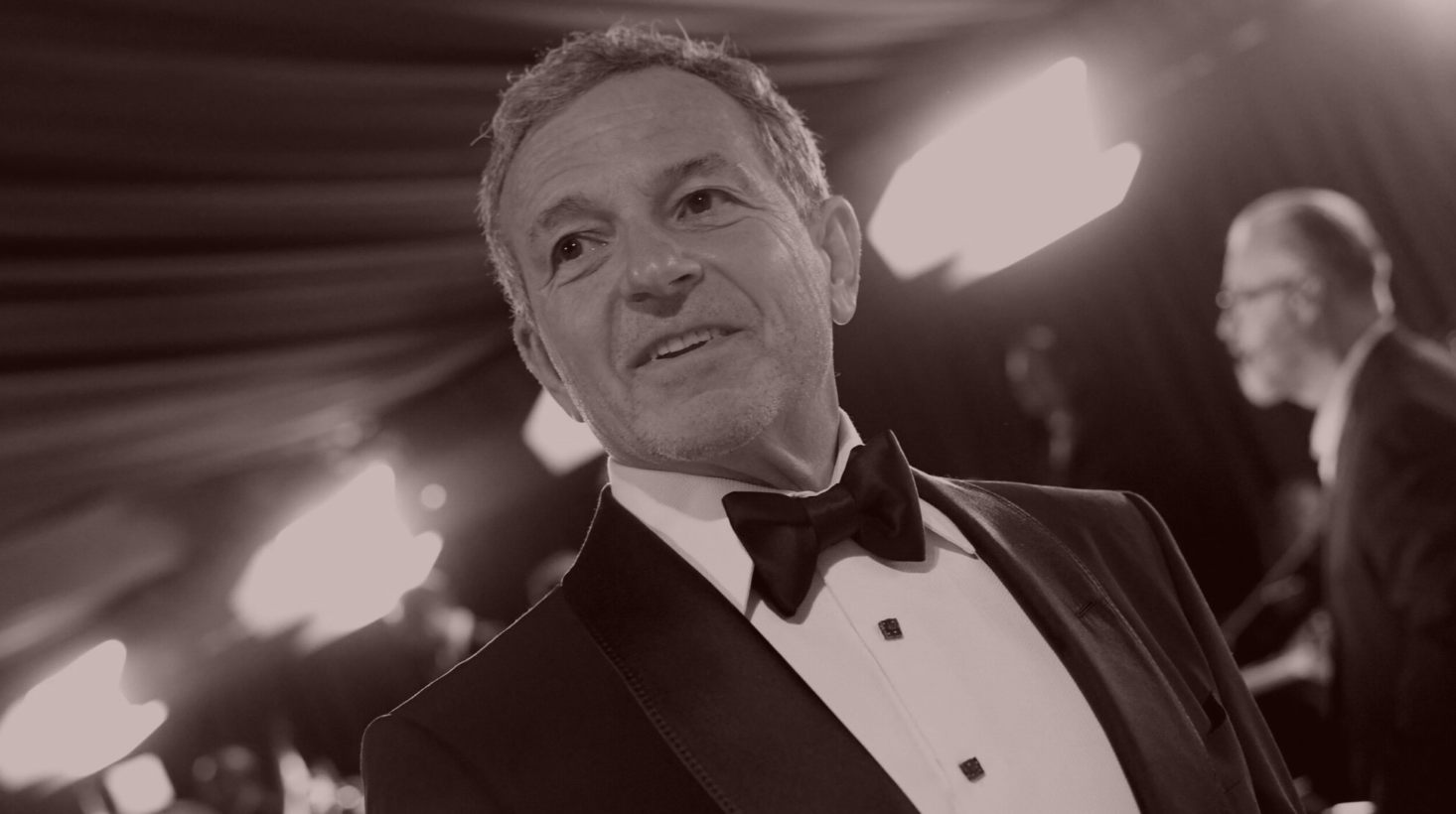
| Of course, Bob Iger faces a very tough slate of strategic conundrums, ranging from Disney’s stagnant and unprofitable streaming business to its profitable but declining television business, a flailing movie production business and a succession challenge—which Disney is trying to put on the back-burner by extending Iger’s contract by two years but is still of primo importance. And then there is the Disney stock price, which is down 7 percent since the day Iger returned. In last week’s earnings call, Iger tried to address some of his company’s stickiest wickets.
But if you look at each of Iger’s recent strategic decisions, you’ve got to wonder if he may simply be running out of good ideas for how to solve Disney’s myriad of problems—or, as my partner Matt Belloni wrote earlier this week, “it’s hard” not to see Iger’s latest decisions “as knee-jerk plays for quick cash.” Dangling assets for sale on CNBC is not the best way to go about a M&A process, unless of course you are desperate. Now potential buyers are well aware that Iger wants his linear TV assets off the books and can take advantage of that fact. We’ve seen this before: In 2015, when GE publicly announced its desire to sell GE Capital, buyers from Blackstone to Apollo to Wells Fargo all exploited the process to get a good deal for themselves.
But it seems like Iger either didn’t want to simply run a traditional sale process, or he felt that he needed to reach beyond the obvious buyers by making a high-profile public announcement about his desire to sell. After all, who is going to want a TV network that is steadily losing altitude? Disney’s linear TV group, which includes all of ABC, FX, ESPN, and the Disney Channel, among a few others, saw its operating income fall 23 percent in the recently concluded third quarter, to $1.89 billion. Wall Street analysts had hoped for $100 million more.
Whatever assets from this group Iger decides to sell is going to be a tough slog, just as I can’t really see who is going to want Paramount Global’s array of linear and digital assets. I’m not sure what strategic buyer is out there pining away for ABC, as glorious as it once was. I see private equity coming along to pick it up on the cheap. But they will value it as a declining asset, not unlike buying a distressed bond. |
|
|
| Iger’s earnings call on Thursday also revealed that he seems to be taking advice now from Warren Buffett, the largest economic shareholder in Paramount Global and a man of great financial wisdom. Faithful readers will recall that Warren recently spoke about the streaming business at his annual confab in Omaha, in May, and basically said that unless consumers are willing to pay even more than they already do on a monthly basis for their streaming services, the future of the business is pretty much doomed.
The trouble, Buffett explained, is that there are “a bunch of companies who don’t want to quit,” and ultimately, for the streaming business to be profitable, you need fewer competitors and higher prices and better margins. He went on to compare the streaming dilemma to what it was like for him to own a gas station in Omaha when he was in his 20s: There was one other station across the street that kept cutting prices every time he did, and sold more gas, and there was no way for him to raise prices, either.
Well, now Iger is testing the Buffett thesis about whether Disney’s streaming customers will be willing to pay more. According to Iger, Disney will soon be raising the monthly prices on its Disney+ and Hulu streaming services some 20 percent, to $13.99 a month and $17.99 a month, respectively, unless you’re willing to endure ads and then the monthly subscription costs will remain unchanged. Then, of course, there is the Disney+/Hulu bundle—he’s calling it Duo Premium, how catchy—that Iger has priced at just shy of $20 a month, making it appear to be the best deal in Disney’s streaming portfolio. Say what you will, but Iger is certainly pushing the limits of his customers’ wallets, just as Buffett said was required. (Disney investors seemed to be rather unimpressed by Iger’s announcement; the stock was down 3 percent on Friday.)
One of the themes of the second Iger era is that, with his reputation and wealth already amassed, he isn’t worried so much about the hearts-and-minds games that many C.E.O.s must play. Instead, he’s pulling levers out of cold hard operational calculation, and in some cases, perhaps, desperation, too. This may be necessary economically—Disney said its streaming losses last quarter narrowed to $512 million. And Disney has lost more than $10 billion since it started offering its streaming product, with another $10 billion likely going out the door to buy Comcast’s one-third stake in Hulu. (Unless he swaps it with Comcast for an equity stake in ESPN.) But it does make one wonder what he’s going to do if these moves don’t work. |
|
|
| I like Jimmy Pitaro, ESPN’s leader. He seems like a good guy and also seems quite determined to figure out how to offset the decline of linear ESPN with a new, direct-to-consumer streaming ESPN that people will be willing to pay for. Talk about a tough business challenge. He seems to want to do it the “right” way, wherever that ends up. But will this mean Disney will also expect customers to pay for a digital ESPN, too, along with higher prices for ad-free Disney+ and Hulu? My head hurts just thinking about it.
As for ESPN’s gambling/sports betting deal with Penn Entertainment, it, too, has the feel of desperation and may end up being too little and too late. According to the company, ESPN will get between $500 million and $1 billion of “adjusted EBITDA” each year from the deal. An ESPN insider told me the deal is about “fan engagement” and that ESPN already has a “ton of betting content” and the deal with Penn is just an extension of that. “Everything we do is fan-first,” this person continued. “It’s a simple mantra but it’s how we’ve built the biz.”
For years, of course, Iger pooh-poohed the idea of bringing gambling into Disney just as he once walked away from a potential acquisition of Twitter—too tacky, too un-family friendly, etcetera. But in the everything-on-the-table era, well, everything seems to be on the table, including brand equity. My ESPN source defended the deal in the lingua franca of Iger, who likes to talk about transactions in funky, corporate-speak. “Research shows it’s a brand deposit for ESPN and not at all a brand withdrawal for Disney,” he told me. Maybe. I assume the folks in Bristol know what they are doing. But something feels off to me about this.
Tom Rogers, one of the founders of CNBC and of NBC’s highly successful cable TV strategy, said on CNBC the other day that he thought the Penn deal was a “good move” for ESPN but then he quickly qualified that comment. “It’s not as big a move as many contemplated sports betting was going to be for the future of ESPN,” he said. “Bob Iger made very clear [on CNBC] that ESPN needs partners to transact. This is a partnership. But many thought that ultimately ESPN might merge with a FanDuel or DraftKings, the two biggest players there. It looks like that kind of strategic savior as an answer for ESPN is off the table.”
Rogers further explained that the deal looks “pretty big,” projecting an additional $1.5 billion in revenue, as opposed to adjusted EBITDA. “But that’s $150 million a year over 10 years,” he continued. “And just to put that in some context for your viewers, an ESPN subscriber on cable or satellite is worth about $150 in revenue a year between fees it gets from the operator and advertising. So this makes up for about a million subs being lost. Now over the next 10 years, ESPN is probably going to lose 15 to 20 million subs. So relative to the strategic issues that it’s facing, this is not going to make up for the secular decline that it faces.” |
|
|
| Iger also appears to have made some new moves on the succession front. As Matt was the first to report, Iger has entered into a consulting arrangement with two former (and future) potential successors, Kevin Mayer and Tom Staggs, whom Iger once upon a time jettisoned from consideration. Instead, he made the mistake of choosing Bob Chapek, only to help to defenestrate him 30 months later. This appears to be another indication that the Disney succession process is not going particularly well, as of course was the board’s decision to extend Iger’s contract by another two years.
Will Disney buy Candle Entertainment for many billions in order to get Mayer and Staggs back into the company, as well as to make them really rich and for Blackstone to get a return on its investment? It won’t come cheaply, if Disney does. Candle has spent around $4 billion on acquisitions to date, including for Reese Witherspoon’s Hello Sunshine, as well as Moonbug Entertainment and ATTN:, a social video company. In the end, I bet Iger will have to pay up bigtime for Mayer, Staggs, and Candle to show the board and investors that he has a credible successor. The irony, of course, is that he could have already had one of them succeed him for free.
Iger was asked on Thursday about whether it’s all just too overwhelming for him and whether the best outcome for Disney shareholders at this point would be to sell the company, preferably to Apple, which has made a commitment to the streaming and content businesses (obviously) and that has a market value of $2.8 trillion these days, more than enough to handle the $200 billion or so purchase price that it would take to buy the Magic Kingdom. Iger dismissed the line of inquiry with a non-answer answer. “Anyone who wanted to speculate about such things would have to immediately consider the global regulatory environment, and I’ll say no more than that,” Iger replied.
The Wall Street Journal’s Heard on the Street columnist accepted Iger’s argument, noting that it was said “correctly.” But I don’t buy it. I don’t see what the regulatory impediment would be for Apple to buy Disney. They are barely in the same businesses. It would be a big deal, yes, and Lina Khan doesn’t seem to like big mergers, but it would be unlikely to be blocked on antitrust grounds. Perhaps she would try to block it out of spite, but that’s not the reason Apple wouldn’t buy Disney. The real reason is probably closer to the fact that Disney seems pretty broken right now and Apple probably doesn’t have the patience or the interest in fixing it. As it currently stands, fixing Disney is Iger’s challenge—and his challenge alone. |
|
|
|
| FOUR STORIES WE’RE TALKING ABOUT |
|
|
|
|
|
 |
|
|
|
Need help? Review our FAQs
page or contact
us for assistance. For brand partnerships, email ads@puck.news.
|
|
You received this email because you signed up to receive emails from Puck, or as part of your Puck account associated with . To stop receiving this newsletter and/or manage all your email preferences, click here.
|
|
Puck is published by Heat Media LLC. 227 W 17th St New York, NY 10011.
|
|
|
|