{{ 'now' | timezone: 'America/New_York' | date: '%b %d, %Y' }} |
|
|
|
Greetings from the San Juan Islands, and welcome back to In the Room. 🦀 Eleven keepers
on the first pull.
In tonight’s issue, I check in with Puck’s resident political expert, Peter Hamby, to assess the state of the left-wing media ecosystem. As Peter notes, many of the new creators and influencers are “deeply pissed” at their own party—an animus that seems to be reorienting candidates’ priorities, and media strategies, as we head into the midterms.
🎙️ Plus, on tomorrow’s special episode of The Grill Room, we’ll have Peter’s
recent interview with progressive media star Brian Tyler Cohen, who assessed the party’s new media landscape. Follow The Grill Room on Apple, Spotify, or
wherever you prefer to listen.
Also mentioned in this issue: David Ellison, Rob Bonta, Makan Delrahim, Jack Blanchard, Adam Wren, Dasha Burns, Will Steakin, Mike Allen, Jonathan Greenberger, Kyle
Tharp, Don Lemon, Johnny Harris, Hasan Piker, Chuck Schumer, Keith Edwards, Suzanne Lambert, Adam Mockler, Jon Favreau, Ken Martin, Mehdi Hasan, Abdul El-Sayed, Scott MacFarlane, Pete Buttigieg, Andrew Schulz, Logan Paul, Andy
Beshear, Gavin Newsom, Carlos Eduardo Espina, Aaron Parnas, Walter Cronkite, Mark Takano, and more. |
-
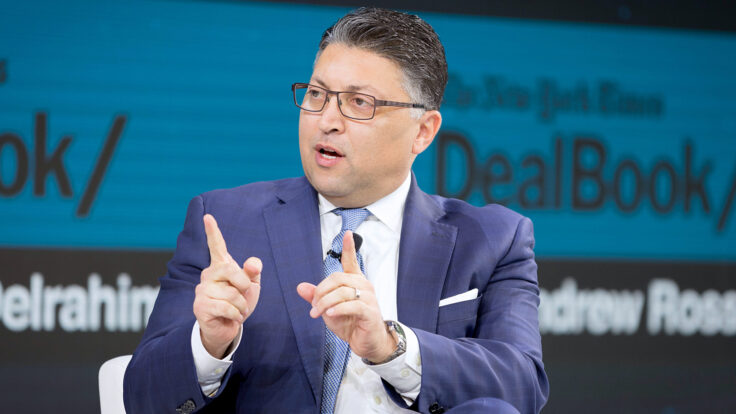
Makan on Matt: David Ellison’s Paramount–WBD merger has been temporarily delayed by a California district judge in order to further review the antitrust questions raised by Rob Bonta and his fellow Democratic A.G.s. Meanwhile, David’s chief legal officer, Makan Delrahim, gave a forceful rebuttal to Bonta & Co. in a conversation with my partner Matt Belloni this week, for his podcast, The Town.
Makan accused Bonta & Co. of “weaponizing” antitrust law and said they should settle the case “if they really want an enforceable commitment.” He also dinged Bonta over reports that he might want David to divest CNN. “Where’s the antitrust harm?” Makan asked. “I think if the states are using their state power to try to control speech by who owns it, that’s a serious First Amendment violation that nobody should be for, especially the creative community.”
|
|
|
|
A MESSAGE FROM OUR SPONSOR |
Helping Customers Stretch Their Budgets
Instacart has saved customers over $3 billion, and is helping more families stretch their grocery budgets with deals, discounts, and retailer loyalty programs. Learn More. |
|
|
|
-
New Playbook: Politico has moved Jack Blanchard off of Playbook and announced a new team for its flagship morning newsletter: Adam Wren, Dasha Burns, and Will Steakin. This move is an attempt to reprioritize scoop-driven political reporting in the flagship newsletter, and mercifully ends John Harris’s notion of importing a Brit to cover Washington like Jane Goodall in
Brooks Brothers. Of course, the proof will be in the pudding.
More than a decade after Mike Allen’s departure, Playbook remains a formidable business largely because of its reliability and consistency, even if it doesn’t really set the agenda anymore. New editor-in-chief Jonathan Greenberger believes this is the best trio to get his team back on a competitive footing. Good luck to them!
|
|
|
|
A political media symposium with Puck’s own Peter Hamby, on the rise of the left’s
new creator class, the business of hating on the Democratic establishment, and the dystopian reality of paid influencers shilling for candidates. |
|
|
|
On Monday, my partner Peter Hamby sat down with the progressive YouTube star
Brian Tyler Cohen to explore the Democratic Party’s long, somewhat awkward migration into the new creator era. Peter—Puck’s resident political savant, and one of the sharpest minds on the intersection of media and politics—has spent his career straddling both worlds and is a reliably brilliant analyst of the landscape. Meanwhile, his discussion with Brian stirred my own thoughts about the broader left-wing media ecosystem around him.
So I reached out to Peter to get his
honest and unvarnished assessment of where this industry stands, how Democrats are navigating the new terrain, and what it all portends for the coming midterms. What happens when Rachel Maddow (remember her?) is replaced by a bunch of Zyn-addled dudes from the more tender and earnest regions of the manosphere? Below is our conversation, edited lightly for clarity. |
“Deeply Pissed at the Democratic
Party”
|
Dylan Byers: Peter, I was fascinated by your
recent conversation with progressive media star Brian Tyler Cohen. On some level, it seems like Democrats are finally starting to build a creator ecosystem that can compete with the right. But is this a true media ecosystem with independent voices and organic communities, or merely a new
distribution channel for the same old party messaging?
Peter Hamby: With some caveats, I do believe there’s finally a real media ecosystem springing up on the left, fueled by independent voices. What’s changed in the second Trump term is that both the veteran creators and more recent entrants to the game share this righteous anger at the Democratic Party for being feckless, timid, and out of ideas. The post-2024 growth in this space is mostly
organic.
But, sure, plenty of progressive shows and creators welcome Democratic politicians on their channels, and give them a friendly platform to spout talking points without much pushback from hosts—who are activists and partisans and clout chasers, not journalists in the traditional sense. And like Republicans who have been doing this for more than a decade now, Democratic pols are embracing these channels as a safe way to reach their voters and discuss their
topics—healthcare, ICE, democracy—without having to go through mainstream news outlets or journalists asking questions that aren’t on topic. So in that sense, yeah, they can be a vehicle for party messaging.
So it is the same old party messaging.
Not really. The same old party messaging is precisely the reason the lefty creator ecosystem has evolved and boomed since 2024. Democratic voters are plainly fed up with the same old, same old. Furious about it,
actually, which is why so many play-it-safe Democrats have been extinguished in the primaries this year. Creators on the left—like voters—are just deeply pissed at the Democratic Party for the Joe Biden debacle, Trump’s return to office, and the lack of clear resistance strategy from Capitol Hill, even if there isn’t much they can do.
Just look at the fastest-growing partisan YouTube channels on the left. According to Kyle Tharp at Chaotic Era, which is a
great newsletter tracking this stuff, they include More Perfect Union, MeidasTouch, Breaking Points, Zeteo, Don Lemon, Johnny Harris, Brian Tyler Cohen, Hasan Piker, and so on. Some of these projects existed before Trump 2.0, some didn’t, and they all play ball in different corners of the progressive sandbox. But they all share anti-establishment impulses and blame both the Democratic Party and the mainstream press for failing the country in the
Trump era. They’ve been raging about it and boosting their followings in the process, making them even more powerful inside the Dem coalition, much to Chuck Schumer’s chagrin. |
|
|
|
A MESSAGE FROM OUR SPONSOR |
Helping Customers Stretch Their Budgets
Instacart has saved customers over $3 billion, and is helping more families stretch their grocery budgets with deals, discounts, and retailer loyalty programs. Learn More. |
|
|
|
But are they working as businesses?
Five years ago, it was harder for
online voices to make a living. Now we have subscription platforms, mid-roll advertising, rev-share models, even merch! You can get a Lemon Head hoodie for the low, low price of $65 at Don Lemon’s Shopify portal!
Brian told me that he had around 8 million followers across platforms at the end of 2024. Today he’s pushed that up to almost 14 million—in just 18 months. That’s a sign of his work ethic, but also the fact that there’s a gettable, anti-Trump, cord-cutting audience that wants
what he’s selling. You also have a bunch of individual creators—Keith Edwards, Suzanne Lambert, Adam Mockler, etcetera—who were certainly posting before Trump 2.0. But they blew up after the Democrats shat the bed in 2024, vowing to stop playing nice and to get down in the mud with Republicans. Edwards told me today he’s added 1.6 million followers since Trump’s second inauguration. |
Selling
the Trump Haterade
|
How much of what’s working is actual journalism, as opposed to just progressive
tantrums?
This is where I should say that plenty of these channels, while generally being friendly to Democrats, also do valuable journalism in their own ways. I wrote about More Perfect Union last year—it was started by Bernie Sanders’s former campaign manager to tell issue-based stories critical of corporate interests. They were
covering populist frustration with A.I. data centers before the mainstream press. There was Jon Favreau’s contentious Pod Save America interview with D.N.C. chairman Ken Martin over the party’s failed 2024 autopsy report—an absolute masterclass in skin-peeling and a true embarrassment to Martin. And Martin asked to do it!
Zeteo has also done some great reporting. Mehdi Hasan, relentless as ever, recently kept
Michigan’s leftist Senate candidate, Abdul El-Sayed, off balance by pressing him on why he was hiding his personal financial disclosure from voters. MeidasTouch News, which has more than 6 million very loyal fans on YouTube, hired the very good Scott MacFarlane from CBS News as their chief Washington correspondent. They also had some riveting on-the-ground livestreams during the Minnesota ICE protests. There’s also The Bulwark, of course, which has found massive
success in the anti-Trump space. They’ve expanded their journalism portfolio, hiring real reporters from Politico and elsewhere to cover the Democrats with a healthy dose of skepticism, along with their usual Trump haterade.
Brian argues that Democrats need to venture beyond progressive media and prove they can “hang” in culturally disparate spaces. But is the party’s problem fundamentally about distribution, or do too many Democratic politicians
lack the personality, confidence, and cultural fluency that this medium rewards?
Democratic staffers and politics junkies love to focus on tactics, but you are correct, it’s a question of talent. This is just an updated version of the Kerry–Bush beer test. Let’s be honest, a lot of politicians are nerds. Or lawyers. We need nerds and lawyers in government, but nerds and lawyers are hard to plug into a vertical scroll on the platforms. Attention
has always been the lifeblood for any politician, but used to be limited, generally, to news programs, radio, newspapers, etcetera.
Now politicians are competing for attention not just against other politicians, but against athletes, hot people, actors, Iranian propaganda videos, A.I. slop, and so on. What’s even harder is they’re competing for those precious first one-to-three seconds of every shortform video, the crucible moment in our dopamine-addled brains that determines whether you
stay or swipe and move along. Tough thing for Hakeem Jeffries or any buttoned-up Democrat to do, even though he’s been trying and at least getting out there.
But you still need longform content to clip from.
True, and there’s a related dynamic. The clip economy relies on longform content—podcasts and YouTube shows. Meaning that if a candidate wants to create a flywheel of content from a single appearance—think of Pete Buttigieg
going on the anti-woke Flagrant podcast with Andrew Schulz last year—that candidate has to be on his or her game, on camera, for 30 minutes or more. Just hanging out in a live-fire setting where the hosts might ask about U.F.O.s or the NBA or trans bathroom laws. A lot of morons go on big podcasts, but politicians—even the dopes—are expected to be smarter than Logan Paul. So the bar is even higher. One has to sound smart, but also relatable, and funny,
all while just hanging out. A great example dropped just today. Maryland Gov. Wes Moore went on the viral music show Track Star and talked about hip-hop and soul music he likes, but also smoothly weaved in stories about himself, Black culture, civil rights, poverty, Baltimore. Really solid media hit on his part. |
The great promise of creator media is authenticity and intimacy; the danger in politics is
that creators become little more than campaign surrogates. Do you worry about these creators losing credibility as campaigns pour more money into this ecosystem?
Well, creators are trying to get paid, and they always will. I’m more worried about voters being fooled or spun by creators who are being paid by candidates and interest groups. This is one of the major questions for the Democratic coalition heading into 2028. Imagine some mom in Grosse Pointe scrolling Instagram next
winter, and she sees a video from a local food creator in Detroit raving about Andy Beshear’s plans to cut grocery costs. Absent federal disclosure requirements, that’s what we’re looking at heading into this next cycle.
This problem flared up in California during the acrimonious gubernatorial primary this summer—and California actually has a disclosure law on the books for influencers and creators dabbling in politics. Gavin Newsom signed the
legislation three years ago. Still, during the heated primary, influencers from around the country were being paid by billionaire Democrat Tom Steyer’s campaign to promote his campaign, with many not disclosing that they were taking a check. The primary’s eventual winner, Xavier Becerra, also ran a paid creator program with similar disclosure problems. And by the way, plenty of these creators who took money were political newbies, some from other states without
similar laws who might’ve just forgotten to add the disclosure until it was too late. Sorry, fam! It’s just a mess.
What really stinks, too, is that one of the left’s most popular Gen Z social media stars, Carlos Eduardo Espina, who delivers Spanish-language news to more than 14 million followers, also took money to promote Steyer ($100,000!) without telling his followers. That’s too bad, because the progressive creator class, and digital strategists in the
Democratic Party, like to hold up Espina as a prized example of someone who cracked the code on delivering “news” to young people and casual voters who don’t follow traditional media.
But the creator ecosystem will always be pay-for-play and unscrupulous. Political influencers on the left have certainly grown their reach and power since 2024, but a few of them are a little too sanctimonious about their craft. Aaron Parnas, a left-leaning Gen Z “news” creator, claims to be
the Walter Cronkite of his generation by bringing headlines to his millions of followers on TikTok and elsewhere. What he doesn’t say is that he built that following by ripping off headlines and original reporting from actual news organizations and passing it off as his own. Cronkite would hate it.
I’m surprised that wasn’t a bigger issue nationally, to be honest. Is there some regulation in the works around that?
The California governor’s race was
so chaotic and unregulated during the primary that Rep. Mark Takano of Riverside introduced legislation in Congress that would require people on social media to disclose payments from campaigns. But that law would apply to human influencers. What about realistic-looking A.I.-generated influencers peddling campaign spin and shitposting? That’s going to happen sooner than we think with generative models getting better by the day. Facebook grandpas are already getting
hoodwinked by fake, A.I.-generated MAGA babes in their feeds. The California primary was also plagued by thousands of fake spam bots that surfaced on X and Facebook mysteriously promoting Becerra and attacking Steyer.
And those were just static avatars. It’s going to get worse. Voters on the left and right are going to get duped by fake influencer videos—or perhaps more depressingly, they’ll know they’re watching a hot robot and just won’t care either way as we all amuse
ourselves to death. |
|
|
|
Join Puck’s chief political columnist, John Heilemann, as he roams the corridors of power and influence in America on
this twice-weekly interview show, taking you beyond the headlines with the people who shape our culture: icons and up-and-comers, incumbents and insurgents, moguls and machers in the overlapping worlds of politics, entertainment, tech, business, sports, media, and beyond. The conversations are rich and revealing, unrehearsed and unexpected… and reliably impolitic. A Puck-Audacy joint, new episodes drop every Wednesday and Friday. |
|
|
|
A professional-grade rundown on the business of sports from John Ourand, the industry’s preeminent journalist,
covering the leagues, players, agencies, media deals, and the egos fueling it all. Plus, the latest intel from Eriq Gardner on the sports legal beat. |
|
|
|
Need help? Review our FAQ page or contact us for assistance. For brand partnerships, email ads@puck.news. You received this email because you
signed up to receive emails from Puck, or as part of your Puck account associated with {{customer.email}}. To stop receiving this newsletter and/or manage all your email preferences, click here. |
Puck is published by Heat Media LLC. 107 Greenwich St., New York, NY 10006 |
|
|
|
|