Welcome back to Wall Power for a special long, summer read. I’m Marion
Maneker.
Tonight, from our friends at Air Mail, we have the fascinating story of the friendship between the world’s premier postwar artist and the third-generation of America’s greatest family of artists.
If you didn’t already know, then let me tell you that Inner Circle subscribers to Wall Power and Puck also get access to Air Mail, where there’s a steady stream of art-related stories like this curious tale of the friendship between Andy Warhol and Jamie
Wyeth. If you want to upgrade your subscription to get access to all our content, you can do so here.
There’s not much going on in the art world in early July, as everyone takes a break before the property gathering begins in earnest for the fall season. So enjoy this yarn.
But first … |
The Art of
Influence, September 23 at the Bowery Hotel
|
Earlier this week, we announced the second iteration of Puck and the FLAG Art Foundation’s Art of
Influence conference. The event is a safe space for art advisors, collectors, artists, and others in the industry to speak freely about the challenges and opportunities facing the art world. This year’s conversation will include Christie’s C.E.O. Bonnie Brennan; Pace Gallery founder and chairman Arne Glimcher, with Pace C.E.O. Marc Glimcher; Metropolitan Museum of Art trustee Jen
Rubio; and the founder of Siren Projects, Sophia Cohen. FLAG founder Glenn Fuhrman and I will moderate. (More speakers will be announced in the coming weeks.)
Buy your ticket here.
Also mentioned in this issue: Jed Johnson, Andrew
Wyeth, Peter Beard, Lincoln Kirstein, President Kennedy, Bobby Kennedy, Mrs. Kennedy, Richard Nixon, Fred Hughes, Stanley Tretick, Caravaggio, Holbein, Walter Hopps, Dennis Hopper, Liza Minnelli, Mick Jagger, Carolina Herrera,
Henry Fonda, Paulette Goddard, Valentino, Maxime de la Falaise, Angela Lansbury, Baby Jane Holzer, John Phillips, Genevieve Waite, Victor Hugo, and more.
Now let’s go to Chadds Ford … |
|
|
|
When Andy Warhol and Jamie Wyeth met in the late 1960s, the king of Pop art and
the heir to America’s first family of painting struck up an unlikely friendship that would carry them from Chadds Ford to Monte Carlo. |
|
|
|
When The Andy Warhol Diaries came out, in 1989, readers of the 807-page chronicle of
daily Warholian doings, gossip, and tabulations of expenditures down to the penny were perhaps surprised to discover that the book effectively begins in Chadds Ford, Pennsylvania. Page one finds Warhol and a couple of associates, including boyfriend Jed Johnson, road-tripping (gas $19.97, tolls $3.40) to that arcadian corner of the Brandywine Valley, about 30 miles southwest of
Philadelphia. They would be spending Thanksgiving 1976 with the artist’s latest friend and pet obsession: the painter Jamie Wyeth—son of Andrew (Christina’s World et al.), grandson of N.C. (the protean book illustrator), and 30-year-old scion of America’s first family of paint.
It was the
photographer Peter Beard, a mutual acquaintance, who’d first introduced Wyeth and Warhol, bringing them together at Warhol’s Factory at some point in the late 1960s. “He’d really like to meet you,” Beard told Wyeth, “and you ought to meet him.”
“Andy, I think, was just scared to
death of Peter,” Wyeth told me recently at his Point Lookout Farm, a 250-acre expanse of gumdrop hills, meandering fences, ponds, and barns near Chadds Ford. But the rapport between the two artists—despite their differences in age, temperament, and chosen media—was instantaneous and comfortable. “Finally it got to the point where I said, ‘Would you pose for me?’” Warhol’s response: “Oh, gee, oh, oh…” |
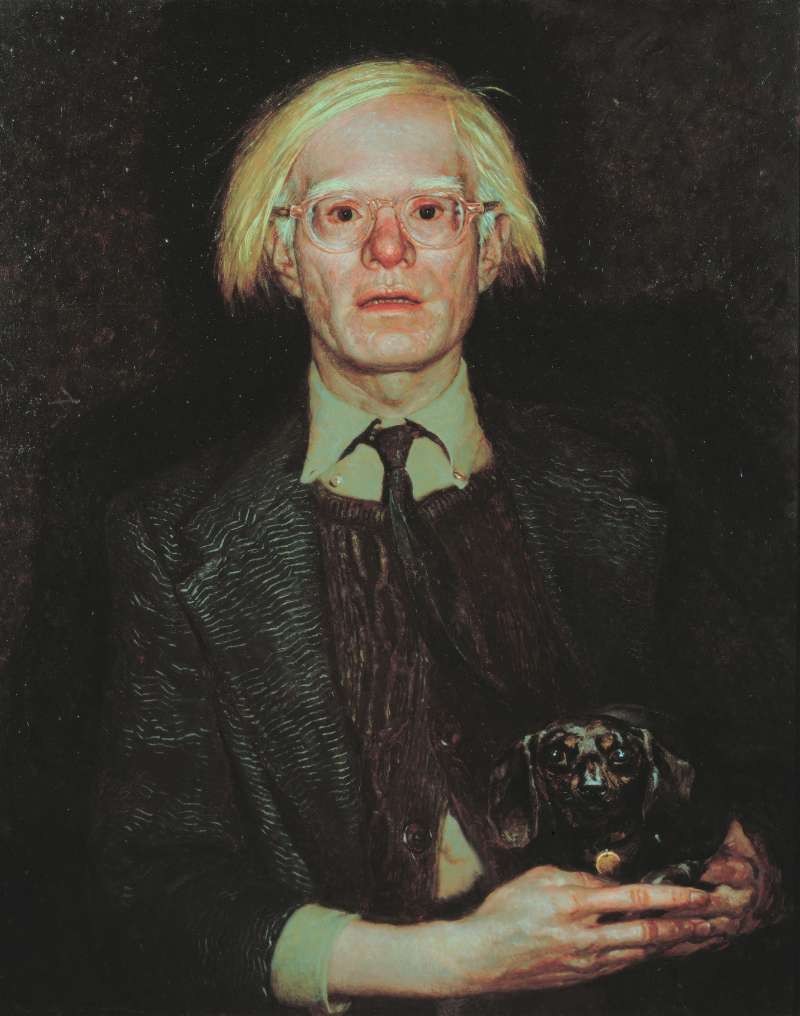
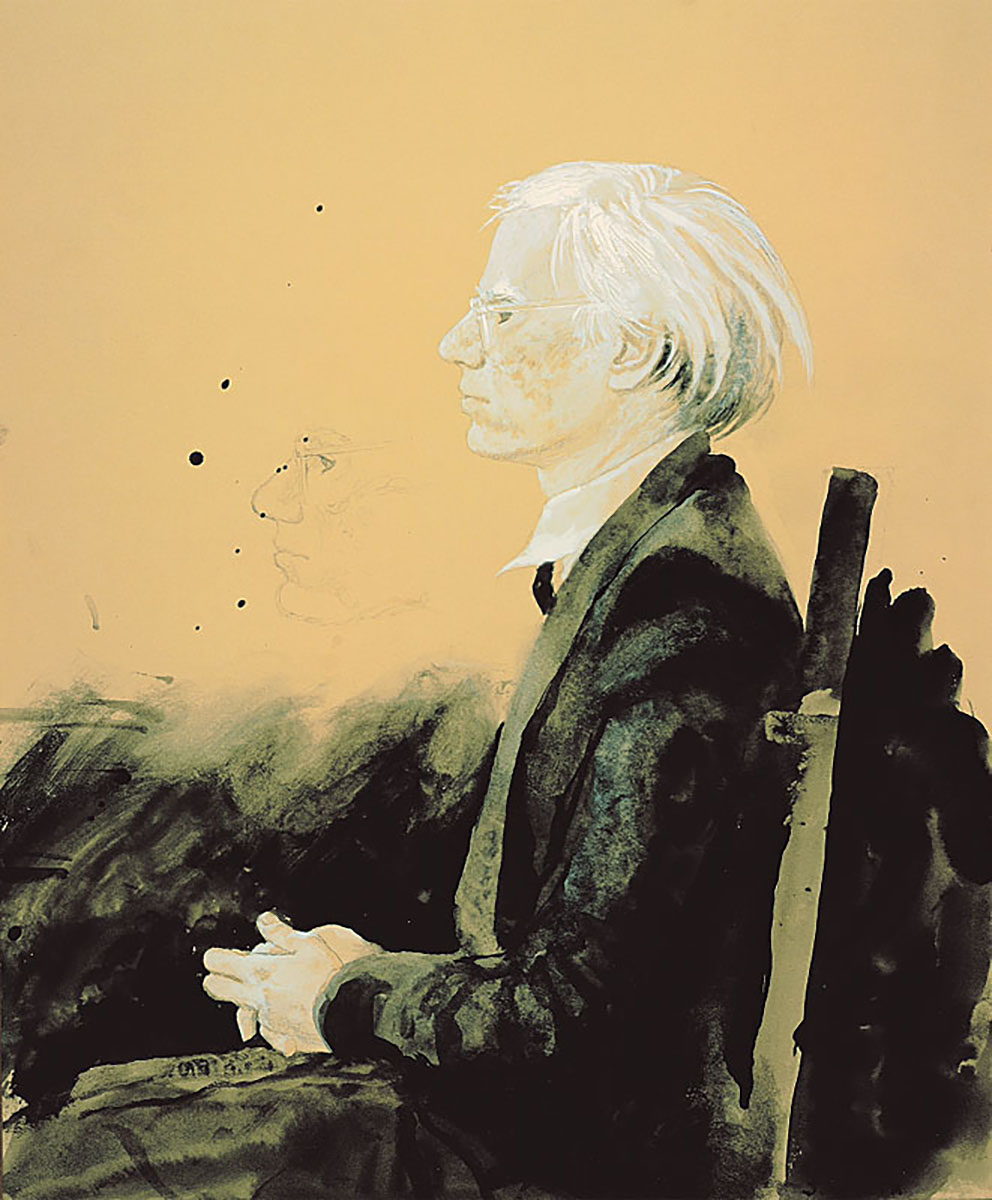
Jamie Wyeth, Portrait of Andy Warhol (1976). Photo: Courtesy of Jamie Wyeth/Wyeth
Archive |
During the height of America’s bicentennial fever, 50 years ago this summer, these two
all-American artists unveiled the fruits of their association at “Andy Warhol and Jamie Wyeth Portraits of Each Other,” a co-headlining show of three dozen works at the now-shuttered Coe Kerr Gallery on East 82nd Street in New York. No surprise, the opening, on June 3, 1976, was a media circus, with 2,240 attendees attempting to cram into the townhouse gallery. When a reporter asked
Warhol what he was looking to achieve in his Polaroid–silk screen renderings of the young Wyeth, he replied, “What I hope to reveal in the portrait is Jamie’s cuteness.” When Wyeth was asked a similar question, about the meticulous oil portrait he’d created of Warhol, he said, “I was fascinated by every pimple on his face.”
Working in tandem with Warhol was a major event for Wyeth, one he’s described as “cataclysmic.” The only other famous artist he’d known—or painted—was his own father.
In Warhol he found a creative dynamo. “Here,” Wyeth says, “was somebody who really had a vision.”
Of Wyeth, Warhol said, “I think he’s peculiar. Maybe even more peculiar than I am.” |
Then and now, Wyeth’s life was spent shuttling between Chadds Ford and coastal
Maine. But he was no stranger to New York. He and his wife, Phyllis, who married in 1968, had an apartment on East 66th. (Warhol bought a townhouse down the street in 1974.) Wyeth first came to the city in the mid-’60s to create a brooding oil portrait of Lincoln Kirstein, the co-founder of New York City Ballet. (The piece is now in the National Portrait Gallery.) Kirstein was smitten with the teen wonder, describing him as “fuzzy and clean like honey on the
best bread.” When Wyeth showed his work at the Knoedler gallery in 1966, Kirstein declared Wyeth “the finest American portrait painter” since Sargent.
By the time Wyeth met Warhol, he’d been living up to that exalted, if cumbersome, reputation while gaining notoriety for capturing his subjects with a realism that bordered on merciless. Wyeth’s posthumous portrait of President Kennedy was so shockingly lifelike that it left Bobby Kennedy enraged.
(Mrs. Kennedy, for her part, loved it.) Wyeth was later summoned to the Nixon White House for a meeting, which boiled down to the president of the United States warning the young portraitist: “Don’t paint me, Jamie.” Warhol had no such reservations. “I knew it was something I wanted the minute it came up,” he said. Given his fixation on bold-faced names and high-ranking WASPs, it’s no surprise than an affiliation with the Wyeth clan was
society catnip for Warhol. “Andy did know my grandfather’s work,” Wyeth says now, “and he knew my father’s work, so that just intrigued the hell out of him.”
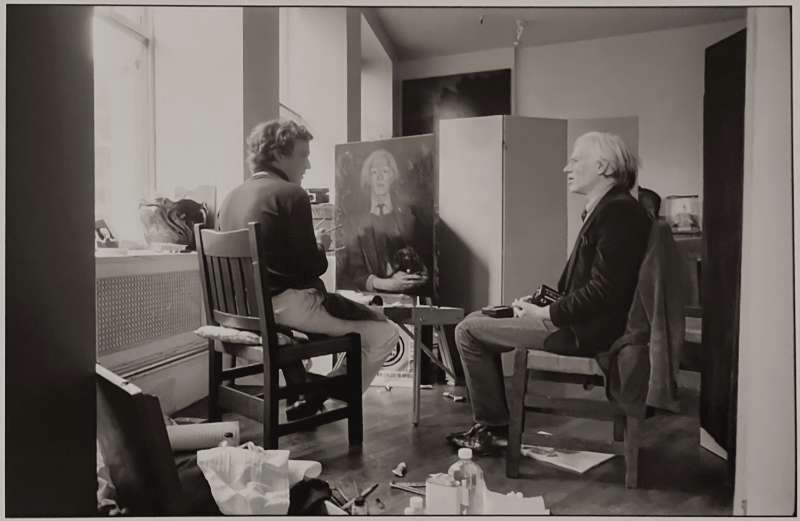
In early 1976, Warhol invited the young painter to set up shop at the Factory. Wyeth was given a little corner to do his work, adjacent to the space used by Warhol’s business manager, Fred Hughes. A black screen was provided for privacy. “Nobody was allowed in,” Wyeth recalls. “Fred made sure of that. So I had my own
kind of world there.” |
Jamie Wyeth, Andy Warhol Facing Left (Study #2) (1976). Photo: Courtesy of Jamie
Wyeth/Wyeth Archive |
Wyeth set about executing dozens of preparatory sketches in pencil, ink, and watercolor, zeroing
in on his subject’s hands, his shoes, his face, and his white wigs, which would change by the day, giving the sitter an ever-mutating aspect. “He was … uncanny looking,” he says, “with that white hair.” For Wyeth, the studies were as important as the final oil portrait, which was the tip of a vast iceberg of observation, rendering, and endless hours of hang time. “When I work on a portrait, it’s really osmosis,” he once said. “I try to get to the point where if the sitter painted, he’d paint a
portrait just the way I’m doing it.”
Warhol could obviously never paint the way Wyeth did. “I love his work,” a spellbound Warhol said. “I always wished I could paint like him.” Wyeth likes to joke that the fumes of oil paint and turpentine had never been inhaled at the Factory until he set up shop there. Nor, probably, had calipers ever been seen. Wyeth used them to obtain precise measurements of Warhol’s face and body, from his nostrils to his toes. “Andy called them ‘torture tools,’”
Wyeth says.
Warhol was absorbed in the process, perhaps understanding that what he was experiencing could have been happening at any moment over the previous few centuries—Caravaggio in Rome, Holbein in London. “He was a good sitter,” Wyeth says, recalling their goofball patter—about the art world, mutual friends, whatever
went on at Elaine’s the night before—as Andy sat with his ever-present tape recorder in his lap and a velvet pillow standing in for his beloved dachshund, Archie. One day the conversation turned to the Plaster Casters, the artist-groupies who made casts of rock stars’ penises. Would Warhol ever consent to such a thing? “He said it would hurt too much!” Wyeth remembers.
On the other side of the screen, it was Factory business and hijinks as usual, a nonstop parade of Warhol creatures,
factotums, and “superstars.” Warhol would jump up and take care of whatever needed his attention, returning to sit for Wyeth for a half hour here, 20 minutes there. Lunch breaks were had in the Factory dining room, complete with mural, mounted moose head, and TV. And then still more sitting, with Warhol’s eyes drawn to Wyeth’s palette amid mounting concern about certain shades of pink: “Jamie, it’s too much pimple paint!” Warhol once wrote that “pimples are a temporary condition. … Always omit
the blemishes—they’re not part of the good picture you want.” But Wyeth did the opposite, capturing every zit and splotch as lovingly as Frans Hals captured the blush on a Dutch maiden’s cheek. |
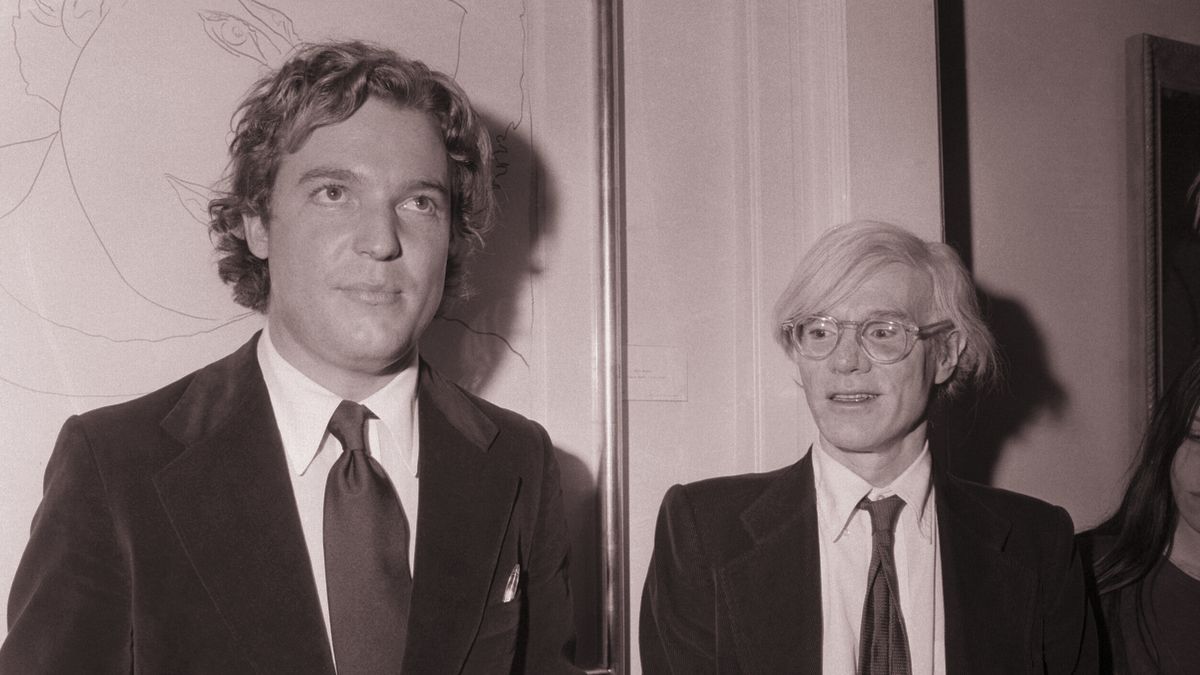
Wyeth and Warhol, photographed by Stanley Tretick at the Factory, 1976. Photo: Estate of
Stanley Tretick |
The result was a 47-year-old Warhol looking like the proverbial deer in the headlights, an
arresting image in which America’s leading Pop artist appears both more corporeal than we’ve ever seen him before and yet eerily wraithlike—spectral, otherworldly, alien. The curator Walter Hopps once said that Dennis Hopper had taken the greatest photo portrait of Warhol, at the Upper East Side’s Sign of the Dove restaurant, in
1963. Thirteen years later, Wyeth was concocting the greatest painted portrait of Warhol.
“I’m sort of amazed now,” Wyeth says, “that he didn’t in the middle of it say, ‘What the fuck are you doing?’” Instead, the idea came up—probably from Hughes—that Warhol should, in turn, do Wyeth. And so Warhol pulled out his Big Shot Polaroid camera and began shooting Wyeth looking this way and that while he painted. The contrast in methodologies—one glacially slow, the other rapid-fire—could not
have been more extreme. Warhol was then well into a decade in which, aside from his Piss Paintings and aptly titled film Bad, he devoted himself to (mostly) commissioned portraits: Liza Minnelli, Mick Jagger, Carolina Herrera, and the like. A few clicks of the Polaroid would be followed by a team of
assistants executing the artist’s admittedly ingenious and inventive technique, a multistep process involving underpainting and silk-screening. For Wyeth, the portraits recalled the cutout paper dolls that Warhol played with as a boy.
Yet Warhol was also stockpiling exquisite pencil drawings of Wyeth. For Wyeth, these belied Warhol’s well-cultivated public image of never breaking a sweat. “He was a funny little bird,” Wyeth says. “He said he didn’t do most of this stuff. You know—‘the
kids did it.’ Well, he’d work like hell on these things.” |
The opening at Coe Kerr was a madhouse, with a line of visitors stretching down the block and a
uniformed Pinkerton guard checking invitations. There were Warhol freaks, the somewhat preppy Wyeth set, and an outpouring of notables: Henry Fonda, Paulette Goddard, Valentino, Maxime de la Falaise, Angela Lansbury, Baby Jane Holzer, John Phillips, and Genevieve Waite. The Warhol and Halston apparatchik Victor Hugo wandered
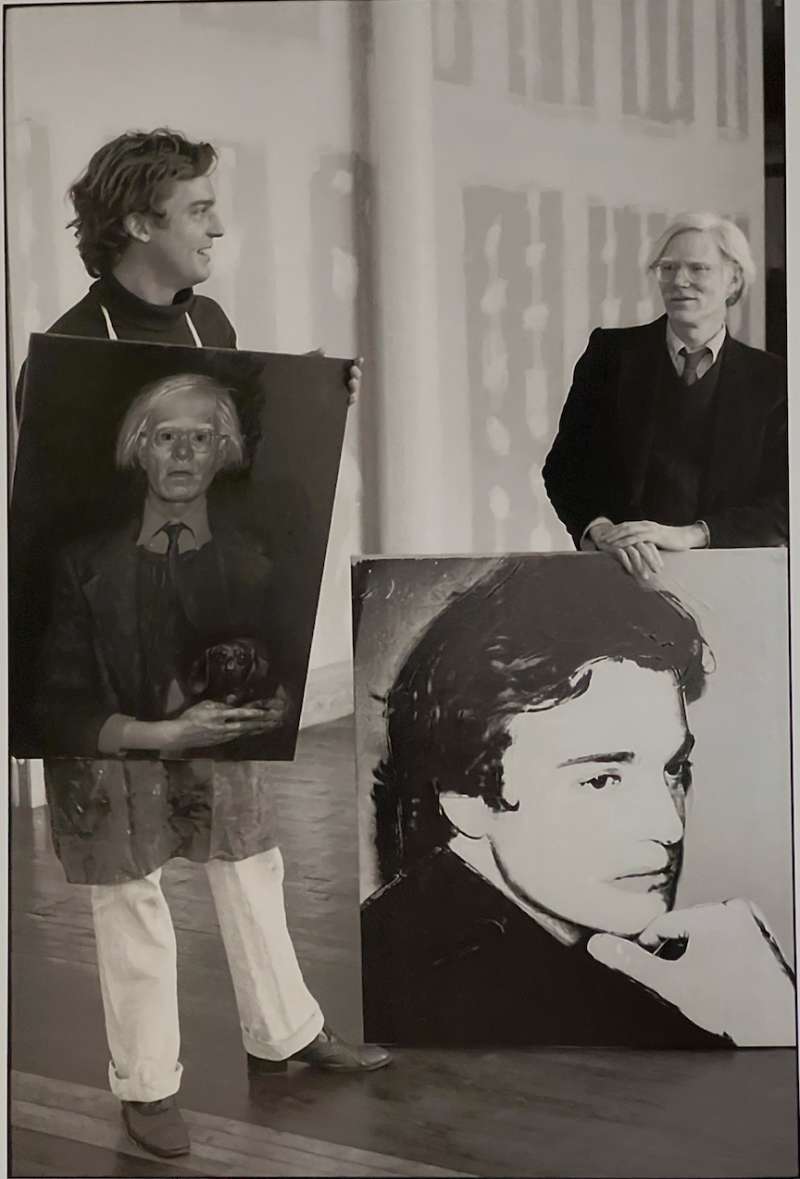
about with a human skeleton as his date. Warhol joked that Wyeth had made Archie the dachshund’s nose too small, while Wyeth joshed about how Warhol had made him look “movie-starrish.” Wyeth also pointed out that nobody was looking at the art, only at each other. But, as he recalls, half the show sold that first night. (Wyeth had brought the Warhol portrait plus 24 prep works; Warhol brought six silk screen portraits and five drawings.)
A New York Times reporter called them the
“Patriarch of Pop” and the “Prince of Realism,” while the paper’s art critic Hilton Kramer described the contrast between them an “all-male version of Beauty and the Beast.” (Cosmopolitan soon named Wyeth one of its “32 Sexiest Men.”) Kramer didn’t love the show, no surprise, but Warhol and Wyeth were both used to critical drubbings. “I could have cared less,” Wyeth says. “And he could have cared less.”
Now it was time to take the Andy-and-Jamie show on the road.
The first stop was Chadds Ford, where the Brandywine River Museum’s exhibition opened Thanksgiving weekend.
When Warhol and crew rolled up the mile-long drive at Point Lookout Farm, the two most famous Andys of American art encountered each other. “Gee whiz,” Warhol blurted out, “is this Andy Wyeth?!” Jamie says his father had always been interested in Warhol; Andrew said he found him to be “very likable and congenial.”
Warhol had walked into a certain kind of Americana heaven. He
swooned over the Thanksgiving dinner: “It was perfect,” he wrote in his diary, “so good.” The days unspooled with cocktails, conversation, and carriage rides. “He would clutch Archie,” Wyeth remembers. “Like, squeeze him for fear that he’d be thrown out! Complete state of terror!” One night Catherine Guinness, who came along with Warhol, regaled one of Wyeth’s friends, a Pentagon official, with tales of S&M clubs, much to everyone’s delight.
Warhol would become a repeat
guest at Point Lookout. (The farm had been inherited by Wyeth’s wife, Phyllis, who died in 2019.) “He would always watch soaps when he came down here,” Wyeth says. “He thought we had better reception.”
The Philadelphia Inquirer savaged the Brandywine River Museum show as a cynical stunt, but in the new year it was on to Nashville for a show at the Cheekwood Estate & Gardens. (Next January, Cheekwood, which owns Wyeth’s original portrait, along with one of the Warhol silk screens,
will mount a 50th anniversary Warhol-and-Wyeth show.) A squad of high school cheerleaders greeted the American art duo at the airport. After being shuttled to a performance at the Grand Ole Opry, the artists chitchatted with Mrs. Tex Ritter and Roy Acuff, the King of Country Music, who had no idea who Warhol was. “Whoever he is,” Acuff said, “we’re mighty happy to have him here.”
It was the month
Jimmy Carter took the oath of office; Redneck Chic was in its ascendancy. The following year, the president, who’d been a subject for both Warhol and Wyeth, proclaimed before a joint session of Congress: “The success of Andy and Jamie shows that we do not have to rely on foreign oils.” |
In the summer of 1980, after Wyeth had returned to the Factory to paint a portrait of
Arnold Schwarzenegger, he and Warhol flew to Monte Carlo, the final stop on their art tour. They hobnobbed with Lynn Wyatt, Sylvester Stallone, and Princess Grace of Monaco, who sauntered through the show. Warhol felt snubbed by the Philadelphia-born princess; he found her besotted with Wyeth and impressed by Phyllis’s du Pont roots. “She was really social climbing,” he wrote in his diary.
As the 1980s
rolled along, the two artists remained in touch. Wyeth noticed that Warhol had found his next young artist to team with—Jean-Michel Basquiat. Warhol, meanwhile, felt that Wyeth was “painting bigger—more Pop.” The younger painter, who had pretty much abandoned straight portraiture, would keep popping up in Warhol’s diaries until the end. When Warhol died, on February 22, 1987, Fred Hughes summoned Wyeth to come down the street to Warhol’s townhouse, presumably to offer
consolation and support. It was a place he’d only been invited to visit about three times. “Talk about a secretive person!” Wyeth says.
What did each artist gain from the association other than friendship? Perhaps Wyeth, the purported traditionalist, acquired a useful patina of avant-gardism, while Warhol… well, hard to say. His biographer Victor Bockris called the Coe Kerr show a “solid success” that returned Warhol to the art world spotlight.
Bob Colacello, who edited Warhol’s Interview magazine, wryly observed that “the Warhol-Wyeth exchange had an important effect on Andy’s image: It alienated him even further from the serious art establishment.” Whether that was good or bad would be left, as with most things Warhol, to interpretation. (Some observers have
noted that Warhol turned to Wyeth-esque subject matter, such as dogs and pigs, in the late ’70s.) In a quirk of art-historical memory, accounts of Warhol’s life often omit this chapter, while those of Wyeth’s always include it. |
Wyeth and Warhol, photographed by Tretick at the Factory in 1976. Photo: Estate of Stanley
Tretick |
Wyeth has little doubt about Warhol’s impact, both on himself and the story of art. “You take the
films, you take everything as a whole, he made an amazing mark,” he says, sitting in the dining room where Warhol spent that Thanksgiving 50 years ago. “It’s phenomenal.” |
Wyeth turns 80 this month, a birthday he says he will studiously ignore. The ever boyish painter
looks like a guy 20 years younger. “Jamie’s so much fun because he’s a troublemaker,” Warhol once said, and Wyeth retains his impish charm. He is given to breeches, mismatched high stockings, waistcoats; the togs suggest a painter of a century or so ago.
Warhol continues to haunt his work. In a 2024 documentary about his so-far seven-decade career, Wyeth said, “There are many ghosts in my head of people I have painted.” If you look at the big canvas from 2009 called Sea Watchers,
in which four men stand along a rocky Maine shore (a tableau that came to Wyeth in a dream), you’ll spy a curious figure at the lower left corner of the painting. His back is turned, but the white wig is unmistakable. (The other figures are Wyeth’s father, grandfather, and Winslow Homer; Stephen King owns the painting.) There’s also his 2013 diorama-like assemblage piece, which recreates the Factory dining room, down to the miniature moose head and TV. And in
Wyeth’s mixed media First in the Screen Door Sequence, from 2015, a found-object screen door, emblazoned with the American flag, stands ajar, paired with the painted figure of Warhol holding Archie. He’s standing at the threshold, at once an indelible presence and an enigmatic apparition, much as he was in life. |
Thanks to my colleagues at Air Mail. And I’ll be back on Tuesday. Speak then,
M |
|
|
|
Puck founding partner Matt Belloni takes you inside the business of Hollywood, using exclusive reporting and insight
to explain the backstories on everything from Marvel movies to the streaming wars. |
|
|
|
Ace media reporter Dylan Byers brings readers into the C-suite as he chronicles the biggest stories in the industry:
the future of cable news in the streaming era, the transformation of legacy publishers, the tech giants remaking the market, and all the egos involved. Also featuring a weekly dispatch from Puck’s crack streaming/media analyst, Julia Alexander. |
|
|
|
Need help? Review our
FAQ page or contact us for assistance. For brand partnerships, email ads@puck.news.
You received this email because you signed up to receive emails from Puck, or as part of your Puck account associated with {{customer.email}}. To stop receiving this newsletter and/or manage all your email preferences, click here. |
Puck is published by Heat Media LLC. 107 Greenwich St., New York, NY 10006 |
|
|
|
|