Good afternoon, I'm William D. Cohan.
Welcome back to Dry Powder. If you're receiving this private email, it means that you have subscribed to Puck, our new media company covering Washington, Wall Street, Silicon Valley, and Hollywood. Thank you.
You may have noticed that Disney's stock went haywire on Friday after my colleague Dylan Byers reported that C.E.O. Bob Chapek has tasked his top deputies with exploring the strategic rationale for spinning off ESPN. That's just the kind of market-moving journalism and insider analysis that you can expect at Puck. You can read Dylan's piece here—and send the subscribe link to a friend.
As always, you can read my latest work online, at your convenience, or in this email, below. Enjoy, and I'll be back in your inbox on Wednesday with more Dry Powder.
Regarding the most pressing questions on Wall Street and in my inbox. LinkedIn ceased operation in China this week. You’ve recently written at length about the anxiety over China’s business crackdown. Is LinkedIn’s decision cause for more alarm, or more of the same?
LinkedIn, owned by Microsoft, was among the last social media companies operating in China following President Xi Jinping’s so-called “regulatory crackdown.” But China apparently objected to the actual social-networking aspect of the social network, meaning, I suppose, the ability of one person to send messages and share opinions on the platform. To evade the “crackdown,” Microsoft has decided to keep the resumes and job bulletins, but shutter just about everything else. It seems to me that Microsoft got off kind of easy, anyway, given how annoying LinkedIn’s “social” features can be at times.
It’s another blow for American businesses in China, and American internet companies in particular, as Xi continues the process of closing the Middle Kingdom to the West. When I visited China five years ago, I was struck by how swiftly I lost access to the outside world—as soon as the door closed on the long China Airlines flight to Beijing, all internet access was cut off. Once in Beijing, there was no Twitter or Google, among an array of other websites that we take for granted. You can get by, of course, and many people use VPNs to do just that. It’s just different and not what Americans are used to, and there are no signs this policy will abate.
A recent report in Bloomberg suggests that top Wall Street executives expect inflation to last—and that the rich on Wall Street will get richer. Does this adjust your thesis on a future correction?
As long as the Fed keeps its intentions for its easy-money policies under wraps, no one knows what the catalyst will be that ends the party that has been raging in the financial markets for the last 12 years. The expectation on Wall Street is that Jay Powell, the Fed chairman, will announce in November that he will start “tapering” (a.k.a ending) the Quantitative Easing program that has ushered in the lowest interest-rates in recorded history and the highest stock prices, at least in the United States. That explains, in part, why analysts are so fixated on rising wage and commodity inflation, which might spur the Fed to act sooner rather than later. Interest rates across the board have already started to move up in expectation of either a Fed hike or the “tapering” of Q.E. in 2022.
The increase in prices across the economy may yet prove to be transitory, as some economists believe it will be. Of course, others, notably Larry Summers, the Harvard economist and former Treasury secretary, believe a new round of genuine—not transitory—inflation has already taken hold. Summers has long urged the Fed to stop Q.E. already and “taper” faster. On Friday, he said the Fed is “behind the curve” and that he has “been alarmed for a long time and I’m alarmed now.” I don’t think anyone would be wise to argue with Larry.
Regardless, the easy-money party will soon end; it has to. On average, there has been a major financial crisis in this country once every twenty years or so. The American Revolution itself precipitated a financial crisis. So we are no strangers to financial crises and we are long overdue for one now. The Fed cannot keep manipulating interest rates to artificially low levels and for more than a decade and not expect there to be calamitous fallout.
If Powell were smart, we’d quit the dilly-dallying about when he’s going to stop manipulating interest rates and declare “mission accomplished.” If the markets want to get themselves in a snit about the end of the Fed’s largesse, then so be it. That would be the best thing at the moment. The sooner we collectively get off the morphine drip that the Fed has been providing, the sooner buyers and sellers of credit can return to a cost of money that more closely reflects the risks investors are taking, as well as supply and demand.
Morgan Stanley C.E.O. James Gorman said Thursday that the Federal Reserve needs to “prick this bubble a little bit,” pointing to the need for rate hikes to counter wage increases, supply-chain bottlenecks and surging commodity prices driving inflation higher. Does Wall Street agree?
With apologies for any redundancy with the answer above—you can never emphasize too often how dangerous things are in the markets right now—Wall Street agrees that the time has come for the Federal Reserve to pull the plug on its 12-year experiment of keeping both short- and long-term interest rates at their lowest level in recorded history.
On the one hand, investment banking revenue and profits have rarely been higher. Any company that hasn’t refinanced its debt, raised equity or done whatever M&A deal they’ve always wanted to do needs to have its head examined. The markets just don’t get any better than this. But, of course, that’s the problem. Investors have bid up the price of stocks and bonds so high that there really is only one direction they can go from here—down—until we come out the other side of a post-Q.E. correction. And while Wall Street is loving its record profits, it also understands that the Fed is playing with fire and that the party has to end at some point, and that will mean a big change in investment banking revenues.
So I agree with Gorman, but not necessarily for the reasons he cited. I believe the Fed needs to “prick this bubble a little bit” to curtail the rampant speculation that has cropped up all over the place. When the yield on the average junk-bond—bonds issued by companies with poor credit—is still around 4.25 percent, when it should be closer to 10 percent, or more, to compensate investors for the risks they are taking, that’s when you know risk-taking has gotten way out of hand. And that is just one example among many—Bitcoin (see below), exorbitant homes, meme stocks, etc.—that provides all the data points anyone needs to know this thing is way, way, way out of control.
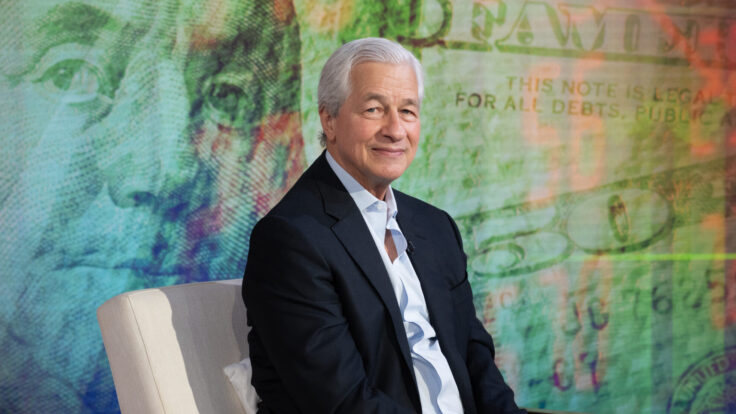
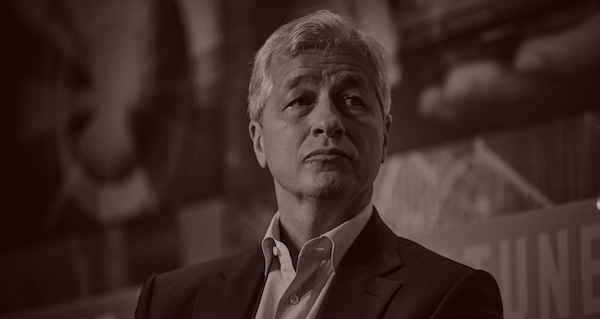
Jamie Dimon had some illuminating comments about crypto this week, essentially noting that he’s not buying the Bitcoin hype. Agree? Disagree? Is he talking his book?
Well, I think he may be talking his book in the sense that if things go the way the crypto zealots believe they will, a variety of financial transactions that used to go through his bank and the other big banks—sending money, paying bills, collecting yield—will no longer need Wall Street as an intermediary. At that point, crypto would be moving into the “currency” phase, from what now is described, charitably, as the “commodity” phase, and less charitably as the speculation phase.
More likely, Jamie doesn’t yet see the “use case” for crypto beyond speculation. I say this because I am not sure I see how crypto threatens the big Wall Street banks in any substantive way at the moment. JPMorganChase, for instance, is printing profits, some $40 billion a year and counting. That doesn’t sound like “fintech” disruption to me. Furthermore, as far as I can tell, JPMorganChase isn’t charging customers to use Zelle, its excellent version of Venmo, or to wire money, so I am not sure what exactly crypto-based banking is intending to solve, beyond higher (but much riskier) returns.
I’m sure I will hear from the crypto fanatics about how “decentralized finance” (DeFi) might ultimately replace some of the functions of financial institutions, such as eliminating the need for certain third parties and sending money anywhere in the world for free. But for now, I just don’t see it. On the contrary, each of the big five Wall Street banks are making more money than ever before, and there’s nothing to stop them from bringing the use of the blockchain technologies in-house. Admittedly we are in the early innings of how crypto will be used in the real world as well as the early phases of how crypto will be regulated in this country. But when, and if, those uses present themselves in a meaningful way, I suspect Jamie Dimon will have long retired from JPMorganChase, even though he has pretty much signed up for another five years and doesn’t seem to be going anywhere anytime soon.
You’ve written at length about Eddie Lampert’s hurdles with Sears. Recently, Jana Partners, the activist investment firm, bought a stake in Macy’s and urged it to spin out its online retail unit, which does about $8 billion in sales. Think Jana will get what it wants?
This is a tough one to answer. Like most big-box retailers, Macy’s is in a tough spot. It’s long been in a tough spot to be honest, and obviously the pandemic has done nothing but make its position more difficult. But I’m not sure why Macy’s management would agree to do what Jana is demanding. Why would Macy’s spin-off its fastest growing division to shareholders, leaving it with a slowly expiring brick-and-mortar retail business?
The big-box sector is famously full of risk. Macy’s filed for bankruptcy once in 1992, joining Allied Stores and Federated Department Stores in bankruptcy—a deal I worked on at Lazard—and later Macy’s and Federated merged, which was how Macy’s ended up owning Bloomingdale’s. Eddie Lampert thought he would make a fortune by buying Sears and K-Mart and those businesses ended up in bankruptcy court, too. (It’s unclear whether Lampert figured out how to make money selling off the Sears/K-Mart carcass; Bill Ackman lost millions betting on the turnaround of J.C. Penney.) And so Jana is playing with fire. If Macy’s gives in to the hedge fund, I suspect a spun-out Macy’s online business might make money for shareholders and Jana. But if I’m the Macy’s C.E.O Jeff Gennette, I would think long and hard before agreeing to Jana’s demand.
Bill, I know you’re nearly done with your book on G.E. What’s the biggest dealmaking lesson you’ve learned from your reporting that is applicable now?
The lessons of the collapse of G.E., once the world’s most valuable company, are many and varied. Among the most important lessons, though, is that chief executives must keep an open mind and listen carefully to dissenting voices when considering any particular course of action.
Thinking you have all the answers, just because you are the C.E.O., is a dangerous game. Toward the end of his tenure, Jeff Immelt, GE’s C.E.O. after Jack Welch, became increasingly imperial and less open to the views of his direct reports about G.E.’s strategic initiatives. Immelt disputes this view in his 2021 book, Hot Seat, but I cannot tell you how many senior G.E. executives shared with me examples of Immelt’s unwillingness to listen to them, once he had made up his mind about something. Maybe that’s called leadership. Maybe that’s called “smartest guy in the room” syndrome. But the proof of Immelt’s decision-making is on display for all to see (and it ain’t pretty).
Other lessons from the GE debacle include the danger of overpaying for acquisitions and divesting assets in a panic and for prices below what they are really worth; the dangers of failing to disclose liabilities that you hoped would stay hidden; and the dangers of confusing brand with business. In GE’s case, that meant losing sight of the fact that half of the company’s profits were consistently coming from a huge bank—G.E. Capital—that was both highly leveraged and derived its source of funding from the short-term commercial paper markets.
I will leave you with one last lesson, which is to avoid inviting foxes into the hen house, even if they seem like friendly foxes. In 2015, Immelt made the tragic mistake of bringing in an activist investor, Nelson Peltz’s Trian Partners, that he thought would ratify his strategic vision at that time (selling off G.E. Capital and investing billions of dollars in G.E.’s traditional industrial businesses) only to have the hedge fund turn on him and force him out the door when Immelt couldn’t deliver the earnings he had promised. With a big hedge fund investor hanging around the hoop, there was no longer any margin for error. Which just proves once again the old Wall Street adage that scorpions sting because that is what they are put here to do. Same with activist hedge funds.
See you Wednesday, Bill
Have a question you’d like answered in the next edition? Email us at fritz@puck.news.
FOUR STORIES WE'RE TALKING ABOUT 
Bob Chapek has asked some of his closest deputies to explore the strategic rationale for potentially decoupling from the sports network. DYLAN BYERS 
Glenn Youngkin is within a few points of becoming the first Republican statewide office-holder in 12 years. But he’s still obligated to genuflect to the Trump base. PETER HAMBY 
The streamer's rationale for defending Chappelle’s transphobic routine has deepened an internal crisis that is not going away. MATTHEW BELLONI 
Most financial projections are rosy, as Wall Street well knows. But winning the case may prove more troublesome than having opened it at all. WILLIAM D. COHAN 
You received this message because you signed up to receive emails from Puck.
Was this email forwarded to you?
Sent to {{customer.email}}
Puck is published by Heat Media LLC.
For support, just reply to this e-mail. For brand partnerships, email ads@puck.news |


SHARE