Welcome back to Wall Power, sports fans. I’m Marion Maneker.
I went to see Larry Gagosian’s honest-to-goodness last show on the sixth floor of 980 Madison, his flagship gallery for more than 35 years. It’s a special Jasper Johns exhibition, borrowing from the best of the best collectors to show a seminal body of work by the 95-year-old living legend. Before we get there, I have a few sales from San Francisco’s FOG art fair; Naomi Campbell’s take on the artist’s gaze; and my colleague William Cohan’s take on Patrick Drahi’s latest act of chutzpah.
Don’t forget: If you’re not a subscriber to Puck, you can—and should—remedy that
here. Also, if you want to engage in witty banter with me, you can do so by replying
to this email, or by sending me an SMS text or WhatsApp or Signal message at +1.917.825.1391.
Also mentioned in this issue: Edvard Munch, Marguerite Hoffman, Henry Kravis, Ken Griffin, Leonard Lauder, David Geffen, Jimmy Iovine, Liberty Ross, Philip Johnson, Sydney and Frances
Lewis, Eli and Edythe Broad, Marsha and Jeffrey Perelman, Ronald Perelman, and many more…
Let’s get started…
|
-
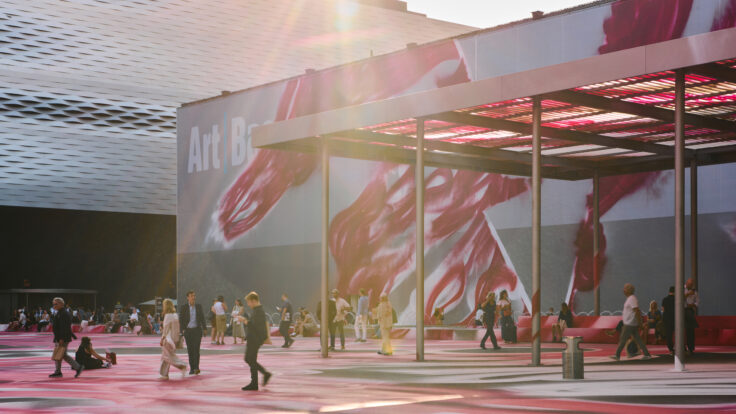
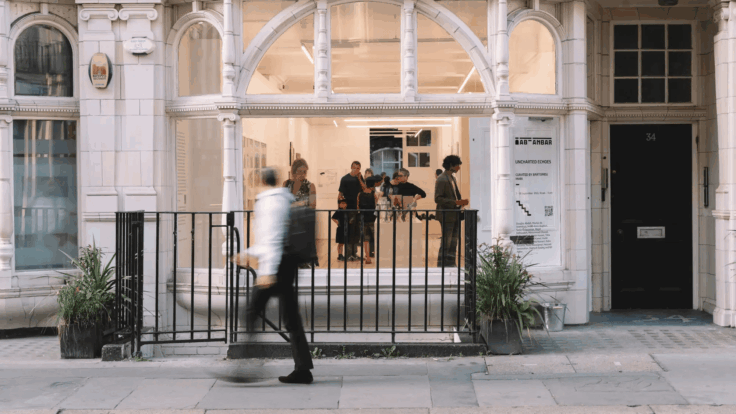
A FOG art fair sales temp check: San Francisco’s FOG art fair, which opened on Thursday and runs through Sunday, has already generated a number of notable sales. At the top of the gallery food chain, Hauser & Wirth sold a $1 million Jack Whitten painting, Solar Space; Rashid Johnson’s Broken Soul “In the City”, for $750,000; works by Luchita
Hurtado ($695,000), Charles Gaines ($595,000), and Avery Singer ($575,000); two works by Jeffrey Gibson ($375,000 and $275,000); along with other pieces. In the middle tier, Tina Kim Gallery made sales for Park Seo-Bo ($250,000) and Ha Chong-Hyun ($250,000), and sold three paintings by Kim Tschang-Yeul ($150,000, $60,000, and
$40,000), as well as a number of other works. And Charles Moffett sold works by Hopie Hill ($16,000 and below) from its single-artist booth.
- Naomi Campbell, art critic: For its show opening in Gstaad on Valentine’s Day, Nahmad Contemporary is bringing together 14 Pablo Picasso paintings from the period between 1963 and 1965, all on the theme of the painter and his model. By that time, Picasso had been in a decade-long relationship with Jacqueline Roque, the last of his many muses, whom he met while she was working at the Madoura pottery workshop in Vallauris. Art history has tended to pay attention to Picasso’s models only as they relate to the great man himself, but the Nahmad show ponders whether these works actually depict Picasso and Jacqueline, or are merely archetypes. After all, the painter/model relationship was one all too familiar to the master.
To flip the focus from the painter to the model, Joe Nahmad brought in Naomi Campbell, the super-est of supermodels, to serve as a narrator of sorts. “I’ve lived most of my life in front of the camera,” she says in the gallery’s release for the show, which is built around her reflections on being an object of desire. “It’s complex, layered, and charged with power. These paintings feel profoundly intimate.” Well, perhaps intimate to her. Which brings Campbell to this hopeful conclusion: “The greatest power in the act of looking may belong not to the one who gazes, but to the one who remains, unmistakably, just beyond reach.”
- Drahi, breaker of worlds: We’ve heard a lot over the last few years about Patrick Drahi’s heedless pursuit of his own agenda at Sotheby’s. But as my partner Bill Cohan pointed out last week, Drahi has also thrown a new twist into attempts to curb Wall Street’s growing “creditor-on-creditor violence.” Optimum, the telecom giant controlled by Drahi, faced a cooperative of banks and financial institutions that had joined together to prevent the company from forcing them to compete against one another to refinance its $21 billion in debt. So Drahi decided to file an antitrust lawsuit in New York’s Southern District just before Thanksgiving.I asked Bill what he thought of Drahi’s legal strategy. “This is pretty much an unprecedented move,” he said. “To claim that creditors getting together to protect their interests against a borrower—which would readily take advantage of them if it could—is a violation of antitrust laws is really quite something. In our current ‘cov-lite’ era, borrowers have been screwing over creditors time and time again without repercussion.” That’s because, Bill continued, creditors signed
on to loans with fewer restrictions, or lite covenants. “But now that creditors are starting to wise up and pull themselves together to take collective action, the borrower comes after them with an antitrust lawsuit? This is preposterous!”
|
|
|
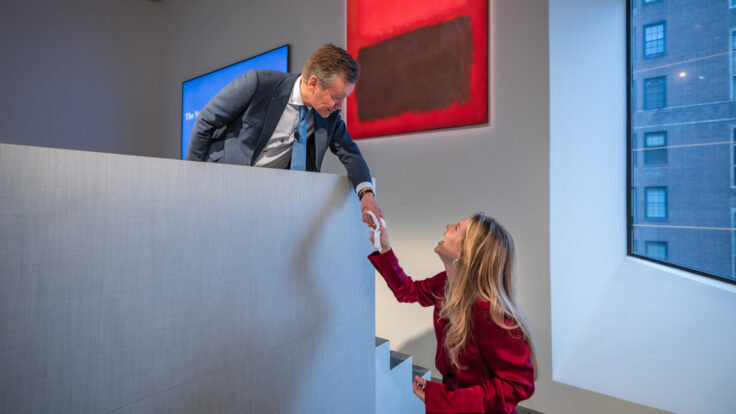
In the final show at Larry Gagosian’s premier gallery on the top floor of 980
Madison Avenue, the legendary dealer is closing out with an exhibition of Jasper Johns—the same artist who inaugurated the space more than three decades earlier.
|
|
|
Last year, at Puck’s Art of Influence
summit in New York, Larry Gagosian told me that he’d built his entire career on instinct rather than any grand strategy. In 1989, he opened his gallery on the top floor of 980 Madison Avenue with a show of Jasper Johns’s famous maps. Now, at the end of its 36-year run, Gagosian’s apex venue is closing with a show
featuring Johns’s crosshatch paintings and drawings, from 1973 to 1983. Among them is a series based on a late Edvard Munch self-portrait called Between the Clock and the Bed, which rank as some of the most important of these works. Who knew Gagosian’s instincts leaned toward the sentimental?
The exhibition, produced in partnership with Castelli Gallery, is a fitting bookend to Gagosian’s extraordinary residency at 980 Madison. After all, there are a
number of similarities between Johns and Gagosian worth noting. Very few artists or dealers are able to find success so young and then maintain their stature and relevance for decades after. In their respective realms, Gagosian and Johns are also both ubiquitous and remote. Indeed, they are such imposing fixtures that it is hard to imagine a modern art world that existed before them—or the one that will inevitably come after.
Johns, in particular, was so immediately successful that many
of his earliest masterworks were acquired by museums, allowing him to produce art without much in the way of financial pressure. That also means his work is not often seen, even though he is represented by Matthew Marks with not-infrequent shows. And, of course, the Whitney and the Philadelphia Museum of Art held unique, dual retrospectives of Johns’s work, titled Mind/Mirror, from September 2021 to February 2022, reminding us all of his stunning fecundity as an artist.
The conceit of Mind/Mirror was that each museum created its own stand-alone Johns retrospective, but the two shows did not duplicate works or series, and instead followed one of Johns’s most consistent tropes: reflection. Which show was the original and which was the mirror image could never be discerned.
The retrospective also revealed something else unique about Johns: his high-quality collector base. On loan were works owned by Marguerite Hoffman,
Henry Kravis, Mitchell Rales, and Ken Griffin. Johns himself also owns a great deal of his own work, including significant pieces that are on loan to major museums. During the run of the retrospective, it was revealed that Leonard Lauder had purchased Johns’s famous sculpture of two ale cans—which had been on loan to the Philadelphia Museum of Art since the 1970s—directly from
the artist. No one thought the deal was cheap.
The other luxury Johns has been afforded is the ability to choose among the best collectors. I remember, about a decade ago, listening to a major collector mock his peers for fawning over Johns just to get access to work. But who would not want to join the ranks? As we learn from the Gagosian show, his collectors include David Geffen; Jimmy Iovine and his wife,
Liberty Ross; Agnes Gund, who donated her work to MoMA; Philip Johnson, who did the same; Sydney and Frances Lewis, the founders of the once high-flying catalogue company Best, who donated theirs to the Virginia Museum of Fine Arts; Eli and Edythe Broad; and Marsha and
Jeffrey Perelman— Ronald’s brother, who has been able to hold on to much more of his art.
|
Between
the Clock and the Bed
|
The Gagosian show, as I noted, focuses on Johns’s crosshatch works. But before he began
experimenting with these patterns, his art depicted familiar objects—everyday signs and signifiers like flags, numbers, maps, and targets—in unfamiliar ways. The way he handled these “things the mind already knows” was different from his contemporaries in the pop art movement (once called “new realists”) in the sense that they treated familiar objects of industrial culture and consumer products as features of a natural landscape. But it was also not entirely different. Pop was concerned with
the surface of things; Johns went much further and saw objects as expressions of ideas.
Both pop art and the work produced by Johns were considered rejections of abstract expressionism. In embracing the crosshatch pattern, Johns began to engage with abstraction, but as Gagosian’s Michael Cary explained to me, he could do so only within a series of arbitrary constraints about how to arrange the crosshatching patterns and which colors to use. These rules
seem designed to take expression out of it. Yet on the fifth floor, Gagosian’s show delves into the many ways Johns was able to get such deep variations from relatively simple rules and patterns: Some of the works are stark black-and-white; others feature primary-color hash marks in red, yellow, and blue. One uses secondary colors—green, purple, and orange—while another has flashes of white and color throughout grey marks. I was particularly struck by an oil-and-encaustic version, painted on
leather, that seemed to feature white crosshatching floating over a sea of pastel undertones.
|
Jasper Johns, Between the Clock and the Bed (1981). Photo: The Museum of Modern
Art/Courtesy of Gagosian
|
Upstairs, in the central space, the show gathers the six works from the Munch-inspired Between
the Clock and the Bed series. There’s some lore around these works. Supposedly, Johns got a postcard from a friend who had visited the Munch museum in Oslo, and noticed the distinctive pattern of a bedspread in the painting. Of course, the bedspread looks nothing like Johns’s crosshatch pattern. But a whole show
that appeared at the V.M.F.A. in Richmond and Oslo was devoted to declaring the postcard apocryphal and suggesting a deeper connection.
Johns was entering his 50s when he painted the three large Clock and Bed-inspired works. Munch was in his late 70s when he painted his self-portrait, symbolically pinning himself between the relentless clock of aging and the increasingly remote bed of sexuality (a painting of a nude hovers in the background above the bed). It seems hard to
believe that Johns—still alive more than 45 years later—was that concerned with his fading powers. It seems more likely he was engaged by the formal elements of these works. There are no figures in any of the paintings in the main gallery, but one can see a density of colors (or shading, in the case of the grey-and-white work) in each of the panels that can be read as figures or forms—even in the crosshatched pattern of the bedspread.
The three large Between the Clock and the Bed
works are triptychs, with panels featuring their own rules for how mark direction or color changes. Another triptych riffing on Picasso, titled Weeping Women, does something similar in primary colors. Nearby, Gagosian has hung two other works that are diptychs: End Paper, from 1976, which juxtaposes a flagstone pattern that Johns began to explore almost a decade earlier; and Corpse and Mirror, from 1974, which presents mirror images of
black-and-white crosshatching—on one side, the image is made with oil paint, and on the other, it’s constructed in encaustic, a mixture of pigment and glue that has to be melted to be manipulated. The encaustic—a favorite technique of Johns’s—leaves a scumble of white across the pattern. On top of that, Johns has added an imprint of the iron used to melt and work with the glue, along with a large X—a symbol he regularly used to mark a lithography stone when he was finished with an edition and
wanted to prevent further impressions. It’s an act of negation, an expression of finality that fittingly concludes Gagosian’s run atop 980 Madison.
|
That gallery is closing, but Gagosian’s under-construction street-level space—though not his
restaurant, which remains open—will be revealed soon enough. So we have that to look forward to.
In the meantime, I’ll be back on Sunday with the results of the American art sales, particularly the big blowout success of the William Koch collection.
Speak then,
M
|
|
|
Puck founding partner Matt Belloni takes you inside the business of Hollywood, using exclusive reporting and insight
to explain the backstories on everything from Marvel movies to the streaming wars.
|
|
|
The ultimate fashion industry bible, offering incisive reportage on all aspects of the business and its biggest
players. Anchored by preeminent fashion journalist Lauren Sherman, Line Sheet also features veteran reporter Rachel Strugatz, who delivers unparalleled intel on what’s happening in the beauty industry, and Sarah Shapiro, a longtime retail strategist who writes about e-commerce, brick-and-mortar, D.T.C., and more.
|
|
|
Need help? Review our FAQ page or contact us for assistance. For brand partnerships, email ads@puck.news.
You received this email because you
signed up to receive emails from Puck, or as part of your Puck account associated with {{customer.email}}. To stop receiving this newsletter and/or manage all your email preferences, click here.
|
Puck is published by Heat Media LLC. 107 Greenwich St., New York, NY 10006
|
|
|
|