Welcome back to Wall Power. I’m Marion Maneker.
Tonight, we’re
headed to Buenos Aires. Late last year, it was announced that MALBA, the city’s popular Latin American art museum, had acquired the Daros Latinamerica collection—a large body of works that complements its current holdings but also transforms the size, scope, and ambition of the growing institution. I spoke to Rodrigo Moura, MALBA’s new artistic director, about how this coup came about.
Also mentioned in this issue: Amedeo Modigliani,
David Nahmad, Oscar Stettiner, Arthur Veil-Picard, Jean-Honoré Fragonard, Hippolyte Walferdin, Hubert Robert, Antoine Watteau, Eduardo Costantini, Alexander, Stephan and Ruth Schmidheiny, Thomas Ammann, Diego Rivera, Frida
Kahlo, Leonora Carrington, Julio Le Parc, Olga de Amaral, Dan Flavin, and more…
But first… |
-
The interminable Modigliani restitution case: It appears that the long-running restitution case over Amedeo Modigliani’s Seated Man with a Cane may be moving closer to trial. The 1918 painting was bought by David Nahmad at Christie’s in 1996, but only came to the attention of its original owner’s heirs—it had been looted in World War II from Oscar Stettiner, a Jewish art dealer in Paris—after it was offered at Sotheby’s a dozen
years later. At the time, Nahmad denied owning the painting, pointing to ownership by an entity called International Art Center. But the Panama Papers leak in 2016 revealed that I.A.C. was actually controlled by Nahmad.
Nahmad, the patriarch of one of the biggest art-trading families, says he needs proof that his painting is the one that the Stettiner heirs are seeking. So far, Nahmad has kept the Nazi-looted art sleuths at bay with legal skirmishes. Now, Le Monde is
reporting that a trial to determine whether Stettiner owned the painting is scheduled for May. That is, unless one of the several motions made shortly before Christmas further delays the case. - Speaking of Jewish collectors in
Paris…: Christie’s announced this morning that it would be selling works from the collection of Arthur Veil-Picard, one of Paris’s foremost art collectors of the early 20th century. The Veil-Picard family, a Jewish banking dynasty with roots in Alsace, were absinthe makers who eventually bought the Pernod brand, which Arthur ran. Veil-Picard’s art collection was well known to curators and connoisseurs but rarely seen—and reproduced only for scholars in
black-and-white renderings.
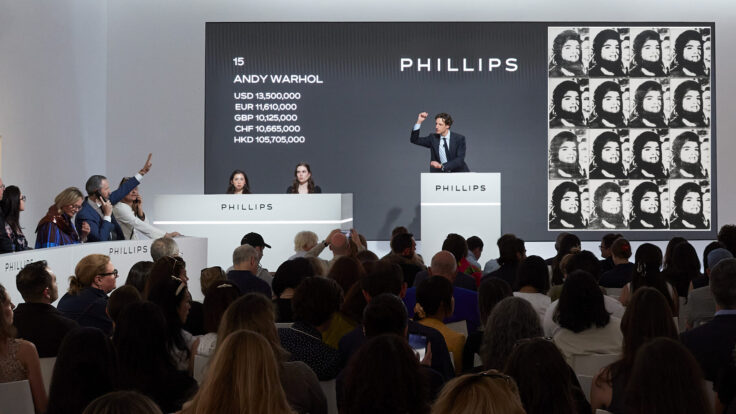
On March 25, Christie’s Paris will sell 30 works from the collection with a combined estimate of €5 million ($5.85 million). Veil-Picard owned up to 16 works by Jean-Honoré Fragonard, five of which are included in the sale. The highlight is The Happy Family, from the 1770s, estimated at €1.5 million and considered by scholars to be the first of several versions that the artist painted. There is another portrait of a young woman titled
The Little Coquette that had once been owned by collector Hippolyte Walferdin and is estimated at €400,000. A drawing, Woman with a Dove, estimated at €200,000, was also owned by Walferdin before it was sold to the Rothschild family. A pair of paintings by Hubert Robert are being offered with an estimate upon request, but €1 million is where the auction house hopes to see them land.
Among the 20 drawings in the
collection is Antoine Watteau’s Actor Holding a Guitar Under His Arm, estimated at €600,000. The work has been known only through a black-and-white illustration in a catalogue raisonné, where it had been annotated as residing in an inaccessible collection.
|
Now, let’s head down to Buenos Aires… |
|
|
How a family of Swiss industrialists helped deepen and redefine Argentina’s
premier art museum, years after their deaths. |
|
|
When Rodrigo Moura joined MALBA, last March, he was excited to help Argentina’s
25-year-old museum of Latin American art expand from its strong modernist holdings to a more comprehensive collection, with strong examples of work made up to the present. Moura, who had joined the museum from El Museo del Barrio, started by making a wish list of a dozen representative, high-profile works by 12 different artists. Curatorially, it made a lot of sense. This core group of artists would have covered the bases in Latin American contemporary art and bought MALBA some time as it
continued to expand.
There was only one problem: Prices for contemporary art had already risen to prohibitive levels. Given Argentina’s massive experiment in government austerity—especially amid breakneck inflation—it seemed like the path forward for Moura was going to be difficult, if not impossible. Then another path unexpectedly emerged.
Both Moura and Eduardo Costantini, MALBA’s founder and main patron, were aware of the Daros Latinamerica collection—a
Zurich-based private holding consisting of some 1,233 works by 117 Latin American artists, made between 1950 and the early 2010s. MALBA had even borrowed a Brazilian pop artwork recently, as had various other institutions. But the two men wondered what had befallen the collection, which had seemingly gone dark after a failed attempt to establish a permanent home in Rio de Janeiro and, later, in 2019, the death of its founder, Swiss collector Ruth Schmidheiny. Although the
collection was in storage, its curators had kept up a program of making loans. “But what we didn’t know,” Moura told me, “is that they were just managing it as an asset in a portfolio with a decent mission of just attending to loan requests.”
Moura appreciated that the Daros collection was putting the artists’ interests first and making sure the works were seen and presented in different contexts. The pair had long speculated about its depth and breadth. “We always wondered,” he said,
“maybe they have a plan for this collection.”
As it turned out, Schmidheiny’s heirs did have a plan, and were looking for an institution a lot like MALBA. An intermediary representing Daros approached MALBA last year, and that’s when the penny dropped for Moura. Here was his chance to acquire far more than a dozen works from important artists spanning the entire period that MALBA needed to complete its story. “This convergence of interests was just amazing,” Moura said. “It’s one
of these moments where you really feel like you’re making history, because they really wanted the collection to grow as a whole, through an institutional home. And… and this was, like, wow. And so, here we are.” |
The Daros collection is actually two different art collections that grew out of the interests of
the Schmidheiny family of industrialists, in Switzerland. Patriarch Max Schmidheiny divided his construction-materials conglomerate between two of his sons, Thomas and Stephan, who have since both become billionaires. But a third son, Alexander, made a life in art, backing Thomas Ammann in his Zurich gallery in the early 1980s. He also formed his own collection.
When Alexander died in
1992, at the age of 40, his brother Stephan inherited a thousand works of art. But Stephan’s interests as a collector were different. In 1997, he established the Daros Collection to focus on 20 prominent European and American artists, acquiring works in depth. Over time, the collection’s core holdings came to include artists like Andy Warhol, Christopher Wool, Jean-Michel Basquiat, Agnes Martin, Louise
Bourgeois, Cy Twombly, Brice Marden, Gerhard Richter, and Willem de Kooning.
In the 1990s, Stephan expanded his share of the family business by building up a group of companies in Latin America. Around that time, his wife, Ruth, began the Daros Latinamerica collection, following a similar theme—favoring depth over breadth, and choosing a greater number of works by fewer artists rather than a
broad cross section. Like Daros, which operated its own exhibition space in the first decade of the 2000s before partnering with the Beyeler Foundation in Basel, Daros Latinamerica had its own space in Zurich from 2002 to 2011. Beginning in 2006, Daros also maintained Casa Daros in Rio de Janeiro, which held more than 20 exhibitions from 2013 to 2015.
MALBA, for its part, has grown out of Costantini’s success as one of Argentina’s largest real estate developers and most prominent art
collectors. Best known for his trophy purchases—Diego Rivera’s Baile en Tehuantepec for nearly $16 million in 2016, Frida Kahlo’s Diego y yo for $35 million in 2021, and Leonora Carrington’s Les Distractions de Dagobert for $28.5 million in 2024—Costantini established a foundation for his art 30 years ago. In 2001, he donated 220 works of Latin American art to MALBA, encouraging his peers to also support the museum
with donations. The collection eventually grew to more than 1,500 works.
Even before the Daros Latinamerica acquisition was announced, MALBA had made plans to expand the museum’s building to 90,000 square feet, to better accommodate the half-million visitors who pass through its doors every year. An additional 250,000 visitors go to MALBA Puertos, in a northwestern suburb of Buenos Aires, which was originally built to decentralize MALBA and give a home to its already expanded
collection.
The Daros acquisition nearly doubles the number of works under Moura’s curatorial control. “It’s like I woke up one day and I’ve got a new museum to run,” he told me. And not just any museum. “We’re the best-equipped institution in the country, building-wise, collection-wise, and audience-wise.” The acquisition gives him many new curatorial opportunities and the depth needed to create semipermanent displays of major figures. The Daros collection, for instance, now contains 40
works by Argentine Julio Le Parc, a central figure in kinetic art who lived in France in the 1960s. “We could integrate this into the collection narrative,” he said. “We certainly have, as one of our missions, to organize major shows and serve as connecting tissue between what happens in the world and what happens in Argentina.”
For example, they’ve got the Olga de Amaral show that sparked so much interest in the artist when it was in
Paris and Miami. And next summer, they’re going to do a Dan Flavin show in partnership with Dia Art Foundation. “That’s for our summer slot,” he told me excitedly. “For us, it’s winter, but… you understand.” |
That’s it for tonight. I’ll see you tomorrow back in the Inner Circle for a look at ARTDAI’s annual
metrics for 2025. If, for some reason, you’re not yet among the elect, you can upgrade here.
M |
|
|
Puck founding partner Matt Belloni takes you inside the business of Hollywood, using exclusive reporting and insight
to explain the backstories on everything from Marvel movies to the streaming wars. |
|
|
The ultimate fashion industry bible, offering incisive reportage on all aspects of the business and its biggest
players. Anchored by preeminent fashion journalist Lauren Sherman, Line Sheet also features veteran reporter Rachel Strugatz, who delivers unparalleled intel on what’s happening in the beauty industry, and Sarah Shapiro, a longtime retail strategist who writes about e-commerce, brick-and-mortar, D.T.C., and more. |
|
|
Need help? Review our FAQ page or contact us for assistance. For brand partnerships, email ads@puck.news. You received this email because you
signed up to receive emails from Puck, or as part of your Puck account associated with {{customer.email}}. To stop receiving this newsletter and/or manage all your email preferences, click here. |
Puck is published by Heat Media LLC. 107 Greenwich St., New York, NY 10006 |
|
|
|